Healthy control is functional because it helps us get our needs met. Unhealthy control — dyscontrol — is dysfunctional because it makes getting our needs met impossible. The big challenge facing recovering control addicts is learning to tell one from the other.
Leave a comment | posted in control
xxx
The Second Law of Control is Our addiction to control causes most (maybe all) of our emotional problems. Anxiety, depression, addictions, bad relationships, broken communication — all deeply rooted in attempts to control what either can’t or shouldn’t be controlled.
2 Comments | posted in control
xx
Addiction is an attempt to control feelings, to change them or make them go away. So the wish for control is the mother of all addictions. And every addiction is an addiction to control.
Leave a comment | posted in control
Everybody’s addicted to something. Tell me you’re not and I’ll just assume you’re lying to yourself about it.
2 Comments | posted in control
xxx
The First Law of Control is We are all addicted to controlling. We control constantly, compulsively, unconsciously, and even when doing it hurts us or people we care about. Which is exactly what it means to be addicted to anything.
Leave a comment | posted in control
xxx
I can’t help but like someone who’s brave or honest (which amount to the same thing). I can’t help being bored by someone who’s neither.
Leave a comment | posted in control
I’m two days into vacation, and it’s not going well.
When I try to rest I feel guilty. I’m at home, and I look around and see all the shit that needs to be done.
Then I try doing some of it and end up feeling angry. I mean, I’m supposed to be on vacation.
All of which reminds me of the Zen proverb:
Sitting,
just sit.
Walking,
just walk.
Above all,
don’t wobble.
Now, I know this. I know that when you’re not paying full attention you feel fragmented. That when you’re not where you are, you’re nowhere.
But knowing doesn’t help. Because I’m also like most people. I spent my life detached from reality, dwelling not in the moment but in tomorrow (What do I have to do? And when?) or yesterday (What did I forget?).
Like most people, I spend my life wobbling.
So hard to get in touch with here/now. To stop doing and just be.
I just installed a mindfulness bell on my computer which rings periodically to remind me to visit here/now.
Every time I hear it I get annoyed. (Monkey mind hates to be told to shut up.)
But then I stop what I’m doing, close my eyes, breathe in and out three times.
And for just a moment I enter the room I’m already in. I feel my body, and the air around it, and hear the sounds in that air, and I settle down a little bit, and feel a little less fragmented.
For just a moment, I’m unwobbly.
5 Comments | posted in addiction to control, anxiety and control, control, personal development, personal growth
One reader responded to Twelve Truisms by asking me to explain #8: When deciding what you truly need, trust the body more than the mind.
I wrote back,
The body is where feelings live.
And the function of feelings is to inform us about what we’re experiencing.
By “feelings” I mean both physical sensations (hunger, fatigue, pain) and emotional reactions (mad, sad, glad, scared).
Attending to these cues is essential to physical and emotional health — to knowing what we need and taking effective steps towards getting it.
Yet each of us is trained to ignore these essential messages on a regular basis.
Don’t pee in your pants, find a toilet. Don’t eat that, it’s not dinner time. Big boys don’t cry. Don’t take that tone with me, young lady. Stop giggling, you’ll disturb people. You can’t nap now, the workday’s not over. Never let them see you sweat.
This is called socialization, and our living together with other people makes much of it unavoidable.
But if we become overadapted – get too good at obeying social cues, and regularly ignore messages from our animal bodies – we end up needy, sick and cut off from ourselves.
Or as John Conger writes, “Many of us have lived like renters in a small room of a house we consider barely habitable. Disembodied, we have dangerously compromised the fabric of nature that supports us.”
So any effective therapy must teach people to listen to their bodies, and base more of their choices on what they hear.
Leave a comment | posted in control
Over time every therapist develops a set of working assumptions that he or she brings to each new case.
Here are some of mine:
1. It is healthier to express feelings than to hide them.
2. Unexpressed feelings lie at the root of all emotional problems.
3. Secrets make us sick.
4. Problems in current relationships tend to echo problems in past relationships.
5. What we don’t get from our parents we will seek from our partners.
6. Being deprived in childhood of attention, acceptance, approval or affection leaves us chronically hungry for the same thing as adults.
7. When trying to understand some feeling or behavior, look for the underlying unmet need.
8. When deciding what you truly need, trust the body more than the mind.
9. There is no such thing as a totally grown-up human being.
10. The greater your need to control things in your life, the less in-control you’re likely to feel.
11. The more you try to control other people, the more you force them to control you back.
12. The price of more control in one part of your life is less control in another.
3 Comments | posted in control
Recently I posted this observation:
And one reader wrote back, “Please say more about this.”
Okay. Here’s a metaphor drawn from my work with victims (the self-defined kind) and blamers:
Think of responsibility as a circle you draw around yourself.
Everything inside the circle belongs to you. Everything outside doesn’t.
By “everything” I mean both bad stuff – problems, demands, risks – and good stuff – solutions, rewards, opportunities.
Some people draw a small circle as a way of avoiding the bad stuff.
It’s their way of telling themselves “Not my fault” or “Not my job.”
They believe the small circle will protect them.
But it’s actually a trap.
Because you can’t solve problems that aren’t yours to solve. So the small circle makes you feel helpless.
And the more demands you avoid, the less capable you become. So the small circle is weakening.
And the more risks you avoid, the fewer opportunities life offers. So the small circle leaves you feeling deprived.
So instead of safe on a cozy island of invulnerability, small-circle folks find themselves afloat in a sea of helplessness, weakness and unmet needs.
8 Comments | posted in control
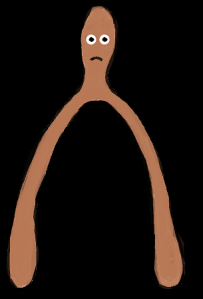 “We walk into the restaurant and sit down and right away I’m in trouble. My mother — she always does this — wants to switch tables. And my husband absolutely refuses to move.
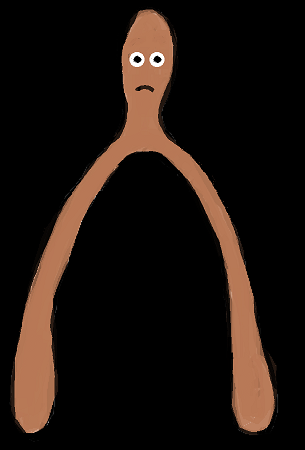
“And I’m in the middle. They’re both looking at me, and I can’t please both of them, and I feel like a wishbone.”
She turns to me.
“What do you do?”
“Leave them at the restaurant, go to McDonald’s and get a cheeseburger,” I say.
The group laughs. But I’m not kidding.
Often the only way out of such dilemmas is what I call healthy selfishness.
Healthy selfishness — listening to yourself, and putting yourself first at least occasionally — is indispensible practice for any codependent serious about recovery.
Without it you live a kind of wishbone existence, perpetually suspended between the pull of your own needs and preferences and the pull exerted by others.
You may hate hearing this, though. Because if you’re a codependent you probably see selfishness as some sort of sin.
But here’s the thing:
Most people who see selfishness as sinful were taught to do so by selfish people.
By parents, maybe, who preached unselfishness but at the same time made it clear they expected you to put their preferences first always. Or by partners, who delivered the unspoken but persistent directive Don’t take care of your self. Take care of my self instead.
Sinners in sheep’s clothing.
So in recovery your choice is between continuing your wishbonish existence or become honestly, courageously sinful yourself.
Guess which I’m rooting for?
Enjoy your cheeseburger.
Leave a comment | posted in control
“I’m working on it,” he says. “Almost there.”
He’s telling me, for the tenth time in ten weeks, that he’s almost ready to end his bad marriage.
“No,” I say. “You’re camping.”
He knows just what I mean. It was one of his sessions that inspired Resigned, which compared discouraged clients to mountain climbers who camp on the side of the mountain.
“I know,” he says sadly. “But I have to keep climbing. I’ll never be happy otherwise.”
“Have I ever told you about the Paradoxical Theory of Change?” I ask. “It’s an idea from Gestalt therapy. It says As long as you try to change yourself, you stay stuck. But accept yourself as you are, and change happens automatically.”
“I don’t get it,” he frowns.
“Sometimes trying to change feels less like growth than self-abuse. Not I deserve more, but I’m not good enough as I am.
“I think that’s happening here. The Adult part of you says I’ll never be happy here, so I better get on with ending this marriage. But the Kid part says Hell, no. Divorce scares the crap out of me. I’m not going anywhere. Sound about right?”
He nods. “And the Kid wins the argument.”
“Always. And you’re not going anywhere without that Kid. Nowhere good, anyway. So maybe you should listen to him.”
“I shouldn’t just drag him along?”
“No. He’s had a lifetime of that. Stop pushing him. Accept him as is, for now.”
“Let him camp?”
“For now. Let him build a campfire, roast a marshmallow, get a good night’s sleep. You’d be surprised how strengthening real rest can be.
“And the mountaintop will still be there tomorrow.”
Leave a comment | posted in control, personal growth
“Which jail would be easier to escape from,” I ask. “One where they feed you, or one where they starve you?”
We’re in group, where two women are describing their inability to end abusive relationships.
“I kicked him out two weeks ago,” one says. “Now I can’t stop texting him.”
“Me too. Every hour,” the other admits.
“What are we, crazy?” the first asks me.
I reply with my question about jails.
“The jail that starves you,” the first woman answers. “Because you’d want to escape more.”
“But motivation’s one thing, strength’s another,” I say. “And how can you escape if you’re too weak to run away?”
They look at me.
“That’s what’s happening here. You’re not crazy. These relationships have just weakened you to where it’s hard to escape.”
“Weakened how?” asks the second.
“Starved of acceptance, approval, affection, respect — everything that makes someone strong enough to stand on her own. The same thing happens in dysfunctional families, which starve you emotionally as a way of keeping you attached.”
“Intentionally?”
“Yes, on some level. Abusive partners and dysfunctional families know just what they’re doing. They know each time you knuckle under you become less confident, less able to escape. It’s why they discourage you from entering therapy, attending self-help, even taking meds. Those things might make you stronger. And they need you weak and dependent.
“Because — more than anything else — your weakness is the lock on the jailhouse door.”
12 Comments | posted in control