…
***
Never apologize for showing your
feelings. When you do,
you are apologizing for the truth.
~ Benjamin Disraeli
…
***
Never apologize for showing your
feelings. When you do,
you are apologizing for the truth.
~ Benjamin Disraeli

***
There is no problem so big,
so scary or so confusing
that it cannot be ignored.
~ S. Hauptman
…
* * *
Buy here.
…

…
I don’t believe in magical curses.
….
I do believe in psychological ones.
….
As they appear in therapy, psychological
curses are false beliefs absorbed in
childhood by a kid too innocent to
know better.
…
You’re stupid, his father tells him
over and over. So he believes it.
He may be bright as Einstein. No
matter. He’ll start to feel, think
and behave like a stupid person.
Because that’s what dad told him
he is.
….
You’re lazy, his teacher tells her.
Try harder. You could do so much
better if you’d just try harder. So
she spends her life trying harder
and harder and harder.
…
There are many common curses.
….
The world is unsafe.
…
People are not to be trusted.
….
Relationships will disappoint you.
…
I run into such curses every day.
…
They don’t always emerge immediately.
Usually I need to know someone for
a while before I spot the patterns of
thinking, feeling and behavior that
suggest they may be carrying a curse.
…
You’re not enough.
…
You won’t succeed.
…
You’re unlovable.
…
These are among the most poisonous
curses of all.
…
How to lift such a curse?
…
Insight usually isn’t enough.
…
That’s because insights (Ah, I see how
I came to believe that) usually come
to the Adult part of the personality.
….
And it’s the Kid part that’s been
cursed.
….
What the Kid requires is a corrective
emotional experience.
….
That’s an experience which directly
contradicts the false belief beneath
the curse.
….
And since curses are embedded in
a deep part of us, the contradictions
usually need to happen over and over.
.
The Kid who feels unsafe needs to
repeatedly experience safe relationships.
…
The Kid who feels inadequate needs
repeated experiences of being accepted
as-is.
…
And the Kid who feels unlovable needs
to feel unconditionally loved, not just
once, but over and over.
….
Of course, therapy with the right therapist
can provide some of these corrective
experiences.
….
But I think real recovery from a cursed
childhood requires that we seek out, or
create, such experiences in the real world.
…
Because without them it’s hard for the Kid
to unlearn the lies he or she absorbed in
childhood.
…
And because. without them, a curse can last
a lifetime.
* * *
Buy here.

(Continued from “About hidden agony.”)
.
The person in the grip of an
old distress says things that
aren’t pertinent, does things
that don’t work, fails to cope
with the situation, and
endures terrible feelings that
have nothing to do
with the present.
~ Harvey Jackins*
.
Of course a therapist can only guess
whether his client received inadequate
attunement from their mothers.
.
But it is not unusual for me to meet
people who make me suspect that
might have be the case.
.
They tend to be people who seem
forever at war with their feelings.
.
Like Alan, a quiet man whose marriage
is failing because he’s so disconnected
emotionally, who works all day and
then goes home to pore over paperwork
at his kitchen table, who is so turned
inward that he can barely sustain a
conversation in session, and whose
frustrated wife complains that “even
when he’s there he’s not there.”
.
Or Bonnie, a chronic people pleaser
who always looks tired, and seems
surrounded by people who discount
or abuse her, and who worries
constantly about falling back into
the suicidal depression which
overwhelmed her twenty years ago.
.
Or Caroline, an attractive and
educated woman who keeps drifting
into relationships with emotionally
unavailable men, who spends months
trying to get them to love her, then
blames each realtionship failure
not on the man but on her own
unloveability.
.
Or Dustin, a recovering alcoholic
stuck in a ten-year affair with a
married woman who gives him
less and less time and attention,
but whom he refuses to leave
because “she’s the only woman
who’s ever made me feel like
someone loved me.”
.
Harvey Jackins’ phrase —
endures terrible feelings that
have nothing to do with the
present — perfectly describes
each of these people.
.
Each is trapped in what I call
the Kid Trance: an emotional life
dominated by how they felt
when they were helpless children.
.
The Trance is an awful place to live.
.
Its defining characteristic is a
tendency to perceive ourselves, and
treat ourselves, as we were perceived
and treated by our parents.
.
If they judged or abused or neglected
us, we judge or abuse or neglect
ourselves.
.
And if our parents had no clue about
how to deal with difficult feelings,
we too are left essentially clueless.
.
What do we do then?
.
We retreat into the ways of coping
we discovered as kids.
.
We may disconnect and distract
ourselves from our feelings, like Alan.
Or exhaust ourselves trying to win
love and emotional feeding, like
Bonnie and Caroline. Or cling
desperately to someone we hope
will meet our emotional needs,
like Dustin.
.
All this keeps our agony alive.
.
“Trauma is a basic fact of life,”
writes Mark Epstein.
.
It is not just an occasional thing
that happens to some people;
it is there all the time. Things
are always slipping away….
The healthy attachment of a
baby to a “good-enough” parent
facilitates a comfort with emotional
experience that makes the
challenges of adult life
and adult intimacy less
intimidating.**
.
But for the agonized adult who never
experienced healthy attunement with
a good-enough mom, healing must
come from one of the scariest
challenges of adult life: adult
relationship.
.
More specifically, intimate relationship,
defined as one where we can be ourselves
without shame or fear, and allow our
partner to do the same with us.
.
While the experience of adult intimacy
can’t erase an unattuned childhood, it
can, more than anything else, reduce
agony. It can become a life jacket to
keep us afloat, a safe harbor to which
we can retreat from storms.
.
For agonizing adults it is often
difficult and scary to learn.
.
But without it we can’t help but feel
adrift, vulnerable to emotional waves
that threaten to drown us, “traumatizing
us again and again as we find ourselves
enacting a pain we do not understand.”**
________________________
*Harvey Jackins is quoted by John Bradshaw, in Homecoming: Reclaiming and championing your inner child. New York: Bantam, 1990.
**Mark Epstein. The trauma of everyday life. New York: Penguin, 2013.
* * *
Buy here.

.
I’ve written here before about emotional
constipation, a kind of unfinished business
left over from childhood which makes it
difficult for us to feel and function like
grownups.*
.
For recovering people, though, there’s
another kind of unfinished business —
another unhealed emotional wound —
that is important to understand.
.
And this wound is not one we’re likely
to discover on our own.
.
It is rooted in how our mothers responded
to us when we were infants.
.
Mark Epstein describes it in his book
The Trauma of Everyday Life, drawing
on the seminal work of British child
analyst D.W. Winnicott.
.
Here’s a simplified version of how Epstein
explains it:
.
One of a mother’s most important jobs is
to teach her child how to identify and
handle feelings.
.
She does this by modeling a combination
of empathy (Oh, you’re having a feeling)
and reassurance (Everything will be fine).
.
Anyone who spends any time observing
mothers with their children sees this happen
over and over.
.
Oh, you’re wet?
Here, let’s get you changed.
Oh, you’re hungry?
Let’s warm up your bottle.
Oh, you hurt yourself?
Here, let mama kiss it.
.
And so on. This ability to pay attention
to and respond appropriately to the
infant’s experience is called attunement.
.
When attuned to the infant, Winnicott
writes,
.
mothers become able to put
themselves into the infant’s shoes,
so to speak. That is to say,
they develop an amazing capacity
for identification with the baby,
and this makes them able
to meet the basic needs of the
infant in a way that no machine
can imitate, and no teaching
can reach.**
.
Mom’s attunement is essential to the
infant’s emotional development,
because it models for the child how
to attune to itself.
.
She is teaching her child Here’s what
you do with a feeling: You notice it.
You respect it. You pay it attention.
You decide what it’s trying to tell you,
and you respond accordingly.
.
An attuned mother provides a kind of
emotional container — an experience
of holding, attention and safety —
which the infant absorbs and learns to
provide for themself.
.
But what if the mother can’t attune to
her infant?
.
What if something else is occupying
her attention or draining her energy?
What if she is sick, or exhausted, or
depressed, or frightened, or angry, or
being abused, or self-medicating with
some substance?
.
“An infant who is held well enough
is quite a different thing from one
who has not been held well enough,”
writes Winnicott.
.
You see two infants: one has been
held…well enough, and there is
nothing to prevent a rapid emotional
growth, according to inborn tendencies.
The other has not had the experience
of being held well and growth has
had to be distorted and delayed,
and some degree of primitive agony
has to be carried on into
life and living.**
.
What Winnicott calls primitive agony is
the experience of being left all alone to
deal with incomprehensible and
uncontrollable feelings.
.
This is not an agony that simply fades
away over time.
.
Instead those afflicted carry it into
adulthood, where can take in two forms.
.
The first form is a chronic background
anxiety, which occasionally erupts as a
fear of breaking down, “losing it,” or
going crazy.
.
The other form is a damaged ability to
deal in healthy ways with their adult
emotional life.
.
(To be continued.)
________________________
**All Winnicott quotes from The Trauma of Every Life by Mark Epstein (Bantam, 2014).
* * *
Buy here.
.

For months she has been in a miserable
relationship with a man she describes as
needy and manipulative.
.
“I’m exhausted,” she tells me. “I feel like
I’m his mother.”
.
“So end it,” I say.
.
“I tried,” she frowns. “He threatened to
kill himself.”
.
“You believed him?”
.
“I’m afraid to take the risk,” she
shrugs helplessly. “He cries and
begs and I feel like a heartless
person.”
.
She looks at me. “Am I? Heartless?”
.
“Hell,” I say, “if you were heartless
you wouldn’t be trapped.”
“Trapped? What trap?” she asks.
.
.
I answer by telling her, as best as I
can remember it, the story of the
dangling man.
A guy is walking across a bridge one
night and hears a faint cry for help.
He looks over the railing and finds
a man dangling from a rope.
“Help me,” the dangling man gasps.
The guy reaches over and grabs the rope,
which comes free in his hands.
Now he’s the only thing keeping
the man from falling.
“Save me,” the man begs.
The guy heaves on the rope,
but cannot pull the man up.
“You’re too heavy,” he says.
“You’ll have to climb.”
“Don’t let go,” the man begs.
“Okay, but I can’t hold on forever,
the guy says. “Start climbing.”
“Just don’t let go,”says
the dangling man.
The guy looks around for help,
but he is alone on the bridge.
He looks for somewhere to tie
to tie off the rope, but finds nothing.
He feels his hands weakening.
“I’m getting tired,” he tells the
dangling man. “I can’t hold
on much longer.”
“Help me,” the man repeats.
“Save me.”
“But I can’t,” the guy says.
“Don’t let go,” the man begs.
“If you let go, I die.”
Time passes.
The guy feels his hands cramping,
the strength draining from his body,
and the impossibility of his situation.
Finally he takes a deep breath.
“Listen carefully,” he tells the man,
“because I mean what I’m about
to say. I can’t help you if you
won’t help yourself. So I’ll hold on,
but only if you start climbing.
I’ll pull from my end. But if you
don’t start climbing I have to let go.”
“You can’t mean that,”
says the dangling man.
“How could you be so selfish?
How could you live with
yourself afterwards? I need you.
I’m your responsibility.”
“I don’t accept that,” says the guy.
I’m responsible for me, and
you’re responsible for you.
I’m willing to help, but the
final choice here is yours.”
“Don’t do this to me,”
the man begs.
The guy waits. Nothing happens.
There is no movement, no
change in the rope’s tension.
“I accept your choice,” he says,
and frees his hands.
_______________________________
* Adapted from Friedman’s Fables by Edwin H. Friedman (New York: Guilford Press, 1990).
* * *
Buy here.

.
New client this week.
As always, I ask what she wants
out of therapy.
“Just to be happy” she shrugs.
I smile encouragingly.
Inside I sigh,
Good luck with that.
.
Most people I meet aren’t happy,
and most of them don’t know why.
.
So here’s a brief guide to the
mechanics of unhappiness.
.
If you’re unhappy, it may be because:
1. You misdefine happiness.
You think it comes from getting what you
want. But real happiness comes from
getting what you need.
.
2. You don’t know what you need.
You’ve been trained to chase the wrong stuff,
like money or success or possessions or status
or the approval of others, and that’s where
you spend all your time and energy.
.
3. In chasing the wrong stuff, you
hide or forget who you are.
In chasing success, for example, you may
work too hard at being what others want
you to be instead of who you are.
Or in chasing love and approval you may
bury your feelings, instead of listening
to them for information about what you
really need.
.
4. You think instead of feel.
Thinking your way through life can leave
you dominated by monkeymind.
Monkeymind is the Buddhist metaphor for
normal human consciousness, which,
like a monkey swinging from tree to tree,
swings ceaselessly from thought to thought
to thought, and dwells in the past and future
instead of the here-and-now. And since past
is just a memory and future just a fantasy,
here/now is the only place happiness can
be found.
.
5. You’re still following Plan A.
Plan A is my label for everything we learn
as kids about life and how to live it.
We each have a Plan A, and we each
learn in the same place and the same way.
The place is our family, and the way
is unconsciously. Nobody sits us down
at the kitchen table and says, “Listen up,
kid, here’s how you do Life.” They just
do Life themselves, and we watch and
listen and soak it all up like little sponges.
And it works for a while, especially while
we’re living in our family of origin.
But Plan A always breaks down.
That happens down when we move
beyond the family into a world filled
with new people and new problems,
and discover that what worked at
home doesn’t always work out there.
That what we needed as kids isn’t
what we need now as adults.
That we’re like tourists trying to
navigate around New York City
with a street map of Chicago.
.
6. You fight reality.
You keep trying to edit people,
situations, outcomes and the future
into the versions you need or would
prefer. And when we fight reality,
guess what usually wins?
.
7. You don’t see how controlling
you are.
What do I mean by controlling?
Look at it this way:
From moment to moment, each of us
carries in our heads a picture of the
reality we want. And we’re constantly
comparing that picture to the reality
we have. Everything we do to bring
those pictures closer together —
whether we do it in public or in the
privacy of our most secret thoughts —
it’s what I mean by controlling.
See it yet?
Add this, then:
Discomfort of any sort — physical,
mental, emotional, spiritual, everything
from agony to an itch — amounts to a
signal that the two pictures don’t match.
And we respond to that signal
automatically.
So wherever there’s discomfort there’s
controlling.
And we all know how uncomfortable
life can be.
Controlling, in short, is as reflexive and
inevitable a response as slapping
a mosquito that’s biting you.
.
See it now?
* * *
Buy here.
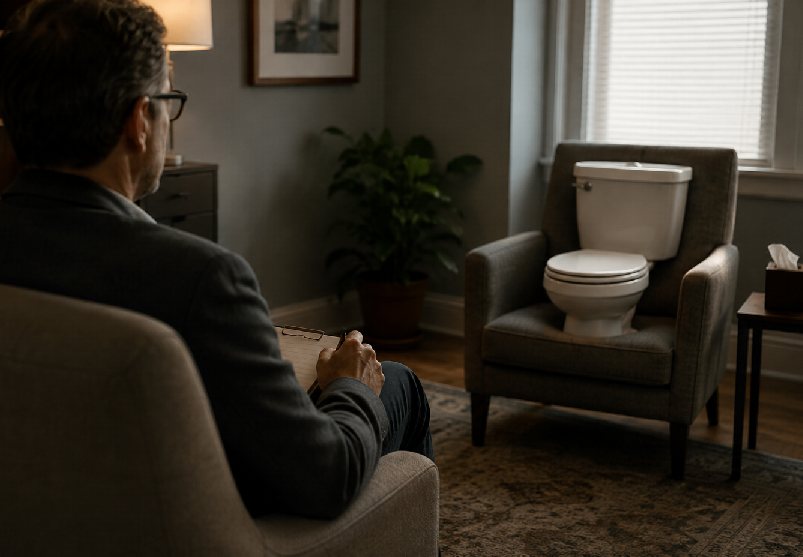
Whatever we don’t own, owns us. ~ Carl Jung
.
.
Among recovering people, and in the lexicon
of nearly every therapist I know, the single
most common word used to describe unfinished
emotional business is shit.
Not surprising. It’s a good metaphor.
Consider:
Actual shit is a waste product, what’s left
undigested after our systems process nourishment.
Emotional shit is what’s left undigested after
human beings process (or can’t process)
emotional experiences.
Actual shit is smelly and unpleasant.
So is emotional shit.
Actual shit, when it collects inside you,
makes you very uncomfortable.
So does emotional shit.
Releasing actual shit is an enormous relief.
Ditto the emotional version.
The biggest difference between them is
that most people instinctually know what
to do with actual shit.
They know they need to expel it from the
body on a regular basis.
And they know that if they don’t they’ll
get sick.
But many people don’t know that about
emotional shit.
They think the way to handle it is to hide it,
keep it inside, store it up.
Then they don’t understand why they go
around feeling shitty.
They’re emotionally constipated.
Emotional constipation can produce all sorts
of symptoms, like anxiety and depression
and anger and addiction.
Also high blood pressure, headaches, backaches,
gastrointestinal distress and exhaustion.
Also arguments and violence and worse.
Perhaps most importantly, this is how our
inner Kids get wounded.
We’re not born constipated. We’re born as healthy
little animals, able to trust what our bodies tell us
and automatically expel waste products.
Then in childhood we begin hearing messages like
Quiet down and Big boys don’t cry or Don’t cry
or I’ll give you something to cry about.
Surrounded by giants on whom we depend for
food, shelter, love and security, we have no
choice but to follow such instructions.
Voila: Constipation.
And why, exactly, does emotional constipation
make us feel shitty?
“When feelings are denied or kept inside there
is typically a buildup of physical tension,”
psychologist Paul Foxman explains.
An accumulation of such pressure
leads to anxiety, due to fears of
losing control emotionally. That
condition also triggers anxiety
because of its physiological similarity
to the fight/flight response, which
is normally associated with danger.
Thus our personality creates a paradox
in which we deny feelings to prevent
anxiety but experience anxiety
when we deny our feelings.*
There’s one more consequence of constipation
worth remembering:
It makes it impossible to feel like an adult.
Feeling adult means feeling healthy and strong
enough to be yourself. That includes being
able to notice your feelings — even the smelly
ones — and take responsibility instead of
hiding them.
Taking responsibility means learning to
express feelings in appropriate ways, ways
that leaving you feeling empowered,
not constipated.
Hiding feelings is what kids do. So no matter
how old we are, to the extent we feel compelled
to hide our feelings from others, we are going
to feel like kids inside.
Adults can, in the jargon of recovery, own
their shit.
Of course there’s more to adulthood than
this one ability.
Owning your shit doesn’t automatically
make you a grownup.
But you can’t start feeling like a grownup
until you start owning your shit.
_______________________________
*Foxman, Paul. Dancing with fear: Overcoming anxiety in a world of stress and uncertainty. Northvale, NJ: Jason Aronson, 1996.
* * *
Buy here.

Anyone who wants a healthy relationship must
answer two questions:
……
How can I have you without losing me?
How can I have me without losing you?
……
Except we can’t really answer these questions.
…
We can only struggle with them.
…
Then again, it’s the struggling that matters.
…
Why?
…
Because those questions represent the two essential
needs each of us brings to any relationship:
…
Connection and freedom.
….
Acceptance by another person, and self-acceptance.
…
A genuine partner, and at the same time, an
authentic self.
…
Sadly, most people I know are secretly convinced
that you can’t have both at the same time.
…
Most came from families — alcoholic, abusive or
otherwise dysfunctional — unable to teach them
to balance connection with freedom.
…
What they learned instead was that having one
meant losing the other. That winning love and
approval from parents, for example, meant
sacrificing important parts of themselves, like
the freedom to express feelings or take care of
their own needs.
…
The family that raised us is where each of us
learned our own personal answer to the two
questions. And the answer we learned grew
into a crucial (though mostly unconscious)
part of our basic view of life and relationships,
what I call our Plan A.
…
Some of us decide, “Since I can’t have both,
I’ll have me, and to hell with you.”
…
Therapists call this the narcissistic answer.
…
Others decide, “Since I can’t have both, I’ll
have you, and to hell with me.”
…
This is the infamous codependent answer.
…
So the narcissistic partner says “Me first,”
and the codependent replies, “Yes, dear.”
…
And the two personality types end up together
with stunning regularity. (Remember Archie
and Edith Bunker?)
…
Watching such couples interact, one is struck
by their predictability. In every situation the
narcissist finds some way to say “Me first,”
and the codependent to reply “Yes, dear.”
…
It’s as if long ago they sat down and signed a contract.
…
Which, in a way, they did.
…
Their complementary answers to the two questions
probably account, in large part, for why they
ended up together.
…
In any case, the vast majority of couples I see for
couples counseling follow this pattern — so many
that I felt the need to give them their own name.
…
I call them split-level relationships.
…
Split-level relationships work for a while, but
almost always break down.
…
Eventually one or both partners realize they’re
not getting what they need.
…
Codependents usually notice first. When that
partner is female, this can lead to the syndrome
called the walk-away wife.*
…
But narcissists tend to be unhappy too. They
often complain of loneliness, lack of connection
to their codependent partner, or an absence of
respect or affection. They may feel impatient,
frustrated, irritated, resentful. Sometimes they
drink, drug, overeat, rage, or cheat, and then
feel bad about that.
…
All this happens because split-level relationship
is inherently unhealthy.
…
Familiar, sure. Comfortable, even, in the way
the predictable may come to feel.
…
But not healthy. The unbalanced answers on
which a split-level relationship is based simply
cannot fill the emotional needs of two adults.
…
So both partners end up feeling deprived, often
without understanding why.
…
What does recovery for such a couple look like?
…
Put simply, a sort of role reversal.
…
Codependent partners must develop courage
and practice standing up, asserting themselves.
…
Narcissistic partners must develop empathy
and practice stepping down, giving instead of
grabbing.
…
Easy?
…
No. Not easy for either of them.
…
Just necessary to life on the same level.
____________
*’The Walkaway Wife Syndrome,” Michelle Weiner- Davis, on YouTube https://www.youtube.com/watch?v=1jRyUbdHn9I
* * *
Buy here.

Because I have trouble liking myself.
Hey, I can do it sometimes.
But only briefly.
I’m like a car that keeps
running out of gas
and needs you to refill it.
Which in itself makes me
not like myself much.
Makes me feel like a needy kid
looking for someone to fill him up.
Reminds me of how it felt
when I was a real kid,
dependent for fuel on
the next refueling.
A smile from dad.
A hug from mom.
Few and far between, sometimes.
I see now what I couldn’t see then.
That they were tired, and sad,
and scared, and confused, and
running on empty themselves.
That they couldn’t give me
what they just didn’t have.
And that I was wrong to think
their inability was about me.
Still.
Their problem became my problem.
Their emptiness became mine.
So now I have to learn what they
didn’t know and couldn’t teach me:
how to like,
and accept,
and approve of,
and love,
and take
really
really
really
good care
of myself.
.
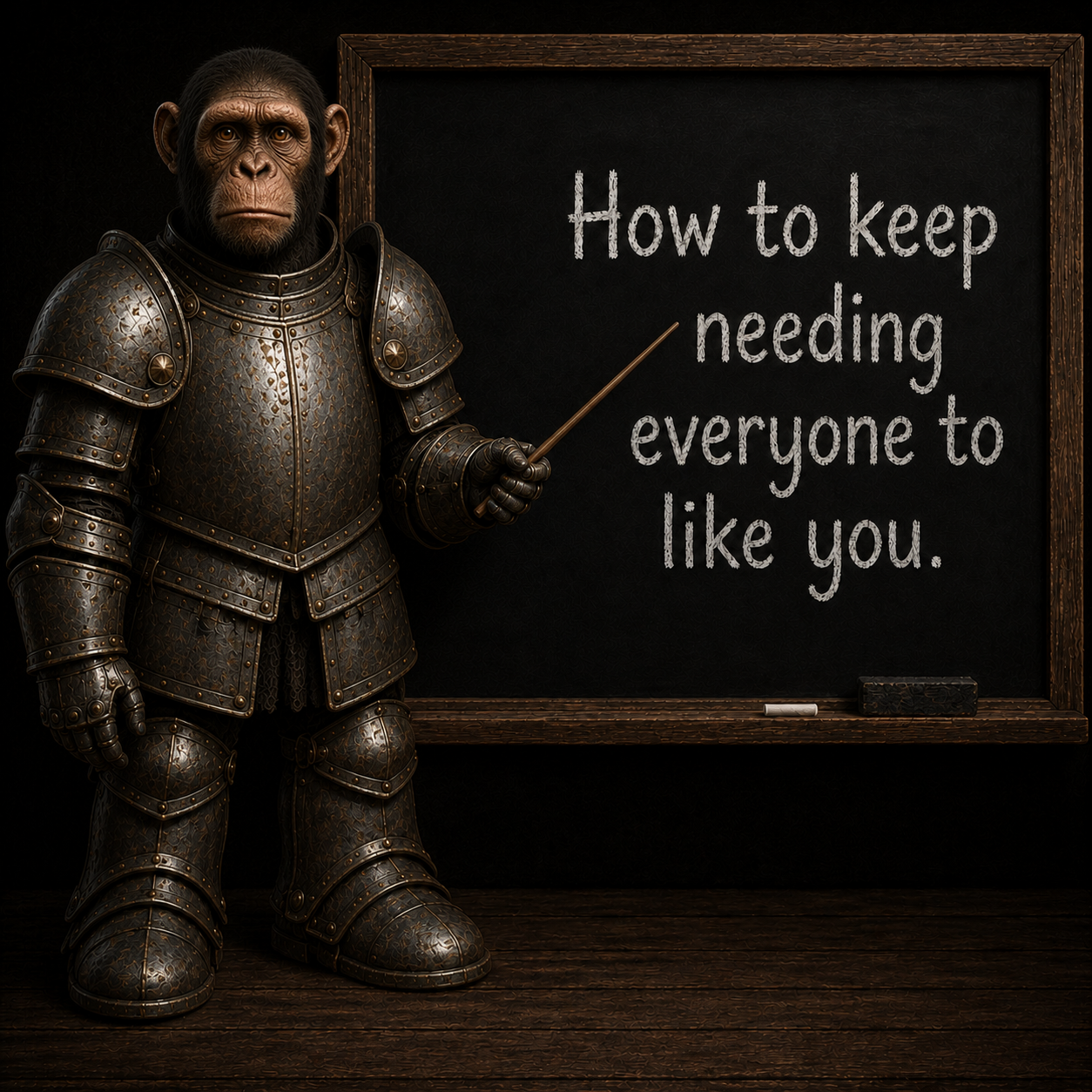
(1) Monitor other people more than you
monitor yourself.
(2) Imagine you can read their minds
about how they see you.
(3) When reading their minds, assume
negative feelings and judgments.
(4) When reading their minds, treat your
projections as if they were the truth.
(5) Treat others’ approval and disapproval
as if they came from your parents.
(6) Implement steps 1-5 constantly and
without realizing it.
(7) Hide your real thoughts, feelings,
needs and preferences.
(8) Practice people-pleasing regularly.
(9) Treat disapproval as evidence, and
approval as a mistake.
(10) Reject all compliments as undeserved.
Next:
[3] Why I need everyone to like me