Monkeyships, part 5: Scratch a codependent

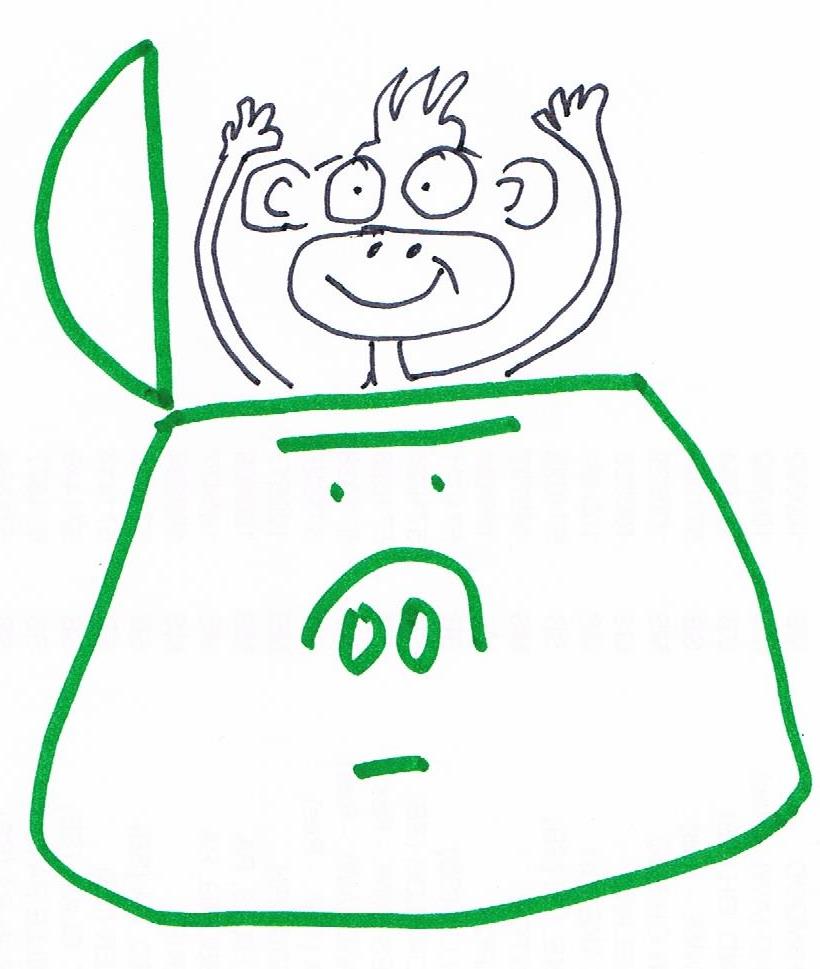
(If you’re new to Monkeytraps, Steve is a therapist who specializes in control issues, and Bert is Steve’s control-addicted inner monkey.

That’s Bert at left, in a narcissistic mood.

This is the last of a five-part series.  The first four were about how control warps relationships [Monkeyships], how controlling backfires [The more you try to control somebody], how control blocks healthy communication  [Can we talk? No, damn it], and “split-level” relationships [Me first. / Yes, dear].

Bert speaking:)

Family session today.  Sally brought her two kids to meet Steve. 

The girl is twelve, the boy fifteen.  Sally’s worried about their reactions  to her new boyfriend.

The girl’s depressed, the boy angry.  The boyfriend is an active alcoholic.

Steve meets with the kids alone.  He asks how they feel about the boyfriend, whose name is Tim.

“I hate how she acts around him,” the girl says.

“How does she act?” Steve asks.

“Scared.”

“I hate how he won’t let her finish an effing sentence,” the boy says. 

“You can curse here,” Steve tells him.

“He won’t let her finish a fucking sentence,” the boy scowls.

None of this surprises Steve, who met Tim last month when Sally brought him in for couples counseling.   At the time Steve diagnosed theirs as a classic narcissist/codependent (or split-level)  relationship, with Tim firmly in the driver’s seat.  Sally did seem scared of displeasing Tim.  And Tim often did interrupt Sally in mid-sentence.

He pointed this out to them.  They never returned as a couple.      

Now he asks the kids, “Have you told Mom how you feel?”

Both shake their heads.

“She won’t listen,” the boy says.  “Tim’s all she cares about.”

“Let’s bring her in and talk about it,” Steve says.

When Sally joins them, Steve tells her the kids have something to tell her, and asks her to just listen.  She nods.  They start. 

Sally cuts them off.  “It’s really hard for me,” she says. 

Steve again asks Sally to just listen.  Again she nods.  Again the kids try. 

Again Sally interrupts.  “Kids, here’s what you don’t understand,” she begins. 

The girl drops her eyes, and sinks back into the sofa cushions.  The boy bites his lip and frowns. 

Sally, oblivious, talks on. 

She has morphed into Tim. 

*** 

Steve, I don’t get this.  I thought Sally was a codependent.

She is.

Don’t codependents put other people first?

Well, that’s how it looks on the surface.

But with her kids she acted like Tim.  Why?

Scratch a codependent, find a narcissist.

Excuse me?

I know, it’s confusing.  I’ll explain.

Codependents only seem to put other people first.  What they’re really doing is trying to get their own needs met.  They just don’t think they can do it in an open and honest way. 

So they people-please and caretake and enable in hopes of getting something back.  Sally defers to Tim in hopes he will reciprocate.  She hopes if  she makes him happy he’ll eventually love her in return. 

But underneath she’s as self-preoccupied as Tim is.  And that underlying narcissism is what came out in the session with her kids. 

 So she doesn’t love Tim?  Or her kids, for that matter?

That’s a good question.  The answer depends on how you define “love.”

If you’re talking about love as a feeling, yes, Sally would probably swear that she loves both Tim and the kids.  And since it’s her feeling, who am I to disagree?

But if you mean love as behavior, then I’d say, no, she can’t really love any of them.  Because loving behavior requires a kind of respectful awareness that narcissism doesn’t allow.

How so?   

Narcissism is like trying to drive a car that has a mirror instead of a windshield.

You look out over the dashboard and you see, not streets and traffic and sidewalks and pedestrians, but only your own preferences, feelings and needs.

You’re so preoccupied with those things that you’re don’t see where you’re going, or who you’re running over to get there.

That’s why it’s so painful to be in relationship with a narcissist, either the covert type (like Sally) or the overt type (like Tim). Because both types will run right over you and not even notice the bump.

That’s not what I call love.  More like hit and run.
Want more?

We are all aware of the term “King Baby.” Although the image conjured up by this phrase is someone who’s arrogant, snobbish, demanding, and aloof, the truth is that these are the very men who feel painfully inferior inside. In fact, the more a person displays this “kingly” behavior, the more second-rate he feels.

From Rokelle Lerner’s article “Narcissists and their relationships,” an explanation of the sort of overt narcissism some alcoholics display.


To “qualify” as an inverted narcissist, you must crave to be in a relationship with a narcissist, regardless of any abuse inflicted on you by him/her. You must actively seek relationships with narcissists and only with narcissists, no matter what your (bitter and traumatic) past experience has been. You must feel empty and unhappy in relationships with any other kind of person. 


From Sam Vaknin’s desciption of the sort of codependent — what he calls “The Inverted Narcissist” — who is attracted to relationships with the King Baby type. 



Monkeyships, part 4: Me first. / Yes, dear.


(If you’re new to Monkeytraps, Steve is a therapist who specializes in control issues, and Bert is his control-addicted inner monkey.

That’s Bert at left.  No, we won’t say which.

This is the fourth in a series of posts on control and relationships.

Steve speaking:)

Anyone who wants a healthy relationship must struggle with two questions:

How can I have you without losing me?

How can I have me without losing you?

They’re not questions anyone can answer, finally.  No matter.  We have to struggle with them anyway.

Why?  Because they represent two essential needs each of us brings to any relationship worth the name:

Connection and freedom.

Security and integrity (a.k.a., personal wholeness).

Acceptance by another, and self-acceptance.

A real partner, and at the same time, a real self.

Most people I meet are convinced they can’t have both at the same time. Most came from families — alcoholic or otherwise dysfunctional — unable teach them how to balance connection with freedom.

What they learned instead was that having one meant losing the other.  That winning love and approval from their parents, for example, often meant sacrificing important pieces of themselves, like the freedom to disagree or express feelings.

The family is where each of us finds our own personal answer to the two questions.  The answer we find grows into a crucial (though usually unconscious) part of our basic view of life and relationships, what I call our Plan A.

Some of us decide, “Well, since I obviously can’t have both, I’ll have me, and to hell with you.”  Shrinks call this the narcissistic answer.

Others of us decide, “Well, since I obviously can’t have both, I’ll have you, and to hell with me.”  This is the infamous codependent answer.

So the narcissistic partner says “Me first,” and the codependent replies, “Yes, dear.”

And the two personality types end up together with remarkable regularity. (Remember Archie and Edith Bunker?)

Watching such couples interact, one is struck by their weird predictability. In almost every situation the narcissist finds a way to say “Me first,” and the codependent finds a way to reply “Yes, dear.”  It’s as if they sat down and signed a contract at the start of the relationship.

And in a way, they did.  Their complementary answers to the two questions probably account, in large part, for why they felt attracted to each other.

In any case, the vast majority of couples I see for marital therapy follow this pattern — so many that I felt the need to give them their own name. I call them split-level relationships.

Split level relationships work for a while, but almost always break down. Eventually one or both of the partners realizes that they’re just not getting what they need.

Codependents usually notice first.  (Remember when Edith stood up to Archie?)  When the codependent partner is female this can lead to the syndrome called the Walk-Away Wife.

But narcissists tend to be unhappy too.  They often complain of loneliness, no sense of connection to their codependent partner, or admit guiltily to feeling a lack of respect or affection.  They often feel impatient, frustrated, irritated or resentful.  Sometimes they drink, drug, overeat, rage or cheat, and then feel bad about that.

All this happens because this pattern is essentially unhealthy.  Familiar, sure.  Comfortable, even, in the way the predictable may come to feel.  But not healthy.  The unbalanced answers on which split-level relationship is based simply cannot fill the emotional needs of two adults.  So both partners end up feeling deprived, often without understanding why.

What does recovery for such a couple look like?

Put simply, a sort of role reversal.  Codependent partners must practice standing up, asserting themselves.  Narcissistic partners must practice stepping down, deferring.

Not easy for either of them. 

Just necessary to life on the same level.

***

Want more?

Photo by Jay Town/Newspix /


In a relationship, takers operate from the belief that “You are responsible for my feelings of pain and joy. It is your job to make sure that I am okay.”

      Caretakers, on the other hand, operate from the belief that “I am responsible for your feelings. When I do it right, you will be happy and then I will receive the approval I need.”

Another take on the narcissist/codependent dynamic by Margaret Paul, PhD., who calls them Takers and caretakers.


And finally (just for fun*) two free self-tests: 


Are you narcissistic? 


 Are you codependent?


*Note the disclaimer at the bottom of each. 

***


Monkeyships, part 3: Can we talk? No, damn it.


(If you’re new to Monkeytraps, Steve  is a therapist who specializes in control issues, and Bert is his control-addicted inner monkey.

That’s Bert at left.  We won’t say which one he is. 

Bert speaking:)

Once upon a time a dad brought his fourteen-year-old son to Steve for family counseling. 

He said he wanted the two of them to be closer, to talk more. 

The session started this way:

DAD:  Go ahead, buddy.  This is a safe place.  You can say anything here.

SON:  I want to go home.

DAD:  No, damn it.  We’re doing this.  Now open up. 

(He actually said that.)

Steve was professional.  He took a breath, fought down the urge to roll his eyes, and tried to explain to Dad how he was sending what Steve called a “mixed message.”

My reaction was simpler.  I wanted to strangle Dad.

He reminded me, I suppose, of all the times I’d witnessed some adult coerce some kid into something for their “own good.”   

And all the times some wife or husband sat on Steve’s sofa and demanded “openness” from their partner, only to wither them with criticism when the other finally dared open up. 

And all the times one partner justified withering another with “I’m just expressing my feelings.”

And all the times I saw teachers coax students into participating in discussions, only to reward them with humiliation.

And all the times I saw parents demand honesty from their kids, only to punish them for telling the truth.

All the times, in short, I watched one person verbally mug another and call it “communication.”

See?  Getting mad again.

Steve, give your professional opinion.

I think you can have communication, or you can seek control.  But you can’t do both at the same time.

And I think that, to the extent any party to a conversation seeks to control it, healthy communication becomes impossible.

Which makes healthy communication pretty rare.

What’s “healthy” communication?

The sort that permits people to give up control — to risk being honest, vulnerable, spontaneous, authentic — without fear of the consequences.

Not easy.

Not easy at all.  

And it can be terrifying.  

Why is that?

Because we’ve all been burned by unhealthy communicators.  

If,  for example, you grew up in a family where words were used to coerce, wound or manipulate — forget it.   Not only would opening up scare you, you might not even believe that safe communication is possible.  Why should you?

That’s the case with many people I work with.  When I talk to them about “healthy communication” I might as well be speaking Martian.  They simply have no internal model for what I’m describing.

What do you do about it?

I help them learn a new model.

For example, most people don’t know how to listen.  I mean, really listen.  (Often they mistake listening for merely waiting their turn.)

So I may teach a couple Monologuing, which asks one partner to sit and pay attention while the other lists feelings for five minutes.  Then the listener plays back what he/she heard.  (Which always contains surprises.)  Then they switch roles.

Another problem:  Most people don’t realize how often and how casually they hurt others with their words.  

So I teach them to distinguish between You- and I-statements  — how, for example, there’s a world of difference between saying “You’re an idiot” and “I’m mad at you.”   Then I teach them to abstain from the former and practice the latter.  Which most people find really difficult to do.

 Not easy, as I said.

No, it’s not. 

Just our only hope. 

 For what?

For really connecting with another human being. 

* * *

Want more?

Coming soon, to a chat room near you: 


(No, it won’t really cost 5 cents.  You’ll just need to subscribe to Monkeytraps.)

***

Talk more, not less.

You’re also invited to join my new LinkedIn group, About Control.

Created to provide a place for us to discuss this important, neglected idea, the group will explore, among other things,  

~ Control as an emotional problem. Compulsive controlling as a cause of anxiety, depression, addictions, dysfunctional relationships and bad parenting.

~ Control as a clinical problem. The struggles of client and therapist to control both the client’s symptoms and what goes on in the therapeutic relationship itself.

~ Control as a spiritual problem.  Controlling that grows out of seeing reality as dangerous, and an inability to trust in anything larger than one’s individual ego.

~ Control as a cultural phenomenon.  Controllling as an attempt to pursue both happiness (as if it were something you could hunt and chase down) and freedom (usually price-tagged) from all pain and suffering.

Interested?

Come join the conversation.

(Not a LinkedIn member?  It’s easy to join.  Click here: LinkedIn.  Once you’re a member, go to Groups and type in About control in the search box in the upper right corner.  That will take you to a Join Group button.

See you there.)


Monkeyships, part 2: The more you try to control somebody…

(If you’re new to Monkeytraps, Steve is a therapist who specializes in control issues, and Bert is his control-addicted inner monkey.

This is the second in a series on control and relationships.

Steve speaking:)

“All happy families,” wrote Tolstoy, “are alike; each unhappy family is unhappy in its own way.”

Not in my experience.

In my experience, unhappy families — unhappy marriages, especially — are remarkably similar.

Consider:

~ Heather wants to marry Ian, who’s scared of commitment.  So she pressures him to propose, which scares him, so he backs away.  This scares her, so she steps up the pressure (“Why won’t you marry me?”).  Which makes him back away further and faster.  And so on.

~ “He never talks to me,” is Jane’s main complaint about Kevin, who grew up in a family where no one talked to anyone about anything.  The more she begs him to talk, the more inadequate Kevin feels.  The more inadequate he feels, the more silent he becomes.  Which angers Jane, which makes her beg harder.  And so on.

~ Lisa is a people pleaser who gets anxious when Mark is unhappy.  So she knocks herself out putting his feelings, needs and preferences ahead of her own.  Mark — who enjoys this and doesn’t want it to stop — finds he can keep Lisa motivated by remaining unhappy.  The unhappier he becomes, the harder she tries.  The harder she tries, the unhappier he becomes.  And so on.

~ Nancy: “If you didn’t drink, I wouldn’t nag you.” Oscar: “If you didn’t nag me, I wouldn’t drink.”  Rinse and repeat.

~ Both Patty and Ron grew up in families that didn’t acknowledge or respect feelings.  Hungry for emotional validation, they now seek it from each other.  Unfortunately each takes the position, “I’ll validate you after you validate me.”  Since neither validates first, no one gets validated.  Ever.  So their childhood deprivation continues.  Indefinitely.

Notice a pattern?

All these examples (and the variations are infinite) illustrate what I call the Second Paradox of Control: 

The more you try to control somebody, the more you force them to control you back.

This is the interpersonal version of the First Paradox of Control, which we explained here several weeks ago: “The more control you need, the less control you have.”

 This Second Paradox grows out of a fairly obvious fact of human nature: 

We all want control, and we all resent being controlled by others.

That’s just what is being played out in these examples.  Each of the ten partners is trying desperately (if often unconsciously) to transform the other into the partner they want.  And each of the ten is resisting the transformation as hard as they can.

You might call it control addiction a deux.

Or you could use the catchy term explained here last time: monkeyships, relationships bent out of shape by control issues.

Some of this goes on in all our relationships, because at some point every relationships turns monkeyish. 

It has nothing to do with how much we love our partner. 

It has everything to do with how much control we think we need. 

And we can expect it to continue unless we learn alternatives to monkeyish behavior.


Want more?

Typically, the co-dependent person came from a dysfunctional home in which their emotional needs were not met. Their parents were not able to provide the attention, warmth and responsiveness which kids need in order to feel that their needs count….

The need to re-play the childhood drama and TRY, TRY, TRY to achieve a different ending is so intense, that it determines even the type of person the co-dependent is drawn to. A person who is kind, stable, reliable and interested would not be attractive, typically, to the co-dependent person…they would appear “boring.”

From Patty Simko’s article “Co-Dependency” at the Planet Psych website.


Monkeyships

(If you’re new to Monkeytraps, Steve is a therapist who specializes in control issues, and Bert is his control-addicted inner monkey.

Bert speaking:)

Steve’s seeing more and more couples lately.

Not sure why, since he never trained as a couples therapist and doesn’t advertise himself as one.  But couples apparently like his approach, because they keep sending him new couples to work with.

Which at one time would have pissed me off.

Because I hated couples work. 

It scared me.

It scared me for two reasons.  First, there was too damned much going on in the room. 

Steve, explain.

Well, work with couples means paying attention to many levels and variables at once.  Like

~ what the partners say, and what they don’t say;

~ which feelings they express, and which they feel they must hide;

~ which of their goals and motives are conscious, and which remain out of awareness; and

~ what’s happening between them here and now, as opposed to  whatever past experiences (often buried, usually painful) are getting triggered.

Right.  All that felt overwhelming.  It was just too much. 

Too much to control, you mean.

Yes.  Couldn’t control it mentally.  Couldn’t organize it in my head.

And then I hated the tension.  Many couples were so angry at each other that sessions with them felt like watching someone juggle live hand grenades.  I kept waiting for some emotional KABOOM to blow the whole office into matchsticks.

You couldn’t control the emotional situation either.

Right.  I couldn’t control either their feelings or my own feelings about not being able to control how they felt.

All of which explains why, for years, whenever someone called Steve to request couples counseling I’d immediately climb up onto his shoulder and whisper Just say no over and over.

He didn’t listen, though.

Well, we had to make a living.

I know.  Didn’t care about that.  My priority was not feeling scared. 

But I’m glad he didn’t listen.   Because over time he learned something important about how to help couples.  And I even started to feel safe. 

Both these things happened after he came up with his Monkeyships Theory.

Steve explain what a monkeyship is.

It’s any relationship that becomes dysfunctional because both partners are struggling for control.

And the theory?

Simply that most (maybe all) relationship problems are monkeyship problems, since at one time or another all relationships turn, well, monkeyish.

This theory helped me feel safer with couples work in two ways. 

First, focusing on the idea of control helped me to observe and organize what was happening in each session, like a magnet rearranges iron filings.  

Yes.  Noticing how people try to control each other really clarifies how they get into trouble in the first place. 

More importantly, it gave Steve a way to help them get out of trouble.

 I realized my job wasn’t so much to fix or change any couple’s interaction as to help them notice how they were trying to get control.  I did this by pointing out what I was seeing and hearing.

Once they could spot their own patterns, the next step was to teach them the three alternatives to control — surrender, responsibility and intimacy (see the end of “What you damned well better know about control”).   And then get them to practice.

This sort of therapy is no quick fix, and it works better with some couples than others.  Its success depends mainly on how willing they are to stop playing blame tennis and look hard at themselves. 

For those who can do that, the alternatives offer a path out of monkeyship and towards what relationship is meant to be: a place where both partners can be themselves with each other, and where both come to see that what’s good for their partner is — surprise — also good for them. 

(To be continued.  This is the first in a series of posts on control and relationships.)


Want more?

“Did you know that of the over one million marriages that will end in divorce this year, two thirds to three quarters of those divorces will be filed for by women?

“What is this so-called, ‘Walk-away Wife’ syndrome all about?”

Click here to read “The Walk-Away Wife Syndrome” by Michelle Weiner-Davis, taken from her Divorce Busting website.  

Describes a pattern I’ve seen again and again.  Essential reading, especially for husbands in unhappy marriages.


Session 1: Bert starts therapy


I have secrets.

 Okay.

……………………….

……………………….

……………………….

 Awful secrets.

 Okay.

……………………….

…………………………………………………………………………………………………………………………………………………………………………………………………………………………………………………………………………………………………………………………………………………………………………………………………………………………………………………………………………………………………………………………………………………………………………………………………………………………………………………………………………………………………………………………………………………………………………………………………………………………………………………………………………………………………………………………………………………………………………………………………………………………………………………………………………………………………………………………………………………….

.

Stuff I could never tell anyone.

I understand.

……………………….

……………………….

………………………. 


Are you going to make me talk about them? 

Nope.

……………………….

……………………….

……………………….

……………………….

…………………………….

Why not?

My job is to accept you as you are.

……………………….

……………………….

……………………….

It is? 

……………………….

Yup.

……………………….

……………………….

………………………..

. . . . . . . .

……………………….

……………………….

……………………….


May I see your diploma?


The Big Five


(If you’re new to Monkeytraps, Steve is a therapist who specializes in control issues, and Bert is his control-addicted inner monkey.

That’s Bert at left, imitating the guy at right.

Bert speaking:)

Steve is suggesting it might be a good idea to pause in the midst of what we’re doing to point out that we’re doing it.

What we’re doing is a series of posts examining what he calls the Big Five — the five most common problems people bring into therapy.

The Big Five are anxiety, depression, addiction, poor relationships and parenting problems. 

In our last three posts I wrote about anxiety, depression and addiction from a recovering monkey’s point of view.  I.e., mine.   I explained how I came to see my own anxiety, depression and addictions as all rooted in my need for control.   

Wait, Steve wants to add something.

Not to be picky, but I’d rather say those symptoms come from a need for dyscontrol — the dysfunctional or unhealthy form of controlling.

Explain the difference between the healthy and unhealthy forms.

Sure.  One’s realistic, and the other isn’t. 

Healthy controlling aims at what can and should be controlled.   When I’m driving I can and should be controlling my car, for example.  If my kid gets sick I can and should control the kind of medical care he receives.   

But dyscontrol aims at targets that either cannot or should not be controlled. 

That’s because dyscontrol comes not from a realistic view of  some situation or problem, but from anxiety.  It’s compulsive behavior, whose real goal is to make uncomfortable feelings go away.   Which means it’s not always rational.  Which explains why we keep doing it even after we find it doesn’t work.

All this will be important to remember when we come to discuss the last two of the Big Five, both of which concern relationships.

Why?

Because relationships are confusing as hell.

The main reason we find relationship problems so hard to solve is that they grow out of unconscious feelings and motives.  Often we don’t know what we’re doing or why we’re doing it.  But we keep doing it over and over again.   (Ever notice how you and your partner keep repeating the very same argument?)

Becoming conscious of how we try to control our anxiety by controlling other people is probably the single biggest step we can take towards healing our relationships.   

Okay, enough for now. 

Coming next week: 

Control and relationships, in three parts.


Also coming soon:

Monkeytraps will soon have a sister site, devoted to recovery from codependency. 

It will contain articles, book reviews, links to resources, guest posts by experts, a forum, cartoons, podcasts, maybe even a video or two.

We’re calling it Power Monkeys.  

Stay tuned.

*** 

Finally, a bit of

Shameless self-promotion

A Monkeytraps post titled “Bert’s strawberry” was reviewed recently by blogging coach and online copywriter Judy Dunn on her blog Cats EyeWriter.

Judy wrote:

What the blog is about: Steve Hauptman is a therapist, Gestaltist and leader of Interactive Therapy groups.  His blog, Monkeytraps, is devoted to the oldest human addiction: control.  Its thesis is simple.  Unless we distinguish between what we can and cannot control, we try to control everything, and make ourselves sick and miserable.  Steve blogs with Bert, his “inner monkey.”

The post: Bert’s strawberry

What I liked about it:  Steve intrigued me with his blog post teaser: “Who eats fruit on the verge of death?”  I was hooked.  I had to read the story.  His blog is an interesting concept.  Bert is his control-addicted inner monkey.  Some interesting (and enlightening) conversations must go on at Monkeytraps.

In Bert’s strawberry, Bert is retelling one of Steve’s stories, with his own reactions interspersed, control freak that he is.  It’s a story about living in the moment, with a sort of mindfulness, and awareness of the present.  To get this post, you really must read it.

Clever and creative way to help us understand how our “monkey mind” messes with us.  I was especially impressed because the field of therapy can have its challenges when it comes to blogging.

Connect with Steve:  On Twitter, on Facebook, and on his blog.

Thanks, Judy.


The garden of Numb: Control and addiction

(If you’re new to Monkeytraps, Steve is a therapist who specializes in control issues, and Bert is his control-addicted inner monkey.

That’s Bert at left, stuffing feelings.

Bert speaking:)

I’m an addict.

Technically, I suppose, you’d call me a polyaddict, since I’ve had many addictions in my time.

They came in two flavors: substances and behaviors. 

The substances included food and tobacco.  (Sugar’s my drug of choice.  In grade school I ate it by the spoonful.  I also drank maple syrup.  In grad school I smoked a pipe until cumulus clouds formed in my office and my tongue morphed into raw hamburger).

The behaviors include watching television (an alternate reality where I spent most of ages twelve through eighteen), reading books (the alternate reality I still find preferable much of the time), and writing (in my thirties and forties I carried a spiral notebook everywhere with me, compulsively filling page after page whenever I felt confused or stressed out or scared.  Apparently I felt that way often; there are thirty-one spirals stacked in a corner of my garage).

I’m addicted to work, too.  Can’t write intelligently about that, though, since I’m still in denial.

Anyway, these were the main paths I followed to what Steve calls the Garden of Numb.  

Steve, explain your view of addiction.

Addicts are people who can’t handle feelings.

Usually it’s because they never learned to as kids.  Usually because their parents never taught them.  Usually because they couldn’t teach them, because their parents never taught them.  (Usually.)

In any case, being unable to handle feelings is uncomfortable, since feelings tend to keep coming.  So the kid naturally starts looking around for something to make the damn things go away.  

To escape a jungle of unwanted, disagreeable feelings by entering the Garden of Numb. 

Drugs and alcohol are the most obvious paths to the garden, but anything that alters your mood can be turned into an addiction.  

And though some are more dangerous than others, in the end each addiction is the same as all the others, because each has the same goal: to give the addict control over emotional life.  

Which is why when I’m asked “What does control have to do with addiction?” I reply: “Everything.” 

Because finally every addiction is an addiction to control.

Now don’t get me wrong.  I love the Garden of Numb.  Great place to visit. 

Yes.  Necessary, even.  We all need (and deserve) vacations.   The world can be a frightening and painful place, and living a human life is no picnic.

The problem comes, of course, when you find you can’t live outside the garden. 

Right.  Which is what happened to me with each of my addictions. 

My eating and smoking and tv-watching and reading and scribbling took on  lives of their own.  Each stopped being something I was doing and became something that was doing me.   I lost control of my need for control.

At which point I had to revisit my relationship with feelings. 

 Made friends with them, you mean.

Well, no.   Not sure I’ve done that yet.  But I sure had to stop being scared of them.   

Which meant learning (and then relearning) the function of feelings, to see them as feedback about what was happening inside.  And then to learn (and relearn) healthier ways of processing or digesting that feedback — mainly by identifying and expressing what I felt — instead of trying to make it go away.

I’m still working on all this.   

And, I hope, so are you. 

It’s what we each have to learn.  We’re all control addicts.   If you’re human and breathing, there’s no avoiding it.

And recovery from this addiction involves hard work.   It means overcoming emotional constipation, facing scary feelings, and learning alternatives to control. 

The work’s worth it, though, because the alternative is worse. 

Since living in Numb isn’t really living at all.

Want more?

For other views of addiction:

Check out Breaking the cycles — Changing the conversations, where I occasionally guest post, and where Lisa Frederiksen employs “21st century brain and addiction-related research to change how we talk about, treat and/or prevent alcohol and drug abuse, underage drinking, alcoholism, drug addiction, dual diagnosis, DUIs and secondhand drinking/drugging (SHDD).”

Lisa’s also the author of two valuable books: If you loved me you’d stop: What you really need to know when your loved one drinks too much, and Loved one in treatment? Now what!

Also look at Bill White ‘s website chipur, whose mission is “to provide powerful and effective relief and healing resources – and hope – to those enduring a mood and/or anxiety disorder(s),” and which offers a free weekly newsletter. 

Bill writes,  “We’ve all been dealt a hand.  Some are seemingly excellent. And some – well – perceptually not so hot.  But that’s just the way it is, and all of us have to play our cards the best we can as we move forward.  Recovery and healing are truly a matter of personal choice.  And when the decision is made to assertively move ahead, all of the strength and insight you’ll need to come out on top will be right at your fingertips.”


Constipated: Control and depression

(If you’re new to Monkeytraps, Steve is a therapist who specializes in control issues, and Bert is his control-addicted inner monkey.

That’s Bert at left, looking depressed.

Bert speaking:)

Steve says depression is called the “common cold” of mental illness.

Interesting way to view it. 

I’ve had my cold for almost sixty years.

It started when I was in grade school.  Nobody called it depression, of course.  This was the fifties.  I’m not sure if back then anyone even knew kids got depressed.   

All I knew was I felt crappy: sad, shy, nervous, worried.  Different.  Flawed. Preferred being alone.  Preferred books to people.  Preferred tv to real life. 

“Moody,” mom called it.  “Difficult” was dad’s diagnosis.

I also remember feeling guilty about feeling crappy.  Must be my fault, I thought.  Teachers were always writing on my report cards could do better if he’d try.   So I decided feeling crappy meant I was somehow doing Life wrong, that I’d feel better if I just tried harder.   Only I didn’t know how.

Steve wants to add something.

Self-blame is pretty common.  The depressed people I know tend to see their mood disorder not as illness but some sort of personal weakness or failure.  I’ve always thought this is the worst part of depression.  It’s hard enough to feel bad all the time.  Blaming yourself for feeling bad just adds insult to injury.

I felt lousy through adolescence and into adulthood.   I got some therapy and some medication along the way.  (And read lots of books.  I mean, lots of books.)  But it was only in middle age, after Steve began to work as a therapist, that I came to understand why I felt like this.  

It was Steve’s work with clients that taught me I didn’t get depressed because dad drank, or mom was unhappy, or they divorced when I was in second grade.  Or because of anything, really, that happened to me.  

I got depressed because of how I reacted to what happened.

Or rather, how I didn’t react.

Steve, you explain.

The best book I know on the subject is Depression and the Body by Alexander Lowen.  It taught me to see depression as a physical symptom — a form of  exhaustion that comes from fighting oneself, by holding in feelings that want and need to come out. 

Put differently: depression is caused by emotional constipation. 

Ever been physically constipated?  Did you notice how, the longer it lasted, the more uncomfortable you felt?  How it came to occupy all your energy and attention?    

Held-in feelings affect us the same way.

It’s no accident that people in recovery use excretory metaphors  (“my shit’s coming up,” “get my shit together,”  “acts like his shit doesn’t stink”) to describe emotional processes.  For feelings are a kind of waste material, the emotional byproducts of experience, just as feces are the physical byproducts of what we eat.  And just as physical waste must be expelled from the body, feelings are meant to be expressed — not hidden or stored up.

And when they aren’t, we get sick: emotionally, physically and spiritually. 

“The self is experienced through self-expression,” Lowen writes, “and the self fades when the avenues of self-expression are closed…. 

“The depressed person is imprisoned by unconscious barriers of ‘shoulds’ and ‘shouldn’ts,’ which isolate him, limit him, and eventually crush his spirit.”

In my family self-expression wasn’t an option.  Dad’s drinking and mom’s depression made that impossible.   Neither of them knew how to deal with their own feelings; how could I expect them to cope with mine? 

So like all kids, I adapted to my parents.  I learned to control their reactions to me — avoid rejection, conflict, disappointment — by hiding or burying what I felt.  I moved out of my body, took up residence in my head, and developed a personality organized around this way of coping.

I’m a sixty-one-year-old monkey now, and still organized that way. 

Yes, despite all that Steve and I learned together, Plan A isn’t easy to leave behind.  So stuffing feelings is still my first impulse, especially under stress.  I still find it scary to surrender to feelings, to give up overcontrolling myself and others.  I probably always will.     

But I rarely feel lousy in the old way anymore. 

Why?  Because now I know I have a choice. 

I can express myself, or I can depress myself.

Or, put another way: 

I can fight against feelings and keep losing.   Or I can practice surrender and, at least some of the time, rise above the common cold.


Want more?

“You are your body.  And your head doesn’t control it.”

Check out this interview with Alexander Lowen (subtitled in Spanish) in which he outlines his ideas about the body, feeling, movement, basic principles of Bioenergetic therapy, culture, insanity, health, breathing and connection.  Compiled from fragments posted on the Lowen Foundation web site.

*

Read “What is depression (and what is it not)?” at the interesting Wing of Madness web site . 

*

Finally, an article by Deborah Gray about  “Identifying non-traditional depressive symptoms”  at MyDepressionConnection.com.


Background music: Control and anxiety

(If you’re new to Monkeytraps, Steve is a therapist who specializes in control issues, and Bert is his control-addicted inner monkey.

That’s Bert at left, having a bad day.

Bert speaking:)

I’m a nervous monkey.

Not full-blown, panic-attack nervous (though there have been times, like my first day of kindergarten, when I came pretty close).  

No, my anxiety is more of the garden-variety, chronic type.   You know, where you go around tense or uneasy, unable to fully relax or enjoy yourself because it feels like something bad’s going to happen, only you’re not sure what.  You know.  

I’ve been this way as long as I can remember.   Anxiety has followed me around throughout most of my life, wherever I go, whatever I do, like background music. 

It took me a while to figure it out. 

How to keep yourself nervous 

What I finally discovered — mainly by sitting in on sessions where Steve was teaching clients about control addiction — is that I have  two favorite ways to keep myself nervous. 

One way is to

(1) Control the future.   
I do this mainly by thinking about it.  Anticipating it.  Planning it.  Worrying about it.   Obsessing about it.   Forming expectations.  In other word, by letting my thoughts be dominated by monkey mind.

This is a highly efficient system that keeps anxieties growing like weeds.  Because the more I worry about the future, the more anxious I get.  And the more anxious I get, the more I worry about the future.  And so on. 

My other favorite way of staying nervous is to

(2) Control other people. 

I do this by insisting — secretly, I mean, in the privacy of my own mind — that other people always like me, and approve of me, and admire me, and agree with me, and laugh at my jokes.  That I really need them to behave that way, and that I’ll find it intolerably painful when they don’t. 

(That second part is an exaggeration, of course.   But it’s not hard to convince myself that it’s true.  All I have to do is check in with Top Dog, who reminds me how inadequate I am.  Then monkey mind does the rest.  Like tag-team wrestling.) 

I try to control other people mainly by editing myself — hiding the parts I think they won’t like.  For example, I bury feelings instead of expressing them.  The more feelings I bury, the more anxious I get.   The more anxious I get….

No doubt you’ve noticed a pattern here.  The main symptom of my addiction is an endlessly repeating cycle: anxiety leads to controlling, which leads to more anxiety, which leads to more controlling, around and around and around.

So.  What to do?

Stop the music

Well, you can’t stop it; not entirely.  Some background anxiety is simply the cost of being human — of having a big brain that worries endlessly, and of needing relationships to feel secure.

But you can turn down the volume.

I find the two ways — two practices, actually — that work best both involve (surprise) giving up control.

The first practice is not controlling the future.  I do this (even though I hate it) by meditating.  This involves sitting for twenty minutes a day in one place, watching my own anxious thoughts run amuck, pushing them gently aside and counting breaths instead.  And doing this over and over.  It’s difficult.  It gets easier with practice.  It works. 

The other practice is coming out of hiding with people.  I do this by  noticing the urge to go into hiding, even in small ways.  (No, that dress doesn’t make your butt look big at all.)   I face this choice between fifty and a hundred times a day.  My practice is to gradually increase the percentage of times I tell the truth, show myself as I am.  To exercise the honesty muscle. 

This, too, is difficult.  This, too, gets easier with practice. 

And this, too — probably more than anything else —  helps turn down the volume of the music in the background.


What you damned well better know about control

(If you’re new to Monkeytraps, Steve is a therapist who specializes in control issues, and Bert is his control-addicted inner monkey. 

That’s Bert at left, explaining control addiction. 

Bert speaking:)

Whenever he meets a new client Steve asks him or her the same question: 

“So what do you know about you and control?”

The answers he gets vary.   But everyone ends up admitting, in one way or another, that control is pretty damned important to them.

Until today.

Today Steve met a new client — I’ll call him Harry — who answered his question with a shrug. 

“Nothing,” he said.

“Nothing,” Steve echoed.

“Nothing,” Harry repeated.  “I have no problems with control.”

Steve was flabbergasted.  He’s always assumed everyone has at least a sneaking suspicion that control issues figure in their need for therapy.  But Harry disproved that. 

So, in recognition that there may be other Harrys out there who are clueless about the role of control in their emotional lives, he asked me to write this post.

Glad to oblige.   Because this is important stuff.

So here’s what you damned well better know about control:


1. You’re addicted to it.

Yes you are.  Consider: 

Control (as we define it) means the ability to dictate reality — to turn some piece of the world into what we need or want or prefer.  Who doesn’t want that?  And who doesn’t seek it constantly? 

We human beings seek control in a gazillion ways, ranging from huge (starting wars) to tiny (changing channels), from mindful (driving a car) to unconscious (forming expectations), and from dangerous (beating a child) to innocuous (scratching an itch). 

However you explain this urge (and I blame it on our big restless brains), it’s both an elemental part of human nature and the one that most clearly separates us from other animals, who pretty much have to take reality as it comes. 

It’s so familiar we barely notice it.  Most of the controlling we do is habitual, automatic and unconscious.   In fact should we meet someone who is not automatically controlling (think: Dalai Lama) that person would probably strike us as, well, unhuman. 

What makes controlling an addiction?  Several things.  But here’s the most obvious: 

Addictions are famously difficult to give up. 

Try giving up control for a day, and see how you feel.

Hell, try giving up control for ten minutes.    


2. Overcontrolling makes you sick.

We tend to overcontrol two things: our own feelings, and other people. 

Overcontrolling feelings makes us anxious, depressed and addicted.  Overcontrolling other people ruins our relationships.

There.  I’ve just summarized 99% of what Steve talks about in a typical  working day.

He wants to add something. 

The most common problem clients bring to therapy is emotional constipation: the suppression of normal feelings. 

We suppress feelings out of fear.  There are plenty of advantages to living with other people, but its chief curse is that we spend our lives terrified of how they will react if we dare to reveal ourselves emotionally. 

This curse is what makes us sick.  I’m not exaggerating.  To deny feelings is to go to war with your own body, ignoring both its intelligence and its needs.  I once asked a client who was a doctor what practicing medicine had taught him about human beings.  “That no illness is purely physical,” he said. 

When feelings get buried, dis-ease grows. 


3. All controlling is an attempt to control feelings.

We seek control because we’re convinced we’ll feel better with it than without it. 

Controlling reality, we figure, will allow us to avoid all sorts of discomfort:   pain, anxiety, boredom, anger, confusion, embarrassment, fear.

True enough.   Unfortunately most of the time (have you noticed yet?) reality is beyond our control.  

What then?  How handle feelings you cannot avoid?

Having no alternative to control leaves you hopelessly addicted to it — forced to manage your emotional life by compulsively wrestling people, places and things into submission, and condemned to helpless anxiety when you can’t.

Luckily, there are alternatives.

Three, in fact:

~ The first is being able to let go — to stop trying to control what you can’t control anyway.   We call this alternative surrender.  It allows you to relax, accept life on life’s terms, to swim with the tide of events instead of against it.   

~ The second is being able to listen to feelings instead of denying or concealing them.  We call this alternative responsibility (as in ability to respond).  It allows you to avoid splitting yourself into two selves —  public and private — and to make healthier choices, ones that take your true needs into account. 

~ The third alternative is the hardest to learn.  It’s being able to be yourself with another person, and to allow them to do the same with you.  We call this alternative intimacy.  It’s the hardest because it combines both surrender and responsibility, and because it demands that we rise above fear.  But it also offers us our only chance to feel truly connected to and accepted by another human being.

None of the alternatives is easy to learn or practice.  If we choose them it’s because we’ve come to realize, like any recovering addict, that being addicted to control is even harder. 

*

Steve has a last word:

As Bert said, this is important stuff.  Stuff we all need to know.  In an ideal world, we’d teach it more.  Parents would teach their kids.  Kids would teach other kids.  Married people would teach each other.  So would religions.  So would nations.

Control is too important, really, to leave to just therapists.   


How to spot monkeytraps

(If you’re new to Monkeytraps, Steve is a therapist who specializes in control issues, and Bert is his control-addicted inner monkey.

Steve and Bert wrote this together:)

Steve:  Some weeks ago we asked readers to tell us what they most want to learn about control.  One of you replied with this:

I like your blog, but it’s a little scary, since before this I had no idea how controlling I am and how many problems it causes me.  

What I want now is to learn to be more aware of my controlling, to keep the idea of control at the surface of my mind and to understand how wanting to control things drives how I react and what I do and say.  

Got any tips on that?

Bert:  Good question.

Steve:  Yes.  She wants to learn how to spot monkeytraps. 

Bert:  Exactly.

Maybe you should remind everyone what a monkeytrap is.

Steve:  In the East they trap monkeys by placing fruit in a weighted jar or bottle with a narrow neck.   The monkey smells the fruit, reaches in to grab it, and traps himself by refusing to let go.  

A psychological monkeytrap is any situation that triggers you into compulsive controlling — i.e., into holding on when you really should be letting go.

Bert:  And yes, we have tips on how to spot them.

Steve:  Here’s tip #1:

Notice where you’re uncomfortable.

We’re controlling whenever we need or want to change some piece of reality (instead of accepting it as it is).  And we’re most likely to want to change realities that make us uncomfortable.  So it makes sense that our discomfort zones are where we’re most likely to get monkeytrapped. 

Bert:  I, for example, can’t stand rejection.  So it’s with people I think might reject me that I tend to be most controlling.  I do it in all sorts of ways: hide feelings I think will upset them, pretend to agree when I really don’t, laugh at stupid jokes, avoid confronting behavior I dislike, try to read their minds, and so on.      

Steve:  Tip #2: 

Notice where you’re stuck.

Stuck as in not learning, healing or growing — struggling with the same damn problem over and over again.  

Bert:  Same example.  Working hard at controlling people’s reactions to me is a monkeytrap because it (a) stops me from being myself, which (b) prevents me from ever getting accepted as myself, which (c)  keeps me chronically scared of rejection.  In short, a merry-go-round.

Steve:  Right.  You know you’re monkeytrapped whenever you find yourself doing, over and over and over again, what doesn’t work.

And why do you?  That brings us to Tip #3:

Notice where you’re scared.

Unhealthy controlling is driven by anxiety.  We stay monkeytrapped because we’re scared to do anything else.  Often even the thought of giving up control in such situations is enough to scare us silly.

Bert:  Like me telling my mother-in-law her breath stinks.    

Steve:  Uh, yeah.  Good example.

So if you want to spot where you’re compulsively controlling, look for the three clues: discomfort, stuckness, and fear.

Want more?

Check out George A Rickert’s essay “How to spot a monkey trap — and avoid it”  where he uses the metaphor to discuss values, and Marc MacYoung’s article “Monkey trap: Staying human (and rational) in conflict,” which is about conflict resolution.


Bert’s brain (#2)


“Be yourself,” my therapist says.


Yeah.  Right.


Easy for him to say.


Look, man. I need people to like me.


If they don’t, how can I like myself?


Then again, I know the real me.


Which leaves me no choice in the matter.


 *

Want more?

Oscar Wilde once said with his usual wit: Be yourself; everyone else is already taken.

As humorous as this might seem, it’s a basic summation of the truth. 

Yet you can’t be yourself if you don’t know, understand, and accept yourself first.

It should be your primary goal to find this out.

Click here to read the rest of the WikiHow article “How to be yourself.”

 *

And check this out:

A poem by Fritz Perls:

“Be as you are.”

 Graphics and music by David Kettlewell.


Why I hate meditating, why I do it anyway

(If you’re new to Monkeytraps, Steve is a therapist who specializes in control issues, and Bert is his control-addicted inner monkey.  That’s Bert at left, meditating.  Or napping.  Not sure which.

Bert speaking:)

At Steve’s urging, today I resumed meditating.  I had stopped for a few weeks. 

I stopped because I hate it.

Well, hate may be too strong.  But I’ve gotten damn good at avoiding it.

I practice (when Steve can nag me into it) my own version of zazen, the Zen form of meditation.  I’m self-taught.  I bought myself a navy blue zafu and cushion online and read lots of books about it. 

From Albert Low I learned how to point my head towards the ceiling and follow my breath instead of leading it.  From Joko Beck I learned to label thoughts when they come up (eg, thinking how much I hate meditating), which lets me to detach from my own thinking and go back to breath-following. 

Another writer (can’t remember who) taught me to half-close  my eyes and defocus my vision so I retain some connection to the outside world.  And I think it was Philip Kapleau who taught me to keep a half-smile on my face, as a sort of secret reminder that the scary noise in my head is not to be taken too seriously. 

Why do I hate all this?  One reason, really. 

It’s uncomfortable. 

The discomfort takes three forms:

Discipline.  Discipline means making a plan and following it even when you don’t want to.  But I want to do what I want to do, and nothing else.  (So there.)   Anything else makes me feel, well, whiney inside.  It feels like being bossed around, chewed on by Top Dog, or like giving up my freedom.  I keep forgetting that freedom and discipline have a yin/yang relationship, and that I can’t have the first without the second.

Monkey mind.  Meditation forces me to sit and listen to my own internal chatter.  As Eric Maisel says, “It’s real bedlam in there.”  It’s no fun sitting and watching my thoughts gallop away with my sense of security.  No fun facing my inability to control my own mind.  No fun abstaining for twenty minutes from work, tv, books, music, food, conversation, or any other everyday narcotic. 

Discomfort itself.  The ability to avoid both mental and physical discomfort feels like a perk of adulthood.  Hey, I like comfort.  I like numbness.  Why leave it voluntarily?  Asking myself to do so feels somehow…unfair.

So why, despite the above, do I keep dragging myself back to the zafu?

I have five reasons.

(1) It makes me feel grown up.  You know, like you feel when you do something you don’t want to, just because it’s the right thing.  Like going to the dentist, or walking the dog in the rain, or voting.

(2) It calms me.  The first ten minutes of any practice session feels like mental roller derby.  But (on a good day) in the second ten minutes my shoulders drop, my breath slows, and a small space opens in the center of my mind where there are no thoughts, no feelings, just quiet.

(3) It reduces static.  By static I mean that level of unconscious tension or stress that plays in my head like endless background music.   After a week of  meditating that music starts to quiet down.  I  find myself sleeping better, less annoyed by commercials, more able to notice things like birds and sunshine.      

(4)  It helps me practice detachment.  Zazen forces me to stop all forms of doing — including trying to control life by obsessing about it — and, for twenty minutes, just be.  Among other things, this leads to not taking thoughts too seriously.  Instead of worrying No one will like that post I just published I can step back and say “Oh, look.  A projection.”  Or in bed at night I can tell monkey mind Oh, shut up, start counting breaths, and fall asleep despite not having solved all my problems.

(5) It’s the best alternative to monkey mind.  The only alternative, really, to letting monkey-mind dictate my feelings, warp my perceptions, and run my life.

Want more?

In addition to the books mentioned above, there are tons of web sites and videos about meditation.  

If you’re new to all this and want to taste the experience, try this guided meditation for beginners narrated by Jack Kornfield.  Kornfield wrote A Path with Heart, many other books, and also my single favorite line about spiritual life:

Much of spiritual life is self-acceptance, maybe all of it.


Bert’s brain (#1)


I’m just like you. 


******************


I worry a lot. 


 ****************                        


 A lot.

*


 ********************


But over the years I’ve realized something.


 **************


When all’s said and done, I really have only one problem.


*****************


*


*****************


***

(Need a fuller explanation?  See “Bert is nuts.”)

Want more?

For more on monkey mind, read “How to turn your monkey mind into a pussy cat” at Richard Paterson’s Finding Happiness website.


————————————————————————————–

Ahem.

Steve has been designated an official Health Maven (I kid you not) on the WellSphere website — a huge storehouse of information on just about any health issue you can imagine, in the form of articles, videos, Q&A features and more. 

(Actually Bert will be writing most of the contributions, but don’t tell anyone that.)