Monthly Archives: September 2023
. (Continued from Part 2)
2. Monke ymind is all about control. Acquiring control — editing the reality we have into the one we want — is monkeymind’s mission. It pursues it by recalling old wounds and trying to heal them, anticipating new problems and trying to solve them. Monkeymind is pain-driven and anxiety-driven, which is why the narrative it spins can feel like a bad horror movie. It does this with the best of intentions. It’s trying to heal us, protect us, make us happy. Unfortunately the control it chases is an illusion. So in the end what monkeymind mostly accomplishes is to make us confused, scared, angry, unhappy, and more than a little nuts. .
*
Leave a comment | posted in control
(Continued from Part 1.) fro*0m 1. Monkeymind is, arguably, insane. That’s if we define sanity as being in touch with reality. Monkeymind is anything but. Preoccupied with memories of the past and projections of the future, it spins a narrative saturated with fantasy and only minimal awareness of what’s actually happening right here, right now. Anyone who’s tried to meditate knows this narrative all too well. Never have? Try now: Sit still. Close your eyes. Take a deep breath. Stop thinking. Put all your attention on your breathing instead. Count your breaths. (Authorial pause while reader counts.) How far did you get before your counting was interrupted by a thought? That chatter you heard? That’s monkeymind. (Concluded tomorrow.) *
1 Comment | posted in control
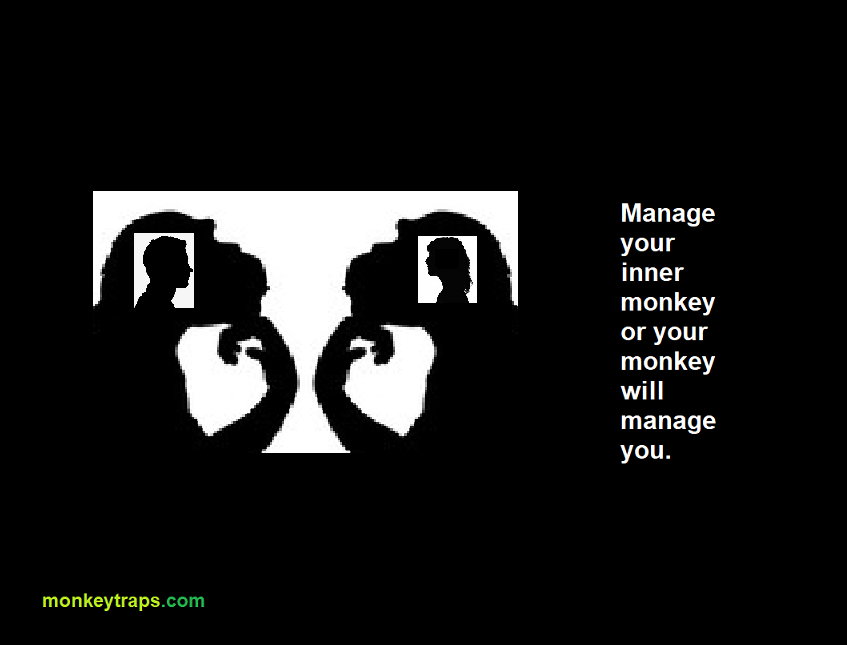
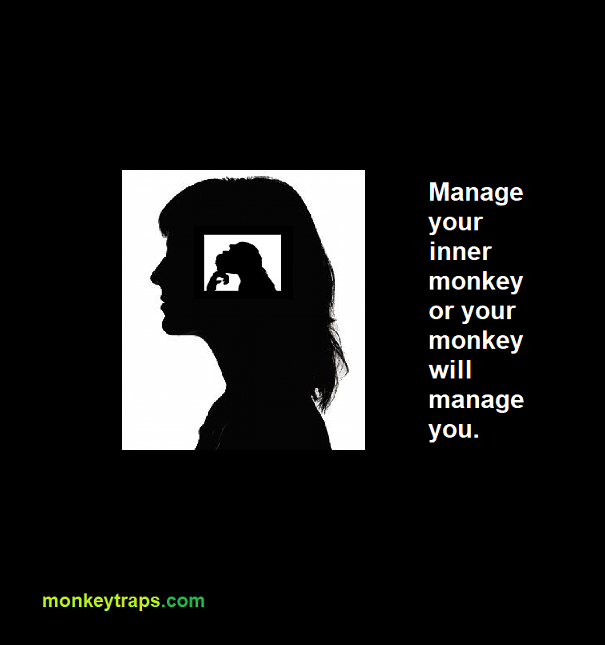
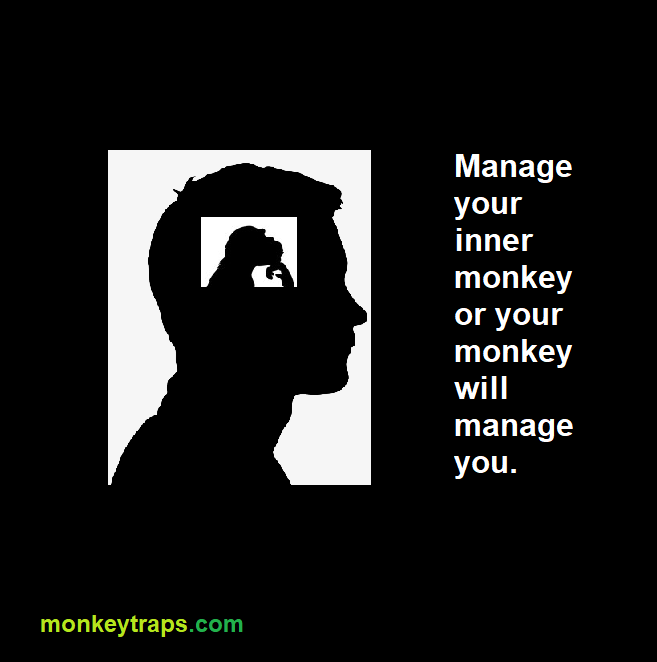
* Monkeymind is a Buddhist metaphor that describes how normal human consciousness operates.
Our minds jump from thought to thought, feeling to feeling, like a monkey leaping from tree to tree to tree.
Unsettled, restless, never content with the present moment, they are constantly distracted by the endless stream of internal chatter passing through.
This is universal.
But there are two important things to remember about monkeymind:
(Continued tomorrow.)
1 Comment | posted in control
* The greatest stumbling block to true communication is the tendency to play “lawyer.”
In an argument with someone close to you, as soon as you begin to recognize your desire to fix the blame (“I’m right, he’s wrong, I must prove it to him”) you are headed for further frustration.
You cannot handle intimate human relations from the legal angle.
By the time the two of you are ready for courtroom-type arbitration your relationship has already dangerously deteriorated.
~ Muriel Schiffman *
Leave a comment | posted in control
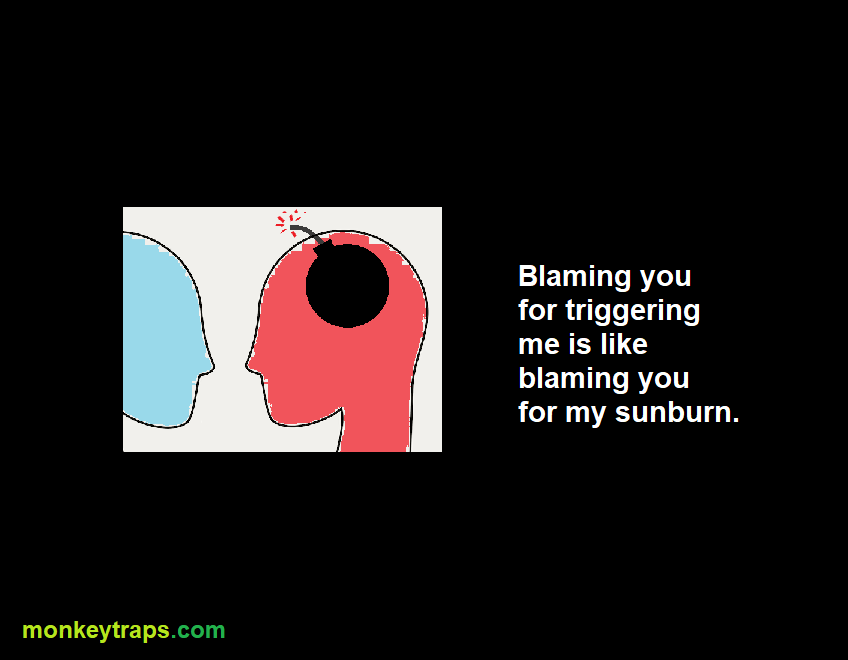
* Blame is the world’s greatest excuse. It enables us to remain limited and small without feeling guilty. But there is a cost — the loss of our freedom. Also, the role of victim brings with it a self-perception of weakness, vulnerability and helplessness…. *
The first step out of blame is to see that we are choosing to blame. ~ David R. Hawkins
xx
xxxxx
Leave a comment | posted in control
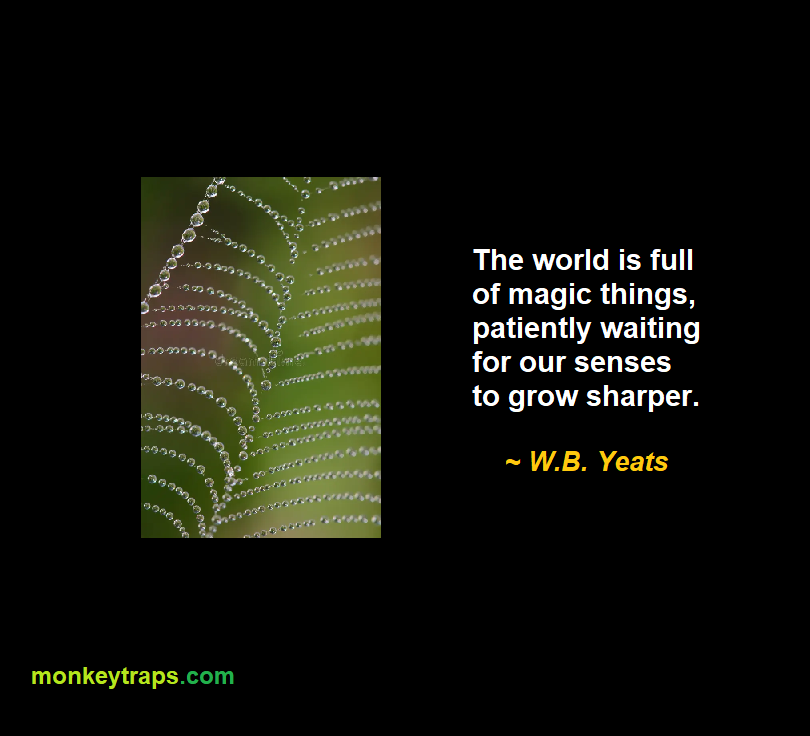
. Most of us lose our ability to observe the world directly along with our roller skates and baseball gloves.
The older we grow, the harder it gets to see our surroundings in detail.
This has less to do with declining eyesight than with the security zone so many of us create to protect ourselves from surprises.
The ability to muffle anxiety feels like a perk of adulthood.
We cut a Faustian deal: in return for not being so anxious all the time, we agree to tune down our whole nervous system.
As a result, our powers of observation decline along with our sense of smell, taste, and hearing.
~ Ralph Keyes .
4 Comments | posted in control
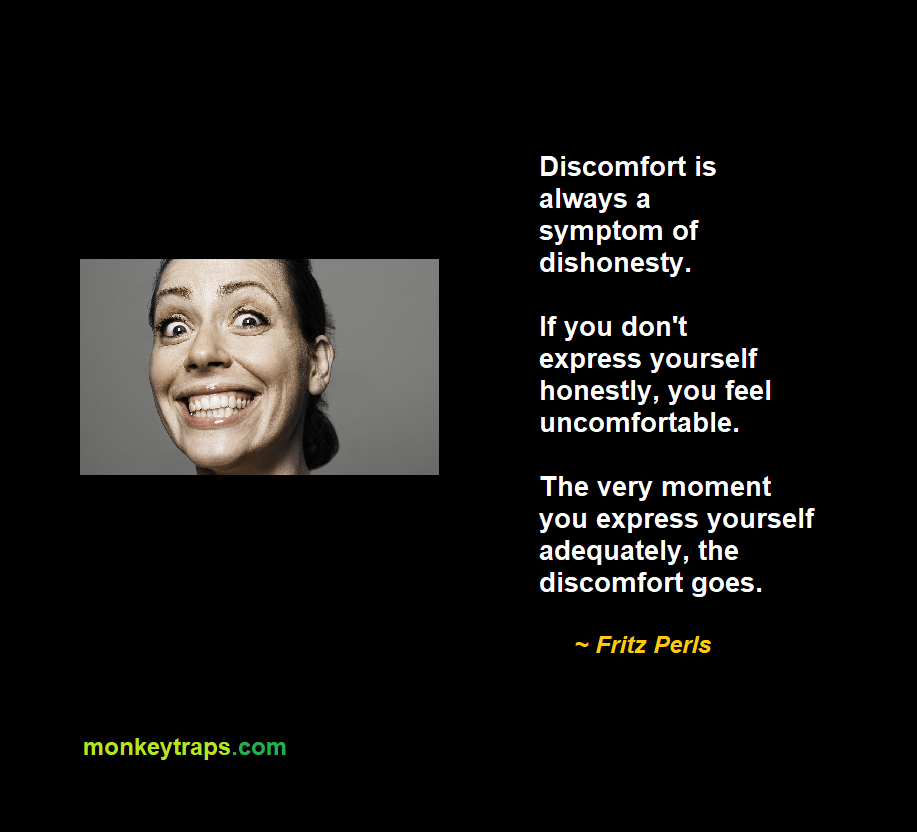
. When feelings are denied or kept inside there is typically a buildup of physical tension.
When that tension is not released, an internal pressure builds up.
An accumulation of such pressure leads to anxiety, due to fears of losing control emotionally.
That condition also triggers anxiety because of its physiological similarity to the fight/flight response, which is normally associated with danger.
Thus our personality creates a paradox in which we deny feelings to prevent anxiety but experience anxiety when we deny our feelings.
~ Paul Foxman .
1 Comment | posted in control
* We’re not born constipated. We’re born healthy little animals, able to trust what our bodies tell us and automatically expel waste products. Then in childhood we begin hearing messages like Quiet down and Big boys don’t cry or Don’t cry or I’ll give you something to cry about. Surrounded by giants on whom we depend for food, shelter, love and security, we have no choice but to follow such instructions. Voila. Constipation. ~ Steve Hauptman, Shit *
3 Comments | posted in control
.
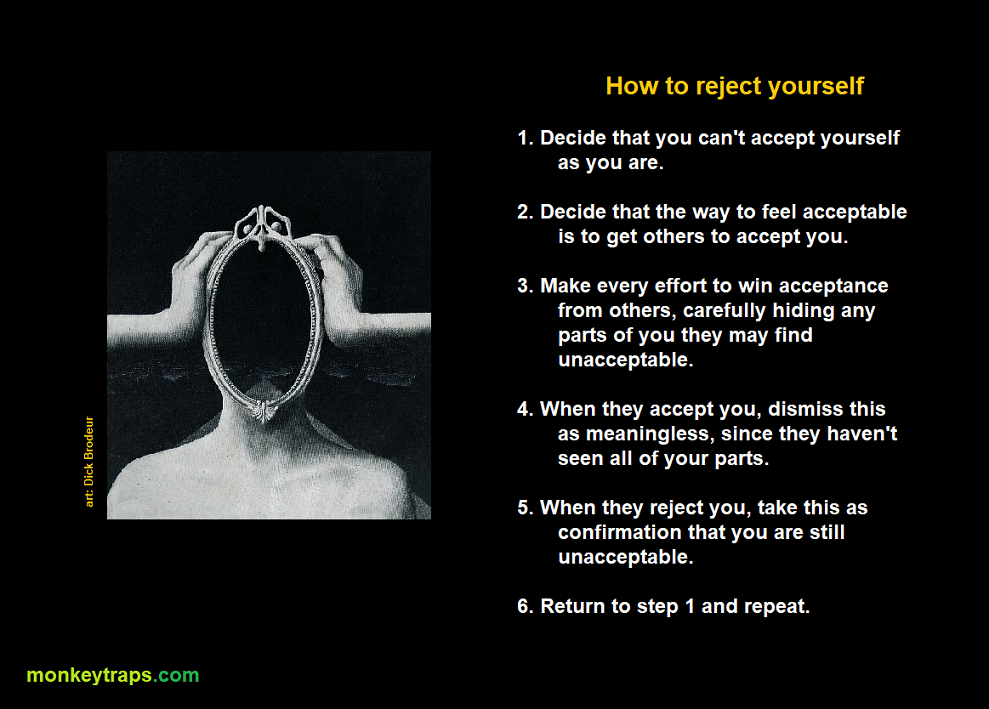
The curious paradox is that when I accept myself as I am, then I change…. We cannot change, we cannot move away from what we are, until we thoroughly accept what we are. Then change seems to come about almost unnoticed. ~ Carl Rogers .
2 Comments | posted in control
. The more you are like the others, the more secure you will feel, yet the more your heart will ache, the more dreams will be troubled and the more your soul will slip off into silences. ~ James Hollis .
Leave a comment | posted in codependency , compulsive controlling , control
. The biggest mistake I made was
to believe that I could graduate
from the school of life by skipping
all the self-knowledge classes. ~ Valeria Teles .
Leave a comment | posted in control
. Yes, we are indeed formed
by traumas that happen to us.
But then you must take charge,
you must take over,
you are responsible.
~ Camille Paglia
Leave a comment | posted in control

 xx
xxxxx
xx
xxxxx