
(Continued from “About hidden agony.”)
.
The person in the grip of an
old distress says things that
aren’t pertinent, does things
that don’t work, fails to cope
with the situation, and
endures terrible feelings that
have nothing to do
with the present.
~ Harvey Jackins*
.
Of course a therapist can only guess
whether his client received inadequate
attunement from their mothers.
.
But it is not unusual for me to meet
people who make me suspect that
might have be the case.
.
They tend to be people who seem
forever at war with their feelings.
.
Like Alan, a quiet man whose marriage
is failing because he’s so disconnected
emotionally, who works all day and
then goes home to pore over paperwork
at his kitchen table, who is so turned
inward that he can barely sustain a
conversation in session, and whose
frustrated wife complains that “even
when he’s there he’s not there.”
.
Or Bonnie, a chronic people pleaser
who always looks tired, and seems
surrounded by people who discount
or abuse her, and who worries
constantly about falling back into
the suicidal depression which
overwhelmed her twenty years ago.
.
Or Caroline, an attractive and
educated woman who keeps drifting
into relationships with emotionally
unavailable men, who spends months
trying to get them to love her, then
blames each realtionship failure
not on the man but on her own
unloveability.
.
Or Dustin, a recovering alcoholic
stuck in a ten-year affair with a
married woman who gives him
less and less time and attention,
but whom he refuses to leave
because “she’s the only woman
who’s ever made me feel like
someone loved me.”
.
Harvey Jackins’ phrase —
endures terrible feelings that
have nothing to do with the
present — perfectly describes
each of these people.
.
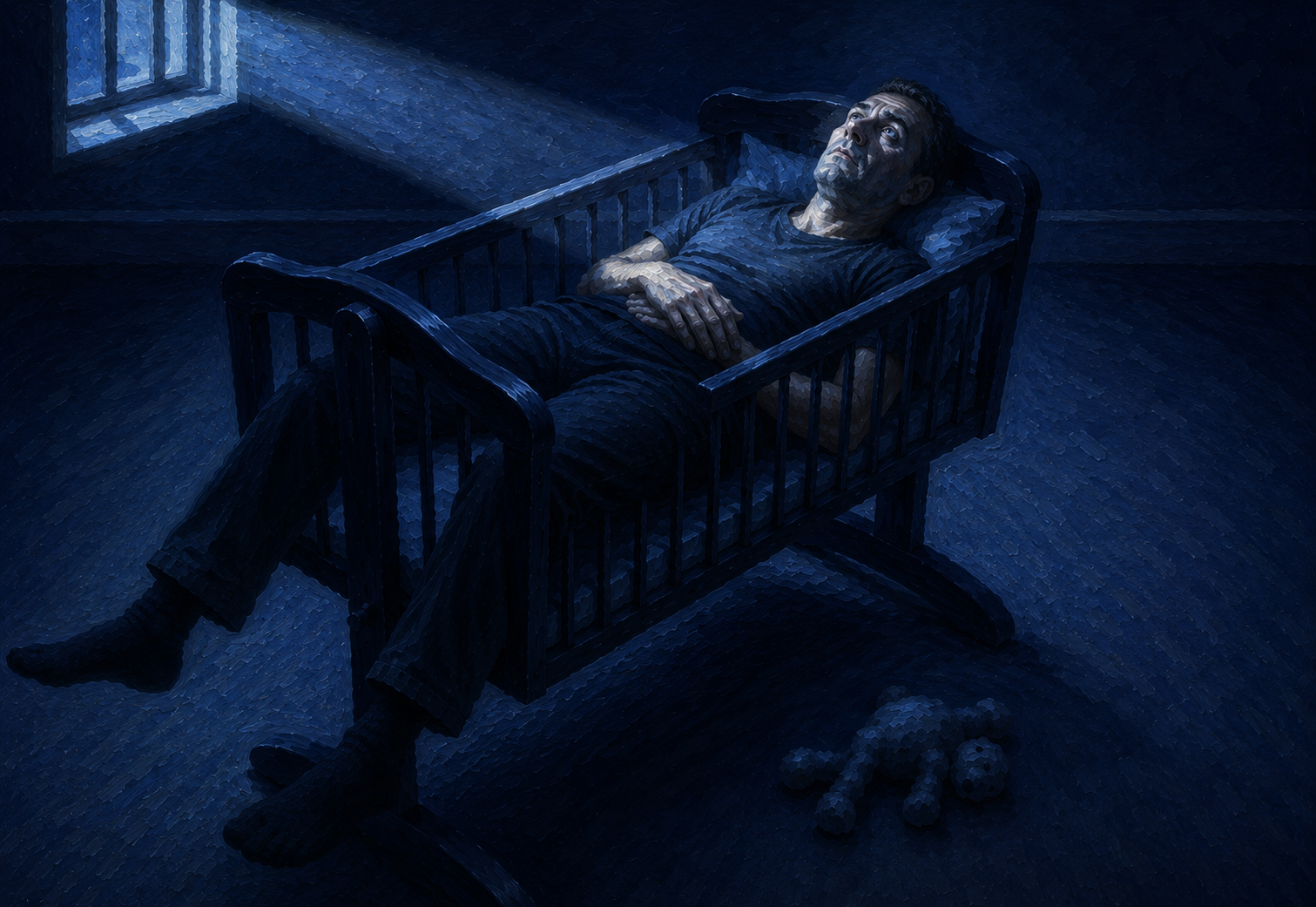
Each is trapped in what I call
the Kid Trance: an emotional life
dominated by how they felt
when they were helpless children.
.
The Trance is an awful place to live.
.
Its defining characteristic is a
tendency to perceive ourselves, and
treat ourselves, as we were perceived
and treated by our parents.
.
If they judged or abused or neglected
us, we judge or abuse or neglect
ourselves.
.
And if our parents had no clue about
how to deal with difficult feelings,
we too are left essentially clueless.
.
What do we do then?
.
We retreat into the ways of coping
we discovered as kids.
.
We may disconnect and distract
ourselves from our feelings, like Alan.
Or exhaust ourselves trying to win
love and emotional feeding, like
Bonnie and Caroline. Or cling
desperately to someone we hope
will meet our emotional needs,
like Dustin.
.
All this keeps our agony alive.
.
“Trauma is a basic fact of life,”
writes Mark Epstein.
.
It is not just an occasional thing
that happens to some people;
it is there all the time. Things
are always slipping away….
The healthy attachment of a
baby to a “good-enough” parent
facilitates a comfort with emotional
experience that makes the
challenges of adult life
and adult intimacy less
intimidating.**
.
But for the agonized adult who never
experienced healthy attunement with
a good-enough mom, healing must
come from one of the scariest
challenges of adult life: adult
relationship.
.
More specifically, intimate relationship,
defined as one where we can be ourselves
without shame or fear, and allow our
partner to do the same with us.
.
While the experience of adult intimacy
can’t erase an unattuned childhood, it
can, more than anything else, reduce
agony. It can become a life jacket to
keep us afloat, a safe harbor to which
we can retreat from storms.
.
For agonizing adults it is often
difficult and scary to learn.
.
But without it we can’t help but feel
adrift, vulnerable to emotional waves
that threaten to drown us, “traumatizing
us again and again as we find ourselves
enacting a pain we do not understand.”**
________________________
*Harvey Jackins is quoted by John Bradshaw, in Homecoming: Reclaiming and championing your inner child. New York: Bantam, 1990.
**Mark Epstein. The trauma of everyday life. New York: Penguin, 2013.
* * *
Buy here.





Leave a Reply