This entry was posted on Saturday, December 6th, 2014 at 11:18 am and posted in control. You can follow any responses to this entry through the RSS 2.0 feed.
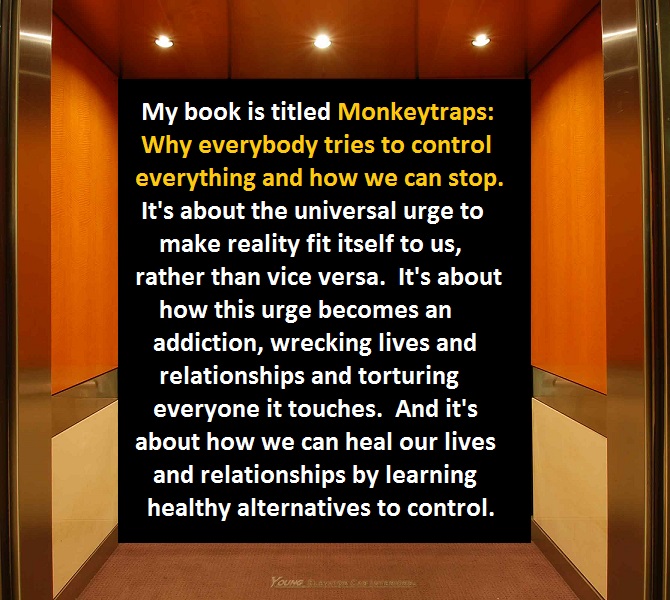
Overall, as a long time blog reader, I get it and like it. But the wording needs tweaking. I’m not sure that “the universal age” makes sense. Is it supposed to be “the universal urge”?
There’s also a typo in your last sentence – alternatives is missing its ‘a’.
Waiting with bated breath for your book to be released. I love the idea of control being explained in depth, admitting the simplicity of it, and discovering solutions not only to help my clients but for my benefit as well. Please give me advance notice of publication so that I can order presently?
The book will start appearing in serialized form right here at monkeytraps.com just after New Year’s.
I expect to post roughly 50 to 75% of it online for free, at the rate three or four short chapters each week.
And I’ll be asking for feedback from you guys along the way.
This will continue into the spring, at which point I’ll release the whole book for sale.
Not sure what form that will take, probably as an ebook.
Though if some publisher takes an interest I’d love to put it out as a physical book. (You know, with pages you can dog-ear and scribble on.)
Thanks for the encouragement, twelter. 🙂
Steve, looks like you have a great start to your book! To provide practical yet compassionate strategies for addressing different issues and “controls” impact on people’s lives.
Do you think the majority of your current readers have seen or are seeing counselors/therapists? If yes, but you would like to reach other readers; you may have to focus your strategies 2-fold: to a “seasoned consumer of counseling” and those who are thinking of “reaching out to a counselor”. i don’t know, just a thought . . .
No, I hadn’t thought of developing a twofold promotional strategy. That’s probably because I frequently see “seasoned” consumers in my practice (some have been around the block many times) and they require essentially the same introduction to my view of things as do neophytes. And that’s because my control theory is essentially a new one. Though it borrows from several different views of psychopathology (psychoanalytic, cognitive-behavioral, Gestalt, 12-Step, etc.) with which clients may be familiar, it combines them in a such a way that every client starts at square one — with, for example, a new definition of both the idea and the importance of control. I’m a fairly seasoned consumer myself, and I’d never heard most of this stuff before I came up with it.
Your brief has left me waiting for more, so it works! Like all the other crumbs you gave left about it ……I like the build up too…!
I would prefer a physical book so I can customise it’s! Let’s hope a publisher is out there and willing!
😀
Al
Great work Steve, looking forward to your book – I’ve referred to your monkey traps many times with my clients- it’s concept is so simple yet amazingly effective.
I like it too and enjoy your blog posts. I am a holistic life coach and definitely resonate with your posts. I would change the wording too, but also realize that it is not the book, it is a speech, meant to be delivered orally to people.
Best wishes, congratulations, and THANK YOU for putting this out there for people. So needed!






December 6th, 2014 at 11:46 am
Overall, as a long time blog reader, I get it and like it. But the wording needs tweaking. I’m not sure that “the universal age” makes sense. Is it supposed to be “the universal urge”?
There’s also a typo in your last sentence – alternatives is missing its ‘a’.
December 6th, 2014 at 11:49 am
Thanks so much, Kirsti. I missed both of those mistakes.
Correcting them now.
December 6th, 2014 at 11:48 am
👍
December 6th, 2014 at 1:13 pm
Waiting with bated breath for your book to be released. I love the idea of control being explained in depth, admitting the simplicity of it, and discovering solutions not only to help my clients but for my benefit as well. Please give me advance notice of publication so that I can order presently?
December 6th, 2014 at 1:26 pm
The book will start appearing in serialized form right here at monkeytraps.com just after New Year’s.
I expect to post roughly 50 to 75% of it online for free, at the rate three or four short chapters each week.
And I’ll be asking for feedback from you guys along the way.
This will continue into the spring, at which point I’ll release the whole book for sale.
Not sure what form that will take, probably as an ebook.
Though if some publisher takes an interest I’d love to put it out as a physical book. (You know, with pages you can dog-ear and scribble on.)
Thanks for the encouragement, twelter. 🙂
December 6th, 2014 at 8:47 pm
Steve, looks like you have a great start to your book! To provide practical yet compassionate strategies for addressing different issues and “controls” impact on people’s lives.
Do you think the majority of your current readers have seen or are seeing counselors/therapists? If yes, but you would like to reach other readers; you may have to focus your strategies 2-fold: to a “seasoned consumer of counseling” and those who are thinking of “reaching out to a counselor”. i don’t know, just a thought . . .
December 7th, 2014 at 3:37 am
No, I hadn’t thought of developing a twofold promotional strategy. That’s probably because I frequently see “seasoned” consumers in my practice (some have been around the block many times) and they require essentially the same introduction to my view of things as do neophytes. And that’s because my control theory is essentially a new one. Though it borrows from several different views of psychopathology (psychoanalytic, cognitive-behavioral, Gestalt, 12-Step, etc.) with which clients may be familiar, it combines them in a such a way that every client starts at square one — with, for example, a new definition of both the idea and the importance of control. I’m a fairly seasoned consumer myself, and I’d never heard most of this stuff before I came up with it.
December 7th, 2014 at 9:09 am
Your comment answered my question and was very thorough. I’ve been pumped about your blogs and now your book.
December 7th, 2014 at 2:38 am
Your brief has left me waiting for more, so it works! Like all the other crumbs you gave left about it ……I like the build up too…!
I would prefer a physical book so I can customise it’s! Let’s hope a publisher is out there and willing!
😀
Al
December 7th, 2014 at 6:42 am
Great work Steve, looking forward to your book – I’ve referred to your monkey traps many times with my clients- it’s concept is so simple yet amazingly effective.
December 8th, 2014 at 12:31 am
Nice to hear. Thanks. 🙂
December 7th, 2014 at 10:03 pm
I like it too and enjoy your blog posts. I am a holistic life coach and definitely resonate with your posts. I would change the wording too, but also realize that it is not the book, it is a speech, meant to be delivered orally to people.
Best wishes, congratulations, and THANK YOU for putting this out there for people. So needed!
December 8th, 2014 at 12:30 am
Thanks, Amanda.
Just curious: What wording would you change?