September 23, 2016
What we talk about when we talk about control (part 1): Inside, outside
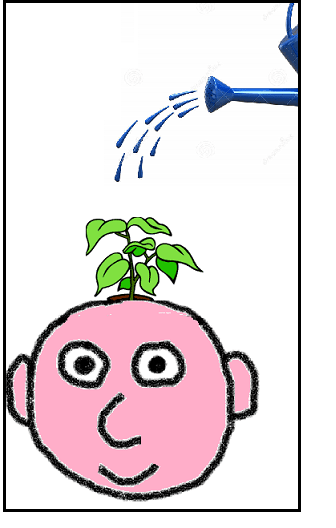 Once upon a time the elderly residents of a nursing home were divided into two groups.
Group A was given houseplants and told to decide where to place the plants in their rooms and when and how much to water them. Group B was given houseplants and told the nursing staff would care for them.
Eighteen months later researchers compared the groups and found the plant-tending Group A members to be healthier, more cheerful, more active and more alert. They also found that less than half as many A group members had died.
Citing this study as evidence of the importance of control, its author later wrote,
Perceiving control apparently is crucial not only to one’s psychological well-being but to one’s physical health as well.
The belief in personal control may be essential to one’s sense of competence and is basic to human functioning.
When one’s belief in control is threatened, the result is severely incapacitating.
All this came to mind the other day while I was explaining the idea of control addiction to a new client named George.
“Addiction?” George frowned. “That makes no sense. Addiction’s a sickness. You have to give up an addiction to be healthy. But control is a necessity. You can’t live without control.”
George’s wife Alice is alcoholic. And like most spouses of addicts, he suffers from what might be called boundary confusion. He’s not sure where his life ends and hers begins.
When Alice has a bad day, so does George. He’s concluded that to protect himself he has no choice but to try to control Alice’s addiction and its consequences. So he begs her to stop drinking, threatens divorce, hides her booze, lies to her boss about why she missed work, lies to their kids about why she passed out on the sofa, and so on.
He’s as addicted to controlling as Alice is to drinking.
But what George said makes sense, right? Isn’t control a necessity? Doesn’t the nursing home study prove that?
Not really.
Notice what Langer actually wrote:
Perceiving control apparently is crucial….
The belief in personal control…
When one’s belief in control is threatened….
We’re talking here about two things, not one.
One outside, one inside.
Actual control, versus a sense of control.
They’re not the same thing, as I pointed out in a post I once wrote about power:
Imagine your rich uncle dies suddenly and leaves you control of his multinational corporation. You wake up one morning the CEO of Big Bux, Inc.
You go to your new job. You sit behind a huge desk. Four secretaries line up to do your bidding. You have tons of control. You can hire and fire, buy and sell, build plants or close them, approve product lines, mount advertising campaigns, manage investments, bribe congressmen, you name it.
How do you feel?
Actual control is what you’d have here. But a sense of control? I doubt it.
One is an objective reality, the other a subjective experience.
Actual control means the ability to dictate or transform external circumstances — make people, place and things behave as we like. A sense of control means feeling competent, grounded, secure and calm inside — in control of one’s internal state.
Put another way: actual control describes something we achieve out in the world, while sense of control describes something we achieve in our heads.
“So what?” you ask. “Why is this distinction important?”
Because actual control and sense of control are achieved by quite different methods.
Because chasing one makes you healthy, while chasing the other makes you sick.
And because one’s a lot easier to come by than the other.
Next:
A sense of control
*






September 24th, 2016 at 4:20 pm
So true. I’ve come to know the [so sad!] truth that I virtually have no control–over anything, but am happy to have an illusion of control!
September 25th, 2016 at 10:47 am
[…] my last post I set out to explain the difference between actual control and a sense of […]
September 25th, 2016 at 10:50 am
[…] my last post I set out to explain the difference between actual control and a sense of […]
September 29th, 2016 at 12:08 pm
[…] At the start of this series you told that story about seniors and house plants, and said having a sense of control is essential to both mental […]
September 29th, 2016 at 12:11 pm
[…] At the start of this series you told that story about seniors and house plants, and said having a sense of control is essential to both mental […]