The adjusted American enters [a] hall of distorting mirrors in childhood.
It is not merely that he fails to learn techniques for achieving self-acceptance; he is virtually forced to find himself unacceptable.
The image of an acceptable person which the child learns in the typical middle-class American home is a fraud. It is not and can never be in the image of any existing person. Rather, the image is a figment of middle-class properties in its general outlines and the specific self-deceptions of parents in its details.
The typical middle-class American child learns that an “acceptable” child would not do, or even want to do, certain things. Hurting the baby, biting his mother, playing with excrement, playing with his genitals, playing with his playmates’ genitals — there are a great many things which he is taught are shameful even to think about doing. Yet inevitably he does think about doing such things and…may do them at times. He could have learned that is is not unusual to feel like doing such things, but that in the family — and society — of which he is a member, such things are simply not the custom. Instead he is led to believe that his “nasty” inclinations set him apart from other people as a “dirty” boy.
As he grows older he is taught to believe that a “good” child…would not resent his parents considering all they have done for him and how much they love him Yet the dynamics of childhood are such that any child must inevitably feel a certain amount of resentment toward his parents…. Thus a vicious syllogism is established: only evil children ever hate their parents; sometimes I hate my parents; therefore I am an evil child…..
In short, the child is presented with a phony image of an “acceptable child,” less as a model than as a point of invidious comparison. No one ever seriously thought he could measure up to it, yet somehow he is condemned because he does not.
…By the time a youth has been transformed into an adult, his thirst for approval seems insatiable.
But to borrow a phrase from Hoffer, he can never have enough of that which he really does not need.
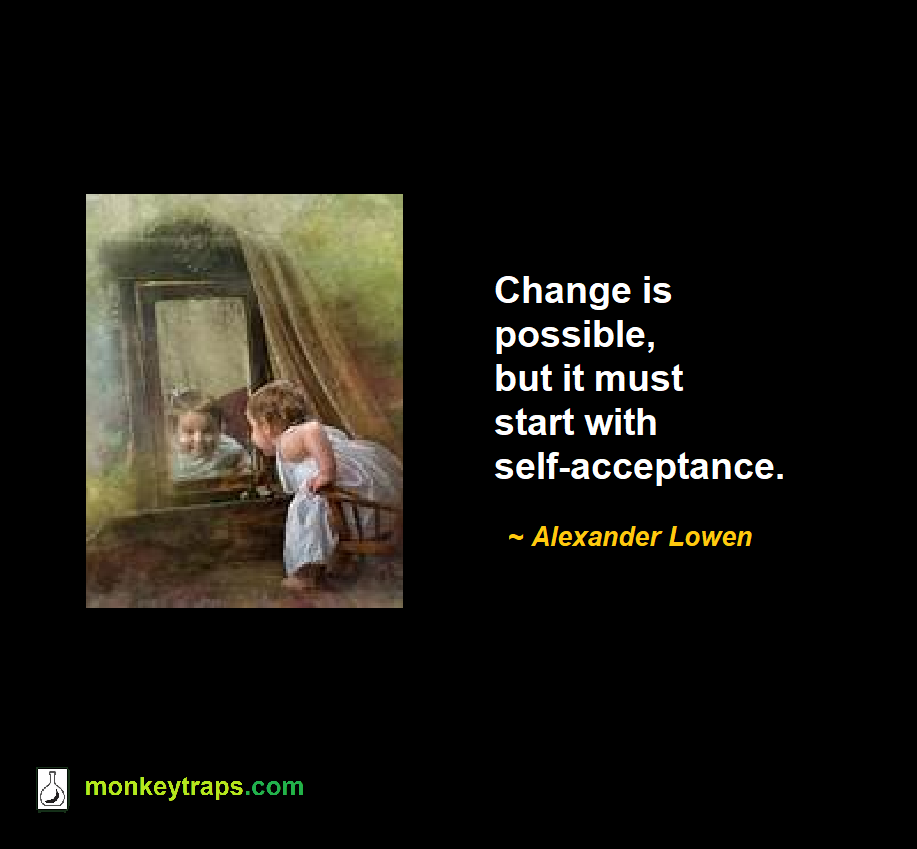
He needs self-acceptance, and however much of his talent, energy, and possessions are committed to the struggle to win approval from others, self-acceptance cannot be achieved thereby.
This entry was posted on Wednesday, November 15th, 2023 at 9:08 am and posted in control. You can follow any responses to this entry through the RSS 2.0 feed.






November 15th, 2023 at 4:29 pm
Steve, Many thanks for these wonderful daily posts of information and inspiration to help us all heal, gratefully yours!
November 15th, 2023 at 5:02 pm
Thank you, Sharon. 😊
Stick around for the next book, which I’ll be serializing here soon.