Author Archives: Steve Hauptman
![[9] 121. Control is a teddy bear FINALll](https://monkeytraps.com/wp-content/uploads/2014/03/9-121-control-is-a-teddy-bear-finalll.jpg)
Dandelion fights
They fight on my sofa.
The themes are familiar. He never listens to me. She won’t stop trying to control me.
Thirty minutes, this goes on.
Finally she breaks down and sobs, and he stares angrily off into space.
“Do you guys have a lawn?” I ask.
Betty wipes her eyes, looks at me. Bob, suspecting I’m crazy, frowns.
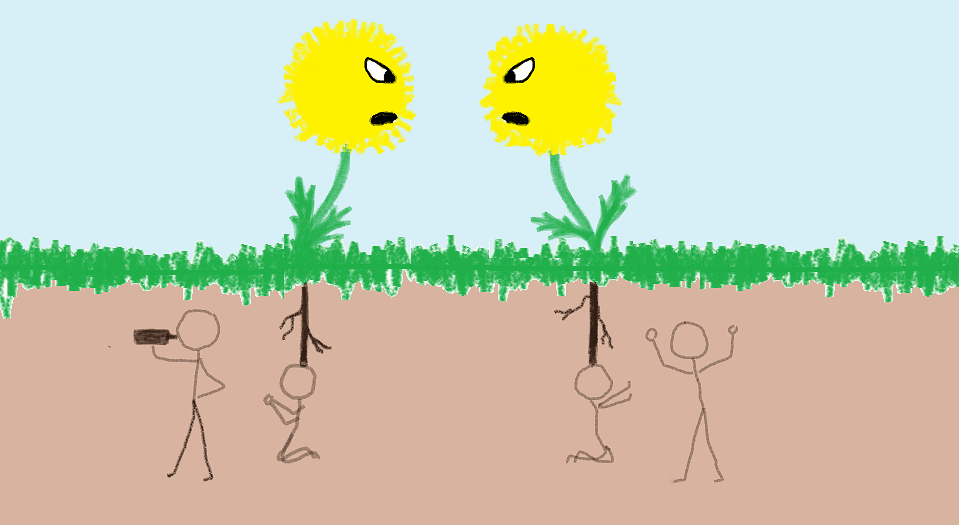
“With dandelions on it?” I continue. “What happens when you mow dandelions? Right. They come up again tomorrow. Because to remove a dandelion you have to dig up the root.
“This is a dandelion fight,” I say. “You keep having it for the same reason you can’t mow dandelions away. You’re not getting to the root.”
“What root?” Bob asks.
“Two roots, actually. One’s emotional: how you feel right now. You guys never talk about that. Betty, what are you feeling right now?”
She sniffles. “Like he doesn’t love me at all.”
“Bob?”
“Like a worthless piece of shit.”
They look at each other in surprise.
But I plow on. “The other root is transference. What’s familiar here? What does this fight remind you of? What other relationship? When have you felt like this before?”
I already know the answers. Betty’s dad was an alcoholic who ignored her. Bob’s mom was a narcissist who treated him like furniture.
“So that’s a dandelion fight. You keep having it because it never addresses what you’re really feeling inside, and where those feelings really come from.
“You’ll keep having it unless and until that changes.
“And if it doesn’t change – if you never find a way to get at the roots — there’s a danger these fights will develop into something nobody ever wants.”
“What?” Betty asks.
“A dandelion war.”
Spiral
She’s a new client, looking around my office.
“I like your pictures,” she says. “But what’s that?”
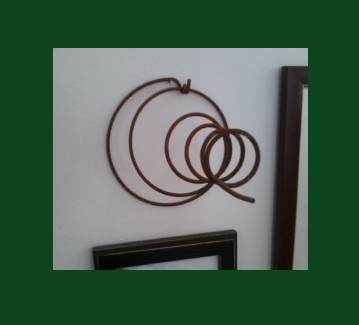
She points to the rusty bedspring on my wall.
“A metaphor,” I say.
“For what?”
“Recovery. It’s the recovery spiral.”
“I don’t understand.”
“Most people think of recovery as a linear process. They think you start off down here, at All fucked up, and 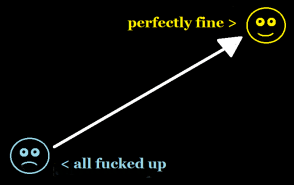 climb straight up to there, Perfectly fine.
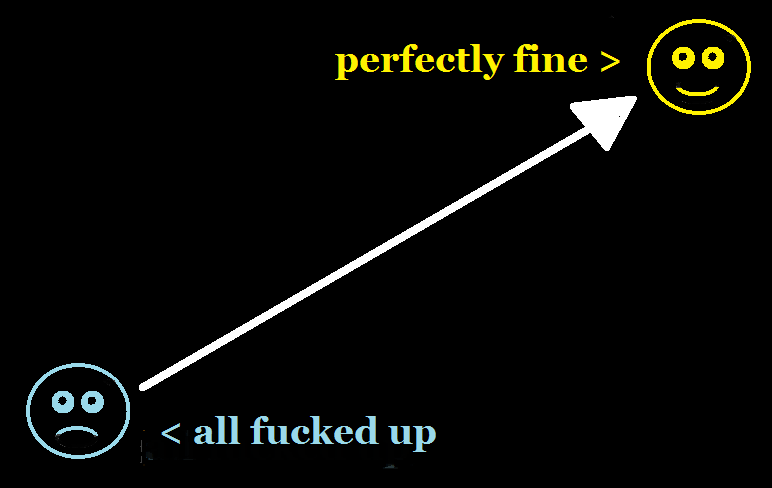
“They think there’s a straight line between those two points, and that any deviation from that line – relapses, setbacks, mistakes — means some kind of failure.”
“Doesn’t it?”
I shake my head. “Not if you see recovery as a spiral.”
“Emotional growth means moving in a circle. The points of the circle are the issues or problems we’re working on — parents, money, work, sex, feelings, communication, control, whatever. And you go around and around the same circle, facing the same issues over and over.
“But each time you go around you’re a bit higher on the spiral. Meaning you know a bit more than the last time around. And you’re a little bit stronger. And you have more resources, both inside you and outside.
“And that’s recovery.
“If you’re lucky, there’s no end to it until you die. There’s no There there, no Perfectly fine end point. Just learning and growing as long as you live.
“So when someone comes to me all discouraged and says Oh god, I fucked up or I’m so embarrassed that I’m still struggling with this I show them the spiral and explain what it means.
“And then I ask, ‘What do you know now that you didn’t know last time you were here?’
“And they can usually find something. And then they can think of their relapse as a lesson, not a failure.”
She frowns, looking at my wall.
“Where can I get a rusty bedspring?”
Bottled
![UNPUB -- 189. Feelings will stay bottled up [D]](https://monkeytraps.com/wp-content/uploads/2014/03/unpub-189-feelings-will-stay-bottled-up-d.jpg?w=490&h=233) xxxxxxxx
xxxxxxxx
![UNPUB -- 189. Feelings will stay bottled up [D]](https://monkeytraps.com/wp-content/uploads/2014/03/unpub-189-feelings-will-stay-bottled-up-d.jpg)
xxxxxxxxx
Think of feelings as energy.
Hold them inside, and they build in intensity.
Hold them in long enough, and eventually they reach a sort of critical mass.
At that point two things can happen.
One is explosion – an unregulated discharge in the form of yelling, or crying, or violence.
Explosion relieves the pressure, but tends to leave you feeling out of control, embarrassed, even frightened. (It’s also frightening to people around you.) Which leads to a new round of holding-in, buildup, and explosion.
Not a great solution.
The other option is implosion. Successfully contained emotional energy turns against the container. The result is discomfort, both emotional (irritability, anxiety, moodiness, depression) and physical (fatigue, indigestion, headaches, muscular tension, and vulnerability to a host of physical ailments).
The more successfully you avoid feelings, the more likely you’ll develop symptoms that have no apparent cause.
Think of these symptoms as a message from your body:
Help.
Please listen.
Because feelings will stay bottled up for just so long.
Apple v. tree
*
*
One reader writes,
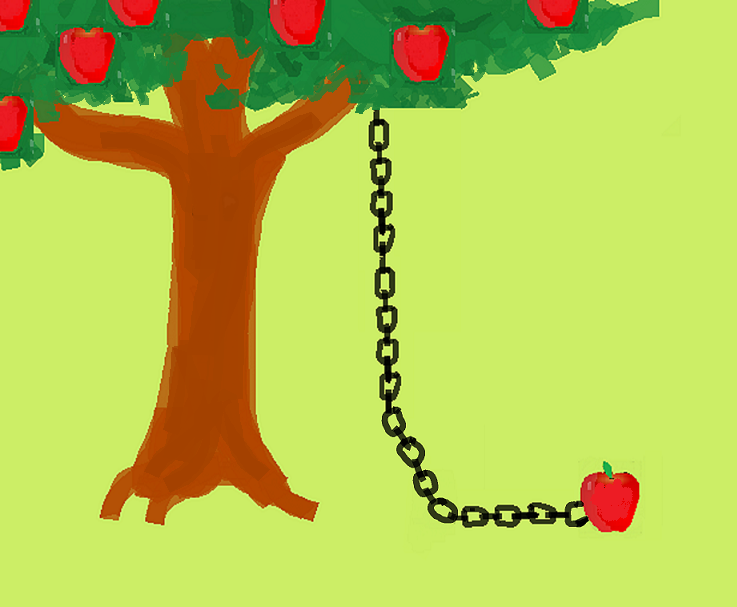
Thirty years I worked in the business my dad left me, building it up for my son. Now I want to retire and my son wants to do something else. What the hell have I been working for? He’s also engaged to a girl I don’t like. Whatever happened to family values?
My reply:
I don’t know you or your son. But I work with lots of families, and this sort of question comes up often. So I’ll answer from that context and you decide if my answer is relevant.
I think a healthy family is one in which all members can get their needs met — not always, maybe, but most of the time.
I think any family that requires a member to sacrifice himself or herself to the needs of the family is unhealthy.
I think some families (they’re called narcissistic families) are set up unconsciously to meet the needs of the parents, even at the expense of the children. And if one comes from such a family, that arrangement seems normal. Parents just expect kids to put their feelings and needs aside for Mom or Dad’s sake. It may even seem like love, or duty, or “family values.”
Personally and professionally, I see it as something else.
So I suspect you need to decide if that’s the sort of family you came from and are trying to recreate now. Sounds like that’s at least a possibility.
I should add that I think the parent’s job — like that of the teacher, doctor, or therapist — is to put himself out of a job. To raise a kid strong and healthy enough to separate, take care of himself, and not stay tied to the parent indefinitely.
If you stayed tied to your father until he died, you may see it differently.
But there’s a big difference between staying connected to your parent by choice and staying connected because the parent refuses to let you go.
Your children are not your children.
They are the sons and daughters of Life’s longing for itself.
They come through you but not from you,
And though they are with you, yet they belong not to you.
~ Kahlil Gibran
Black and white
***
Monday:
Jack slaps Jen.
Jen ends relationship.
“I can’t live this way,” she tells me.
Tuesday:
Jack apologizes.
Jen forgives him.
“I really do love him,” she tells me.
Wednesday:
Jack slaps Jen.
Jen ends relationship….
***
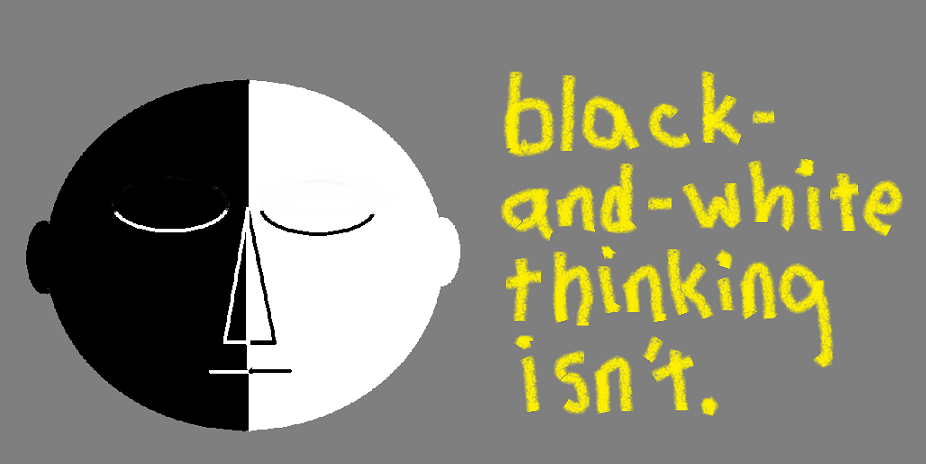
Black and white thinking is that habit of classifying things as either all one thing or all the other.
Kids learn it in dysfunctional families, where dangerous unpredictability prevails.
They learn to protect themselves by formulating rules to keep them out of trouble. Since they’re kids, the rules tend towards oversimplification. Never talk to dad when he’s drinking. Always leave the room when mom and dad fight. Never fail Math, because failure always earns you a beating. Like that.
Thus on Monday and Wednesday Jen’s relationship seems all bad to her, and on Tuesday it seems all good.
For kids this sort of classification (it’s not really thinking) may actually be functional, since it provides a rough road map through difficult situations.
But people who carry it into adulthood tend to find themselves handcuffed, psychologically and emotionally.
Unable to make thoughtful choices based on a variety of considerations — including their own needs, experience and instincts — they end up replaying old scenarios endlessly, swinging like a pendulum between two partial truths.
Therapy
* * *
She’s a new client, and clearly involuntary. She doesn’t want to be here, and doesn’t trust me, and it’s making me nervous.
“So,” she says. “What’s your job? As a therapist, I mean.”
No one’s ever asked me this before.
I know this, I think.
But no answer comes.
I feel like an idiot.
Then into my mind pops an image: of all things, the David. (Thank you, unconscious.) And suddenly I have my answer.
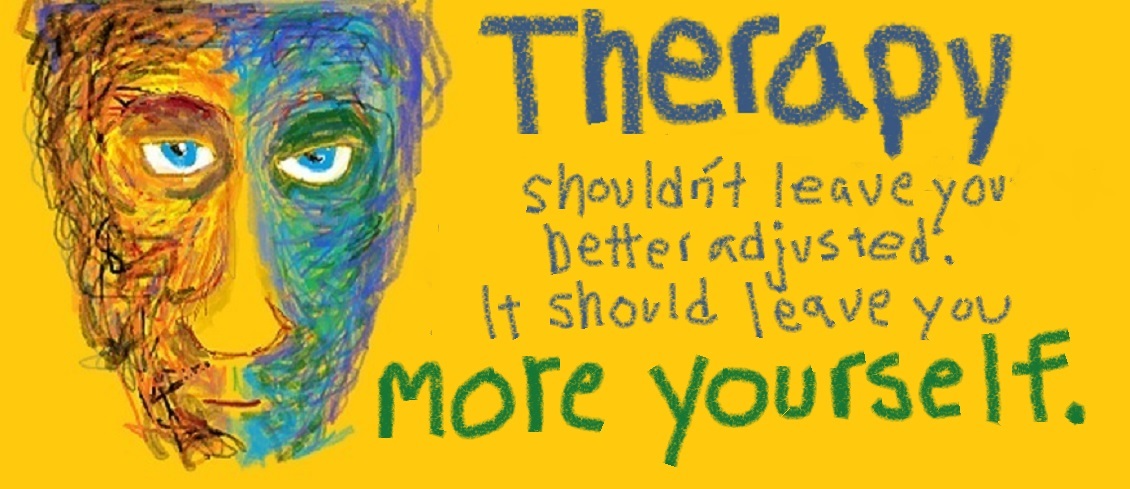
“It’s something like how Michelangelo described his job,” I said. “He said the job of the sculptor was to free the statue from the stone. That’s kind of what therapists do. Try to scrape away everything that isn’t the real person — fears, and defenses, and the lies we’re all taught — so the real person can come out. Something like that.”

Fear versus anxiety
![[24] 181. 95% of what we worry about [E]](https://monkeytraps.com/wp-content/uploads/2014/02/24-181-95-of-what-we-worry-about-e.jpg)
***
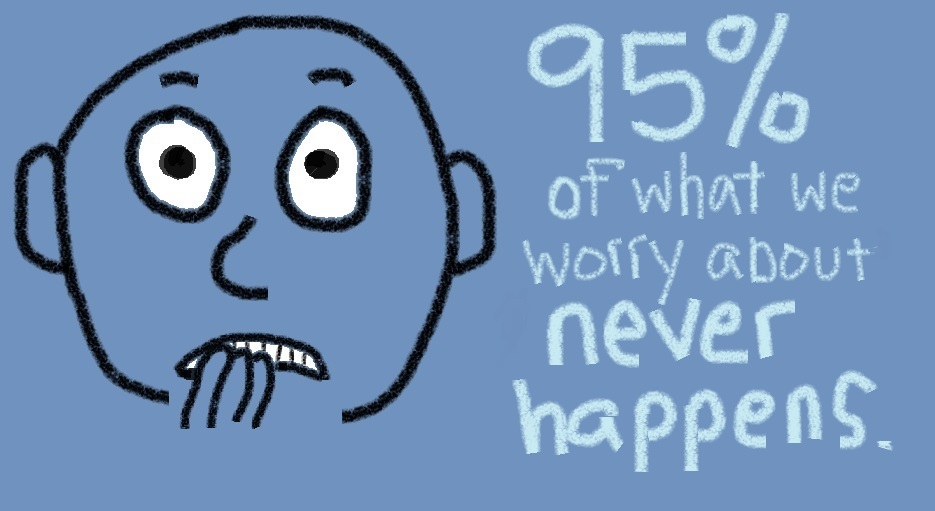
Why do we worry (endlessly, most of us) about stuff that never happens?
Because fear and anxiety are different things.
They feel the same, but they’re not.
Fear’s a reaction to real danger. Anxiety’s a reaction to danger we imagine.
Say you walk into a forest. A bear rushes out from the trees and growls at you.
What you’re feeling is fear.
He’s a real bear, and he could take a real bite out of you.
Now say you walk into a forest, and you look at the trees and think, “Wow, there could be bears in there.”
There speaks anxiety.
It’s a voice that issues from your big, oversized brain. The one that can’t stop remembering and anticipating and analyzing and scaring the shit out of you.
Such brains explain why we’re a race of endlessly, needlessly frightened creatures.
Good thing to remember.
Because there’s a big difference between fighting real bears and fighting those that lurk only in the forest of your mind.
* * *
Related:
“Background music: Control and anxiety”
https://monkeytraps.wordpress.com/2011/06/15/background-music-control-and-anxiety/
and
“Nuts”
https://monkeytraps.wordpress.com/2012/07/22/nuts/
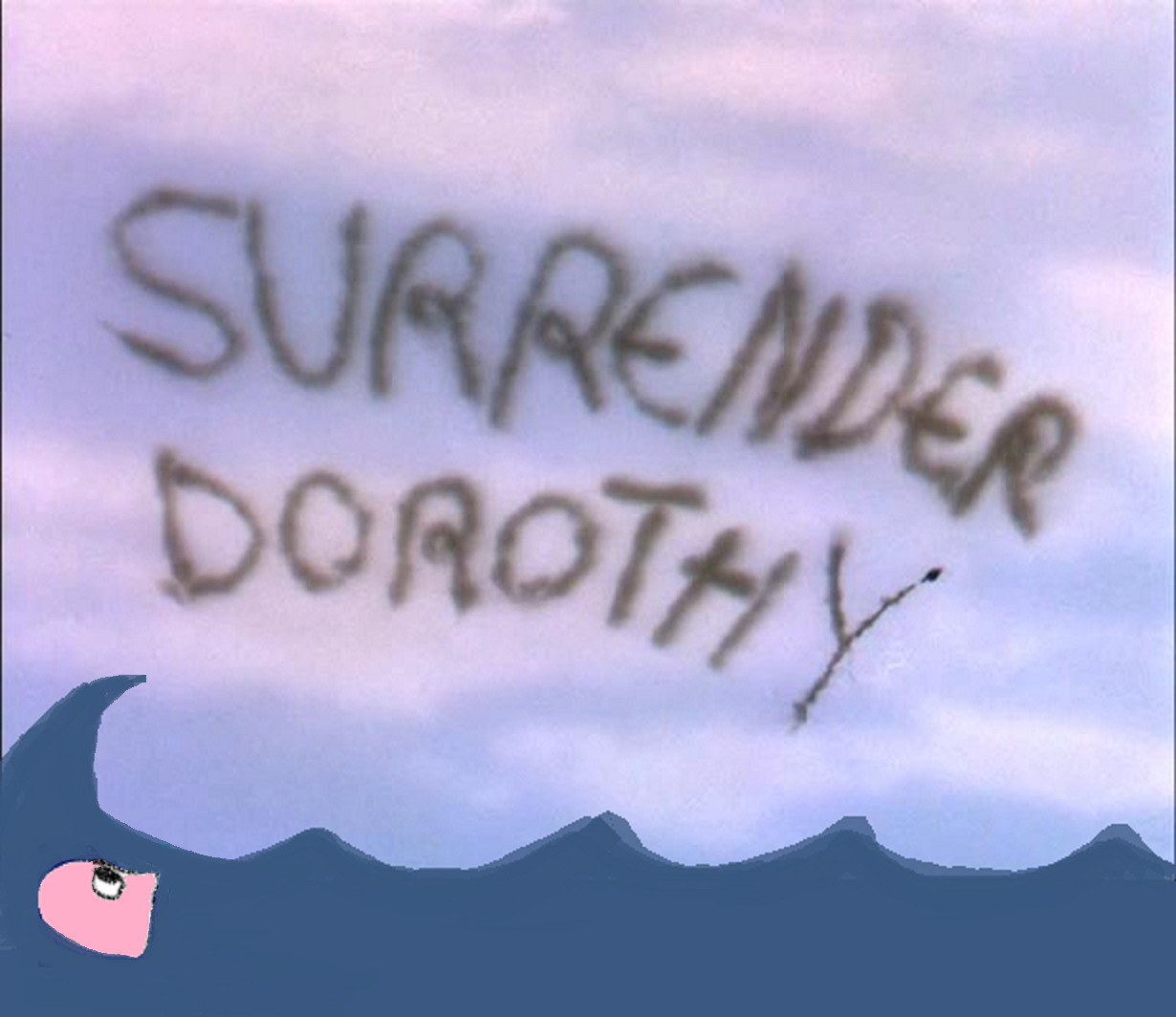
Surrender, Dorothy
*
So this former client moves to Florida, and one day, for the thrill of it, decides to go swimming in the dramatic heavy surf following Hurricane Wilma.
Almost immediately she finds herself sucked out to sea by the riptide. And she panics, and starts to swim harder towards the shore. And very quickly gets exhausted.
This is the end, she thinks.
Then another swimmer nearby calls to her: “Stop struggling. Just float.”
So she just floats.
Her strength returns. Eventually she’s able to make her way back to the blessed beach.
We live in a compulsive, can-do, must-do culture which encourages us to believe we should be in control constantly.
It also teaches us to think of surrender as a species of defeat, failure or weakness.
But sometimes surrender is the only intelligent response to life’s riptide.
Sometimes, surrender is the only way to save yourself.
Pain
![36. For those who are in pain [B]](https://monkeytraps.com/wp-content/uploads/2014/02/36-for-those-who-are-in-pain-b.jpg)
* * *
People see therapists for the same reason they visit dentists.
Their pain has gotten too bad to ignore.
Many leave after they get the relief they came for.
Some stay to learn something besides.
The lucky ones are changed by what they learn.
* * *
People who see pain as the enemy, I have noted, instinctively respond with vengeance or bitterness — Why me? I don’t deserve this! It’s not fair! — which has the vicious-circle effect of making their pain even worse.
“Think of pain as a speech your body is delivering about a subject of vital importance to you,” I tell my patients.
“From the very first twinge, pause and listen to the pain and, yes, try to be grateful.
“The body is using the language of pain because that’s the most effective way to get your attention.”
I call this approach “befriending” pain: to take what is ordinarily seen as an enemy and to disarm and then welcome it.
~ Paul Brand & Phillip Yancey, The gift of pain: Why we hurt and what we can do about it (1997).
*
James Joyce has a memorable line: “History is a nightmare from which I am trying to awake.”
And the way to awake from it is not to be afraid, and to recognize that all of this, as it is, is a manifestation of the horrendous power that is of all creation.
The ends of things are always painful.
But pain is part of there being a world at all.
~ Joseph Campbell, The power of myth (1988).
No clue
xxXXXX
* * *
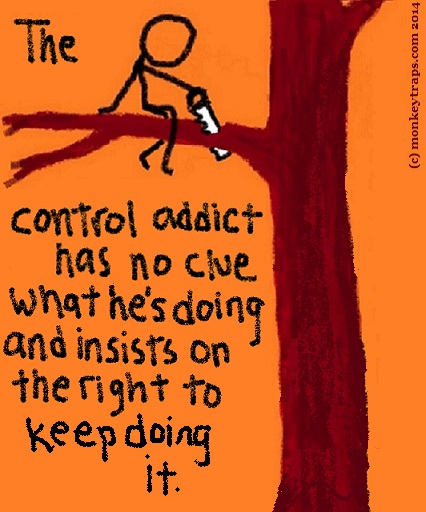
In the neurotic person we find invariably that he has not given up the narcissistic interpretation of reality.
He insists that reality must conform to his ideas, and when he recognizes that this is not so, he reacts either with the impulses to force reality to correspond to his wishes (that is, to do the impossible) or with a feeling of powerlessness because he cannot perform the impossible.
~ Erich Fromm, Zen Buddhism and psychoanalysis (1960).
* * *
[I]n order to manipulate others we become control-mad, power-mad — using all kinds of tricks. I gave you a few examples already — playing helpless, playing stupid, playing the tough guy, and so on.
And the most interesting thing about the control-mad people is that they always end up being controlled.
They build up, for instance, a time schedule that then takes over control, and they have to be at every place at a specific time from then on.
So the control-mad person is the first one to lose his freedom.
Instead of being in control, he has to strain and push all the time.
~ Frederick S. Perls, Gestalt therapy verbatim (1969).
* * *
When the only tool you have is a hammer, every problem starts to look like a nail.
~ Abraham Maslow

Yousage
If I’ve learned anything here
it’s that the minute I say You to my wife
it’s Game Over.
~ Craig
Craig belonged to one of my therapy groups, where I spend lots of time encouraging members to avoid You-statements.
You know what a You-statement is. You just read one. (Two, actually.)
It’s a statement someone makes to you about you.
They’re very popular.
We use them all the time. Especially in the heat of battle. As in “You’re wrong” or “You suck.”
But whenever we use them, they tend to be destructive.
They destroy honesty, trust and connection.
In an interpersonal relationship, reliance on You statements – or Yousage, for short – creates a subtle wall between us.
One reason is that to the listener, You feels like an intrusion or an attack. At yet at the same time it’s so common we barely notice it, even when it’s making us uncomfortable.
The biggest problem with Yousage, though, is that it’s inherently defensive.
That’s because when I talk about You I’m not talking about me. I’m directing our conversational attention away from my thoughts, my feelings, what I want. Yousage allows me to stay hidden. And hidden feels safer.
That’s why it’s so much easier to say “You jerk” than “I’m angry at you.” Or “You look terrific” instead of “I’m attracted to you.” Or “You gave an interesting talk” instead of “I had no fucking idea what you were talking about.”
Less vulnerable. Less honest.
Much Yousage occurs at the level of what Fritz Perls called chickenshit — clichéd small talk that avoids emotional contact (How are you?). But it can also be employed at the level of both bullshit (intentional dishonesty or manipulation) and elephantshit (verbal pretentiousness). See “Three types of shit,” below.
So. Say you decide you’d like to grow beyond Yousage. What’s the alternative?
Well, in group I teach one called feedback. It’s a form of communication that relies on I-statements — I think, I feel, I want. The most complete feedback follows the ABC format: When you (A), I feel (B), because (C). That covers all bases. But the one essential is the I-statement at its heart.
Which means it takes courage.
But the results can be startling. When people stop saying You and start saying I in the group room, the atmosphere changes noticeably. The energy level jumps. Suddenly everyone’s there, emotionally speaking, in a way people rarely are with each other. And then real therapy can happen.
But you don’t need a group to practice this. Just a desire to improve your communication with people to whom you’d like to feel closer.
First, try noticing how often you say You.
Then, try saying it less.
Try I instead.
* * *
According to Fritz Perls (1893–1970), founder of the Gestalt school of psychology, there are three kinds of shit you are likely to run into while talking with people:
(1) Chicken-shit is clichéd small talk, devoid of actual information content, small talk that avoids emotional contact.
(2) Bull-shit refer to out-and-out lies. All lies are told for one of three reasons: to conceal the truth and wrong-doing, to protect someone, and/or in order to gain (money, prestige, sex, etc.).
(3) Elephant-shit refers to grandiose plans that avoid confronting reality and responsibility. For example, telling people what you’ll do when you when the lottery
Chicken-shitters are fearful of human contact and often harbour secrets. Bull-shitters are opportunists. Elephant-shitters are full of plans that have no hope of ever coming true.
~ From “The three types of shit,” at http://isthisshit.com/
![23. Only connect [B]](https://monkeytraps.com/wp-content/uploads/2014/02/23-only-connect-b.jpg)
Silence with teeth

We’re in group, and Jesse’s crying.
“It’s more than I can take,” she says.
“What is?” I ask.
She wipes her eyes. “The silence in my marriage.”
The other four women nod. No explanation necessary, apparently.
“My husband does it all the time,” one nods.
“Does what?” I ask.
“Stops talking.”
“Mine too,” says another. “It’s how I know he’s angry about something.”
“Right?” says a third. “The angrier he is, the quieter he gets?”
Nods all around.
I ask my usual question: “How’s it make you feel?”
“Frustrated.”
“Furious.”
“Lost.”
“Desperate.”
“Like divorcing him,” one mutters.
Another turns to me.
“Why is that? Why does it bother us so much?”
I’m considering my answer when an image flits across my mind.
“There’s a famous psychology experiment,” I say, “in which a mother is placed in front of her infant and told not to respond to the baby in any way. No talking, no smiling, no facial expression at all. Just a blank stare.
“So she does that. At first the kid seems puzzled. Then uneasy. Then anxious. Then it gets desperate and starts to cry. Then it gets hysterical. The whole thing takes about a minute.”
“Meaning what?” someone asks.
“It’s about the child’s need for connection and reassurance. The infant depends on mom for survival, and so he’s exquisitely sensitive to how she feels towards him moment to moment. When she stops acting like she loves him, he panics. It’s an emotional earthquake.”
“So,” Jesse frowns, “you’re saying I’m like an infant.”
“No. You need a sense of connection, like the infant does.” I look around the circle. “You all do. You need to feel connected to your partner. Why else be married?
“And when your husbands fall silent, the connection feels broken.
“And if they do it regularly, you can’t help but get scared, just like the infant.
“And if it continues over time, well, you know. It chews away at you.”
“Like you said,” Jesse says, almost to herself. “Why be married?”
* * * *
The Still Face experiment:
http://www.youtube.com/watch?v=apzXGEbZht0
Steve & Bert

COMING SOON: An expanded 2nd edition

CLICK HERE TO ORDER MONKEYTRAPS (THE BOOK)

Follow the conversation:
-
-

-
-
BERT’S IN THERAPY. To listen in, click on his nose.