March 2, 2014
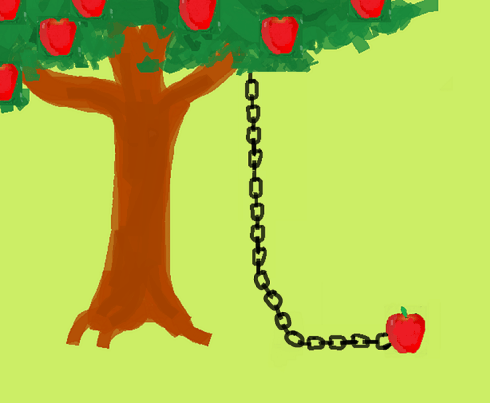
Apple v. tree
*
*
One reader writes,
Thirty years I worked in the business my dad left me, building it up for my son. Now I want to retire and my son wants to do something else. What the hell have I been working for? He’s also engaged to a girl I don’t like. Whatever happened to family values?
My reply:
I don’t know you or your son. But I work with lots of families, and this sort of question comes up often. So I’ll answer from that context and you decide if my answer is relevant.
I think a healthy family is one in which all members can get their needs met — not always, maybe, but most of the time.
I think any family that requires a member to sacrifice himself or herself to the needs of the family is unhealthy.
I think some families (they’re called narcissistic families) are set up unconsciously to meet the needs of the parents, even at the expense of the children. And if one comes from such a family, that arrangement seems normal. Parents just expect kids to put their feelings and needs aside for Mom or Dad’s sake. It may even seem like love, or duty, or “family values.”
Personally and professionally, I see it as something else.
So I suspect you need to decide if that’s the sort of family you came from and are trying to recreate now. Sounds like that’s at least a possibility.
I should add that I think the parent’s job — like that of the teacher, doctor, or therapist — is to put himself out of a job. To raise a kid strong and healthy enough to separate, take care of himself, and not stay tied to the parent indefinitely.
If you stayed tied to your father until he died, you may see it differently.
But there’s a big difference between staying connected to your parent by choice and staying connected because the parent refuses to let you go.
Your children are not your children.
They are the sons and daughters of Life’s longing for itself.
They come through you but not from you,
And though they are with you, yet they belong not to you.
~ Kahlil Gibran






March 2nd, 2014 at 12:23 am
Steve,
I am in the painful, yet good and necessary, process of letting go of both of my kids, who are venturing out into adulthood. One of my daughters had to go to extreme lengths to set boundaries, which forced me to deal with my unconscious enmeshment and pressure for my kids to be ok so I could know I was not my parents. It has been difficult work and I am very grateful to my therapist for supporting me through it.
Reading this was very encouraging and a reinforcement to me of just how important it is to own my own “stuff” so my daughter can go live her own life free of my emotional burdens. Thank you for your clarity about this. ~ AG
March 2nd, 2014 at 12:40 am
Glad you found it helpful, and congratulations on doing that hard, essential work. For me the saddest part of enmeshment is the misunderstanding that lies at the heart of it: the tendency of some parents to confuse normal healthy emotional growth — what psychologists call separation and individuation — with disrespect or disloyalty or abandonment. Often the pain this misreading causes lasts for generations, as kids who were made to feel guilty simply for trying to grow up end up imposing the same guilt on their own children. Like a family curse.
March 2nd, 2014 at 12:52 am
Family curse is the perfect description. I was abused by my dad and am estranged from my mother due to her need to stay in denial. So I raised my children VERY conscious of the need to see them as separate people, not something to be used to meet my own needs. I am sure that you can imagine my horror when I realized that because of what I suffered I was making subtle demands on my children to take care of me. (yes, I am working to understand my own humanity and realize that all parents fail their children. But I also see how my history complicates the separation and indivduation process for my kids.) Even when you are working to break the chain of abuse, some things spill over onto the next generation. But I take comfort in knowing I am light-years ahead of my own parents and my children will do even better. I often think of the Biblical verse that the sins of the father will be visited on to the children, even to the fifth and sixth generation. That was not a promise of punishment, it was a recognition of reality. Thanks again, I appreciate your encouragement and compassion.
March 2nd, 2014 at 7:48 am
Yes, I’ve always read that sins-of-the-fathers verse as being about psychological problems, not moral ones.
In most cases I can honestly tell family members I work with “Hey, there’s no bad guy here. Nobody trying to hurt someone else intentionally. You’re all just doing the best you can with what you know how to do. My job is to help your best become better.” If I have to tell someone they’re abusive, I will. Most times, though, compassion works better than condemnation. We’re all monkeys on this bus.