Author Archives: Steve Hauptman

The First Paradox

(Bert speaking:)

Once upon a time Steve had a client who made him nervous.

Very very nervous.

Actually, no.  Steve’s a trained professional.  He never gets very very nervous.

(Believe that, and I have a bridge to sell you.)

No, this client made me very very nervous.

She did it by being very very nervous herself.

Her name (let’s say) was Angie.  And Angie was nervous about, well, everything.

She was nervous about money.  And her job.  And her health.  And her kids.  And her marriage.  And her hair.  And her lawn.  You name it.

An hour with Angie would leave me a nervous wreck.

Why?  Two reasons.

Steve, explain the first.

Anxiety’s contagious.  Spend much time with highly nervous people and it’s hard not to start feeling nervous yourself.  Like a bad cold, their unsafety infects you.  Like an overdose of cheap perfume, their uneasiness saturates your senses.

True. 

The second reason, though, had more to do with me than with Angie:

I felt an overwhelming need to fix her anxiety.

Not for her sake.  (Steve’s the therapist, not me.)  Because it made me uncomfortable.  I just wanted to make it go away.

So I pushed Steve to say helpful things and give good advice and communicate acceptance (soothing voice, solid eye contact, all that), all in hopes of calming her down.  So maybe I could calm down.

It didn’t work.  Angie stayed anxious.

And I began to feel helpless.  And I began to hate Angie a little.

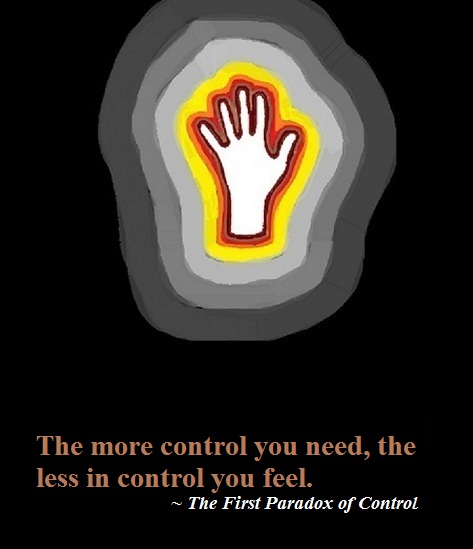
But she was doing me a favor.  Because she was teaching me about the First Paradox of Control.

Wikipedia defines paradox as “a seemingly true statement or group of statements that lead to a contradiction or a situation which seems to defy logic or intuition.”

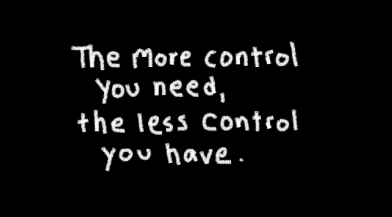
Right.  And the First Paradox of Control goes like this:
. 

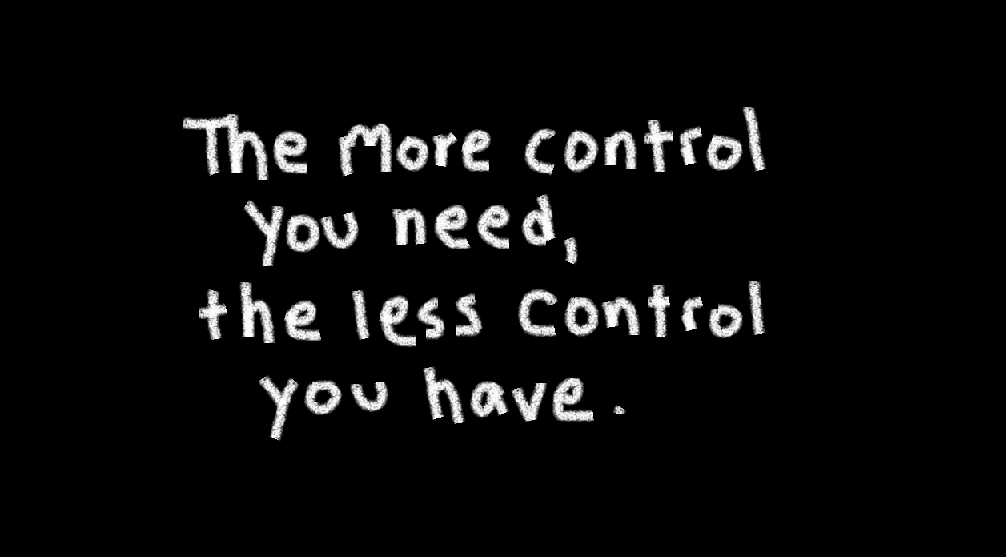
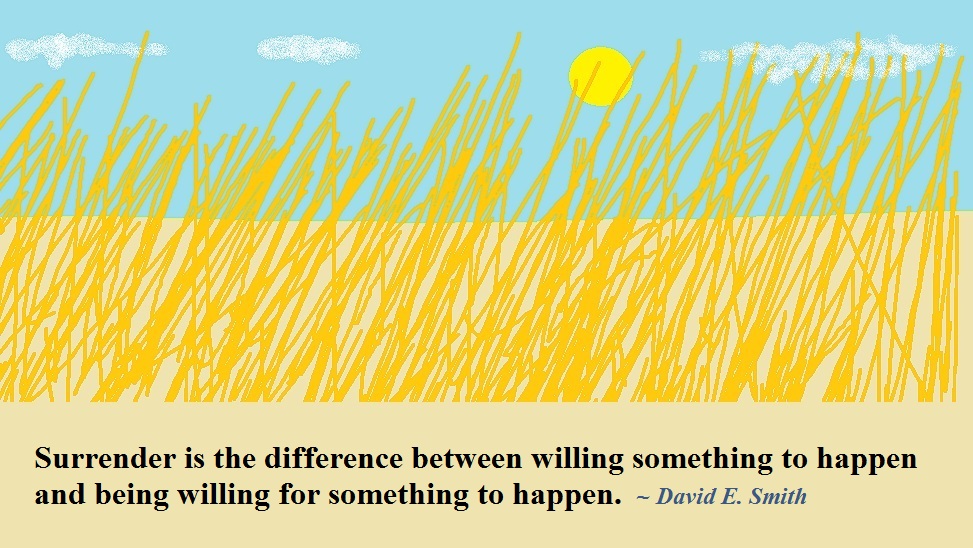
The more I needed to control Angie’s anxiety, the more out-of-control I felt.

I didn’t get this until the day I finally got sick and tired of feeling helpless and hating her.  “Screw it,” I thought, and simply gave up.  Sat back.  Just watched.

Guess what happened.

I felt better immediately.  I found I could watch Angie’s nervousness without taking it personally, without experiencing it as a threat or a challenge.  I could relax, and just let her be her usual nervous self.

Oddly enough, not trying to control her it left me feeling in control.

Confusing, no?

Yes, confusing.

But in part this comes from a confusion of language.

We use the word control to describe two very different things. “Control Angie’s anxiety” refers to something external, to somebody else’s emotional state.  “Feel in control” refers to something internal, your own emotional state.  Apples and oranges.  

But — and here’s the interesting part — this confusion of  language leads us into assuming that we need to control something Out There before we can feel calmer In Here.

And it’s not true. 

In fact, more often than not, the opposite is true:

Only when we give up controlling Out There do we begin to feel calmer In Here.

So what the First Paradox means is that the more you try to control external stuff the less at ease you feel internally.

Weird?  I thought so at first.

Then I began paying more attention to my own reactions.

And I noticed that those situations and people that make me most anxious are the very ones over which I’d like more control.

They’re also the ones over which I try to get more control — if not overtly, then covertly.  If not in my behavior, then in my head.  The ones I fantasize (obsess, even) about changing.

Finally, they’re the situations and people I suddenly feel better about when I shift from trying to control them to just letting them be.  From fighting to surrendering.  Like I surrendered to Angie’s anxiety.

At the very least, surrendering’s a lot less work.

Hey you, reading this:

Any experiences with the First Paradox?  Ever stop controlling and end up feeling more in control?

If so, care to share?   I’d really like to hear about it.

* * *

.
.

* * *

Where the hell is Matt?

Matt Harding (aka Dancing Matt) travels around the world and gets people — all sorts of people — to dance with him. 

He’s made five videos of the results, the most recent being “Where the hell is Matt? 2012”

Wikipedia notes,

On July 22, 2008, and again on July 25, 2010, and July 10, 2012, NASA featured Harding’s videos on the APOD (Astronomy Picture of the Day) Web site. 

Text accompanying these videos, under the heading “Happy People Dancing on Planet Earth,” claims that humans worldwide share a common love of dance, stating that “few people are able to watch the above video without smiling.”[20]

Watch “Where the hell is Matt? 2012.  You’re welcome.
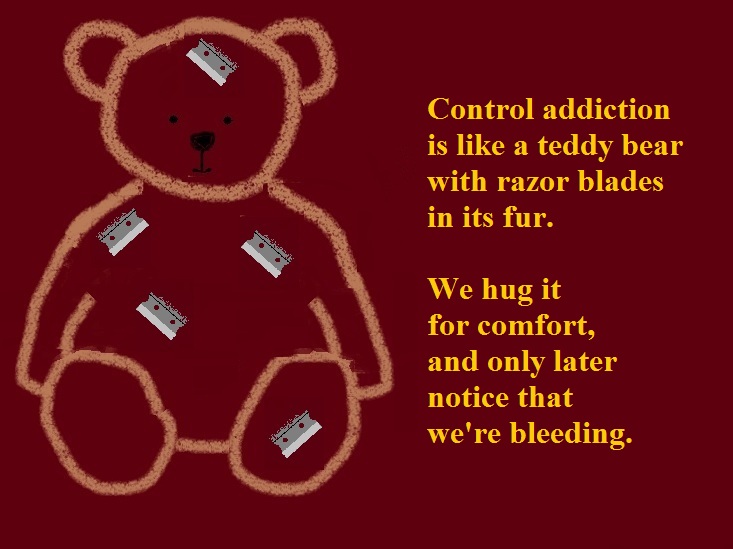

Like a teddy bear


Plan B

(Bert speaking:)

Last time I mentioned that Steve created me to get control of his emotional life.

I tried to do that by controlling everything and everyone around me. 
I call this my Plan A.

It included hiding his feelings, wearing masks to impress other people, and reading their  minds – i.e., guessing what they liked or wanted and trying to give it to them. 

It also included sending him to social work school.

Social work didn’t interest me.  I wanted Steve to be a therapist, and that seemed the fastest way.
Why did I want him to be a therapist?

Selfish reasons.

Therapists know stuff civilians don’t.  I saw them as special, something like priests,  possessed of secret knowledge and understanding.  I liked that idea.  I wanted in on that.  

I also thought a therapist’s position allowed him to get really close to other people without exposing too much of himself.  Since people scared me, I liked that idea too.  I liked it a lot.

Finally, I figured if anyone’s in control of their emotional lives and their relationships, it must be therapists. 

What did I know?  I’m a monkey.

So I sent Steve off to social work school.

And he graduated.

And got hired as a therapist.

And began to work.

And discovered (surprise) that he couldn’t follow Plan A and do his job.

At least, not competently.

Steve, explain why.

Because good therapy is all about healthy relationship.  And you can’t create that and seek control at the same time.

You can’t, for example, seek control and have real communication.  Real communication means surrendering control, being honest and real and, yes, vulnerable.  Therapists have to do all that within professional boundaries, of course.  But editing out all realness and  vulnerability leaves a relationship cold, unreal, and sterile.  Which solves nothing and helps nobody.

Nor, I found, can a therapist overcontrol his own feelings and do good work.  It’s feelings that connect us,  allow us to understand other people. When I overcontrolled mine I lost touch with my clients.  When I lost touch, I did bad therapy.

It quickly became apparent that what therapy demanded from Steve was essentially the reverse of our Plan A.  Instead of guarding against feelings, he had to trust them.  Instead of handling people, he had to connect with them instead.

This was disturbing.  I began to think I’d made a terrible mistake. 

Then around this time Steve, suddenly and unexpectedly, burped up a poem.

Steve, describe that.

It came out of nowhere.  I was lying in bed one night and heard the thing writing itself. 

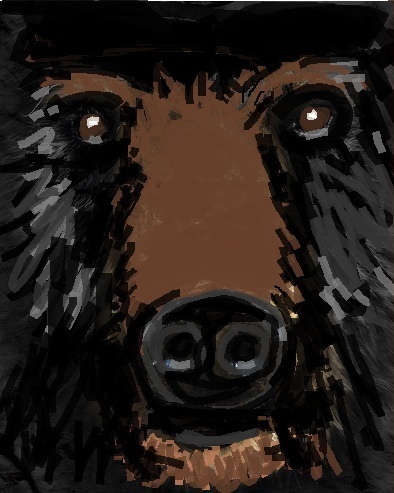
It began, “The truth is like a bear in the house.”  

And it went on to describe how, if you’re trapped in a house with a bear, you have only two choices: run away and wait for the bear to find you, or turn around and hunt the bear.  

At first I had no clue what this was about.

It took weeks to realize that my personal bear is the idea of control.

And so you set out to hunt it.

Right.  I figured the poem was like a telegram from my unconscious.  Part of me sending a message to another part. 

And when I brought bear-hunting to my work, I got another surprise.

I discovered that control isn’t just my bear. 

It’s everyone’s.

I saw that controlling is addictive, its patterns predictable and universal, and that they cause nearly all of the problems people bring to a therapist.

I saw that anxiety, depression, addictions, bad relationships and lousy parenting all stem from someone trying to control something they can’t or shouldn’t control.

And eventually I learned that a day comes — if we’re lucky — when we realize that controlling simply doesn’t work as a life strategy.

That’s the day we shift to Plan B.

Describe that shift. 

We start to notice our own controlling, catch ourselves in the act, learn and practice healthy alternatives.  We stop trying to control life and find ways to accept and cooperate with it.

And a great relief follows. 

That feeling is hard to describe.  It’s like you suddenly find yourself  sanding with the grain, instead of against. 

Or like giving yourself permission to stop swimming against the tide of feelings and events, and letting it carry you along instead.

Friends, consider this an invitation:

Come join the hunt.

.

* * *

“Love is how we ask for peace” 


Dear Friends,
 
Our young friends in Afghanistan, members of the Afghan Peace Volunteers, need our help.
 
Their requests for visas that would enable them to join the U.S.-Mexico Caravan for Peace that is touring the U.S. this summer were denied last Sunday after a less-than-10-minute interview at the U.S. Embassy in Kabul.
 
We are mounting a new campaign to try to convince Consular officials to take another look at their applications. We want them to understand that Abdulhai and Ali have many U.S. supporters, and that they are devoted to their work for peace and nonviolence in Kabul (and so would be eager to return to Afghanistan at the end of the Caravan tour).
 
Please help us by going to the following Roots Action page and adding your signature. If ever there was a time for us to encourage friendship between the youth of Afghanistan and the youth in this country, it is now.
 
And after you do that, would you please consider encouraging others in your network to do the same by forwarding this information?
 
Here is the link to the action page.
 
And here is a link to “Why Afghanistan can’t wait,” the Truthout article that Kathy Kelly and Hakim (mentor to the Afghan Peace Volunteers) recently wrote. 
 
Our new friend in the office saw them first.  “Here come your friends,” she said.  “Rejected,” she added, as we looked at their faces.  She and another Afghan guard listened sympathetically as Ali and Abdulhai described their absurdly brief interviews – they too had spent all but ten minutes of the three hours merely waiting. During those ten minutes, the interviewer had never touched the documents they submitted in their packets.
 
Please take a few moments to read this piece, which captures the true spirit of the work that Abdulhai and Ali and the other Afghan Peace Volunteers are involved in.  
 
As our friends in Kabul say, “Love is how we’ll ask for peace.”
 
We can do this.
 
Thank you,
Susan Perretti
 
PS:  If you want more information about our movement or how you can help, you can email me directly at oceanofjoy129@aol.com.
 

* * *

Steve here:

Afghanistan seems so far away.  Here’s a video (1:34) that brings it closer:

Be one of two million friends

.

***


Plan A

(Bert speaking:)

Today someone asked Steve, “Exactly how does a person get addicted to control?”

“We’re born that way,” Steve answered.

“We’re born with this big brain that can’t stop remembering and projecting, which keeps us scared and worried and trying to control everything and everybody.  Sort of like a paranoid computer run amuck.”

He was referring to the idea of monkey mind, which I wrote about not long ago.  (See Nuts.) 

But that’s only half an explanation.  Because some people are obviously more controlling than others.

Why is that so, if we’re all dominated by monkey mind?

The other half of the answer has to do with Plan A.

Steve has a little speech he gives to new clients about why people enter therapy.  Steve, please summarize.

In the end there’s only one reason anyone goes to a therapist:

Plan A has broken down.

Plan A is my label for everything we learn as kids about life and how to cope with it.

We each have a Plan A.  We learn it mainly as kids, mainly from our parents, and mainly unconsciously.  I mean, nobody sits us down at the kitchen table and says, “Now listen up, kid.  Here’s how you do Life.”   No, they just do Life themselves, and we watch and listen and soak it all up like little sponges.  That’s why our Plan A tends to look so much like others in our family.

And it works okay for a while.  Especially while we’re still living in the family.  It’s like we’re all following the same unwritten rule book.

But Plan A always breaks down. 

Because eventually we move beyond the family into the larger world, filled with new people and new problems.  And we discover that what worked at home doesn’t always work out there.

At which point we have a choice, at least in theory.  We can decide, “Oh, I see.  I guess I need a Plan B.” 

Or we can keep trying to make Plan A work in every situation.

Guess which we choose?

Right.  Plan A.  Always Plan A.

Why?  First of all, we may not even know there’s such a thing as Plan B. Childhood has trained us to see Plan A as normal.  (Why would anyone want to do Life in any other way?)

Second, even when we realize there are other options, we cling to Plan A because…it’s familiar.  We know how to do it.  And change is scary. So we keep following Plan A even after we suspect it no longer works.

And that’s when we begin to develop symptoms — anxiety, depression, addictions, communication problems, lousy relationships.

And those symptoms are what drive us into therapy.

Seeking a Plan B.

Bert again:

In our case — Steve’s and mine — Plan A was shaped by growing up in an alcoholic family.

Steve’s dad was alcoholic, and his mom was depressed.  Together they taught him two important lessons he’s spent his adult life trying to unlearn.

The first lesson was, “Feelings are at best inconvenient, and at worst dangerous.”  The implication of this lesson? So you’d damned well better keep them to yourself.

The second lesson was, “You’re responsible for other people’s feelings.”  The implication: So you damned well better be careful about what you say and do around other people.

These two lessons were the foundation stones, so to speak, of our Plan A.

They’re also what called me, Bert, his inner monkey, into being.

Steve created me to take control of what was a fairly chaotic emotional life.  I set out to do that by doing things like burying his feelings, developing an impressive image (see “Bert’s mask”) and becoming exquisitely oversensitive to the feelings, perceptions and opinions of others.

I also convinced him to become a therapist.  It seemed a natural fit to our original Plan.

How was I to know that becoming a healthy therapist (not to mention a healthy adult) meant I’d need to grow a Plan B?

.

* * *


There

Saturday morning, and as usual I wake with an agenda in mind.

It plays like background music while I rise, use the bathroom, pull on shorts, walk to the kitchen, kiss my wife, pour a cup of coffee. 

Today for some reason it reminds me of a calliope echoing over a fairground.  I hear the thumping of its mechanical drum while I sip coffee and my wife and I chat.

“Loose Ends” is my title for this particular agenda.   (It’s a  title I’ve used before.)   Nothing dramatic on it.  Mow the lawn.  Sweep the driveway.  Clear brush from the side yard and bundle it for pickup.  Clean my desk.  Clean my office.  Make a library run.  Write this blog post.

The drumbeat continues when I sit down in my desk chair to meditate.  For ten minutes I watch the pinball of my attention bounce off each of the agenda items (thump, thump) in turn. 

Then something happens.

It’s something that happens occasionally during zazen.  How to describe it? 

It’s like a part of my mind suddenly detaches itself, takes a giant step back, hears what I’m thinking, and laughs.

It laughs now because it’s heard me fantasizing about There.  

You know, There.  That place where the agenda is completed.  Where all chores are done, all loose ends tied off.   Where you’re finally done doing stuff.  Where you can relax.  Totally, guiltlessly relax.

You know.  There.

And the stepped-back part of me chuckles and mutters, You know better than that.

And phrases I’ve read about this mythical There float into my mind.

We must make our fictions conscious.

Ideas we have, and don’t know we have, have us.

When we remember we are all mad, all the mysteries disappear and life stands explained.

And suddenly every muscle in my body goes slack.

Because I’m remembering what I already know:

There’s no There there.

And if so, there’s nothing to strain after.

Just this dreamlike pursuit of There we laughably call consciousness. 

No There there.

There’s only here.

And for one brief blessed moment,  here’s where I am too.

.

* * *

We must make our fictions….  ~ James Hollis, Creating a life: Finding your individual path

Ideas we have, and don’t know we have….  ~ James Hillman, Kinds of power: A guide to its intelligent uses

When we remember we are all mad….  ~ Mark Twain, Notebook


Monkeytraps, and how to spot them

(Steve and Bert wrote this one together:)

Steve:  One reader writes,

I like your blog, but it’s a little scary, since before this I had no idea how controlling I am and how many problems it causes me.

What I want now is to learn to be more aware of my controlling, to keep the idea of control at the surface of my mind and to understand how wanting to control things drives how I react and what I do and say.

Got any tips on that?

Bert:  Good question.

Steve:  She wants to learn how to spot monkeytraps.

Bert:  Yeah.  You should remind everyone what a monkeytrap is.

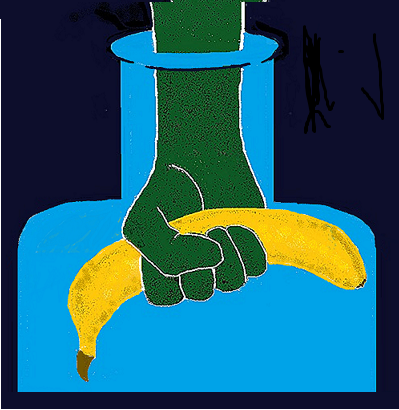
Steve:  In the East they trap monkeys by placing fruit in a weighted jar or bottle with a narrow neck.  The monkey smells the fruit, reaches in to grab it, and traps himself by refusing to let go.

A psychological monkeytrap is any situation that triggers you into compulsive controlling — i.e., into holding on when you really should be letting go.

Bert: And yes, we have tips on how to spot them.

Steve: Here’s the first:

Notice where

you’re uncomfortable.

We’re controlling whenever we need or want to change some piece of reality (instead of accepting it as it is).  And we’re most likely to want to change realities that make us uncomfortable.  So it makes sense that our discomfort zones are where we’re most likely to get monkeytrapped.

Bert:  I, for example, can’t stand rejection.  So it’s with people I think might reject me that I tend to be most controlling.

I do it in all sorts of ways: hide feelings I think might upset them, pretend to agree when I really don’t, laugh at their stupid jokes, avoid confronting behavior I dislike, try to read their minds, and so on.

Steve:  Tip #2:

Notice where

you’re stuck.

Stuck as in not learning, or healing, or growing — struggling with the same damn problem over and over again.

Bert:  Same example.  Working hard at controlling people’s reactions to me is a monkeytrap because it

(a) stops me from being myself, which

(b) prevents me from ever getting accepted as myself, which

(c) keeps me chronically scared of rejection.

In short, a dysfunctional merry-go-round.

Steve:  Right.  You know you’re monkeytrapped whenever you find yourself doing, over and over and over again, what doesn’t work.

And why do you?

That brings us to Tip #3:

Notice where

you’re scared.

Unhealthy controlling is driven by anxiety.  We stay monkeytrapped because we’re scared to do anything else.  Often even the thought of giving up control in such situations is enough to scare us silly.

Bert:  Like me telling my mother-in-law her breath stinks.

Steve:  Uh, yeah.  Great example.

So if you want to spot where you’re compulsively controlling, look for the three clues: discomfort, stuckness, and fear.

* * *


What do you know about control?

(Bert speaking:)

Whenever he meets a new client Steve asks him or her the same question:

“What do you know about you and control?”

The answers he gets vary widely.  But nearly everyone ends up admitting, in one way or another, that control is pretty important to them.

Until last Tuesday.

Tuesday Steve met a new client — I’ll call him Barry — who answered his question with a shrug.

“Nothing,” he said.

“Nothing,” Steve echoed.

“Nothing,” Barry repeated. “I have no problems with control.”

Steve was flabbergasted.  He’s always assumed everyone has at least a sneaking suspicion that control issues figure in their need for therapy.  But Barry disproved that.

So, suspecting that there may be other Barrys out there just as clueless about the role control plays in their emotional lives, he asked me to write this post.

Glad to oblige. 

Because this is important stuff.

So here’s what you really should know about control:

1. You’re addicted to it.

Yes, you are.  Consider:

Control (as we’re defining it) means the ability to dictate reality — to turn some piece of the world into what we need or want or prefer.

Who doesn’t want that?  Who doesn’t seek it constantly?

Human beings chase control in a gazillion ways, ranging from huge (starting wars) to tiny (changing channels), from mindful (exiting the highway) to unconscious (forming expectations), and from dangerous (beating a child) to innocuous (scratching an itch).

However you explain this urge (we blame it on our big restless brains), it’s both an elemental part of human nature and the one that most clearly separates us from other animals, who pretty much have to take reality as it comes.

It’s so familiar, this urge, that we barely notice it.  Most of the controlling we do is automatic and unconscious.  If you were to meet someone who’s not automatically controlling (think: Dalai Lama) that person would probably strike you as, well, unhuman.

What makes controlling an addiction?  Several things.  But here’s the most obvious:

Addictions are famously difficult to give up.

Try giving up control for a day, and see how you feel.

Hell, try giving it up for ten minutes.

2. Overcontrolling stuff makes you sick.

We tend to overcontrol two things: our own feelings, and other people.

Overcontrolling feelings makes us anxious, depressed and addicted. Overcontrolling other people ruins our relationships.

There.  I just summarized 99% of what Steve talks about in a typical working day.

He wants to add something.

The most common problem clients bring to therapy is emotional constipation: the suppression of normal feelings.

We suppress feelings out of fear.  There are plenty of benefits to living with other people, but its chief curse is that we spend our lives terrified of how they’ll react if we dare to reveal ourselves emotionally.

It’s this curse that makes us sick.  I’m not exaggerating.  To deny feelings is to go to war with your own body, ignoring both its intelligence and its needs. 

One of my clients was an MD, and I asked him what practicing medicine had taught him about human beings. “That no illness is purely physical,” he said.

When you bury feelings, dis-ease grows.

3. Behind all controlling is the wish to control feelings.

We seek control because we believe we’ll feel better with it than without it.

We assume controlling reality will enable us to avoid all sorts of discomfort: pain, anxiety, boredom, embarrassment, anger, confusion, frustration, fear.

We all believe this, without exception.

And it’s true enough, as far as it goes.  Unfortunately most of the time (have you noticed?) reality is beyond our control.

What then?  How handle feelings you cannot avoid?

Having no alternative to control leaves you hopelessly addicted to it — forced to manage your emotional life by compulsively wrestling people, places and things into submission, and condemned to helpless anxiety when you can’t.

Luckily, there are alternatives.

4. There are better ways to handle feelings than control.

In fact, there are three:

~ The first is the ability to let go — to stop trying to control what you can’t control anyway.  This allows you to relax, accept life on life’s terms, and to swim with the tide of events instead of against it.  We call this alternative surrender

~ The second is the ability to listen to feelings instead of ignoring or concealing them.  This allows you to avoid splitting yourself into two selves — public and private — and to make healthier choices, ones that take your true needs into account.  We call this alternative responsibility (as in ability to respond).

~ The third alternative is the ability to be yourself with another person, and to allow them to do the same with you.   This is the hardest to master, because it combines both surrender and responsibility, and because it demands that we rise above fear.  But it also offers us our only chance to feel truly connected to and accepted by another human being.  We call this alternative intimacy.

None of these is easy to learn or practice.  If we choose them it’s because we’ve come to realize, like any recovering addict, that being addicted to control is even harder.

Steve has a last word:

As Bert said, this is important stuff.  Stuff we all need to know. 

In an ideal world, we’d teach it more.  Parents would teach kids.  Kids would teach other kids.  Partners would teach each other.  So would religions.  So would nations.

Control is too important to leave to therapists.

* * *


Addict

(Bert speaking.)

I’ve been addicted to control for as long as I can remember.

That is, for as long as I can remember I’ve been trying to force reality — people, places, things, even myself — to match the pictures in my head of how I want reality to be.

I do this constantly.

I do it unconsciously.  Which means I usually don’t know when I’m doing it.

And I do it compulsively.  Which means I get really really anxious when I can’t get control.

I expect to stay an addict until I die.

Yes, I’m in recovery.  But that just means I’m less controlled by my need for control than I used to be, just as recovering alcoholics are less controlled by their need to drink.  They’ll always be alcoholics, though, and I’ll always be a control addict.

I’ll always feel this urge to control stuff.  Even when I know it’s crazy to try.

It’s crazy, I’ve learned, because control is largely an illusion.

Sure,  it’s not always an illusion.  If I pour sugar in my coffee the coffee gets sweeter.  If I pull the steering wheel to the right my car will reliably turn right.

But the world is larger than sugar and steering wheels.  And the truth is that, beyond these concrete ways of changing my immediate circumstances, much of my controlling operates more on the level of wishful thinking.

Why?  Because most of my controlling is an attempt to control feelings and relationships.

And feelings have no steering wheel.  And in relationships sugar doesn’t always work.

Let me explain.

Say I have a feeling I don’t want.  Say I feel inadequate.  But it’s uncomfortable to feel that, and I also worry that if you see that I feel inadequate you may agree with me, which would make me feel worse.  So I hide my feeling, from you and from myself.  I work hard at presenting myself as adequate, even superior. (For an example, see “Bert’s mask.”)  And let’s say it works: I convince you I’m superior.  I have successfully controlled your perception of me.

Do I feel better?

Not so much.

At least, not for long.  Why?  Because I know it’s an act, a pretense.  I’ve basically fooled you about me, and I can’t forget that.  So whatever approval I get from you is essentially meaningless.  And I end up feeling both inadequate and phony.

See how that works?

Another example:

Say I’m mad at you, but afraid to show it.  I’m scared you might get mad back at me, which would make me unhappy.

So I hide my anger from you.  I bury it.

But overcontrolling feelings tends to be bad for me.  Feelings are meant to be expressed, not contained.  Released, not stored up.  So burying my anger makes me uncomfortable.  Constipated.  Pressured.  Uneasy.  Anxious.  And when I do it long and habitually enough, I get depressed.  I.e., chronically unhappy.

How’s that for irony?

Why doesn’t control work better in the realms of feeling and relationships?

Because at the heart of this addiction lies an annoying but inescapable paradox:

The more control I need, the less in control I feel.

* * *


Nuts

(Bert speaking:)

I’m nuts.

Yes, you heard me right.

I’m nuts.

Not embarrassed to admit it, either.

Why?

Because I know a secret.

You’re nuts, too.

How do I know this?

Because you’re human. (Unless, of course, you’re one of the many dogs or cats who enjoy this blog.)

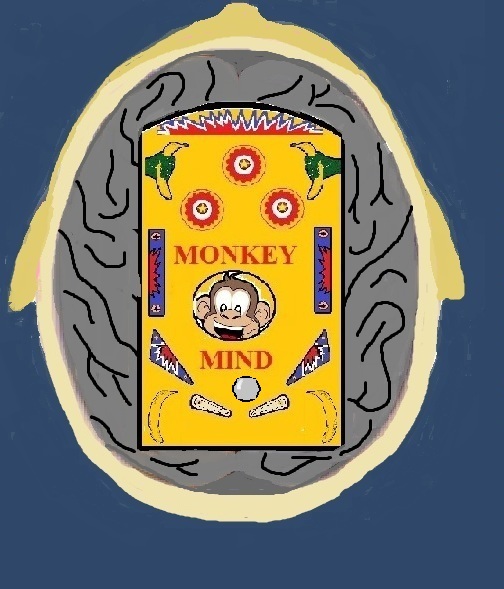
And, being human, you’re a victim of what has been called monkey mind.

What’s monkey mind?

It’s what you hear in your head when your attention isn’t distracted.

It’s the sound of a brain which over millennia has evolved into a sort of top-heavy computer, built for problem-solving, and devoted to finding new problems to solve.

It’s the whispering, worrying, fretting, scolding and mocking that keeps you unhappy and on guard against life.

It’s the sound of a normal human mind at work.

In other words, the most human part of you.

Still not sure what I mean?

Experiment. Take a moment now (when you finish reading this sentence) to sit without thinking for, oh, a minute or so. Just sixty seconds.

(Pause.)

Hear that?

Yep. Monkey mind.

The nuts part.

Steve wants to add something.

What makes it nuts is that it’s so detached from reality. Like a monkey swings from tree to tree to tree, monkey mind swings from past to future and back again, over and over, ceaselessly remembering, anticipating and fantasizing. It’s never still, never focused on the here-and-now — which may actually be fine, perfectly safe and okay. So when you’re in monkey mind you’re having all these feelings — often painful ones, anxiety and anger and such — that have nothing to do with what’s really happening in your life at the moment. It’s like being trapped in a nightmare, unable to wake up.

Speaking as a recovering inner monkey, I would add that there’s one other thing that makes monkey mind nuts.

It really, really believes in control.

It operates on the assumption that if we think and analyze and strategize long and well enough we can solve every problem and bring life under control. That if we could just figure things out, life could be perfect. Perfectly safe, perfectly comfortable, perfectly happy.

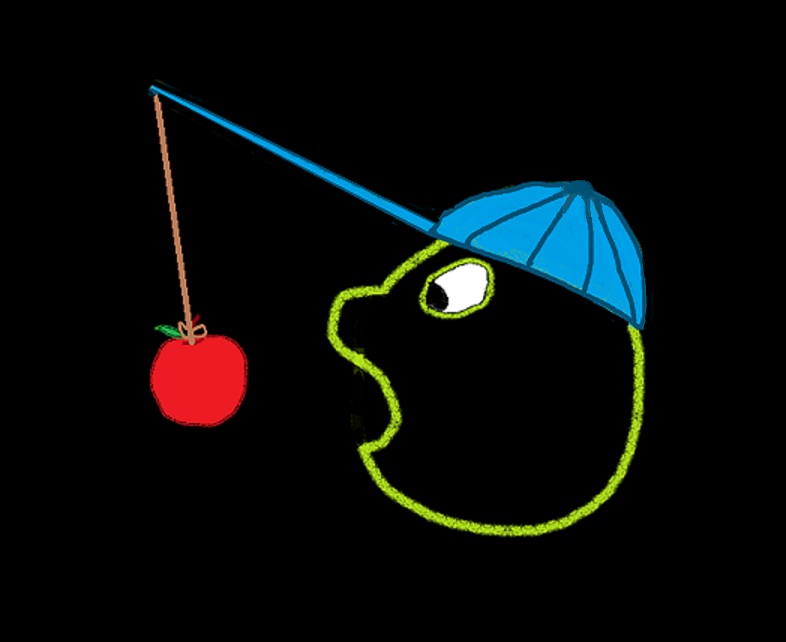
I remember a Little Rascals episode in which the kids got their mule to walk in a circle by extending a pole out over his nose with an apple dangling from the end. The donkey kept plodding after the apple endlessly, never getting closer, and apparently never noticing.

Yes. We all chase that apple.

Well, I for one am sick of it.

That’s why I’m a recovering monkey. I’m sick and tired of feeling victimized by my own mind.

Tired of fighting reality instead of accepting it.

Tired of trying to control everything.

Tired of this never-ending plod towards an apple I can never reach.

Tired — so, so tired — of being nuts.

.

* * *

All of humanity’s problems stem

from man’s inability to sit quietly

in a room alone.  

~ Blaise Pascal


Monkeythoughts


Twenty years ago,

when we began

studying the idea

of control,

we also began

collecting thoughts

on the subject,

from thinkers both

famous and obscure.


Below are a few of them,

arranged as a slideshow

(4:00).


Take a look.

Maybe you’ll find one

that changes how

you see things.


(To pause, move your cursor over the picture and click the || button that appears.) 
 

This slideshow requires JavaScript.

(c) Steve Hauptman, 2012.  All rights reserved.

Goofy

Recently Beth Wilson of B Here Today recommended Monkeytraps to her readers with this comment:

I confess that I haven’t been a regular follower of Steve Hauptman’s work. Until this post: Three rules for recovering from anything.

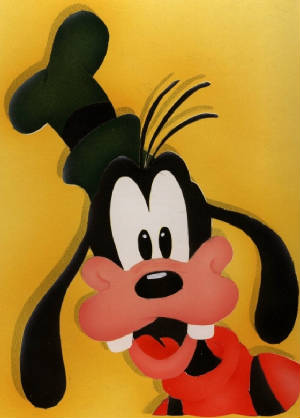
Normally, this blog is kind of goofy.  I like it, but it’s kind of goofy.  Steve, who is a therapist who specializes in control issues, co-writes Monkeytraps with Bert, his control-addicted inner monkey.  It’s a recipe for goofiness.

This particular post touched me because it addresses the issue of presence as it relates to paying attention to our thoughts, our monkey minds, if you will.  Check it out.

It’s always nice to be recommended.  But I had a surprisingly strong  reaction to Beth’s second paragraph. 

I’m 62 now, and have grown used to certain descriptions of myself.  Serious usually heads the list.  Followed by intense.   And, for many years, trailed closely by angry.

And then there’s always right.   My wife’s favorite.  In fact, I once wrote her a poem summarizing her view of  me:

you’re right

you’re right

you’re always right

you’re right all day

you’re right all night

I get so mad

I want to bite

because you’re

always

always

right 

Can’t remember what inspired that burst of self-awareness, but it was atypical.   During most of our marriage I was too busy being serious, intense or angry.

Never before has anyone called me goofy.

Initially I went back and forth with it.

First I was puzzled.  Why that particular word? 

So, like any seriously serious person, I looked it up.

goofy. Adjective. (goo-fey.)  Ludicrous, foolish.

Then I looked up ludicrous.

ludicrous. Adjective. (loo-du-krus.) Broadly or extravagantly humorous; resembling farce

“Not bad,” I thought.  “Humorous is good.”  I decided to stop looking shit up.

Then I found myself wondering: what in Monkeytraps might strike someone as goofy?

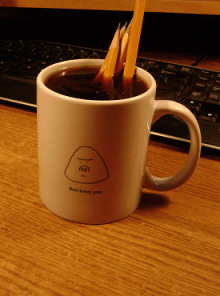
This answer came more easily.  I remembered the photo I used to illustrate various uses of the Bert Mug:

THE BERT MUG.
(Contents not included.)

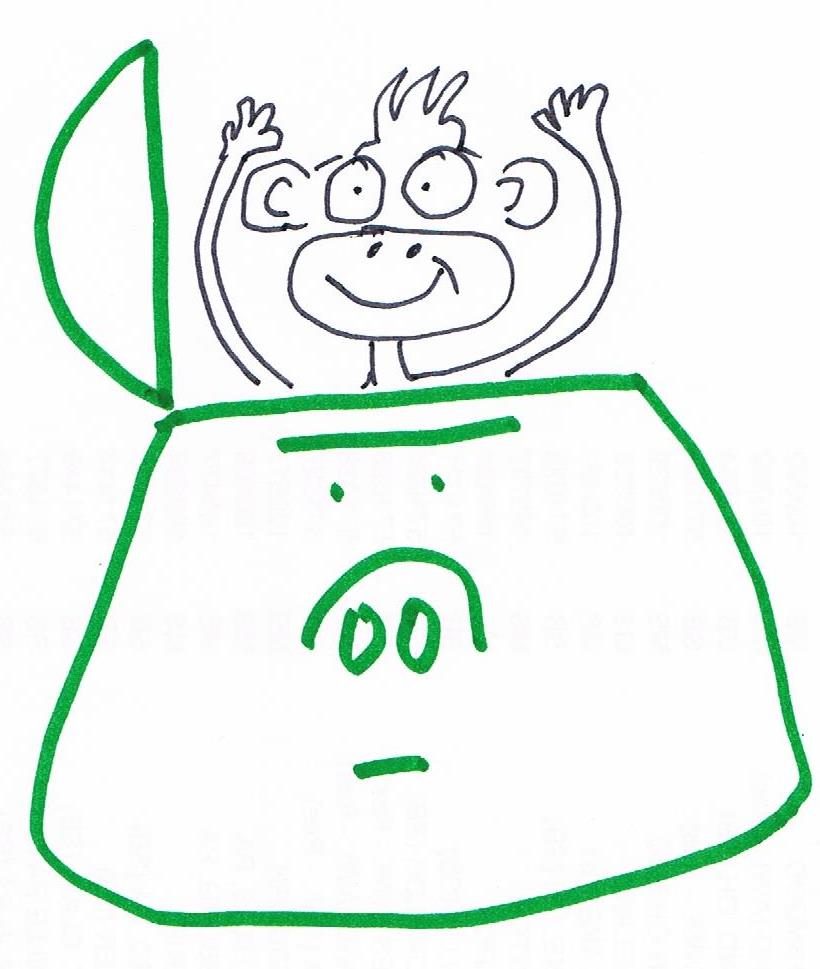
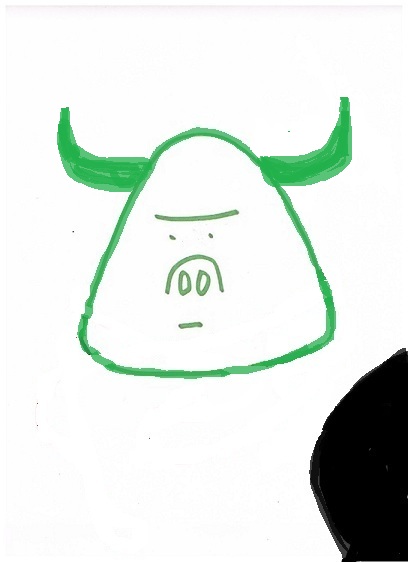
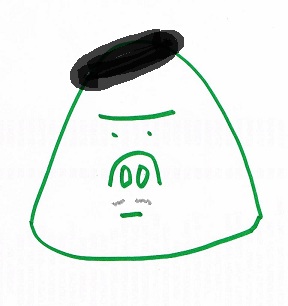
 And some of the Bert cartoons:

*

*

*

*

*

“Wow,” I thought.  “I am goofy.” 

And, unexpectedly, felt proud.

See, for me the worst part of being a control addict has always been fear of other people.  Convinced of my own inadequacy, I expect criticism, rejection and humiliation if I come out of hiding.  So I spent decades trying to protect myself by impressing people and concealing what I really thought and felt.

But goofy doesn’t care about any of that. 

Goofy isn’t scared to be itself.   

Goofy can relax.  Goofy can play. 

Goofy is free. 

“If I’ve attained goofiness,” I thought, “I must be getting healthier.”

I decided to celebrate.

How? 

Do something goofy, of course. 

So I concocted a plan.  It’s a secret, so don’t tell anyone.

I lead a therapy group that meets weekly.  Five members.  Seriously serious people, all of them. 

My plan:

1. Visit the Family Dollar near where I live.  Buy each group member a plastic bottle of bubbles.  You know, the kind with the wand with the circle at the end.

2. Arrange the bottles on a tray in a circle.  In the center of the circle place a dollar bill. 

3. Present the tray to the group.  Tell them: “Blow the biggest bubble, and the dollar is yours.”

4. Watch what happens.

I’m telling you this as a way of committing to it.  I may get cold feet (i.e., relapse into Seriousness) before the next group rolls around. 

But I want to go ahead with it anyway.  I think it would be good for them.  Goofy is therapeutic.  For me too.

And I have a reputation to uphold.

*

* * *


My friend Joe knows how to acknowledge his inner little boy. 

When I saw him the other day, he was standing outside the building where we were both attending a meeting.  He reached into the front pocket of his bib overalls and pulled out a small clear tube containing a bluish color liquid.

I watched in amazement as he took the top off the tube, which–you guessed it, was a plastic stick with a tiny oval on the end–and began blowing bubbles.

”Ah,” he said. ”This is a good batch.”

I looked around to see if anyone was watching.

Joe was unfazed.  ”Haven’t you seen me with these? I carry a tube of homemade bubbles around with me most all the time.” 

My question, of course, was “Why?”  To which he answered, “It helps me when I get a case of red-ass.”

Now I looked around to see if anyone overheard. 

“And what is red-ass?” Big Me questioned.

“Red-ass,” Joe said in a matter-of-fact tone, “is when I get so mad that my face turns red and I want to kick somebody’s ass. So I blow bubbles instead.”

~ From B here like a child by Beth Wilson. 
*
 

* * *


*


The Dark: Dog

xxx1

1

2

3

xxx2

1

2

3

xxx3

1

2

3

xxx4

1

2

3

xxx5

1

2

3

xxx6

1

2

3

xxx7

*What’s a Top Dog?  See “Bert’s Dog.”  

2

3

xxx8

1

2

3

xxx9

1

2

3

xxx10

1

2

3

xxx11

1

2

3

xxx12

1

2

3

xxx13

1

2

3

xxx14

1

2

3

xxx15

1

2

3

xxx16

1

2

3

xxx17

1

2

3

xxx18

1

2

3

xxx19

1

2

3

xxx20

1

2

3

xxx21

1 

2

3 

xxx21

1 

2

3

* * *


The Dark: Prayer

xxx1

1

2

3

xxx2

1

2

3

xxx3

1

2

3

xxx4

1

2

xxx5

1

2

3

xxx6

1

2

3

xxx7

1

2

3

xxx8

1

2

3

xxx9

1

2

3

xxx10

1

2

3

xxx11

1

2

3

xxx12

2

3

xxx12

1

2

3

xxx13

1

2

3

xxx14

1

2

3

xxx15

1

2

3

xxx16

1

2

3

xxx16

1

2

3

xxx17

1

2

3

xxx18

1

2

3

xxx19

1

2

3

xx

1

2

3

xxx

1

2

3

xxx21

3


xxx21

1

2

3

xxx22


On vacation

Sometimes I go about in pity for myself, and all the while, a great wind carries me across the sky.

~ Ojibwe saying

* * *


Back on Sunday, July 8.

Happy Independence Day, everybody. 


Three rules for recovering from anything

Hi guys, it’s Bert.

Years ago I used to run for exercise.

And I remember reading a little book about running which reduced the process of training to three simple rules:

Push.

Rest.

 Listen.

Push meant stretching myself, working to increase my strength and stamina by gradually running farther or faster or longer.

Rest meant pausing between workouts, giving my body time to recuperate and build new muscle.

And Listen meant paying attention to what my body was telling me in order to decide whether I needed to be Pushing or Resting.

Eventually I decided I was too neurotic to be a runner.  I just couldn’t follow all three rules.  I was able to Push just fine, but Resting made me uncomfortable — anxious and guilty.   And Listening?  Deaf as a post.

So what’s my running history have to do with anything?

This:  These same rules apply to recovery.

I don’t care what you’re recovering from — addiction, depression, emotional trauma, physical illness, whatever.  There will be times when you need to push, times you need to rest, and times you need to listen.

For me, as a recovering control addict,

~ Push means stretching beyond my comfort zone by doing the opposite of whatever I usually do.

This means different things on different days.  It might mean expressing a feeling I’d rather stuff, telling a truth I’d rather ignore, tackling a chore I’d rather avoid, or starting a project I’d prefer to forget entirely.

Pushing often feels like cutting my way through jungle with a machete.   The jungle is all those years of tangled fears, scared projections and bad habits that keep me stuck, feeling like a kid in an adult’s body.

Pushing can be hard work.

But there’s no recovery without it.

~ Rest means the opposite of Pushing.

You know, to take a break.

To actually breathe.

Or maybe nap.  Walk on a beach.  Eat a candy bar.  Read a mystery.  Draw or paint something.  Watch the sun set.  Reflect.  Regroup.

Easy and pleasant, right?

Not always.

Like most control addicts I tend towards workaholism, a compulsion to keep planning and moving and doing.  It allows me to stay in my head and avoid feelings.

So there are times when it takes a real effort — even courage — to stop playing Energizer Bunny and let myself feel whatever’s happening inside.

Which means Resting can be difficult.  Sometimes it feels like just another sort of Pushing.

But there’s no recovery without it.

~ Listen means to change channels — to say “Shut up” to my own mind and tune into my body instead.

By mind, of course, I mean monkey mind, that whispering, worrying, scolding and mocking voice that keeps me permanently on guard against life.

Mind also means Dog, that self-critical part whose sole mission in life is to chew endlessly on the sore ankle of my self-esteem.

Neither of these parts wants me to Listen to my body.  They want me listening only to them.

Which I usually do.

Which can be pretty damned risky.

Because mind tends to be, well, crazy.  It absolutely believes in the illusion of control and spends all its time trying to grab more.  Behind this control-seeking are all the bad memories, scared projections, and false truths it’s absorbed and held onto since I was a baby.

In short, mind is full of shit.

But my body tells me the truth if I let it. 

Listening to what my body says is the only reliable way I know to figure out what I really need: when I need to pee, or rest, or eat, or take a walk, or take a hot bath, or meditate, or sit and talk with my wife.

I admit it.  I have to really work at Listening.

Like Resting, it takes practice, and more than a little guts.

But I don’t have much choice about whether I practice or not.

Because there’s no recovery without it.

q

* * *

a

Rather listen than read?

Click below

and Bert will read this post to you:

Three rules for recovering from anything (version 2)

 (4:39)


* * *

So a funny thing happened while Bert was writing what you just read.


He found himself Listening.


And what he heard was a tiny voice.


And the tiny voice whispered, “Go fishing.”


Since he’s no more a fisherman than he is a runner, Bert knew the voice was whispering metaphorically.


He knew what it meant was, “Stop working.  Take care of yourself.  Practice what you preach, already.”


So Monkeytraps is going on vacation.


We’ll resume posting new stuff on Sunday, July 8.


Meanwhile, check our our new page, Bert Reads, to hear Gumdrop Head read some of his posts. 


And our forum Monkey House remains open to visitors, venters, questioners, answerers, and the occasional runaway.


See you in two weeks.


And while we’re away, please take care of yourself too.


Because if you don’t, who will?


Love,

~ Steve & Bert