* * *
.
.
 (Bert speaking:)
I’m an addict.
Technically I guess you’d call me a polyaddict, since I’ve had so many addictions in my time.
They came in two flavors: substances and behaviors.
The substances included food and tobacco. Sugar’s been my drug of choice since I was a kid. In grade school I made white-bread-and-white-sugar sandwiches. I drank maple and (when I could get it) chocolate syrup. Halloween and Easter, the only times mom bought candy, left me in a hyperglycemic stupor.
Even now sugar can still trigger me. Wave a York Peppermint Patty under my nose, I’ll follow you anywhere.
For a while I was addicted to pasta. I’d mix it with vegetables and convince myself I was eating healthily. The more stressed I felt, the more pasta I ate. I was approaching Orson Welles proportions before I learned to beware of simple carbs. But for most of my adult life there’s been too much of me.
I did escape cigarettes. But in grad school I smoked a pipe until cumulus clouds formed in my office, and my tongue morphed into raw hamburger, and other students made rude remarks when I went by.
My addictive behaviors include
~ Watching television. TV was the alternate reality where I hid out between ages twelve and eighteen, the years dad was drinking and my parents were divorcing and I was evolving a depressed view of life.
~ Reading books. The alternate reality I still find preferable much of the time. Books are great. You can skim forward to see what happens next, reread parts you forgot or don’t understand, and skip over whole chapters if they’re confusing or uncomfortable. Life should be more bookish.
~ Writing. In my thirties and forties I carried a series of cheap spiral notebooks with me everywhere, compulsively filling pages whenever I felt stressed, bewildered or scared. I must have felt that way often, since there are thirty-one spirals now gathering dust on the bottom shelf of a bookcase in my office. I save them the way a veteran might save his dogtags. But I never reread them. That would be like dangling my toes in a cesspool.
~ Working. My current addiction. Unfortunately I can’t write intelligently about it yet, since I’m still in denial.
These are just some of the trails I blazed to what Steve likes to call the Garden of Numb.
Steve, explain.
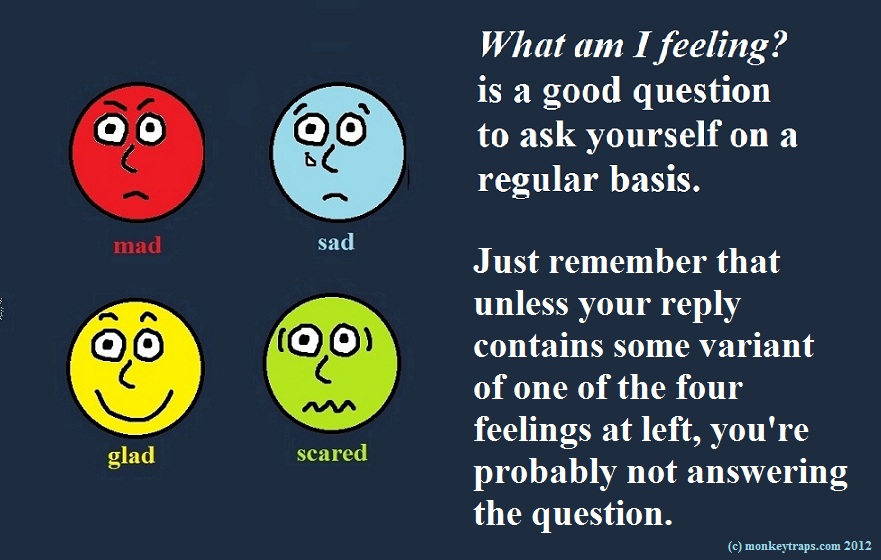
Addicts are people who can’t handle feelings.
Usually it’s because they never learned to as kids. Usually because their parents never taught them. Usually because their parents never taught them.
This sort of ignorance is uncomfortable at best, painful at worst. So early on the emotionally undereducated kid seeks ways to make feelings go away. To escape a jungle of unwanted, disagreeable feelings by entering the Garden of Numb.
Drugs and alcohol are popular paths to the garden, but anything that alters your mood temporarily can be turned into an addiction.
I believe everyone’s addicted to something.
And I believe, in the end, all addictions are the same. Because they all share the same goal: to give the addict some control over emotional life.
That’s why when someone asks me, “What does control have to do with addiction?” I reply, “Everything.”
Because every addiction is an addiction to control.
But I love the Garden of Numb. Such a great place to visit.
Yes. The world can be painful and scary, and living a human life is no picnic. We all need occasional vacations.
The problem comes when you find you can’t live outside the garden.
Right. Which is what happened to me with each of my addictions.
My eating and smoking and tv-watching and reading and scribbling took on lives of their own.
Each stopped being something I was doing and became something that was doing me.
In other words, I lost control of my need for control.
At which point I had to revisit my relationship with feelings.
Make friends with them, you mean.
Well, no. Not sure I’ve done that yet. But I did have to stop being scared of them.
That meant learning (and then relearning) the function of feelings, which is to help us perceive and interpret experience — provide feedback about what’s happening inside.
And then to learn (and relearn) healthier ways of processing or digesting that feedback — mainly by identifying and expressing what I felt to other people — instead of trying to make the feelings go away.
I’m still working on all this.
So are you, I hope.
Because it’s something we each have to learn. Because we’re all control addicts. If you’re human and you’re breathing there’s no avoiding it.
Recovery from any addiction requires courage and work. It means facing scary feelings, overcoming the habit of self-constipation, and learning alternatives to control.
But the work’s worth it.
Because the alternative is worse.
Since living in Numb really isn’t living at all.
.
 The problem is, like addiction, codependency is characterized by denial.
.
.
.
~ From Codependent children — What can parents do? by Darlene Lancer at BreakingTheCycles.com.
.
.
.
 20 years ago:
.
~ From I have to feel what? by catsmeow at Living While Healing.
 ..
...
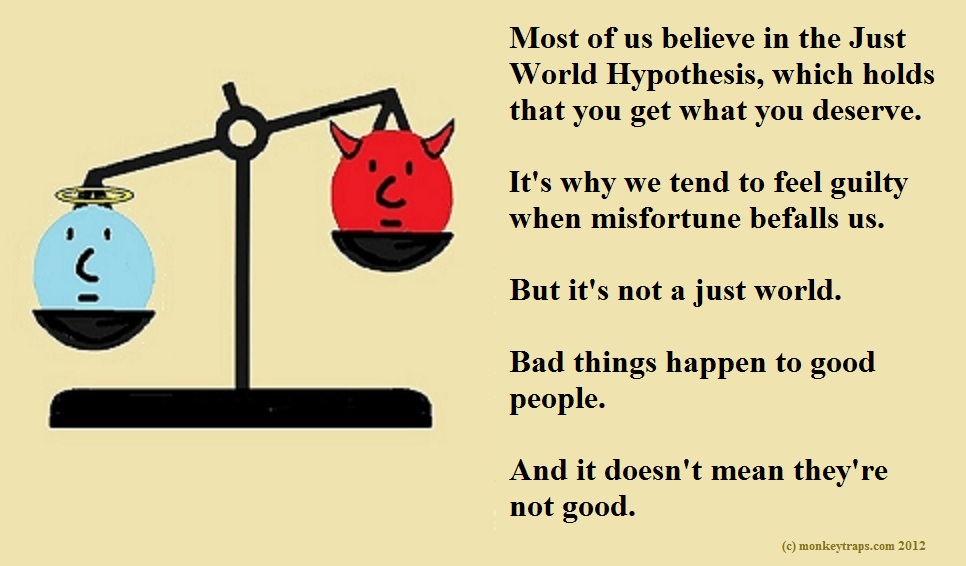
 Now, remind me again, good Rabbi, why does crap befall decent folk?
~ From “When crap befalls decent people” by Therese Borchard at Beyond Blue.
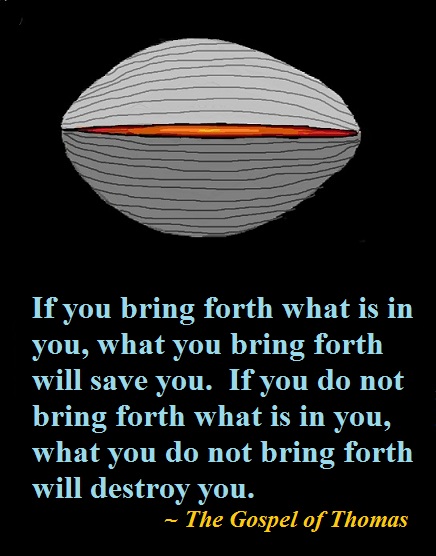
.
.
~ From Show your true colors (3:48)
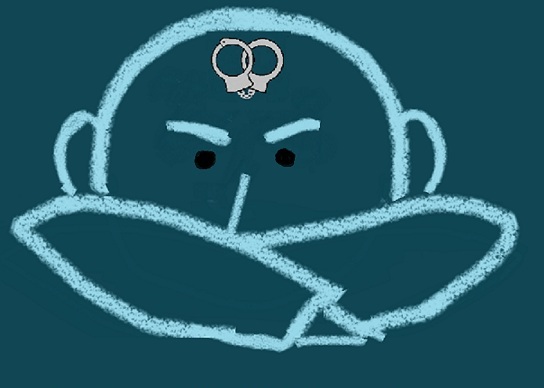 (Bert speaking:)
Therapists, Steve tells me, see depression as the “common cold” of mental illness.
I’ve had my cold for six decades.
I caught it in grade school. Nobody called it depression then. This was the fifties. Not sure if back then anyone even knew that kids got depressed.
All I knew was I always felt sad, shy, nervous, worried. Different. Inadequate. Flawed.
I preferred being alone. Preferred books to people. Preferred tv to real life.
“Moody,” mom called me. “Difficult” was dad’s diagnosis.
I also felt guilty about feeling crappy. It must be my fault, I thought. Teachers were always writing on my report cards could do better if he’d try. So I decided feeling crappy meant I was somehow doing Life wrong, that I’d feel better if I just tried harder. I just didn’t know how.
Steve wants to add something.
Self-blame is common among depressed people, who often see their mood disorder not as an illness but as some sort of weakness or failure.
It’s the worst part of depression. Hard enough feeling bad all the time. Feeling guilty for feeling bad adds insult to injury.
I felt bad through high school, college, and well into adulthood. Through courtship, marriage and fatherhood. Through college, graduate school and starting a professional life.
Along the way I got some therapy, and some medication, and read lots of books. I mean lots of books. The idea of happiness, always mysterious to me, became a preoccupation, then a challenge, then a sort of quest.
I read everything I could lay my hands on that might cast some light on what had become my life’s central question: How do you feel good about life?
But it was only after Steve began to work as a therapist that I found an answer.
It was his work with depressed clients that taught me I didn’t get depressed because dad drank, mom was unhappy, or they divorced when I was eight. It wasn’t because I never had as much money as I wanted, or the body I wanted, or wrote the book I always wanted to write. Or because of anything that had happened to me.
I was depressed because of how I reacted to what happened.
Or, rather, didn’t react.
Steve, explain.
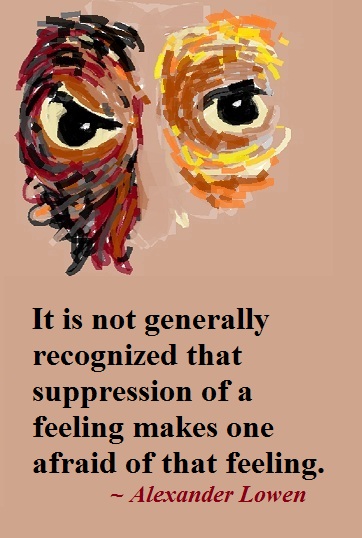
The best book I know on the subject is Alexander Lowen’s Depression and the Body. Lowen explains that depression is a physical symptom — an exhaustion that comes from fighting oneself by suppressing feelings that need and want to come out.
Depression, in short, is caused by emotional constipation.
Ever been physically constipated? Notice how, the longer it lasted, the more uncomfortable you felt? How the internal pressure and tension came to occupy all your energy, all your attention?
Suppressed feelings affect us in the same way.
It’s no accident that people in recovery use excretory metaphors (“my shit’s coming up,” “get my shit together,” “acts like his shit doesn’t stink”) to describe emotional processes. Feelings are a kind of waste material, the emotional byproducts of experience, just as feces are the physical byproducts of what we eat. And just as physical waste must be expelled from the body, feelings must be expressed — not hidden or stored up.
When they aren’t, we get sick, emotionally, physically and spiritually.
Lowen writes,
The self is experienced through self-expression, and the self fades when the avenues of self-expression are closed.
The depressed person is imprisoned by unconscious barriers of “shoulds” and “shouldn’ts,” which isolate him, limit him, and eventually crush his spirit.
In my family self-expression was no option. Dad’s drinking and mom’s depression made that impossible. Neither of them could handle their own feelings; how could I expect them to cope with mine?
So like all kids, I adapted to my parents. I learned to avoid disappointment, conflict and rejection — to control their reactions to me — by burying what I felt.
I moved out of my body and took up residence in my head. I developed a personality organized around this way of coping.
Now I’m a sixty-two-year-old monkey, and still organized that way.
Yes, despite everything I learned from Steve and his clients, my Plan A isn’t easy to leave behind. Stuffing feelings is still my first impulse, especially under stress. I still find it scary to give up overcontrolling myself and others, to surrender to feelings, to be myself without fear. I probably always will.
But I rarely feel crappy in the old way anymore. Because now I know I have a choice.
I can express myself or I can depress myself.
Or, put another way:
I can fight myself and keep losing. Or I can make room for feelings in my life and relationships.
And, at least some of the time, escape the common cold.
.
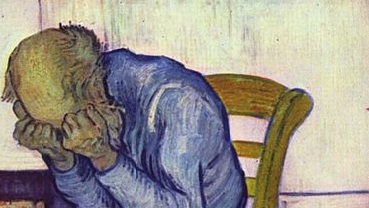 Feeling down from time to time is a normal part of life.
~ From Understanding depression: Signs, symptoms, causes and help at HelpGuide.org.
Recently one reader wrote to complain that when he tried to leave a comment here, WordPress required him to register, which he found annoying. As would I.
Has anyone else had that experience here?
If so, please let me know by emailing me at fritzfreud@aol.com.
 (Bert speaking:)
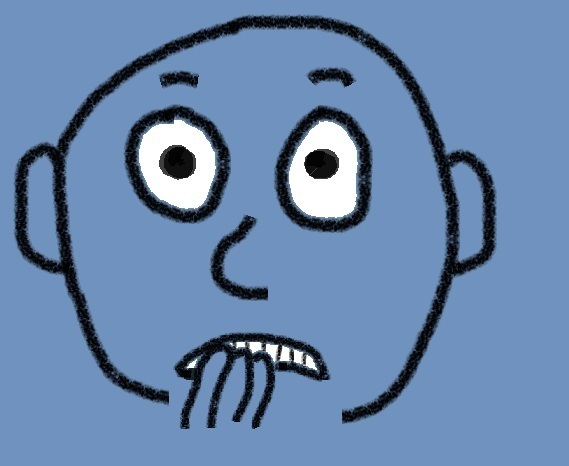
I am one nervous monkey.
Not full-blown panic-attack nervous (though there have been times when I came close).
No, my anxiety is more of the garden-variety, chronic type. You know, where you go around tense or uneasy, unable to fully relax or enjoy yourself because it feels like something bad’s going to happen, only you’re not sure what.
You know.
I’ve been this way as long as I can remember. Anxiety has followed me around throughout most of my life, wherever I go, whatever I do, like background music.
It’s taken me a while to figure it out.
What I finally discovered (mainly by eavesdropping on sessions while Steve was teaching clients about control addiction) is that I have three ways to keep myself nervous.
The first is to
(1) Try to control the future.
I do this the same way you do it — by thinking about it.
I anticipate. Plan. Worry. Obsess. Form expectations. Insist that my expectations be met.
In other words, I allow my thoughts to be dominated by monkey mind.
This is a highly efficient system: it keeps anxieties growing like weeds. The more I worry about the future, the more anxious I get. The more anxious I get, the more I worry about the future. And so on.
The second way of staying nervous is to
(2) Try to control other people.
I do this by insisting — secretly, I mean, in the privacy of my own mind — that other people always like me and approve of me and admire me and agree with me and laugh at my jokes.
I actually convince myself that I really need them to behave that way, that it will be intolerable if they don’t.
That’s bullshit, of course. But it’s not hard to convince myself it’s true. All I have to do is check in with my Top Dog, who’s always happy to remind me how inadequate I am. Then monkey mind does the rest. Sort of like tag-team wrestling.
How do I control other people? Mainly by editing myself — hiding the parts I’m afraid they won’t like.
Which brings me to the third way of making myself nervous:
(3) Bury feelings.
This one’s sure-fire.
As Steve explains it, feelings are like shit: waste products meant to be expelled from the body, not hidden or stored up. Bodies that holds in shit feel constipated. People that holds in feelings feels anxious.
This, too, is a self-perpetuating method. The more feelings I bury, the more anxious I get. The more anxious I get, the more I try to hide my feelings.
Thus the main symptom of my control addiction is an endlessly repeating cycle: anxiety leads to controlling, which leads to more anxiety, which leads to more controlling, around and around and around.
So. What to do?
Two practices
Some background anxiety is simply the cost of being human — of having oversized brains that worry endlessly, and of fearing rejections which make us feel insecure.
But you can turn down the volume.
I find the two practices that work best for me both involve (surprise) giving up control.
The first practice is taming monkey mind: meditation. Twice a day I sit at my desk for twenty minutes and try to count breaths. I rarely get beyond three or four before anxious thoughts interrupt and run amuck. I push the thoughts aside and go back to counting. I do this over and over and over.
Yes, it’s hard. Yes, it gets easier with practice. Yes, it works.
The other practice is emotional honesty. This has two steps. The first is to notice how often I feel the urge to lie, even in small ways. (Pleased to meet you. Ha ha, funny. No, that dress doesn’t make your butt look big.)
I face this choice maybe a hundred times a day. The second step is to try to increase the frequency with which I tell the truth, show myself as I am.
This too is difficult. Often, scary.
This too gets easier with practice.
And when I can do it, this — more than anything else — makes me a less nervous monkey.

~ From The energetics of bioenergetics by Alexander Lowen, MD (5:37)
“All happy families are alike; each unhappy family is unhappy in its own way,” wrote Tolstoy.
Not in my experience.
In my experience, unhappy families — especially unhappy marriages — are surprisingly similar.
Consider:
~ Heather wants to marry Ian, who’s scared of commitment. So she pressures him to propose, which scares him, so he backs away. This scares her, so she steps up the pressure (“Why won’t you marry me?”). Which makes him back away further and faster. And so on.
~ “He never talks to me,” is Janet’s main complaint about Kenny, who grew up in a family where no one talked to anyone about anything. The more she begs him to talk, the more inadequate Kenny feels. The more inadequate he feels, the more silent he becomes. Which angers Janet, which makes her beg harder. And so on.
~ Liz is a people pleaser who gets anxious when Mark is unhappy. So she knocks herself out putting his feelings, needs and preferences ahead of her own. Mark – who enjoys this and doesn’t want it to stop – finds he can keep Liz motivated by remaining unhappy. The unhappier he becomes, the harder she tries. The harder she tries, the unhappier he becomes. And so on.
~ Nan: “If you didn’t drink, I wouldn’t nag you.” Olivor: “If you didn’t nag me, I wouldn’t drink.” Rinse and repeat.
~ Patty and Ron both grew up in families that didn’t acknowledge or respect feelings. Hungry for emotional validation, they now seek it from each other. Unfortunately each takes the position, “I’ll validate you after you validate me.” Since neither validates first, no one gets validated. Ever. So their childhood deprivation continues. Indefinitely.
Sensing a pattern?
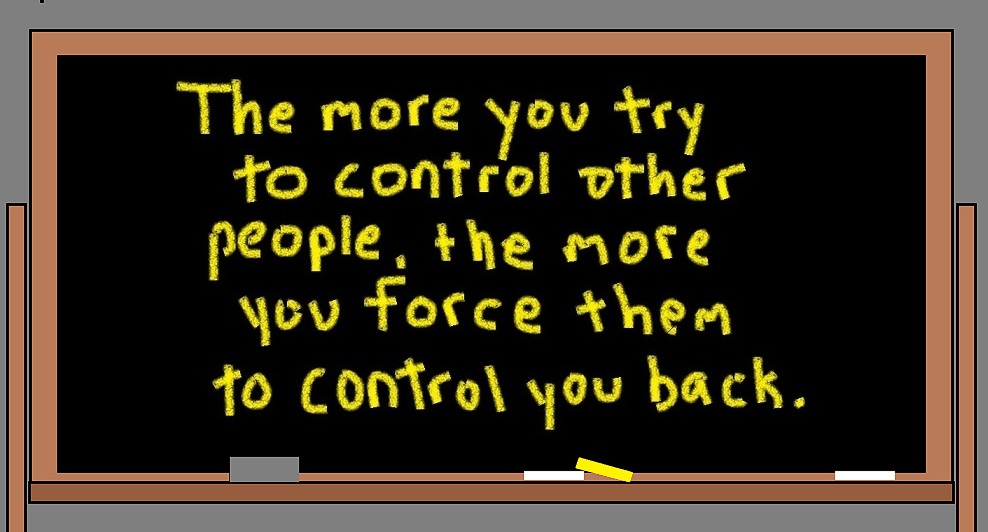
All five examples (and the variations are infinite) illustrate the Second Paradox of Control:
.
.
This is the interpersonal version of the First Paradox of Control (“The more control you need, the less control you have”) explained here last week.
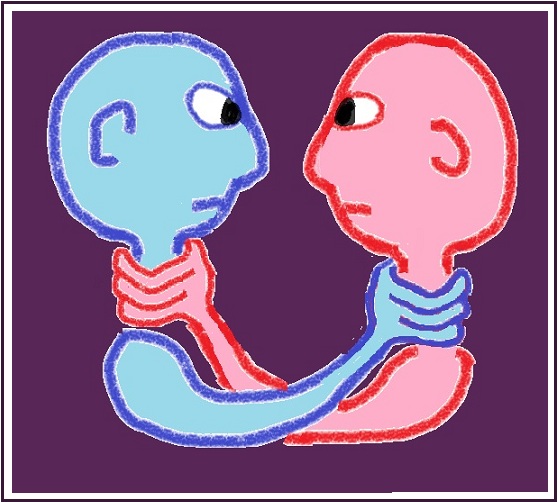
This Second Paradox grows out of an obvious fact of human nature: We all want control, yet we all resent being controlled by others.
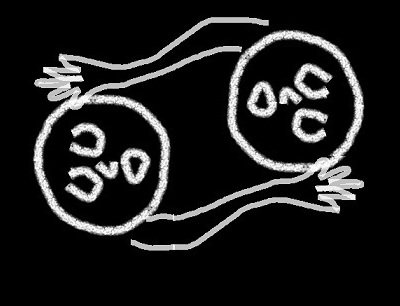
That’s just what is being played out in these examples. Each of the ten partners is trying desperately (if unconsciously) to transform the other into the partner they want. And each of the ten is resisting being transformed as hard as they can.
Call it control addiction a deux.
Or you could use the term I sometimes use in my clinical notes — monkeyships, meaning relationships bent out of shape by control issues.
Some of this goes on in all our relationships, because at some point we all turn monkeyish.
We all try to make the relationship and/or our partner into what we want them to be.
It has little to do with how much we love the person we’re with.
It has everything to do with how much control we think we need to feel safe.
And it continues unless and until we learn alternatives to our monkeyish behaviors.
 There are many signs and symptoms of controlling behavior in a relationship.
~ From How to tell if you’re in a controlling relationship (3:01) by Donna Marie Thompson, Ph.D. of bouncingbacknow.com.
.