Category Archives: control
A guy visits a farmer.
“Want to meet the smartest mule in the world?” the farmer asks.
“Sure,” says the guy.
So the farmer takes him to the barnyard and shows him a mule.
“What’s two plus two?” the farmer asks.
The mule stares back at him.
“I said, what’s two plus two?” shouts the farmer.
The mule stares.
The farmer picks up a rake handle and smacks the mule between the eyes.
The mule blinks, then stamps his foot: one, two, three, four.
“Great,” the guy says. “Smart mule. But why’d you hit him with the rake handle?”
“Oh,” says the farmer, “that was to get his attention.”
Control addicts are like all addicts.
Who are just like that mule.
They must get hit over the head before they can start recovering.
An addict’s rake handle is called “hitting bottom.” Bottom being that point where the pain of their addiction becomes larger than their fear of giving it up.
Control addicts need this no less than alcoholics and drug addicts.
They need that pain.
Without it, they won’t pay attention.
So don’t waste your time trying to convince them to stop their controlling.
And — please — never protect them from its consequences.
They need those consequences.
They need that pain.
And unless and until they feel it…
They’re just another mule in the barnyard.
4 Comments | posted in control
x
Don’t know?
Don’t worry.
You will,
after you read
 x
x
Coming soon to this space.
Leave a comment | posted in control
 x
x
Be honest, now.
x
If you are,
you’ll probably realize
how much
you need to read
![[MTB] + Part 1 - Addiction](https://monkeytraps.com/wp-content/uploads/2014/12/mtb-part-1-addiction.jpg?w=508&h=249)
Coming soon to this space.
.
1 Comment | posted in control
 x
x
Not sure what
you’re trying to control?
Uh oh.
Not good.
Be sure to read
Coming soon to this space.
Leave a comment | posted in control
 .
.
Maybe you’re picking
the wrong fights.
.
Learn how to pick
the right ones.
.
Read:
Coming soon to this space.
1 Comment | posted in control
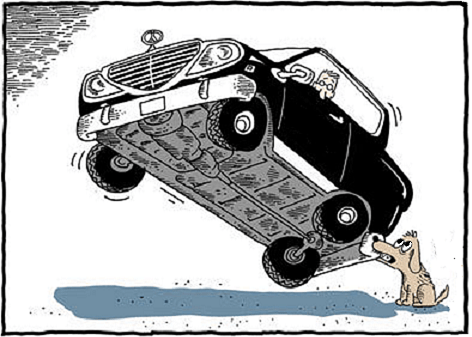
 We’re walking.
Loki lunges after every car that passes.
“What would you do if you caught one?” I ask.
He doesn’t answer.
But his silence gives me a chance to think about how people are like dogs.
The car we chase, of course, is control.
Ever wonder what would happen if we caught the car?
I know of two interesting possibilities.

One is the sedated, carefully emotionless dystopia of The Giver (2014), now available on DVD. (Can’t catch the movie? Read the book. It’s even better.)
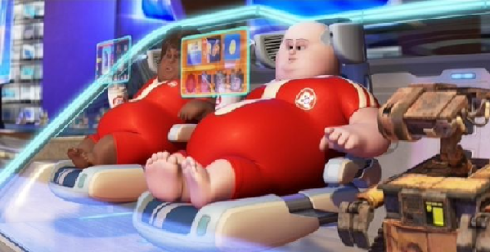
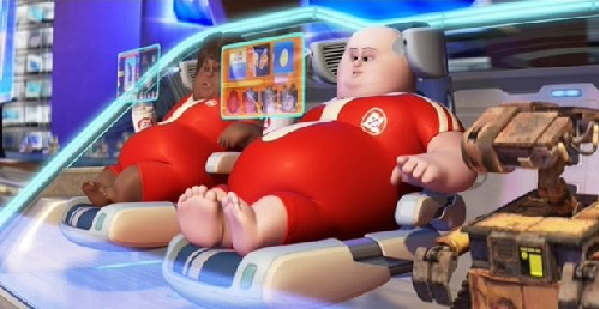
Another is Wall-E’s (2008) depiction of a fat, comfort-soaked future where robots do all the work and humans have nothing to do but develop morbid obesity.
What these two visions share is a recognition of humanity’s craving for comfort, aversion to pain, and how disastrous it would be if we ever managed to gratify both totally.
Life would change fundamentally, they agree. And it wouldn’t be pretty.
It wouldn’t even be life.
Seventy-six years ago Aldous Huxley took the same view in Brave New World (1939). That novel describes a world where war, aging, illness, hunger and anxiety have been largely eradicated, and features this dialogue between two characters called the Controller and the Savage:
Controller: We prefer to do things comfortably.
Savage: But I don’t want comfort. I want God, I want poetry, I want real danger, I want freedom, I want goodness. I want sin.
Controller: In fact, you’re claiming the right to be unhappy.
Savage: All right then, I’m claiming the right to be unhappy.
Controller: Not to mention the right to grow old and ugly and impotent; the right to have syphilis and cancer; the right to have too little to eat; the right to be lousy; the right to live in constant apprehension of what may happen tomorrow; the right to catch typhoid; the right to be tortured by unspeakable pains of every kind.
Savage: I claim them all.
My point here is simple.
Like all animals, we’re wired to seek pleasure and avoid pain.
But we’re the only animals able to exert control over the world into which we are born.
In many ways, this is a good and useful thing.
But given our tendency to overcontrol reality…
God help us if we ever catch that car.
x
x
1 Comment | posted in control
 First session of the new year.
She looks haggard.
I ask how her holidays went.
“Awful,” she says. “My demented inlaws visited. Which started my husband drinking. Which started us fighting. Which scared the crap out of the kids.
“Now I can’t stand the marriage and can’t stop thinking about leaving it. Can’t sleep or eat. Can’t stop crying at work. Can’t stop worrying or feeling scared.”
“Jesus,” I say. “How can I help?”
She looks at me. “Get me out of here.”
We exchange sad smiles.
“Or at least,” she says, “teach me how to survive a shitstorm.”
“Okay,” I say. “Leave the room.”
“Huh?”
“You have two rooms in your house,” I say. “Your mind and your body. Right now you’re trapped in your mind. Stay there and you’ll go crazy. You need to drop down a floor.”
“How?”
“Whatever works for you. Walk. Go to the gym. Take a yoga class. Dance. Take a bath. I used to lie on a hard floor and focus on trying to get comfortable. Anything that moves your attention from thinking to feeling.”
“And then?”
“Then listen. Your body will tell you what you need first. It’s telling you now, but you’re too scared to listen.”
“What I need,” she repeats.
“Sure. There’s stuff you can solve right now and stuff you can’t. Can’t fix your husband or his family. But you can take better care of yourself, get rest and food and exercise. And that will help you feel better and give you strength to figure out the other stuff.”
“Still not sure how,” she frowns.
“Start now. Take a breath. Move your attention to your body. What do you notice?”
She breathes and listens.
“My heart hurts,” she says.
“What’s it feel like?”
“Like being squeezed by a big hand.”
“And what’s your body need?”
She breathes again. And starts to cry.
She cries for ten minutes.
I pass her a box of tissues and wait.
Finally she stops and looks at me. I raise my eyebrows to ask how she is.
“Better,” she smiles.
4 Comments | posted in control
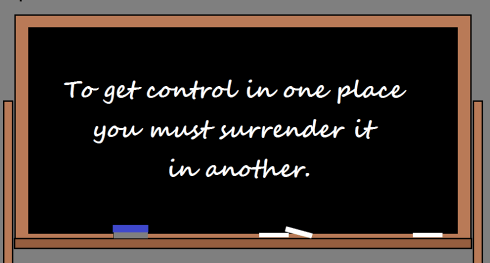
The Third Paradox of control:
.
Controlling boils down to a tradeoff.
Gain control here, lose control there.
Think of the original monkey trap:
To hold on to the banana, the monkey surrenders his freedom. To regain his freedom, he must let the banana go.
It also explains all garden-variety codependent interactions:
To control you (make you like, love or accept me) I must surrender control of something else — like my ability to be honest, or spontaneous, or emotionally expressive.
Conversely,
Taking control of my emotional life — especially how I feel about myself — means surrendering control over how you react to me.
It also applies to New Year’s resolutions, not to mention all goal-setting:
To reach a particular goal (like writing my book) I must surrender control of others (like spending time with my family, or on chores that absorb my energy and attention).
To gain control of my weight I must surrender control (i.e., limit my choices) of what I put in my mouth.
To control my social anxiety I must detach from how other people see me and practice being myself.
And so on.
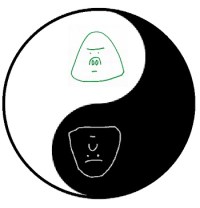
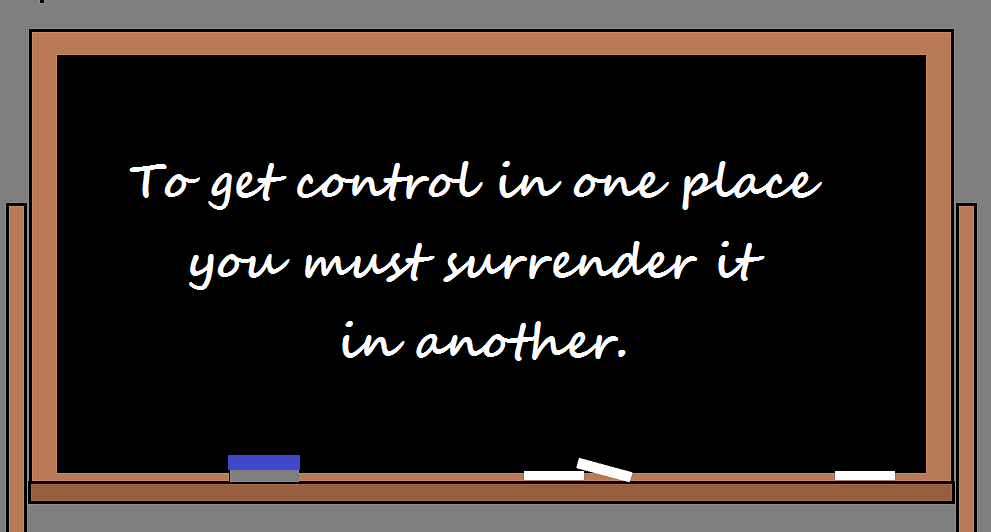
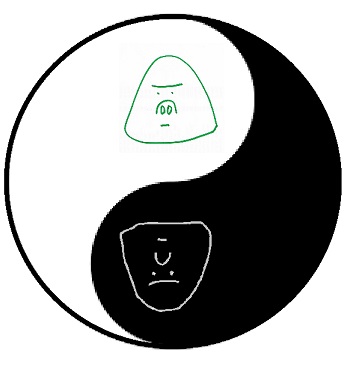
So control and surrender are two sides of the same coin.
And getting control of anything means losing control of something else.
To win A, you must sacrifice B.
Tradeoff.
Balance.
Yin-yang.
Fill your bowel to the brim
and it will spill.
Keep sharpening your knife
and it will blunt.
Chase after money and security
and your heart will never unclench.
Care about people’s approval
and you will be their prisoner.
1 Comment | tags: addiction to control, anxiety and control, control, control - alternatives to, control - detachment vs, control - idea of | posted in addiction to control, anxiety, control, control addiction, paradoxes of control, personal development, personal growth, recovery, surrender, Third Paradox
As I was saying, control addiction behaves paradoxically.
The Second Paradox is:
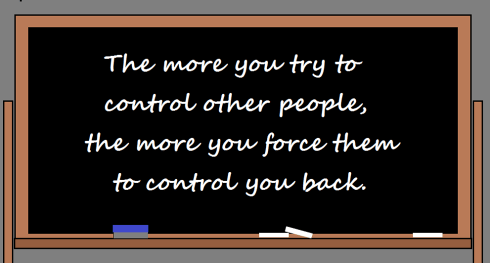
.
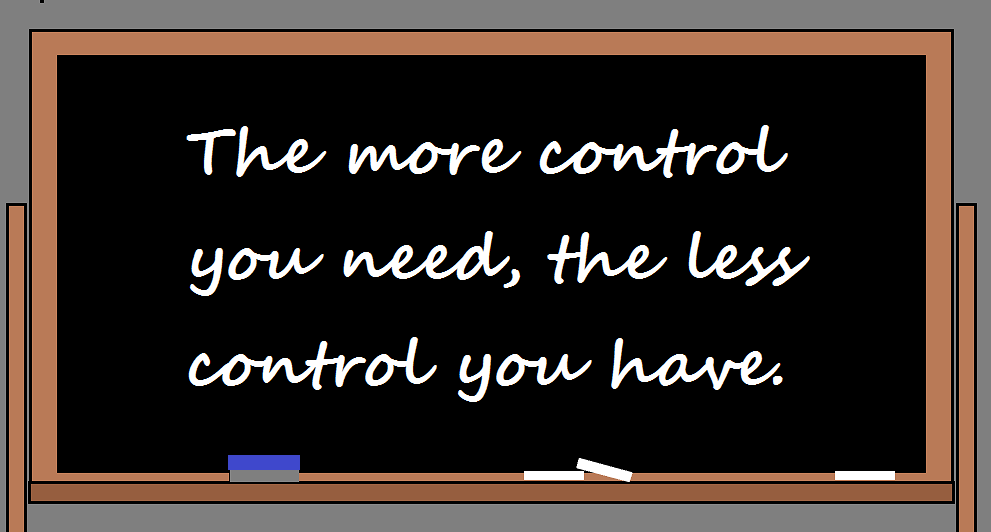
This is an interpersonal version of the First Paradox (“The more control you need, the less control you have”).
And what does it look like in action?
Consider:
Heather wants to marry Ian, who’s scared of commitment. So she pressures him to propose. This scares him, so he backs away. This scares her, so she steps up the pressure (“Why won’t you marry me?”). Which makes him back away further and faster. And so on.
*
“He never talks to me,” Janet complains about Kenny, who grew up in a family where no one talked about anything. The more she begs him to talk, the more anxious and inadequate Kenny feels. The more anxious and inadequate he feels, the more silent he becomes. Which angers Janet, which makes her beg harder. And so on.
*
Liz, a people pleaser, gets anxious when Mark is unhappy. So she knocks herself out putting his feelings, needs and preferences ahead of her own. Mark – who enjoys this – finds he can keep Liz motivated by remaining unhappy. The unhappier he becomes, the harder she tries. The harder she tries, the unhappier he becomes. And so on.
*
Nancy: “If you didn’t drink, I wouldn’t nag you.” Oscar: “If you didn’t nag me, I wouldn’t drink.” Rinse and repeat.
*
Patty and Ron both grew up in families that didn’t acknowledge or respect feelings. Hungry for emotional validation, they now seek it from each other. Unfortunately each takes the position, “I’ll validate you after you validate me.” Since neither validates first, no one gets validated. Ever. So their childhood deprivation continues. Indefinitely.
See the pattern?
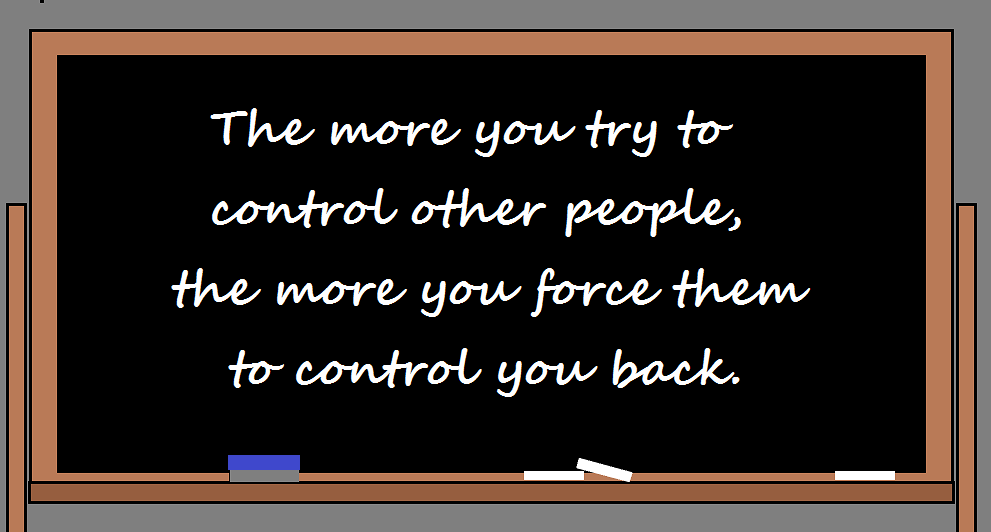
This paradox grows out of two facts of human nature: Everyone wants control, and no one wants to be controlled by others.
That’s what is being played out above. Each of these ten partners tries desperately (if unconsciously) to transform the other into the partner they want. And each resists transformation as hard as they can.
Even people who seem to comply with their partner’s (or parent’s) demands are doing it out of a need to control the other’s behavior.
This creates not love, not intimacy, not healthy connection, but monkeyship — relationship bent out of shape by control issues.
Some of this goes on in all our relationships. At some point we all turn monkeyish. We all try to make our partner into the person we want them to be.
It has little to do with how much we love that partner.
It has everything to do with how much control we think we need to feel safe.
And it continues until we learn alternatives to monkeyish behavior.
2 Comments | posted in control
x
paradox: a seemingly true statement or group of statements that lead to a contradiction or a situation which seems to defy logic or intuition. ~ Wikipedia
x
Control addiction is hard to escape because it behaves paradoxically.
I.e., not as you’d expect.
So far I’ve noticed three paradoxes that confuse the hell out of people and keep them addicted.
Here’s the First Paradox:
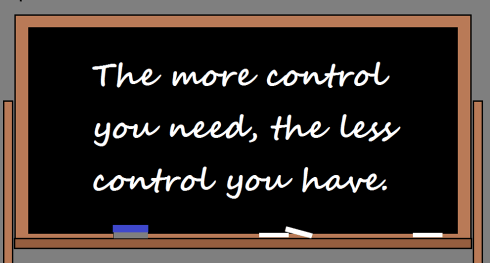
Needing control has a sort of boomerang effect. The harder you try to get more of it, the more you end up feeling controlled.
You feel controlled by, surprise, your need for control.
And this happens with weird regularity.
Still, it’s easy to overlook if you’re not looking for it. So I thought some stories might help illustrate this stubbornly reliable principle.
The actors in each of these (except the last) are heavily disguised, but all the events are based in fact.
Annie’s depressed because she’s overweight. So she eats cookies to make the depression go away. Which makes her more overweight. Which makes her more depressed. Which makes her eat more cookies. The more control you need, the less you have.
*
Barry’s wife drinks. This panics Barry, so he does everything he can think of to stop her. He reasons, begs, nags, yells, makes nasty comments, threatens divorce, hides her wine, pours it down the toilet. Stressed by Barry’s behavior, his wife drinks more. The more control you need, the less you have.
*
Carol’s daughter fails Math and lies about it. This enrages Carol, who can’t stand to be lied to. So she confiscates her daughter’s cell phone and warns her of worse punishments if she lies again. This scares her daughter, who starts keeping more secrets and lying about more stuff. Which leads to more punishments. Which lead to more fear and more lies. The more control you need, the less you have.
*
Dennis is an anxious man whose last wife cheated on him. Now he worries his new wife might do the same. So he carefully monitors her comings and goings, and makes sure he knows where she is and who she’s with. Then listens in on her phone calls. Then intercepts and examines her cell phone records. Then starts following her on errands. As a result of all this his anxiety soars to panic-attack levels, and his wife finds a boyfriend with whom she can relax. The more control you need, the less you have.
*
Eve’s boyfriend is abusive. He doesn’t hit her, but yells and criticizes and threatens her constantly. Friends beg Eve to dump him, but she’s scared that will make him angrier. So she does her best to pacify and appease him. Since the boyfriend likes this result, he continues to yell, criticize and threaten. Then one day he hits her. The more control you need, the less you have.
*
Fred and Ginger are married. It’s the second marriage for each, and each brings to it a history of disappointed relationships. Both want the marriage to work and are scared that it won’t, which makes them hypersensitive to any and all relationship problems. They monitor each other closely for signs of dissatisfaction or anger. They repeatedly seek reassurance that their partner still loves them. They discuss their problems constantly. All this leaves them chronically uneasy in each other’s presence. The distance between them grows, which increases their uneasiness. They begin to bicker, then to fight. When they finally come to me for couples counseling the marriage is, in Fred’s words, “Circling the drain.” The more control you need, the less you have.
*
Steve’s dog runs away from home. Steve chases him across front lawns and through backyards, up and down streets. Panting and bracing himself for his first heart attack, Steve suddenly remembers the First Paradox. He stops running. He sits down in the street. The dog glances back at him over his shoulder. Steve flops over sideways. Closes his eyes. Waits. Hears nails clicking on pavement. Feels a long tongue flick his nose. Reaches out and grabs the dog’s collar. The more control…
Oh, you know.
1 Comment | posted in control
.
How are your holidays going?
Thought so.
Bert and I guessed you could use this refresher:
.
In Asia they trap monkeys by placing bait in a heavy jar with a narrow neck. The monkey smells the bait, reaches in to grab it, and traps himself by refusing to let go.
A psychological monkeytrap is any situation that triggers you into compulsive controlling — into holding on when you really should let go.
And how can you tell when you’re at risk of entrapment?
Three tips:
.
Tip 1:
Notice where you’re uncomfortable.
We’re controlling whenever we need or want to change some piece of reality instead of accepting it or adapting to it as is. And we’re most likely to want to change realities that make us uncomfortable. So it makes sense that our discomfort zones are where we’re most likely to get monkeytrapped.
![[] bert panel (print for edit)](https://monkeytraps.com/wp-content/uploads/2014/04/bert-panel-print-for-edit.jpg?w=490) Bert: Me, I hate rejection. So I’m most controlling with people I think might reject me. I hide feelings I think will upset them, pretend to agree when I really don’t, laugh at stupid jokes, avoid confronting behavior I dislike, try to read their minds, and so on and so on. Keeps me busy.
Bert: Me, I hate rejection. So I’m most controlling with people I think might reject me. I hide feelings I think will upset them, pretend to agree when I really don’t, laugh at stupid jokes, avoid confronting behavior I dislike, try to read their minds, and so on and so on. Keeps me busy.
.
Tip 2:
Notice where you’re stuck.
Stuck as in not learning, healing or growing — struggling with the same damn problem over and over. You know you’re monkeytrapped whenever you find yourself doing what you already know doesn’t work.
Bert: All that controlling I just described traps me because it (a) stops me from being myself, which (b) prevents me from ever getting accepted as myself, which (c) keeps me chronically scared of rejection, which brings me right back to (a). Like riding an endless merry-go-round.
.
Tip 3:
Notice where you’re scared.
Like all addictions, compulsive controlling is anxiety-driven. We stay monkeytrapped because we’re scared to do anything else. Often even the thought of giving up control in such situations is enough to scare us silly.
Bert: Took me a long time to see that controlling doesn’t work. Or it does, but only for five minutes. Then another scary thing comes along and I have to control that. And life being what it is, there’s no end to scary things. So as an anxiety-reduction tactic controlling is a total flop.
The most frightened people are the most controlling people, and the most controlling people stay the most frightened.
5 Comments | tags: addiction to control, anxiety and control, control, illusion of control, pathologies of control | posted in anxiety and control, codependency, control, control addiction, personal growth
 Merry Christmas from the monkeys at Monkeytraps.
4 Comments | posted in control
Control is the child’s basic tool.
As kids we have no power, no ability to take care of ourselves. We need big people (like parents) to do that. And we use control to make sure those big people do their job.
We learn this before we have language. We learn it the first time we cry and mom picks us up and feeds or rocks us or changes our diaper. “Hey,” we realize. “What I do affects what she does.”
And the urge to control is born.
We spend childhood learning thousands of ways to control big people:
Want mom to love you? Don’t talk back.
Want dad to be proud of you? Get straight A’s.
Want teacher’s approval? Do your homework.
Want to avoid being bullied? Appease the tough kid.
This is how we navigate early life. For kids there’s no other way.
Of course at some point we’re supposed to develop some power — the ability able to stand up for and take care of ourselves.
But many of us don’t. Many of us (especially if we’ve been abused or traumatized) stay stuck in kid mode.
We keep relying on control to get our needs met and manage relationships. We keep seeking approval and avoiding conflict. We hide who we are, bury our true feelings, and try our damnedest to be whatever we think others want us to be.
Most of the time we do this without even realizing we’re doing it.
And that’s the basic problem of all control addicts.
They’re stuck with the tool of a child to cope with the life of an adult.
2 Comments | posted in control
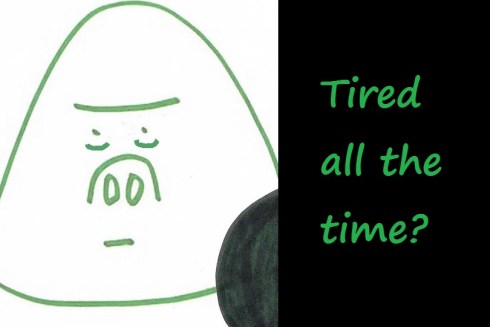
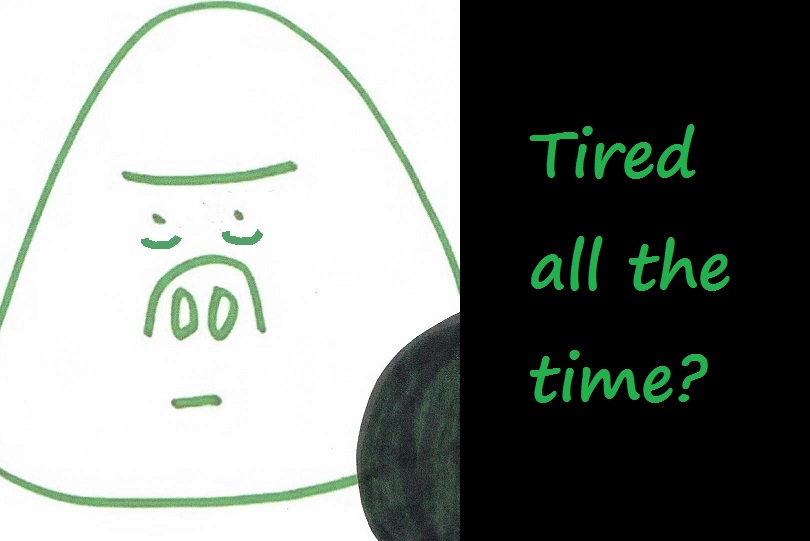
Bert is.
He’s tired because he’s a control addict.
Control addicts get tired a lot, though they don’t always understand why.
It’s because they’re always trying (often without realizing) to bend reality to their will.
And when you fight against reality, reality always wins.
Sound familiar?
If so, don’t despair.
Monkeytraps
(The Book)
starts in January.

(For more Bert, follow Bert’s therapy: Adventures of an inner monkey.)
Leave a comment | posted in control

![[MTB] + Part 1 - Addiction](https://monkeytraps.com/wp-content/uploads/2014/12/mtb-part-1-addiction.jpg)



![[] bert panel (print for edit)](https://monkeytraps.com/wp-content/uploads/2014/04/bert-panel-print-for-edit.jpg)