.
How are your holidays going?
Thought so.
Bert and I guessed you could use this refresher:
.
In Asia they trap monkeys by placing bait in a heavy jar with a narrow neck. The monkey smells the bait, reaches in to grab it, and traps himself by refusing to let go.
A psychological monkeytrap is any situation that triggers you into compulsive controlling — into holding on when you really should let go.
And how can you tell when you’re at risk of entrapment?
Three tips:
.
Tip 1:
Notice where you’re uncomfortable.
We’re controlling whenever we need or want to change some piece of reality instead of accepting it or adapting to it as is. And we’re most likely to want to change realities that make us uncomfortable. So it makes sense that our discomfort zones are where we’re most likely to get monkeytrapped.
 Bert: Me, I hate rejection. So I’m most controlling with people I think might reject me. I hide feelings I think will upset them, pretend to agree when I really don’t, laugh at stupid jokes, avoid confronting behavior I dislike, try to read their minds, and so on and so on. Keeps me busy.
.
Tip 2:
Notice where you’re stuck.
Stuck as in not learning, healing or growing — struggling with the same damn problem over and over. You know you’re monkeytrapped whenever you find yourself doing what you already know doesn’t work.
Bert: All that controlling I just described traps me because it (a) stops me from being myself, which (b) prevents me from ever getting accepted as myself, which (c) keeps me chronically scared of rejection, which brings me right back to (a). Like riding an endless merry-go-round.
.
Tip 3:
Notice where you’re scared.
Like all addictions, compulsive controlling is anxiety-driven. We stay monkeytrapped because we’re scared to do anything else. Often even the thought of giving up control in such situations is enough to scare us silly.
Bert: Took me a long time to see that controlling doesn’t work. Or it does, but only for five minutes. Then another scary thing comes along and I have to control that. And life being what it is, there’s no end to scary things. So as an anxiety-reduction tactic controlling is a total flop.
The most frightened people are the most controlling people, and the most controlling people stay the most frightened.
5 Comments | tags: addiction to control, anxiety and control, control, illusion of control, pathologies of control | posted in anxiety and control, codependency, control, control addiction, personal growth
 Merry Christmas from the monkeys at Monkeytraps.
4 Comments | posted in control
Control is the child’s basic tool.
As kids we have no power, no ability to take care of ourselves. We need big people (like parents) to do that. And we use control to make sure those big people do their job.
We learn this before we have language. We learn it the first time we cry and mom picks us up and feeds or rocks us or changes our diaper. “Hey,” we realize. “What I do affects what she does.”
And the urge to control is born.
We spend childhood learning thousands of ways to control big people:
Want mom to love you? Don’t talk back.
Want dad to be proud of you? Get straight A’s.
Want teacher’s approval? Do your homework.
Want to avoid being bullied? Appease the tough kid.
This is how we navigate early life. For kids there’s no other way.
Of course at some point we’re supposed to develop some power — the ability able to stand up for and take care of ourselves.
But many of us don’t. Many of us (especially if we’ve been abused or traumatized) stay stuck in kid mode.
We keep relying on control to get our needs met and manage relationships. We keep seeking approval and avoiding conflict. We hide who we are, bury our true feelings, and try our damnedest to be whatever we think others want us to be.
Most of the time we do this without even realizing we’re doing it.
And that’s the basic problem of all control addicts.
They’re stuck with the tool of a child to cope with the life of an adult.
2 Comments | posted in control
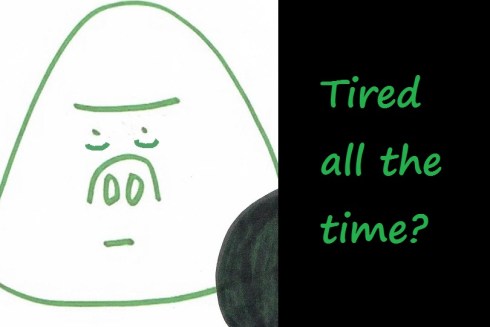
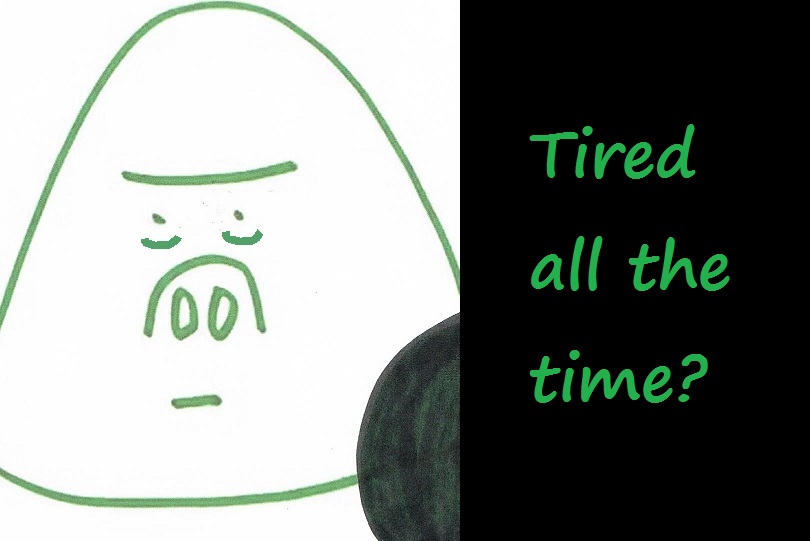
Bert is.
He’s tired because he’s a control addict.
Control addicts get tired a lot, though they don’t always understand why.
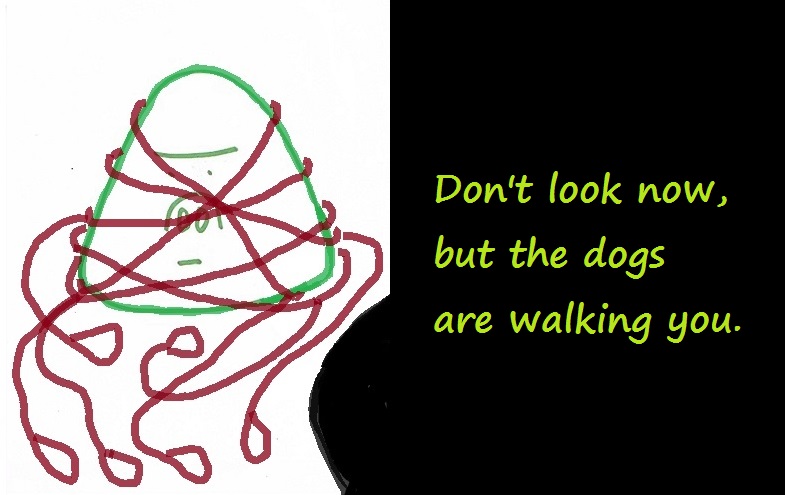
It’s because they’re always trying (often without realizing) to bend reality to their will.
And when you fight against reality, reality always wins.
Sound familiar?
If so, don’t despair.
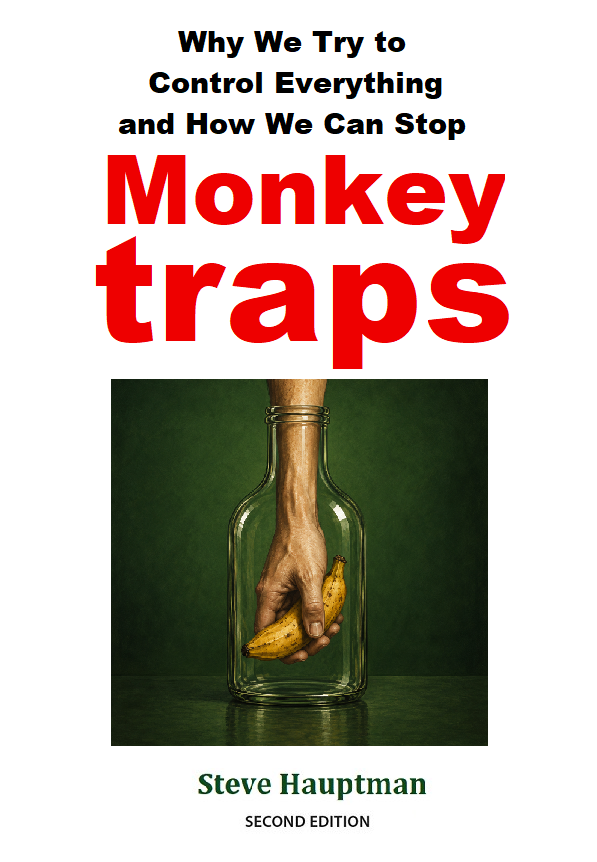
Monkeytraps
(The Book)
starts in January.

(For more Bert, follow Bert’s therapy: Adventures of an inner monkey.)
Leave a comment | posted in control
 Question: Why do the holidays feel like hell to codependents?
Answer: So much to control, so little time.
Control addicts constantly compare the reality they have with the reality they want, then try to bring the two closer together.
‘Tis the season for that.
And how do we do it?
Usually in too many ways to count.
Some favorites:
~ We imagine ideal holidays and try to manufacture them.
~ We remember traumatic holidays and try to compensate for them.
~ We notice relationship problems and try to disguise them.
~ We notice feelings that don’t match the holiday mood (resentment, jealousy, anxiety, rage) and judge ourselves for feeling them.
~ We associate with people we don’t really like, then suppress or deny our inevitable discomfort.
~ We use the holidays as a benchmark to measure our progress through life, then try to conceal our sense of disappointment or inadequacy.
~ We mask our awareness of all the above by eating or drinking or drugging or spending too much, then wonder why we end up feeling empty, lonely and mad at ourselves.
What to do instead?
(1) Pay closer attention. Notice what you already do. Don’t judge your behavior, just observe it. Can’t change what you’re unconscious of.
(2) Focus your awareness with the three questions: What am I trying to control? Have I had any luck controlling this in the past? If not, what can I do instead? The answer to question 3 should be some form of surrender, responsiblity and/or intimacy. But don’t beat yourself up if you’re not sure how to do any of that yet.
(3) Use the year before the next round of hellidays to get better at answering that third question.
4 Comments | posted in control
x
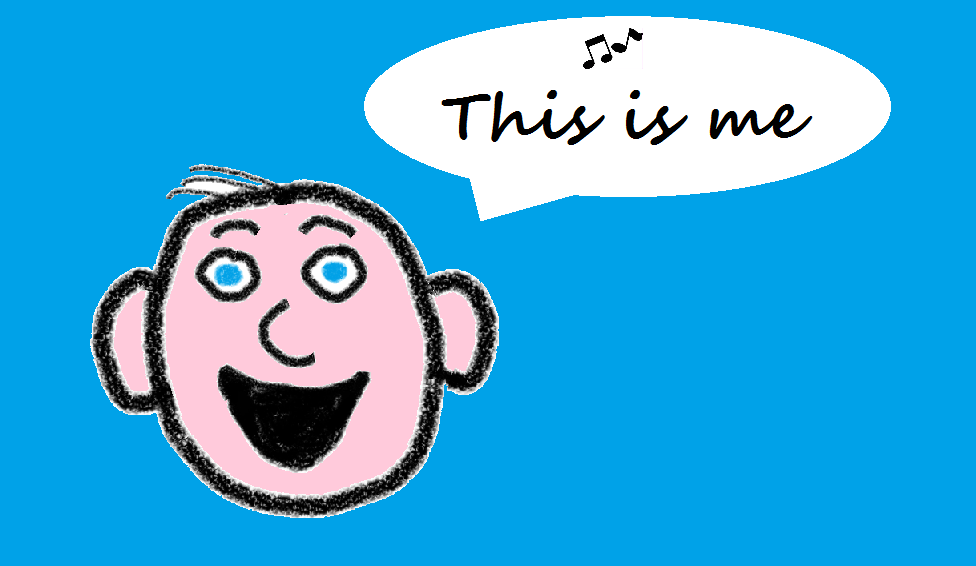
The song of the child:
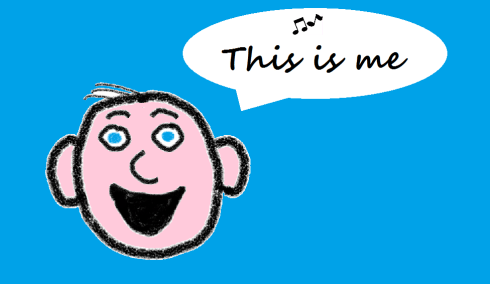
x
The song of the socialized adult:
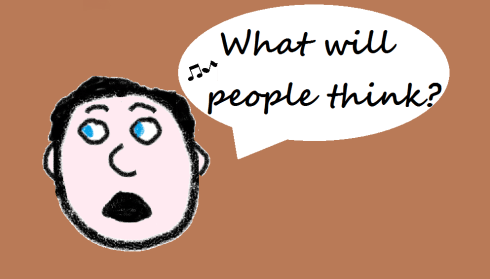
x
The song of the healthy grownup:
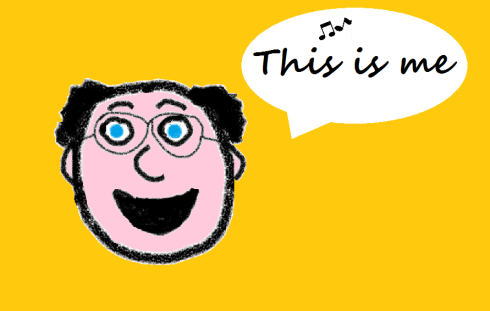
Which is your theme song?
Not the one you’d like?
If so, don’t despair.
Monkeytraps
(The Book)
starts in January.
Leave a comment | posted in control

There’s something we’re all after, something we chase all the time.
Click here to watch The chase.
2 Comments | posted in control
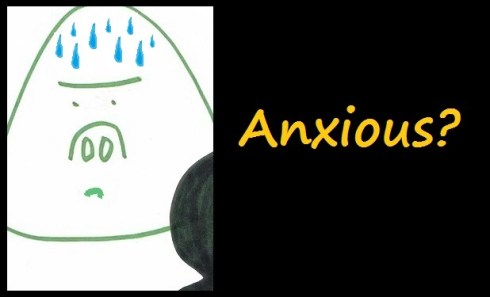
Bert is.
Bert’s a control addict.
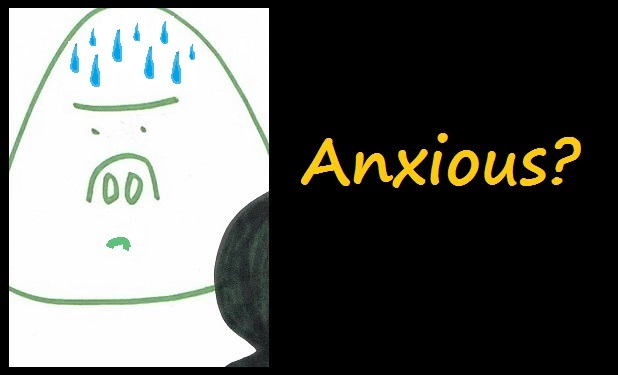
Control addicts are usually anxious.
Their anxiety is what makes them controlling.
Unfortunately their controlling makes them even more anxious.
So the more they try to control stuff they more anxious they get, and the more anxious they get…
Sound familiar?
If so, don’t despair.
Monkeytraps
(The Book)
starts in January.
(For more Bert, follow Bert’s therapy: Adventures of an inner monkey.)
Leave a comment | posted in control
Don’t despair.
Monkeytraps (The Book)
starts in January.
Leave a comment | posted in control
The folks in AA have a term to describe the denial-ridden thought process of alcoholics:
Stinking thinking.
Examples include,
It’s not a problem, I can stop whenever I like. Or Hey, it’s only one beer. Or It’s your fault I drink so much. Or Everyone’s against me. Or Who gives a shit? And so on.
Control addicts have their own version of stinking thinking. It takes various forms, but behind them all is a dangerous (and often unconscious) assumption:
If I just try again, or harder, or longer, or differently,
I can make things turn out the way I want them to.
Yeah. Right.
When stink think crops up in session I usually recommend an antidote I call the three questions:
What am I trying to control here?
Have I had any luck controlling it before?
If not, what can I do instead?*
*(I.e., which of the three healthy alternatives to control — surrender, responsiblity or intimacy — would help me in this situation?)
Taken together, and answered honestly, these questions amount to a free, convenient, and surprisingly reliable bullshit detector.
Like alcoholics, control addicts take a while to notice their own stinking thinking, and even longer to interrupt it.
But those who ask the three questions regularly can speed the process of unstinking their thinking.
_____________________________
3 Comments | posted in control
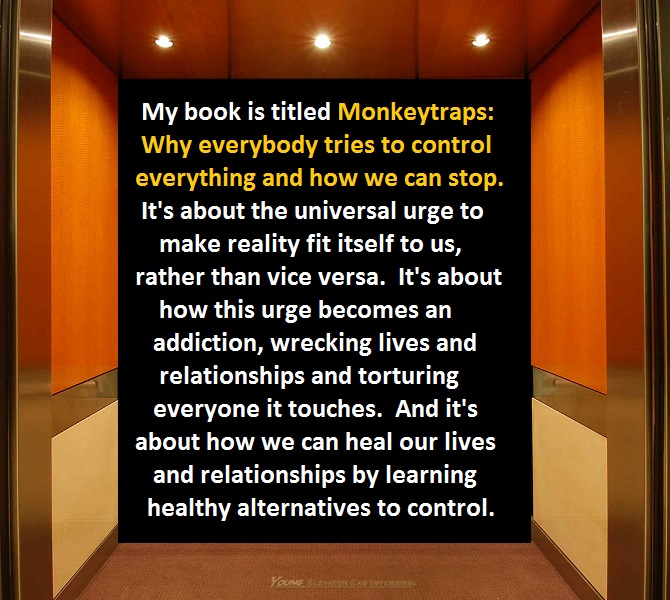
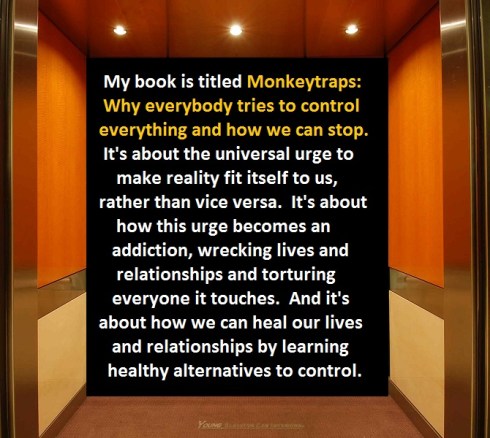
An elevator pitch is a summary of a book brief enough to deliver in the space of an elevator ride.
Below is one I just wrote for my impending opus Monkeytraps.
Feedback welcome.
x
13 Comments | posted in control
First time I heard it, the term adult child made no sense to me.
It seemed an obvious contradiction in terms, like square circle or military intelligence.
I understand better now.
I understand that an adult child is someone who’s adult on the outside, childish inside.
That the childish part is a collection of unmet needs, unresolved conflicts and unexpressed feelings.
That, under stress, this part gets triggered, and the adult experiences all the fears and insecurities of the child when that child’s growth was interrupted.
And that you needn’t have grown up in an alcoholic or abusive or especially dysfunctional family for this to be true of you.
That it happens to all of us.
In other words, that Andrew Malraux was right when he wrote,
There is no such thing as
a grown-up human being.
That we are all adult children.
Leave a comment | posted in adult children of alcoholics, alcoholic family, control, control addiction
Everyone over the age of two knows relationships are difficult.
Not everyone understands why.
It’s because relationship forces us to combine things that don’t go together.
Specifically, to meet two sets of seemingly incompatible needs:
Connection and separateness.
Security and freedom.
Acceptance by another and self-acceptance.
A real partner and a real self.
Put another way, relationship forces us to answer two questions:
How can I have you without losing me?
How can I have me without losing you?
Tough questions.
How do I have you and me at the same time?
Most people I know are secretly convinced that you can’t.
Most came from families — alcoholic, or abusive, or otherwise dysfunctional — unable to teach them to balance connection with separateness.
What they learned instead was that having one meant losing the other. That winning love and approval from parents, for example, meant sacrificing parts of themselves, like the freedom to express feelings or take care of their own needs.
The family that raised us is where each of us learned our own personal answer to the two questions. And the answer we learned grew into a crucial (though mostly unconscious) part of our basic view of life and relationships, what I call our Plan A.
Some of us decide, “Since I can’t have both, I’ll have you, and to hell with me.” This is the infamous codependent answer.
Others decide, “Since I can’t have both, I’ll have me, and to hell with you.” Shrinks call this the narcissistic answer.
Neither answer works.
Eventually codependents tire of feeling like doormats, while narcissists tire of feeling all alone.
At which point, if they’re smart (or have a smart therapist), they go back to struggling with the two questions.
You can’t answer these questions, only struggle with them.
But it’s the struggling that matters.
Because without it, healthy relationship is impossible.
* * *
Re: my impending book,
Leave a comment | posted in control, control addiction
In my work with couples the most common resentment I encounter is over the failure of partners to make each other happy.
And that’s because many of them have signed what I call the Codependent Suicide Pact.
It’s an agreement — usually unstated, often unconscious, always a potent shaper of feelings — that goes like this:
“I’ll sacrifice myself to your happiness, and you sacrifice yourself to my happiness, and that way we’ll both be happy.”
Wouldn’t it be pretty to think so.
But it doesn’t work. It doesn’t work because self-sacrifice of this sort tends to breed not happiness but disappointment, not contentment but anger.
Why?
Because happiness is ultimately the responsibility of each individual, not anyone else.
Because happiness comes from figuring out what you need, and learning how to get it.
From listening to and taking care of yourself, not relying on others to do the job for you.
And because all this takes work and learning and practice that only the individual can do.
When offered this idea some couples respond angrily: “Then what’s the point of being together?”
I reply,
“We’re social animals, wired for relationship. We’re supposed to pair up. Human beings need other human beings. Period.
“So sure, you can and should expect to be happier together than apart. But that’s not the same thing as being responsible for each other’s happiness.
“A couple’s happiness come from discovering each other — and themselves — within the context of relationship.
“From learning who each of you is, and what each of you needs, and how you can combine both identities and both sets of needs in one package.
“It’s like learning to dance. You set out to learn how to listen to the music and respond to it together. It takes practice. You start off bumping and stepping on each other’s toes. But you keep at it in hopes of learning, over time, how to move in harmony.
“Difficult? Sure. Not every couple succeeds at this.
“But working at relationship in this way is always a better approach than expecting your partner to pick you up and carry you around the dance floor.”
2 Comments | posted in control