
Family roles
Therapists who work with families know that unhealthy ones tend to draft their members into roles meant to offset the family’s dysfunction. Like the Hero, whose unconscious job is to make the family look good, and who does this by overachieving and trying to be perfect. Or the Scapegoat, whose unconscious job is to alert the world to how screwed up the family is, and who does this by self-destructing.
The tragedy of such roles is that so long as you occupy one you can never be happy. You can never be yourself, never make your own choices, never recognize your own needs and feelings. You’re not a person. You’re a living sacrifice.
***
From Bert’s Therapy, Session 7:

So? How do you feel?
Read the rest here.
Hard work
Intimacy means being yourself with another person and allowing them to do the same with you. As alternatives to control go it’s the toughest to practice, since it depends on practicing the other two alternatives — surrender and responsibility — as well. Intimacy’s hard emotional work for everyone. For control addicts it can be downright terrifying. But it’s also as good as relationships between human beings ever get.
***
From Bert’s Therapy, session 6:
I’ve decided I don’t like therapy.
Read the rest here.
Answer
To respond means to answer. Responsibility means the ability to do that, answer life and its problems appropriately, intelligently and effectively. Yet control addiction has essentially the same response (I must control this) to every problem, regardless of circumstances or how well it’s worked in the past. That’s neither appropriate, effective nor responsible. It’s crazy.
***
From Bert’s Therapy, session 5:

You face a choice of symptoms.
Read the rest here.
Raincoat
Some people confuse surrender with defeat. It’s not defeat. It’s acceptance. Surrendering to a reality beyond my control is no more defeatist than putting on a raincoat during a rainstorm.
***
From Bert’s Therapy, Session 4:
We didn’t talk at home.
Read the rest here.
Flavors
Controlling comes in many flavors: healthy and unhealthy, necessary and unnecessary, public and private, conscious and unconscious, choiceful and compulsive, functional and dysfunctional. It’s your job to decide which flavors you prefer.
.
* * *
From Bert’s Therapy, Session 2:
 She says I have communication issues.
Read the rest here.
4th law
The Fourth Law of Control: There are better ways of handling feelings than control. Surrender, responsibility and intimacy are our main alternatives to compulsive controlling. Each is difficult. Each requires endless practice. Each is a way of accepting life on life’s terms.
***
From Bert’s Therapy, Session 1:

I shouldn’t be here.
Why not?
Read the rest here.
Bert’s back
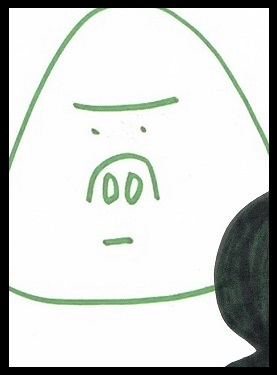
Therapy’s for weaklings.
Oh.
*
*
****
***
Veteran Monkeytraps readers
may remember that several years ago
my inner monkey Bert
went into therapy,
a process I described here
in a cartoon series.
*
I have resurrected that series,
and am reposting all the original
cartoons in a new blog
cleverly named Bert’s Therapy.
*
(Yes, Bert has waived confidentiality.)
*
New readers wondering
who the hell Bert is
should read “The Meaning of Bert”
on the page titled Start Here.
*
If you’d like to receive each new post
as it appears, you can subscribe
to Bert’s Therapy
at the bottom of the page.
Clever
Some obviously bright people are actually more clever than intelligent — better at defending and justifying themselves than opening up to really learn anything. Doing therapy with such people comes to feel, over time, like chewing bubble gum: lots of activity, no discernable progress.
Embarrassed
Maybe, instead of feeling embarrassed by the truth, we should feel embarrassed by our need to hide it.
Purchase
Any safety or comfort you purchase by hiding your real self is neither truly safe nor entirely comfortable.
Terrorism
If we’re in a dysfunctional relationship I have many ways to control you. There’s nagging, criticism and open conflict, obviously. But there’s also the sigh, the smirk, the long silence, the sulk, the raised eyebrow, the sarcastic aside, the body language that shouts Stay Away. These are powerful weapons, ways to punish you for doing or saying stuff I dislike and coerce you into falsifying yourself. It’s a kind of domestic terrorism.
Quench
The control addict’s anxiety is relieved by obtaining more control as much as the alcoholic’s thirst is quenched by drinking more alcohol.
Safety
Lie. Or at least withhold the truth. Disguise your thoughts. Hide your feelings. Never say No. Read people carefully, anticipate their reactions, then give them only what they want or can tolerate. Stay in hiding. Do this until it becomes a habit, your automatic and unconscious default position. Until no one, even those of us who want to, can spot the real you. Then sit back and bask in useless safety.
3rd law
The Third Law of Control is Behind all controlling is the wish to control feelings. We assume more control will make us feel better, and that enough control means happiness. Neither assumption is true. Reality resists all attempts to control it, and reality always wins in the end. So fighting reality is tactically unwise. But most of us take a lifetime to discover that, and some of us never do.
Steve & Bert

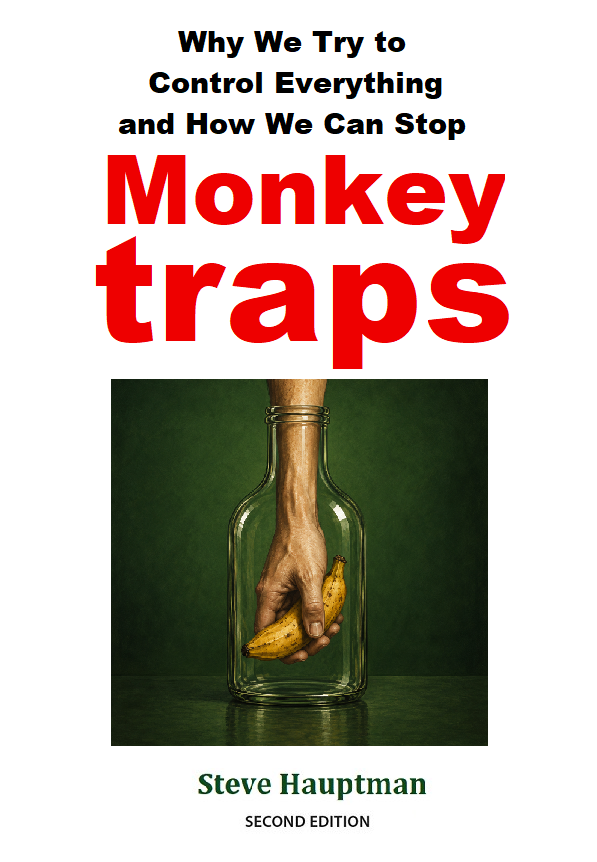
NOW AVAILABLE: An expanded 2nd edition
Follow the conversation:
Steve Hauptman on In time for Christmas. lollapaloozaalwaysbb… on In time for Christmas. gjvett on The two kinds of love About hidden agonizi… on Agony About hidden agonizi… on About hidden agony About hidden agony | on The psychology of shit The split-level rela… on Plan A janetbme01 on [3] Why I need everyone to lik… jpbauer of smashing… on [3] Why I need everyone to lik… Steve Hauptman on Dear friend and fellow mo… E. F. on Dear friend and fellow mo… Steve Hauptman on Dear friend and fellow mo… alisonlowrie on Dear friend and fellow mo… Steve Hauptman on Dear friend and fellow mo… delectablyradiantba9… on Dear friend and fellow mo… -
-

-
-


