Corduroy

I  got interested in control accidentally.   I was giving a talk and suddenly realized I didn’t know what I was talking about.

I was a new social worker, six months out of grad school, working for a clinic attached to a rehab on the end of Long Island.  My new boss decided I was the best one to run the weekly Family Education Series, basically a crash course in alcoholism and how it screws up families.  And tonight the topic was codependency.

I knew the topic well enough.  I’d worked as an alcoholism counselor and treated hundreds of codependents.  I could diagnose one in the first five minutes of a conversation. 

But when it came time to prepare this talk I found I couldn’t define the word.  At work we talked about codependency without ever stopping to explain what we meant.   And when I looked into my half-dozen books on the subject I found each defining it in a different way.  One was:

A specific condition characterized by preoccupation and extreme dependence on another person, activity, group, idea, or substance. [1]

Another:

An  emotional, psychological, and behavioral condition that develops as a result of an individual’s prolonged exposure to, and practice of, a set of oppressive rules. [2]

A third:

A multidimensional (physical, mental, emotional and spiritual)condition manifested by any suffering and dysfunction that is associated with or due to focusing on the needs and behavior of others. [3]

A fourth:

A recognizable pattern of personality traits, predictably found within most members of chemically dependent families, which are capable of creating sufficient dysfunction to warrant the diagnosis of Mixed Personality Disorder as outlined in DSM-III [4],

which sent me off to yet another book to learn what the hell that meant.

Finally I came to codependency maven Melody Beattie, who explained that a codependent is simply

a person who has let another person’s behavior affect him or her, and who is obsessed with controlling that person’s behavior. [5]

Fine definition.  Until I noticed it describes just about everyone.

Having no idea which definition would be best to offer my workshop, I cleverly decided to present them all.

So here I am, having just done that.  I’ve distributed a handout with the five definitions on it, and read them aloud, and am now looking at a roomful of confused faces.

A man in a brown corduroy jacket raises his hand.  I nod back.

“So what the hell is codependency?” he asks.

Everyone laughs.

I laugh too.  (Inside I’m thinking Shoot me now.)  Then I shrug and hear myself say, “Addiction to control.”

I am surprised at myself.  I’ve never thought of it this way before. 

But Corduroy starts asking questions, and I find I have answers, and it’s all making a new sort of sense.  I explain that I see codependents as traumatized people convinced their survival depends on controlling the effects of “their” alcoholic’s illness.  So they do things like hide booze and avoid dad at certain times of the day and lie to his boss about why he missed work or to the neighbors about why he fell asleep in the driveway.  From all these experiences they come to depend on control as a way of coping generally, and set about applying it to everything and everyone in their lives, to the point where it makes them sick. 

“Sick how?” Corduroy frowns. 

Mainly anxious and depressed, I tell him.  But also worried, and tense, and irritable, and unable to relax or have fun, or identify and express feelings, or trust anyone, or like themselves.  And self-medicating with food or work or helping other people or whatever else they can think of. 

And now Corduroy is nodding thoughtfully, and so are others in the room, and I know I’m onto something.

(To be continued.)

___________________ 

[1] Sharon Wegscheider-Cruse, ChoiceMaking: For co-dependents, adult children and spirituality seekers (Health Communications, 1985).
 
[2] Robert Subby, Lost in the shuffle: The co-dependent reality, quoted in Whitfield (see below).
 
[3] Charles Whitfield, Co-dependence: Healing the human condition (Health Communications, 1991).  
 
[4] Timmen Cermak, Diagnosing and treating co-dependence (Johnson Institute, 1986).
 
[5] Melody Beattie, Codependent no more (Harper/Hazelden, 1987).


Me and my monkey

Before I go any further with this blog thing I should introduce my co-author and research assistant. His name is Bert.

Bert is my inner monkey.

< (A recent photograph.   I know, he looks more like a gorilla.  But Bert is a monkey of many moods.  Today he feels gorillaesque.) 

We’ve lived and worked together for decades, Bert and I, but it’s only in the last few years that I began to notice him.  He’s unhappy about that.  He prefers I not notice him at all.  (In fact right now he’s sitting next to me, poking me with his monkeyfinger and trying to get me to stop writing this.  Attention inhibits him, he says.   Tough shit, Bert.)

How shall I describe him?

Well, Bert’s the part of me that

~ Tried to talk me out of writing this blog (because I’ve never done it before and have no idea what to expect).

~ Stops me from writing anything (because he’s scared of what people will think of what I think).

~ Does the same thing over and over, hoping for different results.

~ Avoids new places and new people.

~ Dislikes change (because it leads to feelings).

~ Dislikes feelings (because some are uncomfortable).

~ Loves numbness (especially the sorts induced by tv and sugar). 

~ Dwells in the dark twisted jungle of Worst Case Scenario.

~ Feels, when confused or scared, just like a six-year-old.

~ Regresses, at such times, into narcissism.  Even at his best he tends towards self-centeredness.  When confused or scared he tends not to give a rat’s ass about what anyone else is needing or feeling.

~ Is self-conscious, often about silly things. (Right now he’s wondering how you reacted to rat’s ass.)

~ Pushed me into private practice (because he can’t stand having supervisors).

~ Wants to be a writer (because on bad days he can’t stand clients).

~ Stops me from writing my book (because he’s scared of readers).

~ Can’t relax.

~ Creates To Do lists that stretch beyond the horizon.

~ Loves driving tiny nails into my brain.  Fat.  Lazy.  Undisciplined.  Cowardly.  Nail-driving is his favorite hobby.  He learned it when I was a kid and had it perfected by the time I hit puberty.  It’s taken most of six decades to get him to at least occasionally put down the fucking hammer.

~ Wonders how you reacted to fucking. 

~ Is never here, now.  That is, he spends most of his time is caught up in either memories (mostly bad ones) or projections (usually scary). 

~ Wants.  Endlessly. 

~ Wars with life.  That is, tries to replace whatever reality life hands him with the version he carries around in his head.

All of which amounts to a long way of saying that Bert

~ Believes in what I call the illusion of control: that if he tries hard enough long enough he really will be able to change people, places and things into what he prefers.

I call him my co-author, but in fact Bert’s role in this blog has yet to be determined.  For a while he’ll probably try to stop me from writing it.  Then he’ll try getting me to write as little as possible, and/or only safe stuff that won’t embarrass me or my family.  Eventually I expect he’ll settle for drooling on my shoulder and telling me what a shitty job I’m doing.  

Anyway, Bert and I welcome you to Monkeytraps.

PS: Bert says Hi, and please don’t come back.


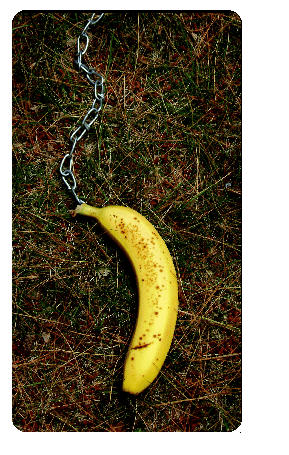
Hey. You. With the banana.

Welcome to monkeytraps.com.

Thanks. What’s a monkey trap?

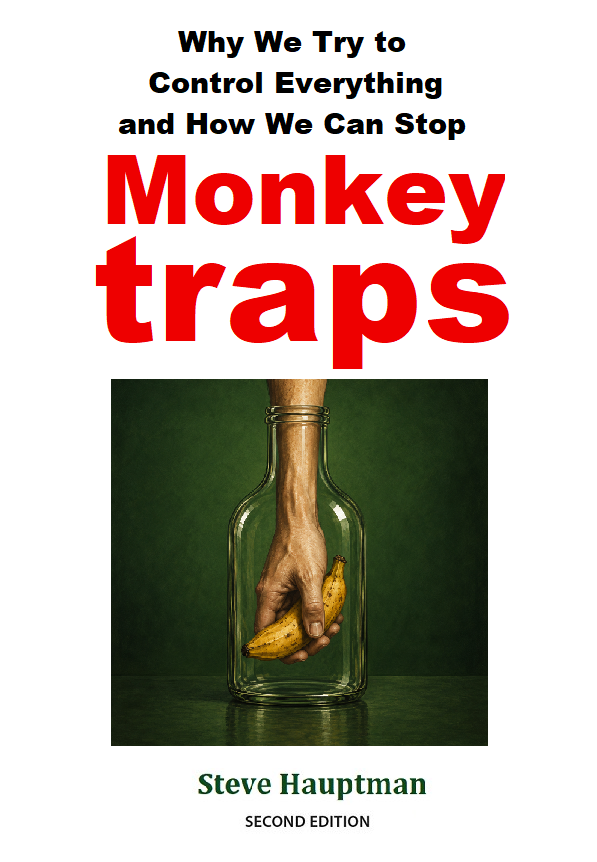
Wikipedia defines it as “A cage containing a banana with a hole large enough for a monkey’s hand to fit in, but not large enough for a monkey’s fist (clutching a banana) to come out.  Used to catch monkeys that lack the intellect to let go of the banana and run away.” A bit harsh towards monkeys, but you get the idea.  Other versions use heavy bottles or anchored coconuts to hold the banana.

And this is what you’re blogging about?  Catching monkeys?

No. It’s a metaphor.

For what?

Psychological traps.  The sort we all get stuck in.

More specific, please.

A monkeytrap is any situation that pulls you into holding on when you really need to let go.  I know I’m in one whenever I find myself trying to control something that can’t or shouldn’t be controlled.

Such as?

Well, feelings are monkeytraps.  So are relationships.  So are stressful situations of all sorts.  Anything that scares us or confuses us or makes us uncomfortable. Come to think of it, life itself is pretty much one monkeytrap after another.

Cheerful.

Realistic, I think.

And you’re writing about this because?

I’m a shrink.  Twenty years of doing therapy have convinced me that just about every emotional problem is rooted in some sort of monkeytrap.  Anxiety, depression, addictions, relationship problems, parenting problems, all of them usually turn out to be caused by someone holding onto something when they really should let go.

Too much control makes us sick?

No.  Too much controlling.  Control itself, that’s usually an illusion.

Beg your pardon?

I know.  Radical thought.  But think about it.  What in your life can you finally, absolutely control?

Um.

Exactly.   We spend our lives grabbing for it anyway.  Control is like a mirage that vanishes when you walk up to it, or a train you chase but never catch.  Most of the time we don’t even know we’re chasing it.   “Ideas we have, but don’t know we have, have us,” James Hillman said.  Control is just such an idea.    

Like an addiction.

Exactly.  We’re all addicted to control.  I know I am.

How can you tell?

Because the opposite of control is the ablity to accept the reality you’ve got instead of trying to replace it with the one you want.   (The reality you want, that’s the banana.)  It means being able to relax, and do nothing, and trust that everything will work out okay.  I’m not able to do that much.  You?

No.  Who is?

Nobody I know.  I’ve known some people who could do it occasionally.  I’ve never known anyone who could do it all the time.  I doubt any human being can.  We’re the monkeys who simply must control things, or die trying.  It’s one of the reasons I avoid the term “control freak.”   There’s nothing freakish about controlling.  What’s freakish is being able to stop.  

Why is that?

Why is one of the questions I hope to explore in this blog.  I have some ideas about it.  I have ideas, too, about how to better understand and deal with this universal addiction.  I created monkeytraps.com as a way to road test those ideas.

Road test how?

Unpack them in public, ask readers to think and talk about them.  Start a conversation about all this.

Okay.  Anything else I should know?

Lots.  But I’m trying to keep these things bite-sized, and I just passed my 500-word limit.  So come back tomorrow.  (Or whenever I do this next.  Sign up below, I’ll let you know).  Bring your banana.