Monthly Archives: February 2016
Control is the child’s basic tool.
As kids we have no power, no ability to take care of ourselves. We need big people, like parents, to do that.
And we use control to make sure those big people do their job.
We learn this before we have language. We learn it the first time we cry and mom picks us up and feeds or rocks us or changes our diaper. “Hey,” we realize. “What I do affects what she does.”
And the urge to control is born.
We spend childhood learning thousands of ways to control big people:
Want mom to love you? Don’t talk back.
Want dad to be proud of you? Get straight A’s.
Want teacher’s approval? Do your homework.
Want to avoid being bullied? Appease the tough kid.
This is how we navigate through early life.
For a kid, there’s no other way.
Of course, at some point we’re supposed to develop some power — the ability able to stand up for and take care of ourselves.
But many of us don’t. Many of us (especially if we’ve been abused or traumatized) stay stuck in kid mode.
We keep relying on control to get our needs met and manage relationships. We keep seeking approval and avoiding conflict. We hide who we are, bury our true feelings, and try our damnedest to be whatever we think others want us to be.
Most of the time we do this without even realizing we’re doing it.
And that’s the basic problem of all control addicts.
They’re stuck with the tool of a child to cope with the life of an adult.
2 Comments | posted in control
 Compulsive controlling — a.k.a. codependency, a.k.a. addiction to control — operates much like an infection, one we pass back and forth between us.
Say we’re friends, and I’m not honest with you about what I feel or what I really want. It may be over something insignificant, like where to have dinner or which movie to see. Maybe because I want you to like me, or agree with me, or I’m afraid of your disappointment or anger. Or maybe I just grew up in one of those families that taught me to lie even when lying was unnecessary. Whatever.
I may fool you for a while, but eventually you come to know this about me. This is inevitable. It’s hard not to sense when someone is in hiding.
So you respond in kind. You stay in hiding, too. You avoid being honest with me about what you think or feel or want.
And all this seems innocuous at first. We spend so much time hiding from other people that it becomes our default position, the place where we feel most comfortable and safe. Why not lie and pretend I want Italian instead of Chinese? Why not hide opinions that might cause conflict or hurt feelings?
So I rationalize my fear and dishonesty, and maybe you do too.
And maybe we transfer this to our other relationships.
Maybe I stay in hiding with other friends, and teach them to see me as you do. And you do the same. And we and they become part of a network of half-real, half-hidden connections where true feelings and motives are never permitted to come into the light.
This network is permeated by the whole array of half-conscious maneuvers people employ in the absence of honest communication — denial, projection, minimization, transference and the rest. And the truth of who we are gets buried under progressively deeper and more tangled layers of obfuscation.
I’ve seen this happen. I’ve seen it spread from one codependent individual to infect entire families, and then everyone who comes in contact with their members. It comes to feel so normal to the people in these networks that they have no idea why they feel anxious and alone so much of the time. I’ve been part of this myself.
It’s because we need connection so much.
And because fear of losing it is infectious.
And so is dishonesty.
And so is addiction to control.
Leave a comment | posted in control
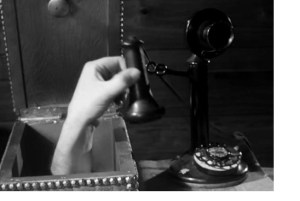 My favorite part of The Addams Family (ABC, 1964-66) was the character named Thing.
Thing was a disembodied hand that lived in a upholstered leather box.
It scrambled across tabletops like a spider and performed small services for members of the family, like answering the phone or playing castanets.
“Thank you, Thing,” Morticia Addams would coo.
In recent years I’ve created my own version of Thing.
Mine’s not a hand.
Mine’s a whisper in my head.
There have always been whispers in my head, as I’m sure there are in yours. One is the bully Gestaltists call Top Dog, always ready to judge, prod or criticize. Another is the whiny Underdog, forever complaining (It’s too hard) or making excuses (I try my best) and promises (I’ll do it tomorrow).
For decades these guys were my constant companions, engaged in endless battles of Should vs Can’t that Fritz Perls called “the self-torture game.”
So the topdog and underdog strive for control. Like every parent and child, they strive with each other for control. The person is fragmented into controller and controlled. This inner conflict, the struggle between the topdog and the underdog, is never complete…. There is no end to the self-torture, to the self-nagging, self-castigating. It hides under the mask of “self-improvement.” It never works. (Gestalt Therapy Verbatim, 1969).
Thing’s voice is different.
Thing’s voice is soothing.
Thing forgives my mistakes, limitations and sins.
Thing reassures me, encourages me, and reframes problems in ways that let me be gentle with myself.
Thing gives me permission to listen to feelings and give myself what I need.
Thing is the voice of a parent I never had.
I began hearing it only later in life. Partly it’s the voice of my own therapist, who years ago encouraged me to stop self-torturing. Partly it echoes my wife and children, who love me as I am. And partly it’s the voice I myself use with clients when trying to teach them self-compassion, self-forgiveness and self-care.
It was nice to discover, after years of self-torture, that I could grow my own Thing.
Thing is good company.
I wish we’d had more time together.
I wonder who’d I be now if we had.
Oh well. Better late than never.
Thank you, Thing.
Leave a comment | posted in control
I work with lots of parents.
They tend to fall into two groups.
One group focuses on behavior. The other focuses on feelings and needs.
The first group talks about expectations, rules, discipline, misbehavior, respect for adults, grades, appearance, accomplishments and success in the future.
The second group is more apt to ask questions and to be confused.
The first group tends to be convinced. It pretty much knows what it wants from its kids, and how it wants them to be.
The second group tends to be curious. It’s still trying to learn how its kids tick, how they feel and what they need.
The first group is apt to say things like “I don’t like that s/he does that.”
The second group is apt to say things like “Why does s/he do that?”
My job with the second group is to teach empathy – to draw on their own emotional experience as a guide to future parenting. I do this mainly by helping them remember what worried, scared, overwhelmed and comforted them when they were their kids’ age. Also by learning to listen to themselves now, to their own feelings and needs, and to respect what they hear.
My job with the first group is get them to join the second group.
2 Comments | posted in control






