
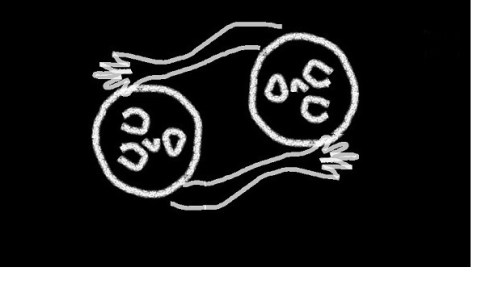
 As I was saying, control addiction behaves paradoxically.
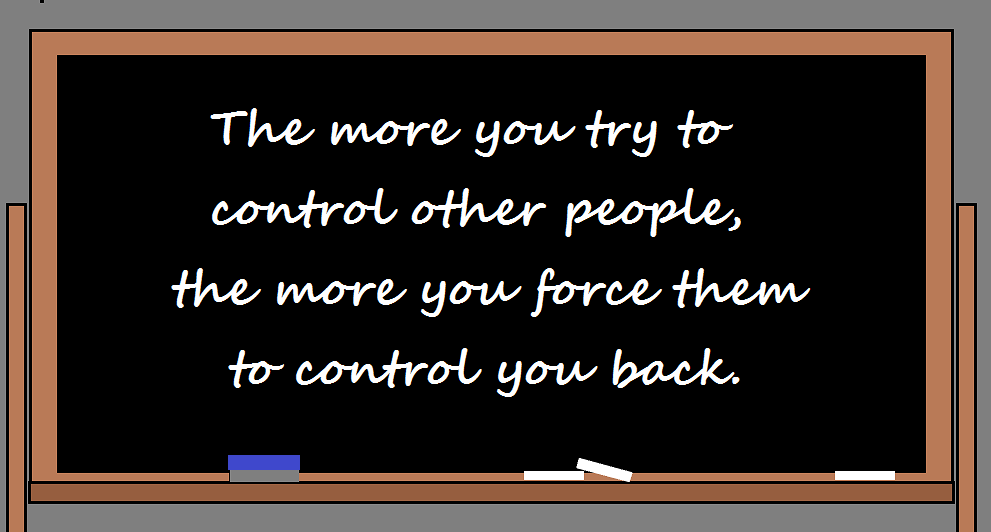
The Second Paradox is:
.
This is an interpersonal version of the First Paradox (“The more control you need, the less control you have”).
And what does it look like in action?
Consider:
Heather wants to marry Ian, who’s scared of commitment. So she pressures him to propose. This scares him, so he backs away. This scares her, so she steps up the pressure (“Why won’t you marry me?”). Which makes him back away further and faster. And so on.
*
“He never talks to me,” Janet complains about Kenny, who grew up in a family where no one talked about anything. The more she begs him to talk, the more anxious and inadequate Kenny feels. The more anxious and inadequate he feels, the more silent he becomes. Which angers Janet, which makes her beg harder. And so on.
*
Liz, a people pleaser, gets anxious when Mark is unhappy. So she knocks herself out putting his feelings, needs and preferences ahead of her own. Mark – who enjoys this – finds he can keep Liz motivated by remaining unhappy. The unhappier he becomes, the harder she tries. The harder she tries, the unhappier he becomes. And so on.
*
Nancy: “If you didn’t drink, I wouldn’t nag you.” Oscar: “If you didn’t nag me, I wouldn’t drink.” Rinse and repeat.
*





March 2nd, 2016 at 11:34 pm
[…] Second Paradox (“The more I control you, the more I force you to control me back”) is […]
March 2nd, 2016 at 11:35 pm
[…] Second Paradox (“The more I control you, the more I force you to control me back”) is […]