Monthly Archives: March 2016
.
Years ago I used to run for exercise.
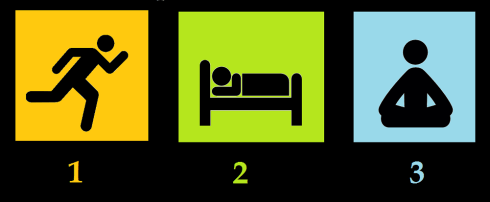
And I remember reading a little book about running which reduced the process of training to three simple rules:
1. Push.
2. Rest.
3. Listen.
Push meant stretching myself, increasing my strength and stamina by gradually running farther or faster or longer.
Rest meant pausing between workouts, giving my body time to recuperate and build new muscle.
And Listen meant paying attention to what my body was telling me in order to decide whether I needed to be Pushing or Resting.
Eventually I decided I was too neurotic to be a runner. I just couldn’t follow all three rules.
I could Push just fine, but Resting made me uncomfortable — anxious and guilty.
And Listening? Deaf as a post.
So what’s my running history have to do with anything?
This:
These same rules apply to recovery.
I don’t care what you’re recovering from — addiction, depression, emotional trauma, physical illness, whatever. There will be times when you need to push, times you need to rest, and times you need to listen.
For me, as a recovering control addict,
~ Push means stretching beyond my comfort zone by doing the opposite of whatever I usually do.
This means different things on different days. It might mean expressing a feeling I’d rather stuff, telling a truth I’d rather ignore, tackling a chore I’d rather avoid, or starting a project I’d prefer to forget entirely.
Pushing often feels like cutting my way through jungle with a machete. The jungle is all those years of tangled fears, scared projections and bad habits that keep me stuck, feeling like a kid in an adult’s body.
Pushing can be hard work.
But there’s no recovery without it.
~ Rest means the opposite of Pushing.
You know, to take a break.
To actually breathe.
Or maybe nap. Walk on a beach. Eat a candy bar. Read a mystery. Draw or paint something. Watch the sun set. Reflect. Regroup.
Easy and pleasant, right?
Not always.
Like most control addicts I tend towards workaholism, a compulsion to keep planning and moving and doing. It allows me to stay in my head and avoid feelings.
So there are times when it takes a real effort — even courage — to stop playing Energizer Bunny and let myself feel whatever’s happening inside.
Which means Resting can be difficult. Sometimes it feels like just another sort of Pushing.
But there’s no recovery without it.
~ Listen means to change channels — to say “Shut up” to my own mind and tune into my body instead.
By mind, of course, I mean monkey mind, that whispering, worrying, scolding and mocking voice that keeps me permanently on guard against life.
Mind also means Dog, that self-critical part whose sole mission in life is to chew endlessly on the sore ankle of my self-esteem.
Neither of these parts wants me to Listen to my body. They want me listening only to them.
Which I usually do.
Which can be pretty damned risky.
Because mind tends to be, well, crazy. It absolutely believes in the illusion of control and spends all its time trying to grab more. Behind this control-seeking are all the bad memories, scared projections, and false truths it’s absorbed and held onto since I was a baby.
In short, mind is full of shit.
But my body tells me the truth if I let it.
Listening to what my body says is the only reliable way I know to figure out what I really need: when I need to pee, or rest, or eat, or take a walk, or take a hot bath, or meditate, or sit and talk with my wife.
I admit it. I have to really work at Listening.
Like Resting, it takes practice, and more than a little guts.
But I don’t have much choice about whether I practice or not.
Because there’s no recovery without it.
Leave a comment | posted in control
 People enter therapy seeking symptom relief.
They want their anxiety or sadness or depression or insomnia or addiction to go away.
Understandable.
But this view overlooks the function of symptoms.
Which, as a therapist, I see differently:
Our happiness and health depend on the freedom to be who we are — to feel what we feel, thinking what we think, need what we need — and to express all that fearlessly.
To the extent this freedom is compromised, we’re other than happy and healthy.
And our unhappiness and unhealth show up as symptoms of the sort listed above.
Now, we may well have been taught to misinterpret these symptoms — that they mean we’re somehow flawed or limited or broken.
And often this misinterpretation is fostered by unhealthy people in our life trying (consciously or unconsciously) to prevent our seeing what’s really going on.
But in fact the symptoms are merely signals from our bodies and minds that we are not getting something we need.
The most neglected needs are those for attention, acceptance, approval and affection.
In other words, the components of love.
When we find ways to meet those legitimate needs, our symptoms vanish.
But until that happens, we actually need the damn symptoms.
Because they remind us of where to put our attention.
3 Comments | posted in control
1. I have been hurt, which makes me feel angry.
2. My situation allows me no safe way to express angry feelings.
3. In self-defense, I internalize my anger — turn it against myself.
4. Anger turned against the self feels just like guilt.
5. I have been hurt, which makes me feel guilty.
![~~~MT IN EVERYDAY LIFE [#2, row] -- for posts](https://monkeytraps.com/wp-content/uploads/2016/02/mt-in-everyday-life-2-row-for-posts.png?w=300&h=414)
Leave a comment | posted in control
 Again, there are three paradoxes of control.
The First Paradox (“The more control you need, the less you have”) is intrapsychic or internal.
The Second Paradox (“The more I control you, the more I force you to control me back”) is interpersonal.
And I guess you’d call the Third Paradox existential, since it seems to apply to existence in general, to reality both inside and outside our heads:
.
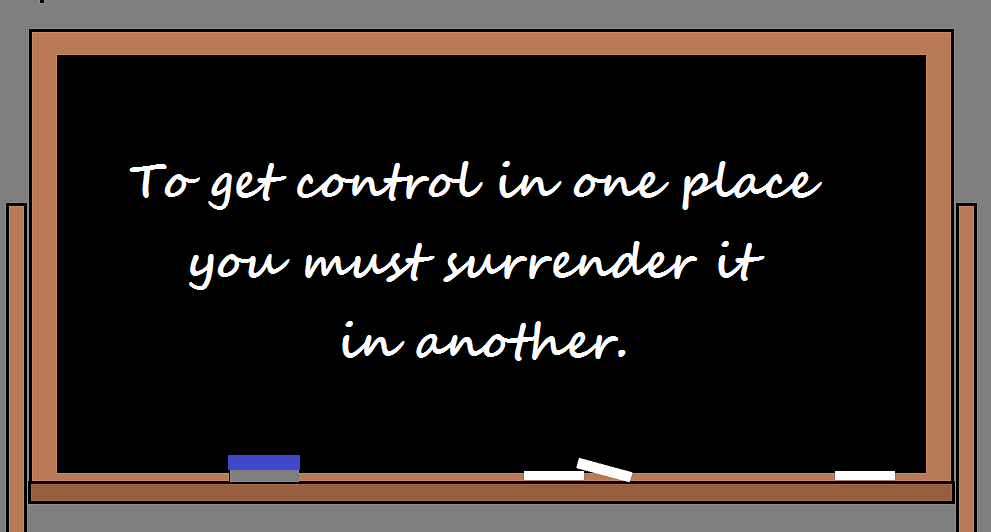
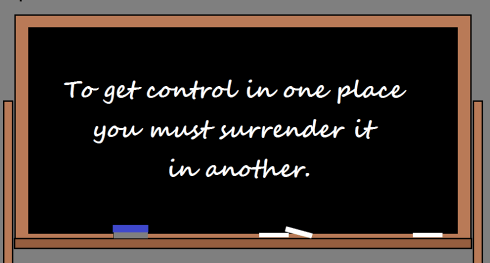
Controlling boils down to a tradeoff: gain control here, lose control there.
Think of the original monkey trap:
To hold on to the banana, the monkey surrenders his freedom. To regain his freedom, he must let the banana go.
It also explains all garden-variety codependent interactions:
To control you (make you like, love or accept me) I must surrender control of something else — like my ability to be honest, or spontaneous, or emotionally expressive.
Conversely,
Taking control of my emotional life — especially how I feel about myself — means surrendering control over how you react to me.
It also applies to New Year’s resolutions, not to mention all goal-setting:
To reach a particular goal (like writing my book) I must surrender control of others (like spending time with my family, or on chores that absorb my energy and attention).
To gain control of my weight I must surrender control (i.e., limit my choices) of what I put in my mouth.
To control my social anxiety I must detach from how other people see me and practice being myself.
And so on.
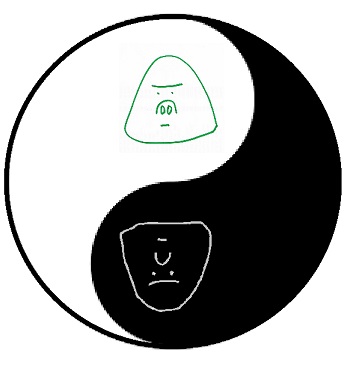
So control and surrender are two sides of the same coin.
And getting control of anything means losing control of something else.
To win A, you must sacrifice B.
Tradeoff.
Balance.
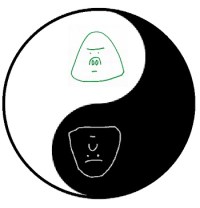
Yin-yang.
Fill your bowel to the brim
and it will spill.
Keep sharpening your knife
and it will blunt.
Chase after money and security
and your heart will never unclench.
Care about people’s approval
and you will be their prisoner.
1 Comment | posted in control
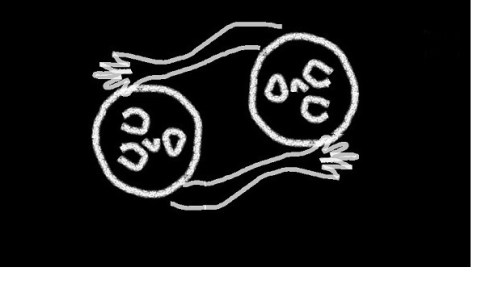 As I was saying, control addiction behaves paradoxically.
The Second Paradox is:
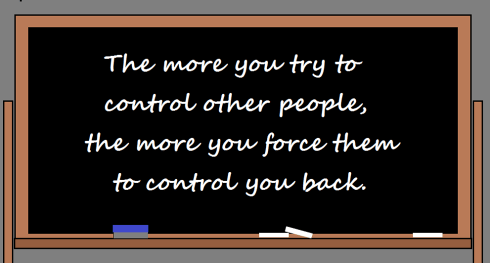
.
This is an interpersonal version of the First Paradox (“The more control you need, the less control you have”).
And what does it look like in action?
Consider:
Heather wants to marry Ian, who’s scared of commitment. So she pressures him to propose. This scares him, so he backs away. This scares her, so she steps up the pressure (“Why won’t you marry me?”). Which makes him back away further and faster. And so on.
*
“He never talks to me,” Janet complains about Kenny, who grew up in a family where no one talked about anything. The more she begs him to talk, the more anxious and inadequate Kenny feels. The more anxious and inadequate he feels, the more silent he becomes. Which angers Janet, which makes her beg harder. And so on.
*
Liz, a people pleaser, gets anxious when Mark is unhappy. So she knocks herself out putting his feelings, needs and preferences ahead of her own. Mark – who enjoys this – finds he can keep Liz motivated by remaining unhappy. The unhappier he becomes, the harder she tries. The harder she tries, the unhappier he becomes. And so on.
*
Nancy: “If you didn’t drink, I wouldn’t nag you.” Oscar: “If you didn’t nag me, I wouldn’t drink.” Rinse and repeat.
*
Patty and Ron both grew up in families that didn’t acknowledge or respect feelings. Hungry for emotional validation, they now seek it from each other. Unfortunately each takes the position, “I’ll validate you after you validate me.” Since neither validates first, no one gets validated. Ever. So their childhood deprivation continues. Indefinitely.
See the pattern?
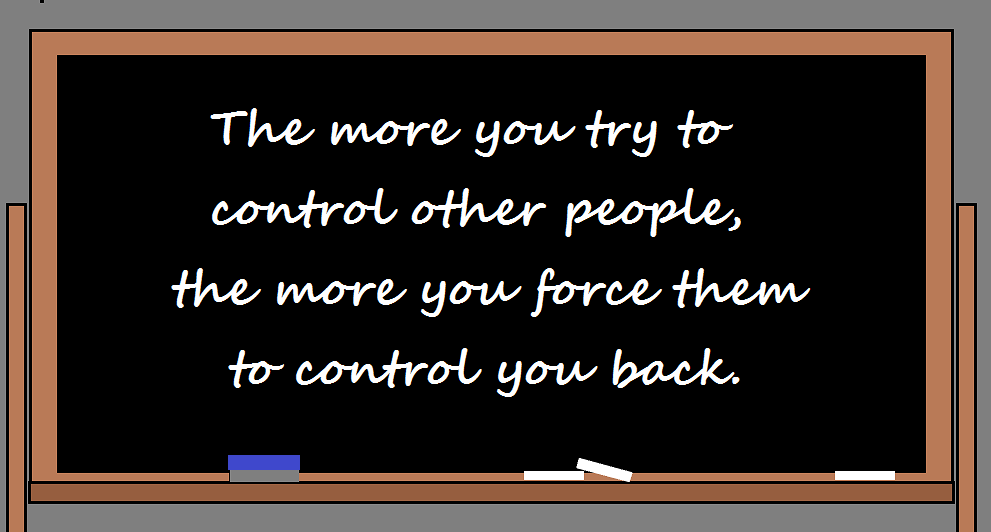
This paradox grows out of two facts of human nature: Everyone wants control, and no one wants to be controlled by others.
That’s what is being played out above. Each of these ten partners tries desperately (if unconsciously) to transform the other into the partner they want. And each resists transformation as hard as they can.
Even people who seem to comply with their partner’s (or parent’s) demands are doing it out of a need to control the other’s behavior.
This creates not love, not intimacy, not healthy connection, but monkeyship — relationship bent out of shape by control issues.
Some of this goes on in all our relationships. At some point we all turn monkeyish. We all try to make our partner into the person we want them to be.
It has little to do with how much we love that partner.
It has everything to do with how much control we think we need to feel safe.
And it continues until we learn alternatives to monkeyish behavior.
2 Comments | posted in control
x
paradox: a seemingly true statement or group of statements that lead to a contradiction or a situation which seems to defy logic or intuition. ~ Wikipedia
.
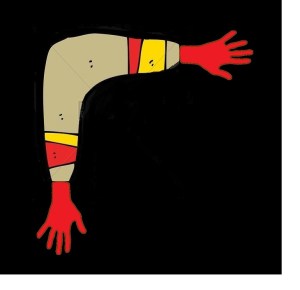 In my book Monkeytraps — which argues that to be a human being is to be addicted to control — I describe how this addiction is hard to escape because it behaves paradoxically.
I.e., not at all as you’d expect.
And I explain three paradoxes that confuse the hell out of people and keep them addicted.
Here’s the First Paradox of control:
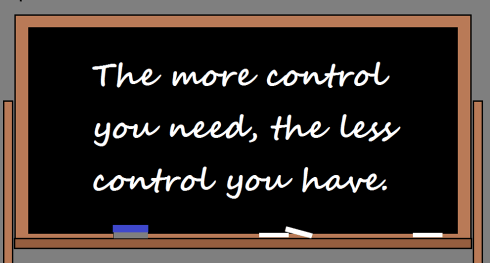
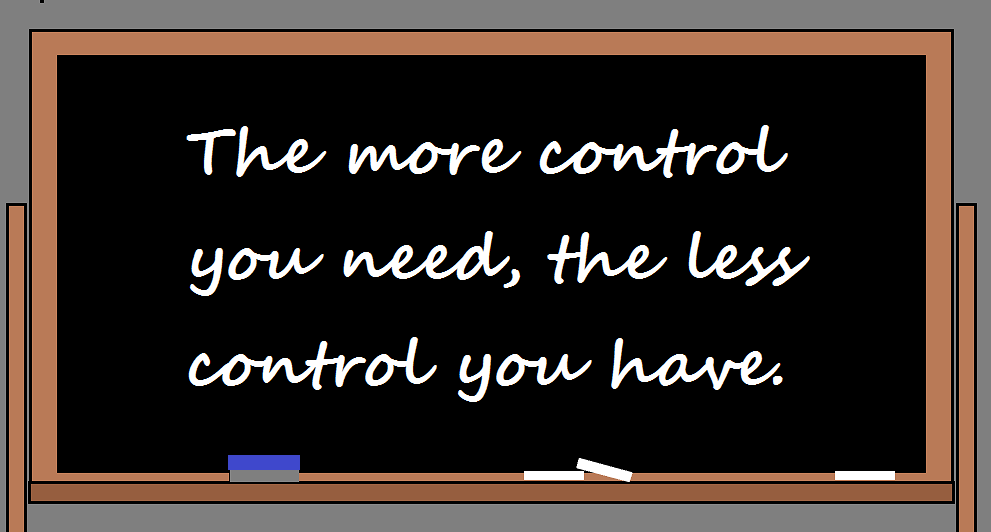
Needing control has a sort of boomerang effect. The harder you try to get more of it, the more you end up feeling controlled.
You feel controlled by, surprise, your need for control.
And this happens with weird regularity.
Still, it’s easy to overlook this phenomenon unless you’re looking for it. So I thought some stories might help to illustrate.
The actors in each of these (except the last) are heavily disguised, but all the events are based in fact.
Annie’s depressed because she’s overweight. So she eats cookies to make the depression go away. Which makes her more overweight. Which makes her more depressed. Which makes her eat more cookies. The more control you need, the less you have.
*
Barry’s wife drinks. This panics Barry, so he does everything he can think of to stop her. He reasons, begs, nags, yells, makes nasty comments, threatens divorce, hides her wine, pours it down the toilet. Stressed by Barry’s behavior, his wife drinks more. The more control you need, the less you have.
*
Carol’s daughter fails Math and lies about it. This enrages Carol, who can’t stand to be lied to. So she confiscates her daughter’s cell phone and warns her of worse punishments if she lies again. This scares her daughter, who starts keeping more secrets and lying about more stuff. Which leads to more punishments. Which lead to more fear and more lies. The more control you need, the less you have.
*
Dennis is an anxious man whose last wife cheated on him. Now he worries his new wife might do the same. So he carefully monitors her comings and goings, and makes sure he knows where she is and who she’s with. Then listens in on her phone calls. Then intercepts and examines her cell phone records. Then starts following her on errands. As a result of all this his anxiety soars to panic-attack levels, and his wife finds a boyfriend with whom she can relax. The more control you need, the less you have.
*
Eve’s boyfriend is abusive. He doesn’t hit her, but yells and criticizes and threatens her constantly. Friends beg Eve to dump him, but she’s scared that will make him angrier. So she does her best to pacify and appease him. Since the boyfriend likes this result, he continues to yell, criticize and threaten. Then one day he hits her. The more control you need, the less you have.
*
Fred and Ginger are married. It’s the second marriage for each, and each brings to it a history of disappointed relationships. Both want the marriage to work and are scared that it won’t, which makes them hypersensitive to any and all relationship problems. They monitor each other closely for signs of dissatisfaction or anger. They repeatedly seek reassurance that their partner still loves them. They discuss their problems constantly. All this leaves them chronically uneasy in each other’s presence. The distance between them grows, which increases their uneasiness. They begin to bicker, then to fight. When they finally come to me for couples counseling the marriage is, in Fred’s words, “Circling the drain.” The more control you need, the less you have.
*
Steve’s dog runs away from home. Steve chases him across front lawns and through backyards, up and down streets. Panting and bracing himself for his first heart attack, Steve suddenly remembers the First Paradox. He stops running. He sits down in the street. The dog glances back at him over his shoulder. Steve flops over sideways. Closes his eyes. Waits. Hears nails clicking on pavement. Feels a long tongue flick his nose. Reaches out and grabs the dog’s collar. The more control…
Oh, you know.

4 Comments | posted in control