January 24, 2024
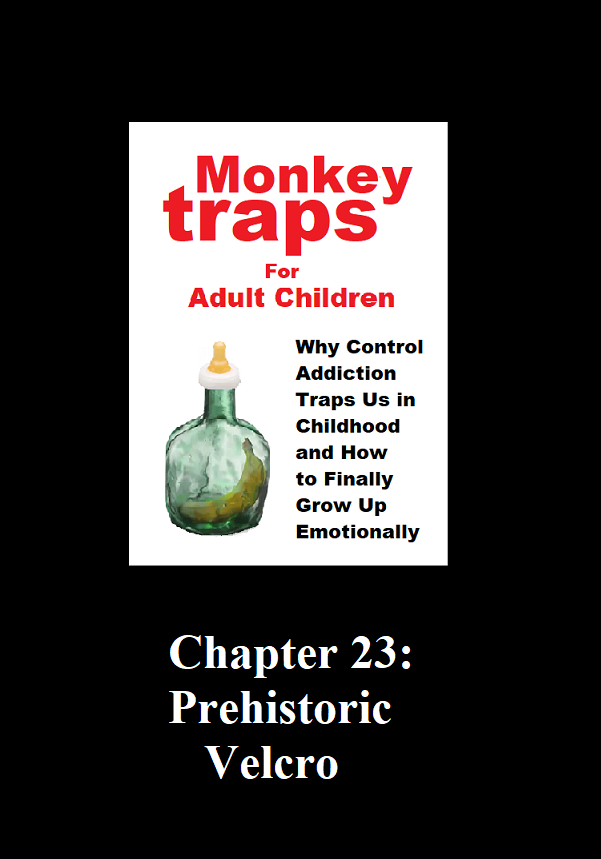
Chapter 23: Prehistoric Velcro
The belief in personal control may be
essential to one’s sense of competence
and is basic to human functioning….
When one’s belief in control is threatened,
the result is severely incapacitating.
~ psychologist Ellen Langer
.
So how did we get so confused?
Why do human beings end up chasing control when what we really need is power?
Yes, the socialization process and family conditioning drive us into compulsive controlling.
But our conditioning did not start there.
It began millennia ago, when we were an at-risk species struggling to stay alive in a hostile environment, and control-seeking was essential to our survival.
Psychologist Rick Hanson offers a description of how this happened.
“Imagine,” he writes, “some of our earliest mammal ancestors, little rodent-like creatures scurrying about in the shadows of the last dinosaurs.”
The ones that became absorbed in the pleasant sensations of a good meal, warm rocks, and sweet-smelling flowers CRUNCH got eaten because they missed the sound of a slither nearby.
The ones that lived to pass on their genes were nervous and jumpy, quick to notice potential threats and to remember painful experiences.
That same circuitry is active in your brain today in the amygdala, hippocampus, and related structures.
It’s hard-wired to scan for the bad, and when it inevitably finds negative things, they’re both stored immediately plus made available for rapid recall.
In contrast, positive experiences… are usually registered through standard memory systems, and thus need to be held in conscious awareness 10 to 20 seconds for them to really sink in.
In sum, your brain is like velcro for negative experiences and teflon for positive ones.
We are descendents of the “nervous and jumpy” ones that lived, the ones that emerged from this dangerous prehistory both gifted and burdened with a brain whose normal state is essentially paranoid – a brain which constantly remembers old threats and anticipates new ones, an anxious brain obsessed with defending us against potentially dangerous people, place and things.
We are, as Hanson says, hard-wired to scan for the bad.
And we simply cannot stop scanning.






January 24th, 2024 at 9:22 am
This reminds me of “making new grooves” in my brain.. literally, by focusing on positive, progress not perfection. Thank you, sir. I hope you are well.
January 24th, 2024 at 10:12 am
Yup. Recovery (from anything) is all about creating new grooves.