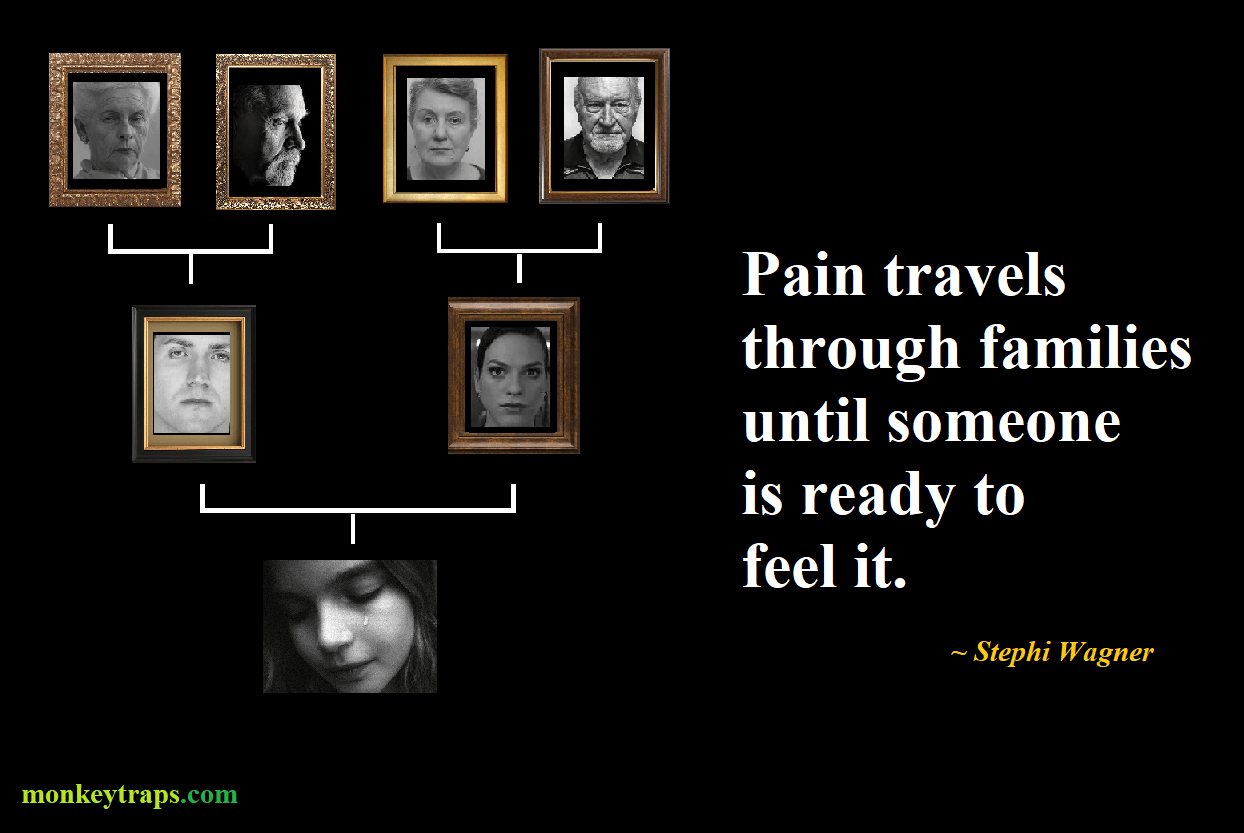
The person in the grip of an old distress says things that aren’t pertinent, does things that don’t work, fails to cope with the situation, and endures terrible feelings that have nothing to do with the present.
~ Harvey Jackins
I can only guess, of course, whether someone with whom I am working received inadequate attunement from their mothers.
But occasionally I meet people who make me suspect that might have been the case.
They tend to be people who seem forever at war with their feelings.
Like Alan, a quiet man whose marriage is failing because he’s so disconnected emotionally, who works all day and then goes home to pore over paperwork at his kitchen table, so turned inward that he can barely sustain a conversation in session, and whose frustrated wife complains that “even when he’s there he’s not there.”
Or Bonnie, a chronic people pleaser who always looks tired, seems surrounded by people who discount or abuse her, and who worries constantly about falling back into the suicidal depression which overwhelmed her twenty years ago.
Or Cate, an attractive educated woman who keeps drifting into relationships with emotionally unavailable men, spends months trying to get them to love her, then blames each failure not on the man but on her own unworthiness.
And Dustin, a recovering alcoholic stuck in a ten-year affair with a married woman who gives him less and less time and attention, but whom he refuses to leave because “she’s the only woman who’s ever made me feel like someone loved me.”
Harvey Jackins’ phrase —
endures terrible feelings that have nothing to do with the present
— is a perfect description of each of these people.
Each is trapped in what I’ve called the Kid Trance: an emotional life dominated by how they felt when they were helpless children.
The Trance is an agonizing place to live.
Its defining characteristic is a tendency to perceive and treat ourselves as we were perceived and treated by our parents. If they abused or neglected or judged us, we abuse or neglect or judge ourselves.
And if our parents had no clue about how to deal with difficult feelings, we too are left essentially clueless.
What we do, then, is retreat into the ways of coping we discovered as children.
We may disconnect and distract ourselves from feelings, like Alan. Or exhaust ourselves trying to win love and emotional feeding, like Bonnie and Cate. Or cling desperately to someone we think capable of meeting our emotional needs, like Dustin.
There’s another reason the Trance is agonizing: shame.
Psychologist Russell Carr writes,
In the absence of a sustaining relational home where feelings can be verbalized, understood and held, emotional pain can become a source of unbearable shame and self-loathing.
Whether it comes from being actively discouraged from identifying and expressing feelings (Big boys don’t cry) or from lacking a model for even noticing them, the inability to process feelings cannot help but leave us feeling flawed, broken, inadequate, and cut off from other human beings.
Why cut off?
Because, in our shame, we won’t see relationship as a safe place in which to feel or reveal ourselves.
We may not even believe in the possibility of what Carr calls a sustaining relational home.
And this is one serious wound.
“Trauma is a basic fact of life,” writes Mark Epstein.
It is not just an occasional thing that happens to some people; it is there all the time. Things are always slipping away…. The healthy attachment of a baby to a “good-enough” parent facilitates a comfort with emotional experience that makes the challenges of adult life and adult intimacy less intimidating.
Relationship is the adult’s secret weapon for handling such challenges, a life jacket to keep us afloat, a safe harbor to which we can retreat from storms.
Without it we can’t help but feel adrift, vulnerable to emotional waves that threaten to drown us, “traumatizing us again and again as we find ourselves enacting a pain we do not understand”(Epstein).
And with no life jacket or safe harbor available to us, we have no choice but to turn to the illusion of control.
________________________
Russell Carr is quoted by Epstein (see below).
Mark Epstein. The trauma of everyday life. New York: Penguin, 2013.
Harvey Jackins is quoted by John Bradshaw, in Homecoming: Reclaiming and championing your inner child. New York: Bantam, 1990.
Leave a comment | posted in control
ssssss.
 x
x
There is no cell of our body that does not have a wounded child in it.
~ Thich Nhat Hanh
There is another kind of unfinished emotional business which predates the kind I just described (see “Shit”) and prevents us from feeling and functioning like grownups.
It is rooted in the way our mothers responded to us when we were infants.
Mark Epstein explains it in his book The trauma of everyday life (Penguin, 2013), drawing on the seminal work of British child analyst D.W. Winnicott.
Here’s a simplified version of his explanation:
One of the most important jobs a mother has is to teach her child how to identify and handle feelings. She does this by modeling a combination of empathy (Oh, you’re having a feeling) and reassurance (Everything will be fine). Anyone who spends any time observing mothers with their children sees this happen over and over.
Oh, you’re wet and uncomfortable? Here, let’s get you changed.
Oh, you’re hungry? Let’s warm up your bottle.
Oh, you hurt yourself? Here, let mama kiss it.
And so on. This ability to pay attention to and respond appropriately to the infant’s emotional experience is called attunement.
“In this state,” Winnicott writes,
mothers become able to put themselves into the infant’s shoes, so to speak. That is to say, they develop an amazing capacity for identification with the baby, and this makes them able to meet the basic needs of the infant in a way that no machine can imitate, and no teaching can reach.
Mom’s attunement is essential to the infant because it models for the child how to attune to itself.
The basic message is Here’s what you do with a feeling: You respect it. You pay attention to it. You figure out what it’s telling you, and you respond.
Attunement provides a kind of emotional container — an experience of holding, attention and safety — which the infant absorbs and, eventually, learns to provide for him/herself.
But what if the mother is unable to attune to her infant?
What if something else is occupying her attention or draining her energy? What if she is exhausted, or sick, or depressed, or frightened, or angry, or being abused, or self-medicating with some substance?
“An infant who is held well enough is quite a different thing from one who has not been held well enough,” writes Winnicott.
You see two infants: one has been held…well enough, and there is nothing to prevent a rapid emotional growth, according to inborn tendencies. The other has not had the experience of being held well and growth has had to be distorted and delayed, and some degree of primitive agony has to be carried on into life and living.
What Winnicott calls primitive agony is the experience of being left all alone to deal with incomprehensible and uncontrollable feelings.
This is not an experience that simply drains away over time.
Instead those afflicted carry it into adulthood, as I understand it, in two forms.
One form is a chronic background anxiety, which occasionally erupts as a fear of breaking down, “losing it,” going crazy.
The other form is an inability to deal healthily with their own feelings.
(To be continued.)
________________________
Mark Epstein. The trauma of everyday life. New York: Penguin, 2013.
Thich Nhat Hanh. Reconciliation: Healing the inner child. Berkeley, CA: Parallax Press, 2010.
D.W. Winnicott. Babies and their mothers. Reading, MA: Addison-Wesley, 1988.
1 Comment | posted in control
 *
*
(Reposted by popular request.)
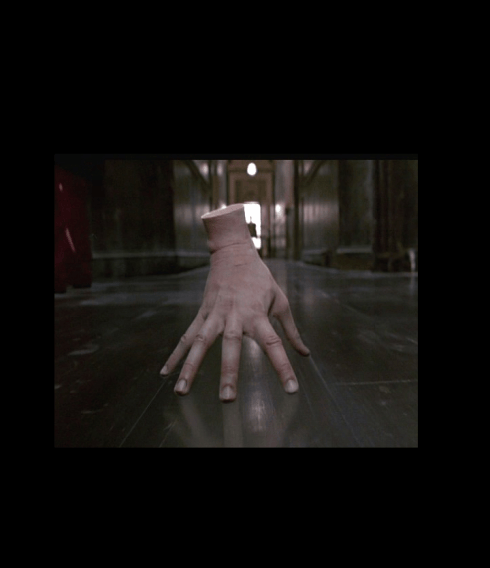
My favorite part of The Addams Family (ABC, 1964-66) was the character named Thing.
Thing was a disembodied hand that lived in a upholstered leather box.
It scrambled across tabletops like a spider and performed small services for members of the family, like answering the phone or playing castanets.
“Thank you, Thing,” Morticia Addams would coo.
In recent years I’ve created my own version of Thing.
Mine’s not a hand.
Mine’s a whisper in my head.
There have always been whispers in my head, as I’m sure there are in yours. One is the bully Gestaltists call Top Dog, always ready to judge, prod or criticize. Another is the whiny Underdog, forever complaining (It’s too hard) or making excuses (I try my best) and promises (I’ll do it tomorrow).
For decades these guys were my constant companions, engaged in endless battles of Should vs Can’t that Fritz Perls called “the self-torture game.”
So the topdog and underdog strive for control. Like every parent and child, they strive with each other for control. The person is fragmented into controller and controlled. This inner conflict, the struggle between the topdog and the underdog, is never complete…. There is no end to the self-torture, to the self-nagging, self-castigating. It hides under the mask of “self-improvement.” It never works. (Gestalt Therapy Verbatim, 1969).
Thing’s voice is different.
Thing’s voice is soothing.
Thing forgives my mistakes, limitations and sins.
Thing reassures me, encourages me, and reframes problems in ways that let me be gentle with myself.
Thing gives me permission to listen to feelings and give myself what I need.
Thing is the voice of a parent I never had.
I began hearing it only later in life. Partly it’s the voice of my own therapist, who years ago encouraged me to stop self-torturing. Partly it echoes my wife and children, who love me as I am. And partly it’s the voice I myself use with clients when trying to teach them self-compassion, self-forgiveness and self-care.
It was nice to discover, after years of self-torture, that I could grow my own Thing.
Thing is good company.
I wish we’d had more time together.
I wonder who’d I be now if we had.
Oh well. Better late than never.
Thank you, Thing.
3 Comments | posted in control

*
If you love an addict, or live with one, or depend on one in some way, you are probably in, as the old saying goes, nine kinds of pain.
And I’m guessing that, whether or not you realize it, the very worst of these pains comes from being confused about the difference between power and control.
No, they’re not the same.
In some ways they are opposites.
One difference: power is possible, but control is usually an illusion.
Another: seeking power can set you free, while seeking control can make you crazy.
Let me explain.
Control, as I define it, means the ability to dictate reality. To make reality what we want it to be. To get life itself — people, places and things — to meet our expectations.
Power, on the other hand, means being able to get your needs met. To take care of yourself. To not just survive, but to heal, and grow, and be happy.
Here’s an example of the difference:
Imagine your rich uncle dies and leaves you control of his multinational corporation. So you wake up one morning the CEO of Big Bux, Inc. You go to your new job. You sit behind a huge desk. Four secretaries line up to do your bidding. You have tons of control. You can hire and fire people, buy things and sell things, build plants or close them, approve product lines and advertising campaigns, manage investments, bribe congressmen, you name it.
How do you feel?
If you’re anything like me, you feel crippled by anxiety. Bewildered and overwhelmed by your new responsibilities. Disoriented. Panicked.
Anything but in control.
Interesting, no?
There are two other interesting differences between control and power.
~ Control looks outward, mainly at other people, places and things. Power looks inward, to your own feelings and needs. So control-seeking pulls you away from yourself, away from self-awareness and self-care.
~ Control operates paradoxically. The paradox goes like this: The more control you need, the less in control you feel. Which means if you depend on getting control to feel safe and happy, you don’t feel safe or happy most of the time. Chasing control is a lot like chasing a train you can never catch. Power, though — rooted in healthy, intelligent self-care — is a real possibility.
Want to become more powerful? Here are seven ways to do it:
(1) Detach.
Let go of what you can’t control anyway. That may be a situation, or a person, or that person’s behavior. If it’s a person you love, you can detach with love, as they say in Al-Anon. Detaching doesn’t mean you stop caring. It just means you acknowledge your limitations. And when you do that, an enormous relief often follows.
(2) Refocus.
Start by shifting your focus from outside — people, places and things — to inside — your own needs, thoughts and feelings. Happiness is an inside job, and most of the answers you need are there.
(3) Take care of yourself.
Stop overcontrolling yourself, and learn to listen to your body instead. Hungry? Eat. Tired? Sit. Rest. Maybe take a nap. (Naps are great.) Lonely? Seek out safe people. (More on this below.) Angry? Scream (into a pillow, maybe, so you don’t scare the neighbors). Sad? Let yourself cry. It’s how the body naturally relieves tension, and it helps.
(4) Educate yourself.
You’re not crazy; your pain means something. Your job is to find out what it’s trying to tell you. Education can take many forms, from Googling alcoholic family or codependency to reading self-help books (start with Janet Woititz’s Adult Children of Alcoholics or Melody Beattie’s Codependent No More), or listening to tapes (try the library), or talking to a friend, or attending a self-help meeting, or finding yourself a good therapist. After his first Al-Anon meeting one of my clients told me, “It was like a light coming on in a dark room, and suddenly I could see all the furniture I’ve been tripping over.” Hey, why live in the dark if you don’t have to?
(5) Get support.
No one gets through life alone. (Even if you could, why would you want to?) Seriously consider checking out a self-help program, like Al-Anon or Nar-Anon or CODA. You’re probably scared of that first meeting. That’s okay; everyone is. Go anyway. It won’t kill you, and you can’t know beforehand what you’ll hear. A good meeting can save your life and your sanity.
(6) Listen to feelings.
This is a big one. Living with an addict usually requires hiding your feelings, sometimes even from yourself. But feelings are essential. You need to get them back again. Hang out with people who are trying to reclaim their feelings, and who can keep you company while you’re trying to reclaim yours.
(7) Have faith.
Develop your spiritual life. No, you don’t need a church. You don’t even need to believe in God. You do need to believe in something bigger than you, something you trust even when you don’t understand it. Call it Nature. Call it The Force. Al-Anon calls it Higher Power, but you can call it what you like. I used to reject the idea of God, but I always believed in psychology. Then I heard Scott Peck suggest that it’s not unreasonable to replace the word God with the word unconscious. That permanently reframed the idea of God for me. I realized there was some intelligence inside I could listen for, and which would guide me if I let it. (I might doubt the existence of God, but who can doubt the existence of that voice? That part that Knows Better?) So that gave me something to trust. Hey, we all need some invisible support.
2 Comments | posted in control
 .
.
We go through four stages in learning anything:
(1) Stage One is unconscious incompetence. That’s where we don’t know that we don’t know.
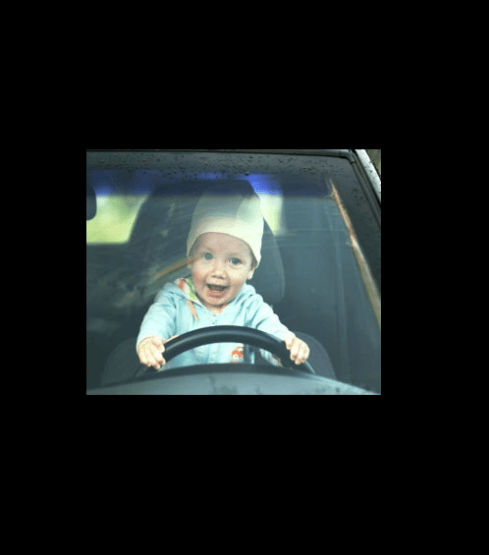
Imagine a four-year-old sitting behind the steering wheel of Daddy’s car. He’s watched Daddy drive, so now he yanks the wheel left and right, peers over the dashboard, waves his hand out the window to signal turns. He thinks he’s driving. He doesn’t know that he doesn’t know.
(2) Stage Two is conscious incompetence. That’s where we know that we don’t know.
Imagine this same kid as a teenager. It’s his first day in the Driver Ed car. The instructor tells him to parallel park. A chill runs through his entire body. He knows that he doesn’t know.
(3) Stage Three is conscious competence. That’s where we know that we know.
Flash forward to this same kid six months later. He’s just gotten his driver’s license. He gets behind the wheel, buckles up carefully, and drives down the street with a smile on his face. He knows that he knows.
(4) Stage Four is unconscious competence. That’s where we don’t know that we know.
Flash forward, one last time, to this same kid at forty. He’s been driving for so long that now it barely engages his attention. He tools along the highway talking on his cell phone, fiddling with his radio, and worrying about the fight he just had with his wife. When he has to parallel park, he does it without thinking. He’s reached the stage where he doesn’t know that he knows.
*
What has all this to do with control?
This:
When it comes to control, we’re all addicted.
And we all start off in the same place:
We don’t know we’re addicted.
We don’t know that we don’t know how not to control.
We control automatically, unconsciously and compulsively.
And when our controlling causes problems, we don’t see it. We find other explanations.
So the first step we face, if we want to recover from this universal addiction, is we must move from Stage One to Stage Two.
We must become aware that, most of the time, we really don’t know how not to be controlling.
That’s where the learning begins.
Leave a comment | posted in control