The Plan B Talks:
I recently began a new group for adult children of alcoholic, narcissistic, abusive, and otherwise dysfunctional families. In this group I’ll be giving a series of talks about how we’re all shaped by our families of origin and what we can do about it. It’s been suggested that my readers might find these talks useful, so I plan to publish the talk notes here. The series continues with (Talk #6) Mindware. Questions and feedback welcome.
***.
.
Change how you see and
see how you change.
~ Zen proverb
.
The idea of anxiety
Before we move on to Plan B, let’s look at anxiety.
My clients and I talk a lot about anxiety, so most of them know how I usually explain it.
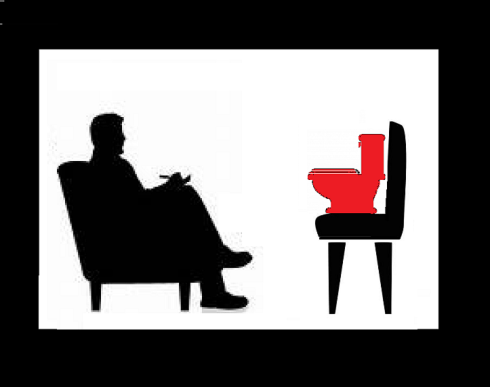
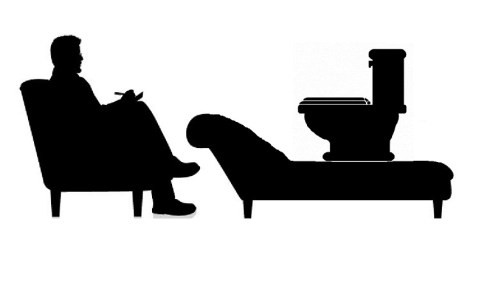
They’ve heard me describe it as a symptom of emotional constipation.
They know I believe that feelings, like shit, need to be expelled from the body, not stored up inside. And that when we don’t express feelings we feel shitty.
Anxiety is the name we give to this feeling.
Psychologist Paul Foxman explains,
When feelings are denied or kept inside there is typically a buildup or physical tension. When that tension is not released, an internal pressure builds up. An accumulation of such pressure leads to anxiety, due to fears of losing control emotionally. That condition also triggers anxiety because of its physiological similarity to the fight/flight response, which is normally associated with danger.
Thus our personality creates a paradox in which we deny feelings to prevent anxiety but experience anxiety when we deny our feelings. (1)
I know this is true because of all the anxious clients who describe how their anxiety drops when they’re able to express what they feel.
But I also think anxiety is much larger than that.
.
Consciousness
Anxiety is an organism’s response to a real or imagined threat.
We tend to experience it as heightened tension, sensitivity to our environment, and a feeling of fear or apprehension about what’s to come.
For human beings anxiety is simply the cost of being conscious. That’s because to be conscious is to be aware of (among other things) threats to survival and safety and wellbeing. We sense threats in the present, remember them in the past, and anticipate them in the future. We can’t help this; we are hardwired to do so.
So to be conscious is to be forever on guard to some extent.
Anxiety both causes and results from being on guard.
It’s not inherently unhealthy. We actually need some anxiety. We wouldn’t want it to go away entirely. That would leave us unconscious and vulnerable.
But anxiety is damned uncomfortable.
Severe anxiety can be crippling. (Ask anyone who’s ever had a panic attack.)
Severe anxiety can be so unbearable that people kill themselves to escape it.
Moderate anxiety depletes energy, impairs concentration, limits productivity and destroys peace of mind.
Even mild anxiety is uncomfortable enough so that we work constantly to lower it and keep it at tolerable levels.
Which is where the idea of control comes in.
.
The goal of control
I’ve defined control as the ability to edit reality, to direct or dictate or manipulate our environment.
Why would we want to do that?
Mainly to manage anxiety.
That’s because we’re used to thinking of anxiety as a reaction to people, places and things.
In their book about American neurosis and neurotics, sociologists Snell & Gail Putney write,
One of the unquestioned assumptions of American culture is the belief that emotions have an external explanation. When an American feels angry he looks around to see what provoked him and when he feels happy he looks around to see who delighted him. (2)
Read that again; it’s important.
Because it is this unquestioned assumption which leads us into control addiction.
Ultimately the goal of all our controlling is
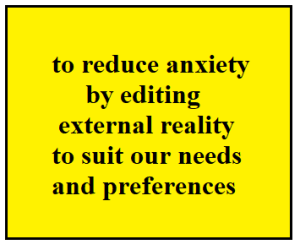
Actually our emotional reactions come not from externals but from how we interpret and respond to them.
But if you don’t know this, you have a big problem.
Because then you’re left with no choice but to try to control the world around you.
Which is largely impossible.
Sure, some externals are controllable. But many are not.
Most are not.
And even when we do get a bit of control we can’t hold onto it for long.
(Have you noticed?)
So a person for whom control is the only defense against anxiety is driven, inevitably, into compulsive controlling.
.
A new goal
By comparison, Plan B has a different goal.
It’s both more realistic and more achievable.
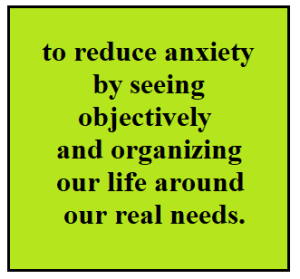
The goal of Plan B is
.
The idea of objectivity
“Seeing objectively” means seeing clearly and realistically. It means moving beyond feeling, fantasy or desire.
Or as Alcoholics Anonymous describes it, dealing with life on life’s terms.
In Plan B the idea of objectivity replaces the idea of control.
Control addicts, in their need to edit reality, find themselves perpetually at war with What Is. Objectivity allows us is to declare a cease-fire in that war, to accept What Is and to cope realistically with it.
For example, objectivity enables me to move beyond fear and desire and become able to see
~ why it’s pointless to try and stop “my” alcoholic from drinking;
~ why I can’t expect a narcissist to meet my emotional needs;
~ why my parent’s inability to love me was about their limitations, not mine;
~ why someone’s abusive behavior is never my fault;
~ why hiding my feelings makes me feel more scared, not safer;
~ that I can feel good even when people around me are feeling bad;
~ that I’m as sick as my secrets;
~ that I’m as healthy as my relationships;
and
~ that there are things I just cannot or should not try to control.
So how do we achieve objectivity?
We change our mindware.
.
Mindware
Mindware is a term used by family systems theorist Michael Kerr to define “Mental knowledge and procedures used to solve problems and make decisions.” (3)
Plan B is a kind of mindware.
It’s a set of ideas and practices which allow us to remain objective under stress — i.e., replace anxiety-driven controlling with more rational and effective ways of managing our emotional lives.
The components of this mindware will be the subject of the remaining talks in this series.
I love the mindware metaphor because it suggests that, once installed, this new learning allows us to respond in a healthier way automatically.
In my first book (4) I told a story to illustrate how I discovered that the mindware I was teaching my clients had seeped deep into me:
During a routine physical my doc runs a cardiogram and finds a blip that suggests a TIA (transient ischemic attack). He tells me to drive to the ER. I feel fine, but I go. At the hospital they put me on a gurney and park me in a hallway for four hours while they run an assortment of tests. I have to cancel six clients, calm my worried wife over the phone, wonder what all this is costing me, and then just lie there and wait. At one time I would have reacted to all this with frustration, worry and anger. Now I surprise myself by closing my eyes and taking a nap. It’s a pretty good nap, too.
Change how you see, and see how you change.
***
Steve Hauptman is the author of Monkeytraps: Why Everybody Tries to Control Everything and How We Can Stop (2015), available here, and the forthcoming There I go again: Monkeytraps for Adult Children.
___________________________________________
(1) Paul Foxman, Dancing with fear: Overcoming anxiety in a world of stress and uncertainty (Northvale NJ: Jason Aronson, 1996), 48.
(2) Putney, Snell & Gail J, Putney, The adjusted American: Normal neuroses in the individual and society (New York: Harper Colophon Books, 1964), 99.
(3) In his book Bowen theory’s secrets: Revealing the hidden life of families (New York: W.W. Norton & Company, 2019). Kerr says the term was coined by Keith Stanovich, in his book What intelligence tests miss: The psychology of rational thought (New Haven, CT: Yale University Press, 2009).
(4) Monkeytraps: Why everybody tries to control everything and how we can stop (New York: Lioncrest, 2015).

 *
*