* * *
Now on YOUTUBE:
the new trailer for
MONKEYTRAPS (THE BOOK):
2 Comments | posted in control
![[3] 56. Every conversation has two floors [][][] [8-30-12]](https://monkeytraps.com/wp-content/uploads/2015/10/3-56-every-conversation-has-two-floors-8-30-12.jpg?w=490)
* * *
Now on YOUTUBE:
the new trailer for
MONKEYTRAPS (THE BOOK):
5 Comments | posted in control
* * *
Now on YOUTUBE:
the new trailer for
MONKEYTRAPS (THE BOOK):
3 Comments | posted in control
![[9] 121. Control addiction is like a teddy bear [][][] [8-12-12]](https://monkeytraps.com/wp-content/uploads/2015/10/9-121-control-addiction-is-like-a-teddy-bear-8-12-12.jpg?w=490)
* * *
Now on YOUTUBE:
the new trailer for
MONKEYTRAPS (THE BOOK):
Leave a comment | posted in control
* * *
Now on YOUTUBE:
the new trailer for
MONKEYTRAPS (THE BOOK):
2 Comments | posted in control
![[5] 69. Control is like a knife [][][]](https://monkeytraps.com/wp-content/uploads/2015/10/5-69-control-is-like-a-knife.jpg?w=850&h=545)
Now on YOUTUBE:
the new trailer for
MONKEYTRAPS (THE BOOK):
Leave a comment | posted in control
Now on YOUTUBE:
the new trailer
for
MONKEYTRAPS
(THE BOOK):
2 Comments | posted in control
When the only tool you have is a hammer,
every problem starts to look like a nail.
~ Abraham Maslow
Occasionally a client gets discouraged about escaping control addiction.
This sometimes happen after we’ve spent hours discussing their narcissistic family, or their abuse as children, or the ravages of socialization, or how inevitably all of us get split into two neurotic pieces.
“What’s the point?” they may say. “If all these factors push us into compulsive controlling, and everyone ends up addicted to control, what hope is there for me?”
It’s at this point I give my little talk about problem redefinition:
There are two ways to see any problem.
We can define it as the situation we’re facing.
Or we can define it as our response to that situation.
Often there’s not much we can do about the first.
But there’s a lot we can do about the second.
Control is the only tool most people have.
It’s essential in some situations, of doubtful use in others, and sometimes it’s downright destructive.
The job of the recovering control addict is not to give up all controlling – that’s impossible – but to learn when to use the hammer of control, and when to put it down and seek alternatives.
Or put another way:
Recovery is the process of learning to distinguish control from dyscontrol — controlling that is compulsive or destructive or counterproductive.
Key to this distinction is a deep understanding of the real reasons we seek control.
Which is the subject of the next section of this book: Emotion.
* * *
xxx
Thanks for reading this far.
The complete book —
Monkeytraps:
Why everybody tries to
control everything
and how we can stop
— is being finalized for publication
in December, 2015.
Also coming: a podcast version
of Part I: Addiction
and Part 2: Dysfunction.
Watch this space for links
and further announcements.
As always, questions and feedback
are always welcome.
You can leave them here as comments
or email me directly: fritzfreud@aol.com.
And thanks, guys,
for your interest in
and support of this project.
![[] bert panel (print for edit)](https://monkeytraps.com/wp-content/uploads/2014/04/bert-panel-print-for-edit.jpg?w=490)
4 Comments | posted in control
*
*
Of course paranoia is an extreme form of craziness. Paranoids believe the whole world is out to get them. I’ve worked with paranoids. They were scared most of the time, unable to trust anyone, led lives of confusion, uncertainty and occasionally panic.
But then, so do control addicts.
~ From “War with reality.”
Read the rest here.
Leave a comment | posted in control
Check out
“The idea of control”

Addicted Minds.
Leave a comment | posted in control
Earlier I described how they trap monkeys in Asia by placing bait in a heavy jar with a narrow neck. The monkey smells the bait, reaches in to grab it, and traps himself by refusing to let go.
The monkeytraps to which humans are vulnerable are psychological — situations that trigger us into holding on when we really should let go.
And how can you tell when you’re approaching entrapment?
Three tips:
.
Tip 1:
Notice where you’re uncomfortable.
We’re controlling whenever we need or want to change some piece of reality instead of accepting it or adapting to it as is. And we’re most likely to want to change the realities that make us uncomfortable. So it makes sense that our discomfort zones are where we’re most likely to get monkeytrapped.
Bert: Personally, I hate rejection. So I’m most controlling with people I think might reject me. I hide feelings I think will upset them, pretend to agree when I really don’t, avoid confronting behavior I dislike, laugh at stupid jokes, and so on and so on. It keeps me busy.
.
Tip 2:
Notice where you’re stuck.
Stuck as in not learning, healing or growing — struggling with the same problem over and over. You know you’re monkeytrapped whenever you find yourself doing what you already know doesn’t work, but can’t think of an alternative.
Bert: All that controlling I just described traps me because it (a) stops me from being myself, which (b) prevents me from ever getting accepted as myself, which (c) keeps me chronically scared of rejection, which brings me right back to (a). It’s like riding an endless merry-go-round.
.
Tip 3:
Notice where you’re scared.
Like all addictions, compulsive controlling is anxiety-driven. We stay monkeytrapped because we’re scared to do anything else. Often even the thought of giving up control in such situations is enough to scare us silly.
Bert: It took me decades to see that controlling doesn’t work. Or that it does, but only for five minutes at a time. Then another scary thing comes along and I have to control that. And life being what it is, there’s no end to scary things. So as an anxiety-reduction tactic controlling is a total flop.
The most frightened people are the most controlling people.
And it is the most controlling people who remain the most frightened.
2 Comments | posted in control
-
The healthiest anyone gets is neurotic.
Thus spake my first supervisor.
I was dismayed. Back then, as both a new therapist and a recovering depressed person, I clung to the idea of mental healthiness the way a sinner clings to the idea of redemption.
But decades later I know he was right.
Neurotic means split into two parts: one public, one private. You create neurosis by convincing a person that it is neither acceptable nor safe to be him- or herself.
This happens to everyone. It is the inevitable result of socialization and other forms of conditioning which teach us not to be ourselves.
Think of it as what happens when two sets of needs collide.
We each need to function as autonomous individuals, to operate in ways that meet our individual needs. Some needs are physical (food, shelter, etc.), some psychological, some emotional. We have a psychological need to establish ourselves as unique individuals, for example, (see the discussion of separation and individuation in Chapter 28) and an emotional need to express how we feel (see Chapters 24 and 25 on anxiety and depression).
Call these the self-needs.
At the same time we’re also social animals with social needs. We need contact and connection with other people, need their acceptance, approval, affection, protection and support. No less than the self-needs, these social needs define what it means to be a human being.
But getting social needs met can be costly. Even if we grow up in a reasonably healthy family able to love and accept us unconditionally, the world outside is less gentle. There we face inevitable demands to adapt and conform, to redefine and disguise ourselves according to what the tribe expects. And we have no choice but to comply.
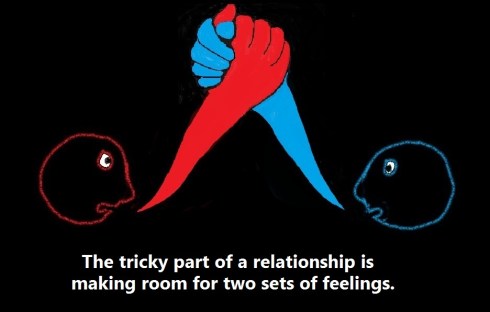
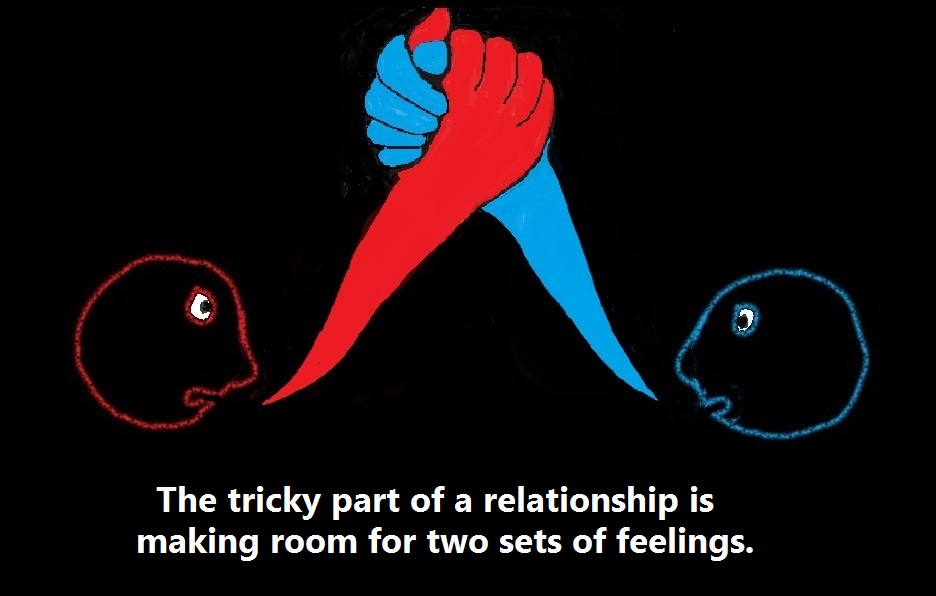
When I work with couples I explain that all relationships are difficult because they force us to wrestle endlessly with two questions: How can I have you without losing me? How can I have me without losing you?
Every socialized human being struggles with the same questions. How can we satisfy self-needs and social needs at the same time? How can we belong to the larger tribe without losing what makes us unique individuals?
So pervasive is this struggle that it can blur the boundaries that define us. For many it becomes hard to tell where we end and the rest of the world begins.
I’m mad at Dad. But if Dad knows I’m angry he may reject me, and I’m scared of that. I’m afraid it would leave me feeling hurt, guilty, inadequate, abandoned and/or disinherited. So I hide my anger in self-defense.
Am I controlling myself in order to control Dad? Or am I controlling Dad in order to control myself?
Thus I get split into two selves, private and public, real-me and false-me, controller and controlled.
And my boundary gets blurred, and after a while I can’t tell who I really am, what I really need, or how I really feel.
Again, nobody can avoid the tension between self and environment.
Which means neurosis happens to all of us.
Which means it’s normal to end up split, and scared, and trapped by the control addiction to which neurosis gives birth.
Which means we’re all monkeys on this bus.
9 Comments | posted in control
I never really wanted those grapes
anyway. I am sure they are sour.
~ Aesop
Rationalization means explaining something in a way that is comforting but dishonest.
Control addicts use rationalization all the time. They actually have to, in order to convince themselves that control is essential and possible.
Sometimes it appears as stinking thinking, the form described in chapter 34 (If I just try a little harder, a little longer…).
And sometimes it manifests as mistaking the desirable for the possible, a type of thinking I call the shoulds.
He should take better care of me emotionally. He should know what I feel and give me what I need. He should know when I need a hug, or to be listened to, or to be left alone. He should know what I want in bed. When I’m upset he should know what to say to make me feel better. If he really loved me he’d just know.
The shoulds can transform a reasonable desire (I want X) into an unrealistic expectation (I should have X), and ultimately to an emotional problem (I’m angry that I don’t).
Control addicts regularly apply this kind of wishful thinking to other people, places, things, and themselves.
The control addicts we call perfectionists should on themselves constantly.
I should be thinner, richer, smarter. I should be further along in my career. I should be nicer to my mother. I should be a better parent. I shouldn’t get so angry. I shouldn’t have made that mistake. I shouldn’t make any mistakes. I can’t stand mistakes.
A third form of rationalization is rooted in the following belief:
Good things happen to good people, and bad things happen to bad.
This is called The Just World Hypothesis, and most people believe in it whether they realize it or not.
It explains why we tend to feel guilty when bad things happen to us, and why we torture ourselves with second-guessing (If only I hadn’t…). It’s common among religious people, raised on the idea of sin. But belief in God is no prerequisite to belief in a Just World. I once worked with an atheist who argued endlessly against the existence of God but never doubted, when confronting personal misfortune, that he himself had somehow caused it.
Why do we cling to this bias? It provides the illusion of control.
If bad things can happen to good people, that means everyone’s at risk. But if the good are rewarded and the guilty punished, maybe I can avoid punishment by being good, and maybe the world makes some sort of sense.
Belief in a Just World also leads to even more pernicious misinterpretations, like blaming the victim.
She was kidnapped at knife-point from a restaurant parking lot by a drifter who raped her twice. But the jury showed little sympathy, and the rapist was acquitted. “We all feel she asked for it by the way she was dressed,” said the foreman.
The type of victim-blaming I hear most often in therapy is self-blame, where clients impede their own recovery by taking unrealistic responsibility for bad things that happen to them. It’s common among abuse survivors, and people who grew up in families prone to unpredictability and emotional turmoil, where kids often got blamed for things that weren’t their fault. They were left feeling vulnerable, vaguely guilty, and too quick to blame themselves.
Sure, imagining cause-and-effect relationships where they don’t exist can be comforting.
But ours isn’t a just world, or the world we want.
Maybe not even the world we deserve.
Just the world we have.
4 Comments | posted in control

![[] bert panel (print for edit)](https://monkeytraps.com/wp-content/uploads/2014/04/bert-panel-print-for-edit.jpg)





![[3] 56. Every conversation has two floors [][][] [8-30-12]](https://monkeytraps.com/wp-content/uploads/2015/10/3-56-every-conversation-has-two-floors-8-30-12.jpg)
![[9] 121. Control addiction is like a teddy bear [][][] [8-12-12]](https://monkeytraps.com/wp-content/uploads/2015/10/9-121-control-addiction-is-like-a-teddy-bear-8-12-12.jpg)
![[5] 69. Control is like a knife [][][]](https://monkeytraps.com/wp-content/uploads/2015/10/5-69-control-is-like-a-knife.jpg)
![[4] 68. At best, control is a temporary solution. [][][][][]](https://monkeytraps.com/wp-content/uploads/2015/10/4-68-at-best-control-is-a-temporary-solution.jpg)