Author Archives: Steve Hauptman

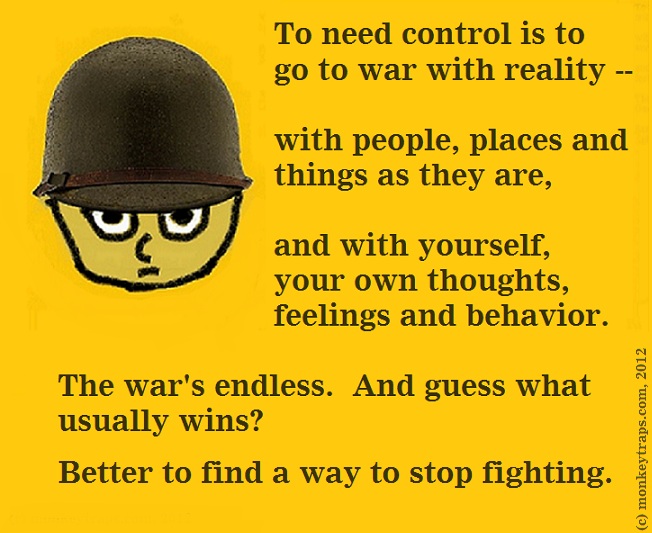
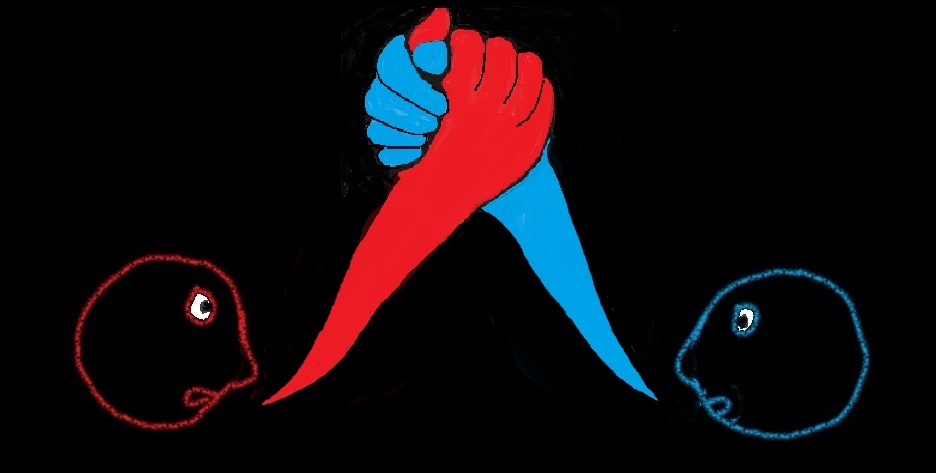
War

* * *

To some people, surrender may have negative connotations, implying defeat, giving up, failing to rise to the challenges of life, becoming lethargic, and so on.

.

True surrender, however, is something entirely different.

.

It does not mean to passively put up with whatever situation you find yourself in and to do nothing about it.

.

Nor does it mean to cease making plans, or initiating positive action.

.

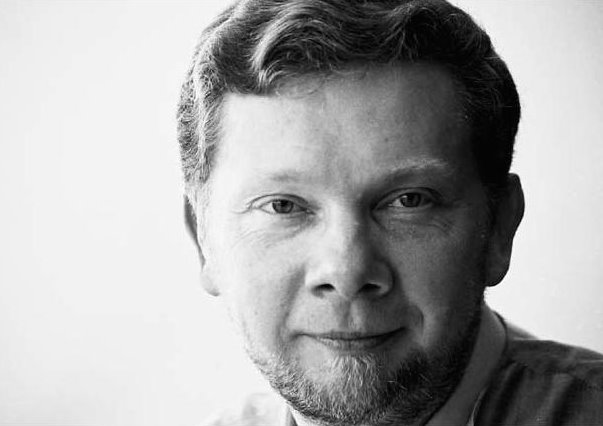
Surrender is the simple but profound wisdom of yielding to, rather than opposing, the flow of life….

.

It is to relinquish inner resistance to what is.

.

~ From

The wisdom of surrender

 by Eckhart Tolle (9:33).


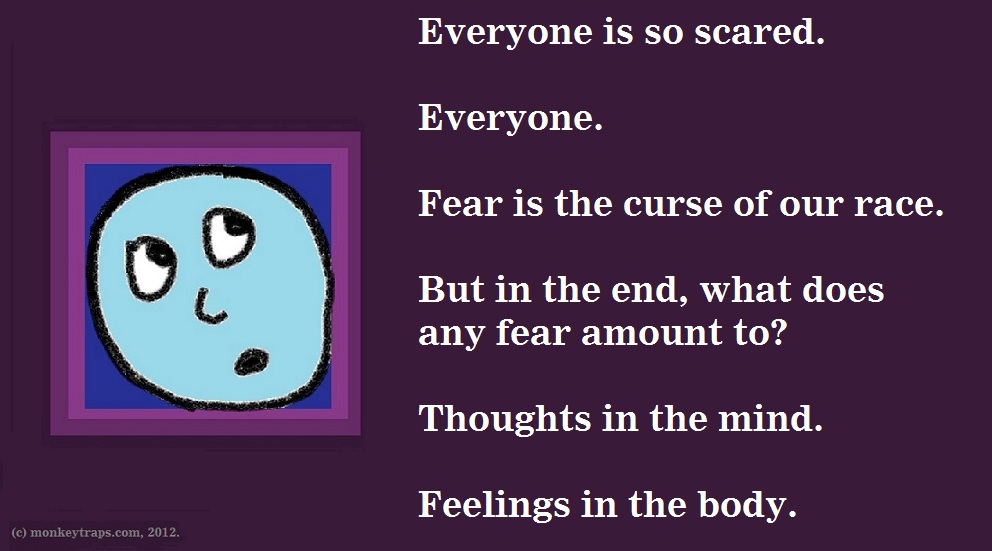
So scared

*

* * *

.

To laugh is to risk

appearing the fool.

.

To weep is to risk

appearing sentimental.

.

To reach out to another

is to risk involvement.

.

To expose feelings

is to risk exposing your

true self.

.

To place your ideas

and dreams before a crowd

is to risk their loss.

.

To love is to risk

not being loved in return.

.

To hope is to risk

despair.

.

To try is to risk

failure.

.

But risks must be taken.

.

 Because the greatest

risk in life is

to risk nothing.

.

The person who risks nothing

does nothing, has nothing,

is nothing.

.

He may avoid

suffering and sorrow,

but he cannot learn,

feel, change, grow,

or live.

.

Chained by his certitude,

he is a slave who has forfeited

all freedom.

.

Only the person who risks

is free.

.

   ~ William Arthur Ward

.

* * *

Guess:

.

Dismissed from drama school with a note that said “Wasting her time.  She’s too shy to put her best foot forward.”

*

*

Cut from the high school basketball team, he went home, locked himself in his room, and cried.

*

*

A teacher told him he was too stupid to learn anything, and he should go into a field where he might succeed by virtue of his pleasant pesonality.

*

*

His fiancee died, he failed in business twice, he had a nervous breakdown, and he was defeated in eight elections.

..

~ From Life = risk (1:19).


Control addicts

.

* * *

.

.

Here are the three things you need to know about shame:

We all have it.

We’re all terrified to talk about it.

The less we talk about it the more we have it.

~ From Part 1 of a PBS interview of Dr. Brene Brown (4:56).

*

Q: You say that shame leads to disconection.  So how do we reconnect?

A:  You know, it’s funny.

One of the ironies is that shame fills us with this fear of disconnection.

But it is our imperfection that connects us to each other.  It is the fact that our shared humanity is imperfect.

I think if we can find the courage to talk about our lives honestly, and our struggles, not only does that free us, it gives other people the freedom to be more authentic and real as well.

I don’t think connection is possible without authenticity.

~ From Part 2 of a PBS interview of Dr. Brene Brown (5:31).


Necessary fictions

Willie’s talking about his job, which he hates.  I ask if he’s thought about doing something else.

He scowls.

“I’m forty-six years old,” he mutters.  “I have a wife, two kids and a 30-year mortgage.  What the hell else am I doing to do?”

“I don’t know.  What would you like to do?”

This pushes a button.  Now he’s angry.

“Shit,” he says.  “I’m so tired of hearing You can be whatever you want to be.  I get sick to my stomach when I hear that.  It’s such bullshit.”

I say nothing.

“You disagree?” he says.

“Yes,” I say.  “I don’t think it’s bullshit.”

“Oh come on,” he says.  “You can’t believe anyone can be anything they want just because they want it.”

“No,” I said, “I don’t.  But I don’t think believing it is bullshit.”

“Why not?”

“It’s what’s called a necessary fiction,” I say.

“What’s that?”

“Ever read Monkeytraps?” I ask.

“Sometimes.”

“Good,” I say.  “Read it tomorrow.  I’ll answer there.”

.

* * *.

A necessary fiction is a story we tell ourselves to help us get through life.

It’s not a lie, exactly.  Nor is it entirely the truth.

It’s more like an aspiration — a way of reaching towards what we need or want.

It makes us feel good about ourselves, or life, or the future.  It makes pain and disappointment more bearable.   Gives us courage.  Gives us hope.  Helps us cope.

We all live by necessary fictions.  We all tell ourselves stories about who we are and what we’re doing and where it will all lead.

For example,

Everything will be okay.

We’ll live happily ever after.

I’ll never die.

The people I love will never die.

I’ll never get old and sick.

Money buys happiness.

Driving is perfectly safe.

If I vote for X, it will make a difference.

Tomorrow’s another day.

I can get control of how I feel.

That last one is my favorite, of course, since the idea of control is the necessary fiction Monkeytraps is all about.

Why do I call these fictions necessary?

Because of our big brains.

Like oversized computers run amuck, our big brains are dominated by the process Buddhists call monkey mind — an incessant stream of remembering and projecting, interpreting and analyzing, worrying and agonizing.

Ever stop to listen?  It’s a nuthouse in there.

Necessary fictions act as a sedative.  They appease monkey mind, quiet it down.

Imagine, for a moment, living without that sedative.

Imagine living day to day, hour to hour if you cannot forget that someday you must die.  I’ll never die fends off death anxiety.

Imagine getting in your car and running to the store for milk if you can’t forget that someone dies in a car accident every 13 minutes.  Driving is perfectly safe is the necessary antidote.     

But:

There’s a difference between relying on necessary fictions and being lived by them.

We must remember that our fictions are fictions.  To do that means being self-aware and self-supporting.

To forget that they’re fictions — that this is a story we believe, not a literal truth — is to lose touch with reality.

Religious bigots are a good example.  They’re convinced themselves the story they believe is The Truth.  It’s a short step from that conviction to seeing everyone who doesn’t share it as deluded, even evil.  (Even deserving extinction.  Read the papers.)

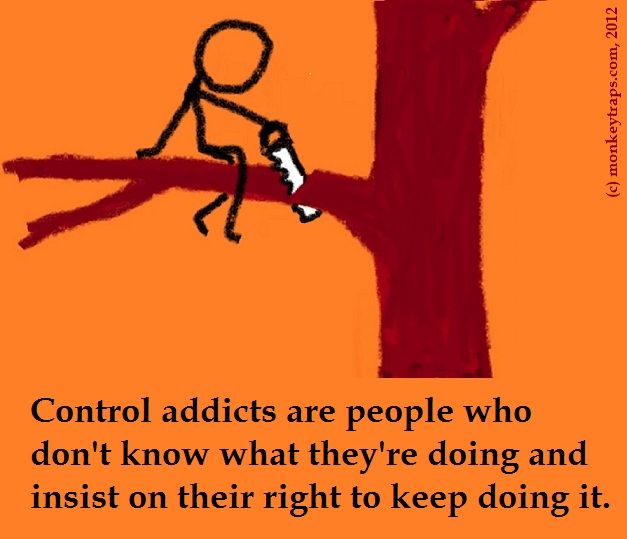
Control addicts are another example.  They’ve convinced themselves — despite all evidence to the contrary — that control is both possible and necessary.  So they spend their lives chasing it, like a hapless commuter ten steps behind a train he can never catch.

Which leads to lives of frustration and misery.  Control addicts make other people pretty miserable too.

In therapy I try to help them see control as a necessary fiction, a story they tell themselves about the way they want things to be.  It’s a very human story.   One that’s sometimes necessary, and sometimes necessary to give up.

Because when you can’t give it up, you’ve made a problem out of a solution.

*

* * *

.

Speaking of illusions:

Less necessary,

more fun.

~ From the video The chalk guy (2:15).

(For best effect,

watch it full screen.)


Questions

.

.

* * *

.

We wake up one day

at the age of forty

dreading going to work

because we were forced

to pick a career

before we could

legally buy a beer.

.

Why does this happen?

.

It’s because so many of us

in our younger years

think that a means goal

is really an end goal.

.

We confuse the two.

.

And these things are

really, really different.

.

.

..

From The three most important questions to ask yourself by Vishen Lakhiani (13:15), who writes,

8

Over the years I’ve come to stop believing in goal setting.

Why?

Because goal setting, or at least the way most of us are trained to do it, actually gets us to be obsessed about the how of attaining our goals, rather than the passion, the vision, and the beauty of the goal itself.

In short, we get obsessed with the “means,” rather than the “end.”

In this video, we are going to change the way you think about goal setting. We are going to present to you the 3 most important questions to ask yourself. If everyone asked themselves these questions at the age of 18, we believe the world would be a much happier place.

But no matter how old you are, it’s not too late.

This exercise will change the way you plan your life and see your goals. It’ll change the way you see your career, mission, and life purpose unfolding. The intro to the exercise takes no more than 5 minutes, and the exercise itself takes 7 minutes.

This could be one of the most important 12 minutes of your life.

.

* * *

Now playing

over at

Mental Health Talk:

“Monkeytraps 101 ~

Bert’s Crash Course

in Control,”

Lesson 2:


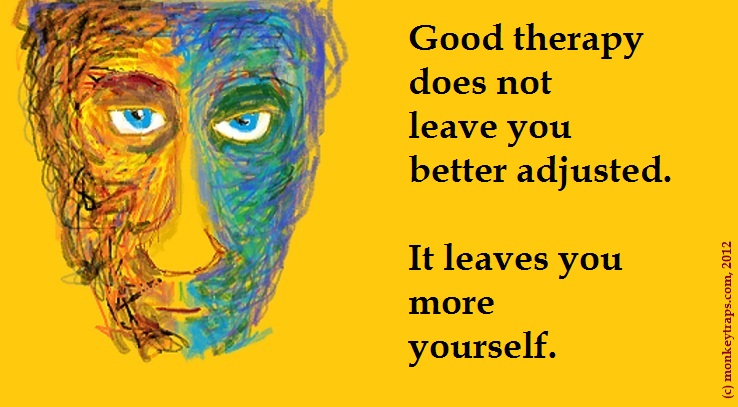
Good therapy

.

.

* * *

Being authentic means risking finding out

what we truly feel deep inside

— not just living out ideas and expectations

of who we are or who we should be — 

and even being willing to be surprised

by ourselves.

.

We need to be able to tolerate

the bodily experience of vulnerability

that arises when we risk being real…. 

.

We are not able to force others

or the world

to meet us with warmth and interest

when we show up in our genuine selves. 

And that is vulnerable.

. 

We need to be able to stay

with ourselves

to feel and deal with the discomfort

of that in our bodies,

if we are to live an authentic life.

.

~ From Authenticity

by Dr. Sandra Parker

.

.


The Monkeyship Theory

(Bert speaking:)

Came across this old post recently, which Steve and I wrote together more than a year ago.  I was surprised how true it remains for me/us today.  So I’m running it again, with some tweaks.

* * *

Lately Steve’s seeing more and more couples.

Not sure why.  He never trained as a couples therapist, and he doesn’t advertise himself as one.

But couples apparently like his approach, because they keep sending him new couples to work with.

Which at one time would have pissed me off.

Because I hated couples work.

It scared me.

It scared me for two reasons.  First, there was too damned much going on in the room.

Steve, explain.

Well, couples work means paying attention to many levels and variables at once.  Like,

~ what the partners say, and what they don’t say;

~ which feelings they express, and which they hide;

~ which of their motives they’re aware of, and which are unconscious; and

~ what’s happening between them here and now, as opposed to whatever past experiences (often buried, usually painful) are getting triggered.

Right.  All that felt overwhelming.  It was just too much.

Too much for you to control, you mean.

Yes.  Forget about controlling it in the room.  I couldn’t control it inside my own head.  Couldn’t organize it mentally.

I also hated the tension.  Many couples were so frustrated or angry at each other that sessions with them felt like watching someone juggle live hand grenades.  I kept waiting for some KABOOM that would blow the office into matchsticks.

So you couldn’t control the emotional situation either.

Right.  I couldn’t control either their feelings or my own feelings about not being able to control how they felt.

All of which explains why, for years, whenever someone called Steve to request couples counseling I’d immediately climb up onto his shoulder and whisper Just say no over and over and over.

I remember.

But you didn’t listen.

Well, we do have to make a living.

Yeah.  I didn’t care.  My priority was anxiety management.

Anyway, I’m glad he didn’t listen.   Because over time he learned something important about how to help couples.  And eventually I even began to feel safe.

Both happened after he created his Monkeyships Theory.

Steve, define monkeyship.

It’s any relationship that becomes dysfunctional because both partners are struggling for control.

And the theory.

That nearly all relationship problems are monkeyship problems, since eventually all relationships turn, well, monkeyish.

This theory helped me feel safer with couples in two ways.

First, focusing on the idea of control helped me to observe and organize what was happening in each session.  Sort of like an Etch-a-Sketch magnet rearranges iron filings.

Yes.  Noticing how people are trying to control each other does clarify how they got into trouble in the first place.

But more importantly, it gave Steve a way to help them get out of trouble.

Steve, explain that.

Well, I realized my job wasn’t so much to fix or change anything as to help the partners notice how they were trying to get control.  I did this by pointing out what I was seeing and hearing.

Once they could spot their own patterns, the next step was to teach them the three alternatives to control — surrender, responsibility and intimacy (see the end of What do you know about control?) 

And then get them to practice.

And this really works.

Better with some couples than others, frankly.  Its success depends mainly on how willing they are to stop playing blame tennis and look hard at themselves. 

And when they do, what do they see?

That control is the secret motive behind most of their behavior.  That they’ve been trying to transform their partner into the partner they want, instead of accepting the one they have.  

“Don’t be who you are.  Be who I need you to be.”

Yes.  That’s the theme song of any monkeyship.         

For partners who can move past that theme song, surrendering control offers a path out of monkeyship and towards mutuality.

Which is?

What relationship is meant to be: a place where both partners can be themselves with each other, and where they come to see that what’s good for their partner is — surprise — also good for them.

* * *

For more on control and relationships, check out The split-level relationship and Monkeytraps and how to spot them.


Avoidance

.

.

* * *
.

Do you know that

most people don’t know

how feelings work?

.

The truth is,

if you don’t

understand how

your feelings work,

you really don’t

understand the world

around you.

.

The truth is,

the way you

see the world

is in large part

distorted by

the feelings

that you have not

expressed….

.

.

~ From Let them off the hook by David Viscott, M.D. (4:49).


Canaries

* * *

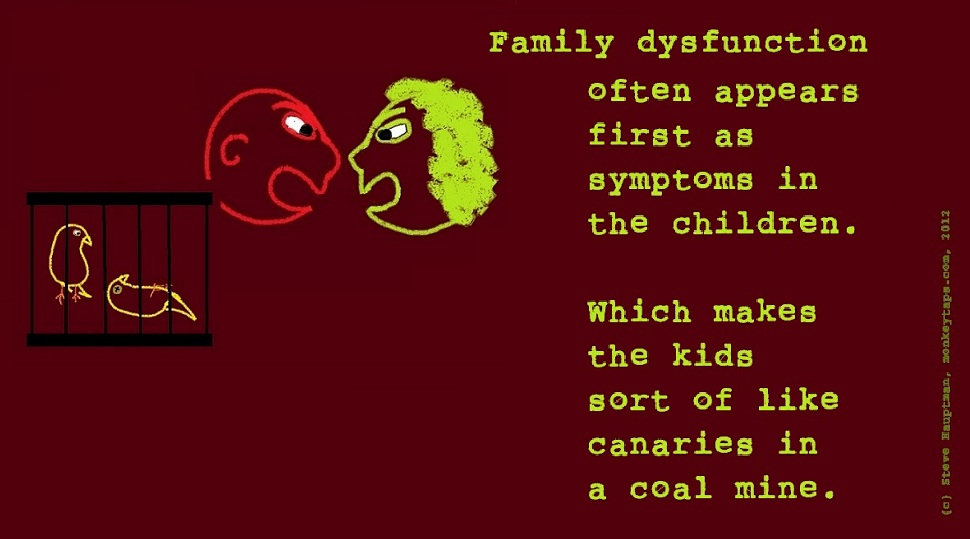
In a some families

— alcoholic, abusive or

otherwise dysfunctional —

kids aren’t

allowed to be

themselves.

.

They aren’t allowed

to listen to

their own feelings

or act in service of

their own needs.

.

Instead they get drafted

into unconscious roles

intended to meet the needs

of the family.

.

They get lost, and end up

believing stuff like:

.

“If I’m smart enough,

and good enough at sports,

I can save my family…”

.

“I just don’t want to cause

any more trouble

for my family.”

.

“If I make everything fun,

we don’t have to think

about our problems.”

.

“If you don’t care,

then I don’t care either.”

.

.

This dynamic is

far more common

than most people think.

.

~ Watch the rest of Common roles played in alcoholic families (2:09).


Premiere!

Ahem.

.

As of today,

Bert has expanded

into cinema.

..

So put down that banana

and hustle your monkeybutt

over to

Mental Health Talk

for the premiere of our

very first

slideshow:

.

.

.

There you’ll find

Lesson 1:

Sex!

Violence!

Thrills!

Political Intrigue!

.

“The Monkey” has none of these.

.

It’s just a brief (3:27) introduction

to a secret part of you

that you really should

get to know better.

.

(What?

You can’t spare 3:27?

Boy, do you need

this slideshow.)

.

“The Monkey” is

the first lesson of six

to be published weekly

by Mental Health Talks.

.

Coming next week,

Lesson 2:

The Addiction.

.

Comments on Monkeytraps 101

are welcome

(nay, eagerly awaited)

both here

and at Mental Health Talk.

.

And while you’re over there,

be sure to browse around

Mental Health Talk.

It’s an awesome resource

(subtitled “Our stories.  Our wisdom. 

Making a difference”) 

created and edited

by my new friend Trish,

whose introduction to MHT

you can read here.

.

See you soon.

love,

Bert


Tea

New client today.  His wife sent him.  She thinks he’s alcoholic.  He went to two therapists before me who agreed with her.  Plainly he’s looking for someone who doesn’t.

So he talks to me for forty minutes, explaining his family history and all the stresses in his life and why his use of alcohol is both justified and manageable.  Then he asks the question.

“Do you think I’m alcoholic?”

“I don’t know,” I answer.  “I don’t know you well enough yet.  But whether you are or not, I don’t think you’re ready for therapy.”

His eyes widen.  Not what he expected. 

“Why not?” he asks.

I tell him one of my favorite Zen stories.

A college professor visits a Zen master.  “I’ve come for your teaching,” he says.  He then proceeds to tell the master everything he knows — all the books he’s read, all the books he’s written, the lectures he’s delivered, the theories he’s developed over many years.  Finally he pauses for breath, and the master says, “Let’s have tea.”  He fills the professor’s cup, then keeps pouring so the tea runs over the brim and onto the table.  “Stop!” says the professor, “It’s already full!”  “So are you,” replies the master.  “And until you empty yourself you’re not ready for my teaching.” 

See, we spend much of our lives in pain.  And we spend a good deal of time explaining our pain to ourselves.

It’s inevitable that we do this. 

Why?  Because it gives us a sense of control over our emotional lives.

And, of course, there’s no shortage of explanations.  You’ll find them here and on a zillion other blogs and websites.  Then there’s books, and Oprah, and Dr. Phil, and pop culture, and cable news, and advertisers, and (god help us) politicians, and your bf, and Mom, and maybe your therapist.  All happy to offer their two cents.

And we can’t help but absorb much of it, and over time piece together a sort of explanatory patchwork that explains nothing but helps us feel like we know what the hell’s going on.

And we often cling to this patchwork, even after all evidence suggests that it’s inadequate and the pain it’s meant to manage persists. 

Hey, we’re human beings.  We’re the monkeys that control.  And we’d rather trust lies than feel helpless.

My new client left looking puzzled.  Don’t know if he’ll be back. 

I’m glad I met him, though, because he reminded me of the question we each need to ask and keep asking:

Would I rather be right, or healthy?  

.

* * *

If you do not

change direction,

you may end up

where you are heading.

~ From Lao Tzu Quotes  

a slideshow (2:04)

courtesy of quotecorner.com.


Teacher

.

.

* * *

There is incredible pain,

and in some

profound way

all of our actions

henceforth are

an attempt to return

 [to a feeling of Oneness].

And we develop

a whole set

of techniques

that we say

make us

“feel good”…

~ From On attachment and addiction by Ram Dass (9:24).

.

.

.


Therapy


The split-level relationship

There are two questions with which you must struggle if you want a healthy relationship:

How can I have you without losing me?

How can I have me without losing you?

You can’t really answer these questions, just struggle with them.

But it’s the struggling that matters.

Why?

Because they represent two essential needs each of us brings to any relationship:

Connection and freedom.

Acceptance by another person, and self-acceptance.

A real partner, and at the same time, a real self.

Most people I know are convinced you can’t have both at the same time.

Most came from families — alcoholic, abusive or otherwise dysfunctional — unable to teach them to balance connection with freedom.

What they learned instead was that having one meant losing the other.  That winning love and approval from parents, for example, meant sacrificing important parts of themselves, like the freedom to express feelings or take care of their own needs.

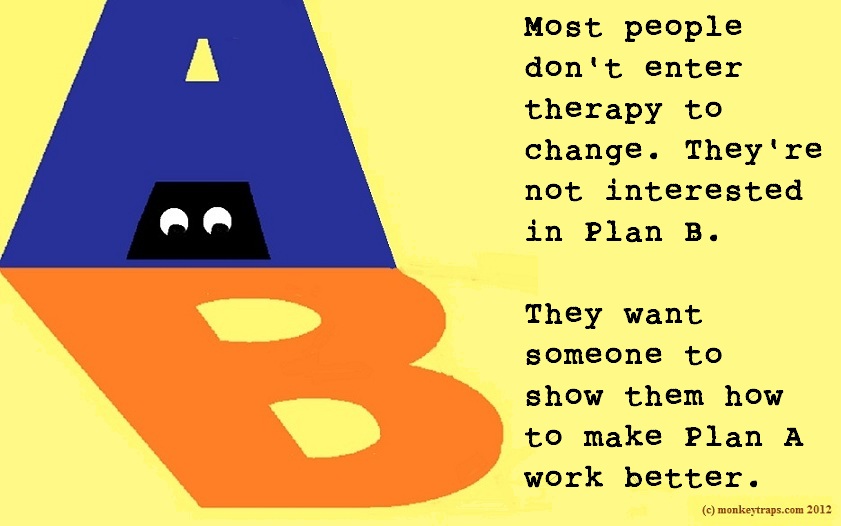
The family that raised us is where each of us learned our own personal answer to the two questions. And the answer we learned grew into a crucial (though mostly unconscious) part of our basic view of life and relationships, what I call our Plan A.  

Some of us decide, “Since I can’t have both, I’ll have me, and to hell with you.”  Shrinks call this the narcissistic answer.

Others decide, “Since I can’t have both, I’ll have you, and to hell with me.” This is the infamous codependent answer.

So the narcissistic partner says “Me first,” and the codependent replies, “Yes, dear.”

And the two personality types end up together with stunning regularity.  (Remember Archie and Edith Bunker?)

Watching such couples interact, one is struck by their predictability.  In every situation the narcissist finds some way to say “Me first,” and the codependent to reply “Yes, dear.”  It’s as if long ago they sat down and signed a contract.

Which in a way they did.

Their complementary answers to the two questions probably account, in large part, for why they felt attracted to each other.

In any case, the vast majority of couples I see for couples counseling follow this pattern — so many that I felt the need to give them their own name.

I call them split-level relationships.

Split-level relationships work for a while, but almost always break down.  Eventually one or both partners realize they’re not getting what they need.

Codependents usually notice first.  When that partner is female this can lead to the syndrome called the Walk-Away Wife.

But narcissists tend to be unhappy too. They often complain of loneliness, lack of connection to their codependent partner, or an absence of respect or affection.  They may feel impatient, frustrated, irritated, resentful. Sometimes they drink, drug, overeat, rage or cheat, and then feel bad about that.

All this happens because split-level relationship is inherently unhealthy.

Familiar, sure.  Comfortable, even, in the way the predictable may come to feel.

But not healthy.  The unbalanced answers on which a split-level relationship is based simply cannot fill the emotional needs of two adults.  So both partners end up feeling deprived, often without understanding why.

What does recovery for such a couple look like?

Put simply, a sort of role reversal.

Codependent partners must develop courage and practice standing up, asserting themselves.  Narcissistic partners must develop empathy and practice stepping down, giving instead of grabbing.

Easy?  No.  Not easy for either of them.

Just necessary to life on the same level.


Ball

* * *

One of Carl Jung’s longtime patients wrote to Jung describing the relationship between radical self-acceptance and self-knowledge:

.

By keeping quiet, repressing nothing, remaining attentive, and by accepting reality — taking things as they are, and not as I wanted them to be — by doing all this, unusual knowledge has come to me, and unusual powers as well, such as I could never have imagined before.

.

I always thought that when we accepted things, they overpowered us in some way or other.  This turns out not to be true at all, and it is only by accepting them that one can assume an attitude towards them.

.

So now I intend to play the game of life, being receptive to whatever comes to me, good and bad, sun and shadow forever alternating, and in this way, also accepting my own nature with its positive and negative sides.  Thus everything becomes more alive to me.
 .

What a fool I was!  How I tried to force everything to go according to the way I thought it ought to.

.

~ From The wisdom of yoga: A seeker’s guide to extraordinary living by Stephen Cope.