I lead three weekly therapy groups all of whose members are busy coping with crazy relationships.
Crazy is my politically incorrect term for any dysfunction in an individual that impacts another person.
That includes anger, anxiety, addiction, depression, narcissism, codependency, chronic illness, and anything else that keeps someone in a chronic state of distress.
Which is stressful for anyone who cares about that someone.
So the question that comes up over and over in group is How do you live with Crazy?
It’s possible, as it turns out.
But it requires following three difficult rules:
1. Don’t take Crazy personally.
2. Don’t try to fix Crazy.
3. Model unCrazy behavior.
Don’t take Crazy personally is the hardest rule to accept.
Because we’re social animals, wired for relationships, it’s hard for human beings to detach from the feelings of the people closest to them.
It’s even harder for those of us raised in alcoholic or otherwise dysfunctional families, where boundaries got so blurred that the pathology of some members seeped into the emotional lives of the rest.
That’s classic codependent conditioning.
And if you were shaped by that conditioning it’s inevitable that, even as an adult, the Kid inside you will experience another’s unhappiness as being somehow your fault.
You will feel both tormented and responsible for the torment.
And so you’ll set out to fix things.
Don’t try to fix Crazy is the rule that targets this tendency.
It takes a long time to learn.
Partly this is because fixing others gets mistaken for love and compassion.
I love X, we think. How can I just sit and watch them suffer?
But there are questions which can help us identify our true motives and distinguish compassion from caretaking.
One is Am I giving from love or from fear? Fullness or emptiness? Strength or desperation?
Another is Has my helping really helped in the past?
Honest answers to these questions can help us decide if we’re acting out of love or merely trying to defend against the kind of emotional spillover kids in sick families experience.
The third rule, Model unCrazy behavior, may be the closest we can get to bridging the gap between a loved one’s emotional pain and our inability to fix it.
It means managing our own anxiety and helplessness in the most intelligent way possible.
It means shifting our attention from outside to inside, from our struggling loved one to our reaction to that person’s Crazy.
And it means asking ourselves What do I need right now?
This too may be difficult for us — even guilt-inducing — if we were taught by our families that self-care is selfish and that the needs of others should always come before our own.
It takes enormous courage to stand up for yourself in the face of such conditioning.
But learning to do so is a gift not only for us, but for the people around us who need to learn healthy self-care and for someone to show them how it looks.
We also need to remember that we can’t give away strength that we don’t really have.
Without, you know, going Crazy ourselves.
Postscript:
I’ve been Crazy plenty of times myself.
And during those times of pain and confusion what I need most from the people who love me is that they follow these three rules.
I’m always grateful when they are able to.
Because it makes my Crazy easier to bear.
I hope they can do it again next time around.
Because it’s safe to assume there will be a next time.
“I keep saying to myself That’s me and That’s me too and That’s me again. I’m on every damn page, and it’s discouraging.”
“Give me an example.”
“Let me look,” she says, and pulls out her copy.
“Okay, it starts with ‘Defense Department,'” she says, “Chapter 30. Then gets worse with each defense you describe. I do all of that.”
“All of what?”
“Oh, I bury my feelings, ignore problems that scare me, confuse one relationship with another. I worry endlessly. And I project all the time,” she frowns.* “Sometimes I feel like all I ever do is what you call stinking thinking.”
“Uh huh,” I say. “Want to hear a secret?”
“Okay.”
“I know the guy who wrote the book.”
She grins.
“And he wrote it from personal experience,” I go on. “In other words, I do all that shit myself.”
“Really?’
“Sure. We all do. That’s the whole point of the book. To show how we’re all addicts, constantly trying to control our emotional lives, and how all that controlling makes us sick.”
She hesitates, then asks:
“What do you do?”
“Good question. Mostly I’m in my head. I try to think my way through life. I make lots of plans and lists. I have this file on my computer desktop where I list all the jobs I need to do in every area of my life — my practice, my writing, my house-and-yard stuff. It’s color-coded, and it’s ridiculous.”
“Why? Doesn’t the list make you feel organized?”
“It does when I’m making it. My Kid thinks adding a job to the list means taking a step towards completing it. And occasionally it does. But mostly I just end up with a longer list.”
“And feeling worse.”
“Exactly.”
“So what can you do about that?”
“I try to practice alternatives.** I try to detach from the endless To Do list and focus entirely on one thing at a time. There’s a Buddhist saying: Chop wood, carry water. I try to get out of my head and just chop wood, carry water. Rake leaves, clean office.”
“And then I try to address the feelings that drive the list-making. Usually they’re old feelings I’ve carried since childhood — guilt, inadequacy, disappointment in myself. Anxiety about how others see or judge me. I try to tell my wife about them instead of acting them out.”
“And that works?”
“When I remember to do it. But I also know the feelings will come back and I’ll have to practice again. And that’s as good as it gets.”
“It is?” she asks. “That’s depressing too.”
“Why?”
“I don’t know. I guess I had this idea that if I worked hard enough and long enough I solve all my emotional problems, and end up…”
“Perfect?” I say.
“I suppose,” she shrugs. “Is that stupid?”
“Unrealistic,” I say. “Also self-defeating. Perfectionism is nothing more than a form of controlling which guarantees we’ll always, always, always feel inadequate. It’s like swallowing a small dose of mental poison every day.”
“Well, shit,” she smiles. “So I should give up on perfect.”
“Right. We don’t get to be perfect. We don’t need to be perfect. There is no perfect. Perfect’s an illusion. Just like control.”
_____________________
*She’s referring to chapters 31 (“Interruptions”), 34 (“Ostrich”), 32 (“Mistaken Identities”), 35 (“Gumchewing”) and 33 (“Superpowers”).
(If you’re new to Monkeytraps, Steve is a therapist who specializes in control issues, and Bert is Steve’s control-addicted inner monkey. That’s the two of us over on the right.
Bert speaking:)
Alexander Grey
I’m nuts.
Yes, you heard me right.
I’m nuts.
Not embarrassed to admit it, either.
Why?
Because I know a secret.
You’re nuts, too.
How do I know this?
Because you’re human. (Unless, of course, you’re one of the dogs or cats who enjoy this blog.)
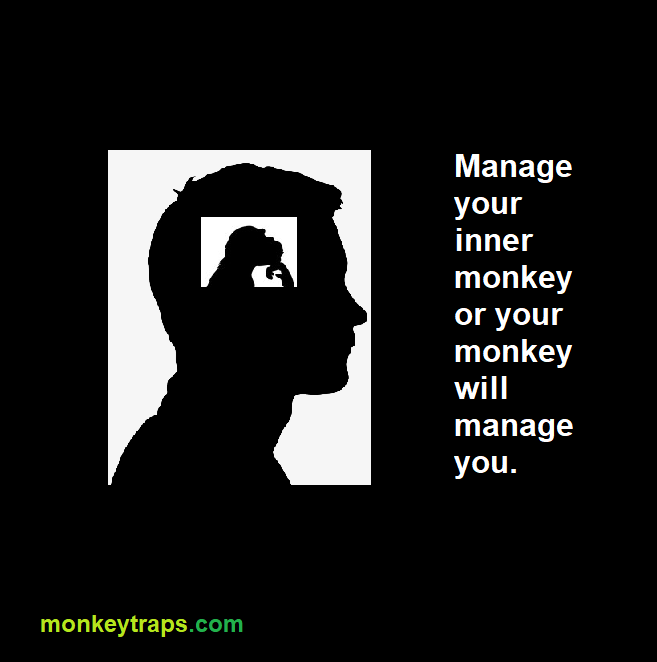
And, being human, you’re a victim of what Buddhists call monkeymind.
What’s monkeymind?
It’s what you hear in your head when your attention isn’t distracted.
It’s the sound of a brain which over millennia has evolved into a sort of top-heavy computer, built for problem-solving, and devoted to finding new problems to solve.
It’s the whispering, worrying, fretting, scolding and mocking that keeps you unhappy and on guard against life.
It’s the sound of a normal human mind at work.
In other words, the most human part of you.
Still not sure what I mean?
Experiment: Take a moment now (when you finish reading this sentence) to sit without thinking for, oh, a minute or so. Just sixty seconds.
(Pause.)
Hear that?
Yup. Monkeymind.
The nuts part.
Steve wants to add something.
What makes monkeymind nuts is its disconnection from reality.
As a monkey swings from branch to branch and tree to tree, monkeymind swings from past to future and back again, over and over, ceaselessly remembering, anticipating and fantasizing.
It’s never still, never focused on the here-and-now — a Now which may actually be perfectly safe and okay.
So when you’re caught up in monkeymind you’re having all these feelings — often painful ones, anxiety and anger and such — that have nothing to do with what’s really happening in your life at the moment.
It’s like being trapped in a nightmare, unable to wake up.
Speaking as a recovering inner monkey, I would add that there’s one other thing that makes monkeymind nuts.
It really really really believes in control.
It operates on the assumption that if we think and analyze and strategize long and well enough we can solve every problem and bring life under control. That if we could just figure things out, life could be perfect. Perfectly safe, perfectly comfortable, perfectly happy.
I remember a Little Rascals episode in which the kids got their mule to walk in a circle by extending a pole out over his nose with an apple dangling from the end. The donkey kept plodding after the apple endlessly, never getting closer, and apparently never noticing.
Yes. We all chase that apple.
Well, I’m sick of it.
That’s why I’m a recovering monkey. I’m sick and tired of feeling victimized by my own mind.
Tired of fighting reality instead of accepting it.
Tired of trying to control everything.
Tired of this never-ending plod towards an apple I can never reach.

 xx
xxxxx
xx
xxxxx

 I lead three weekly therapy groups all of whose members are busy coping with crazy relationships.