Category Archives: control
 What do we mean when we talk about control?
Say someone says “I want to feel in control” — what are they asking for, really?
My opinion:
Peace of mind.
Peace of mind. Consider that phrase, and what it suggests.
Calm. Safety. The absence of stress, pain and fear. Blessed relaxation. Connection to our selves, to others, to the world. Serenity.
And where does peace of mind come from?
Not fighting.
Peace of mind is rare because our minds are usually at war. Mentally we fight everything — each other, ourselves, our environment. “Each of us has our own silent War With Reality,” writes Stephen Cope.
This silent, unconscious war with How It Is unwittingly drives much of our behavior. We reach for the pleasant. We hate the unpleasant. We try to arrange the world so that we have only pleasant mind-states, and not unpleasant ones. We try to get rid of this pervasive sense of unsatisfactoriness in whatever way we can — by changing things ‘”out there.” By changing the world.*
Think about it. How often does the reality you have match the reality you want? How much time do you spend wishing that people, places or things were different? How much energy do you spend fantasizing, plotting or actually trying to make things the way you’d prefer?
Like all addictions, control-seeking is a problem disguised as a solution. It seems to offer a way out of discomfort and unhappiness. It delivers the opposite.
“The life of addiction is one of perpetual longing,” writes William Alexander:
“I want, I want, I want” is the chant of the discontented self. This longing is reckless and insistent. It will never be fulfilled. There is not one thing, one feeling, or one idea that will satisfy it. “I want” is always followed by “more.” It gets worse.**
So that’s control addiction. Is there an alternative?
Actually, there are three.
I call them surrender, responsibility and intimacy:
Surrender is the ability to give up controlling what you can’t control anyway. It grows out of believing that you can let go of control and things will still be okay. Often described with words like “detachment,” “acceptance,” and “faith,” surrender is the spiritual alternative to control.
Responsibility is the ability to respond to a situation honestly and with self-awareness. It grows out of listening to your feelings (instead of hiding or editing them), and trusting that what they tell you is both friendly (not to be feared) and important (not to be ignored). Often described with words like “presence,” “mindfulness” and “authenticity,” responsibility is the emotional alternative to control.
Intimacy is the ability to be yourself with another person and allow them to do the same. It’s actually a combination of the first two alternatives, since it requires that you both (a) abstain from controlling someone (surrender) and (b) share the truth about yourself (responsibility). Intimacy is the interpersonal alternative to control, and represents the high-water mark of emotional development — i.e., it’s about as healthy as we human beings get.
These alternatives do not come naturally to us. Each must be learned, and then practiced. Nor is the practice easy. It requires courage and perseverence, patience and faith.
But the people I know who invest in practicing usually find the investment worthwhile.
Because what the alternatives amount to are three ways of not fighting.
Three ways of declaring peace.
Maybe, in the end, the only ways we have.
__________________________
*Stephen Cope, The wisdom of yoga (Bantam, 2006).
**William Alexander, Still waters (Hazelden, 2006).
Leave a comment | posted in control
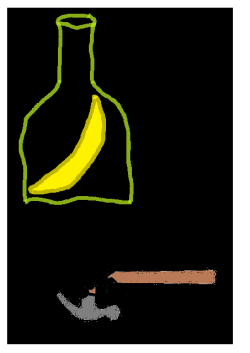 Once upon a time I wrote a post explaining where I got this blog’s title. I described how in the East they put fruit in a weighted jar with a narrow neck and leave the jar where a monkey will find it. The monkey smells the fruit, reaches in to grab it, and traps himself by refusing to let go. I explained that I use this as a metaphor for psychological monkeytraps: situations that trigger us into compulsive controlling, into holding on when we should be letting go.
One reader replied,
Why didn’t the monkeys just break the jar? I get that it was weighted down, but monkeys use tools. Weren’t there rocks laying around?
This led to a conversation with Bert, which is reported below verbatim.
Bert:
Shit. Why didn’t I think of that?
Steve:
Just the comment I’d expect from a control addict.
Bert:
Why? What did I say?
Steve:
You misread the problem.
Bert:
How?
Steve:
You think the jar is what traps the monkey.
Bert:
Sure.
Steve:
But he could escape the jar just by opening his paw.
Bert:
Oh. Yeah.
Steve:
Except he wants the banana more than anything.
Bert:
Wanting the banana is what traps him.
Steve:
Correct. Just as control addicts get trapped by wanting control.
Bert:
How did I miss that?
Steve:
You’re an addict. Addicts respond to a loss of control by thinking, “But I want control. I need control. There must be some way to get it.” That craving distorts their thinking.
Bert:
So instead of letting go we try breaking the jar.
Steve:
Yes. Breaking the jar is a metaphor for seeing life as something we can control. A dangerous illusion.
Bert:
Tell me this part again. It’s an illusion because…
Steve:
There are some bananas we’re not meant to have.
Bert:
Such as?
Steve:
Oh, all sorts of things.
Immortality, for example. We want to live forever, and we can’t.
And control of emotions. We want to feel only happy, safe and contented, and life forces us to feel sad, scared and needy.
And then there’s relationships. Which never go as planned.
Bert:
I noticed. Why is that?
Steve:
Because relationships involve people, and people tend to be hard to control.
Bert:
So there’s no breaking the jar.
Steve:
There’s no breaking the jar. Life’s just what it is. Messy, painful, unpredictable, inconvenient. We have to find some way of making peace with that.
Bert:
And there’s a way to?
Steve:
There are three, actually.
Bert:
What are they?
Steve:
I’ll post about them here tomorrow.
Bert:
No, now.
Steve:
It would take too long.
Bert:
But I want it now. I need it now. There must be some way to get it now.
Steve:
Very funny.
.
7 Comments | posted in control, metaphor for
 *
*
*
Particularization means mistaking some specific way of satisfying a need with the need itself.
It means confusing ends with means — mistaking what we want with one particular way of getting it.
“The genesis of particularization is habit, or conditioned response,” explain sociologists Snell & Gail Putney:
A person who has satisfied a need in one particular way since childhood is likely to have only a vague awareness of the need; his vivid consciousness will be of the familiar means of satisfaction. When feeling needful, he thinks instantly of the usual mode of fulfillment, bypassing recognition of the need itself….
But if for any reason the habitual behaviors are not very effective — as in many case they are not — particularization renders it difficult for the individual to recognize this fact…. Habit prevails, and he tends simply to try again in the familiar way.
The result is analogous to bailing a boat with a sieve.
~ From The adjusted American: Normal neuroses in the individual and society (Harper Colophon, 1964).
I see this all the time in people who grow up in alcoholic, abusive, or otherwise dysfunctional families.
Early on they learn to see life as unpredictable and dangerous (Will Dad drink or be sober? Will Mom hug me or hit me? Will everyone get along or fight until bedtime?) and blame their inner anxiety on events in their immediate environment.
Inevitably they try to manage their anxiety by controlling that environment (hide Dad’s beer, clean Mom’s kitchen, keep everyone laughing or distracted).
And there it is: particularization. As kids they equate something they need (feeling safe) with one particular way of getting it (controlling people, places and/or things). And they grow up convinced I must control things in order to feel safe.
Which leaves them no choice but to keep trying to rearrange the world around them.
Over and over and over.
And that, gentle reader, is how you create a control addict.
This happens to all of us, regardless of what our family was like. Why? Because we all start out as children. And children, having no power, are forced to rely on controlling the grownups around them.
“When the only tool you have is a hammer,” Abraham Maslow wrote, “everything looks like a nail.”
So we’re all adult children. We’re all control addicts. And we all enter adulthood with the same hammer in hand.
Some of us, though, get sick and tired of secretly feeling and functioning like kids.
At which point the crucial question becomes:
Is there another way to rearrange how we’re feeling inside?
Leave a comment | posted in compulsive controlling, control, dysfunctional controlling, external control
Another thing we control addicts tend to get wrong is the difference between actual control and what I call a sense of control.
I’ll explain.
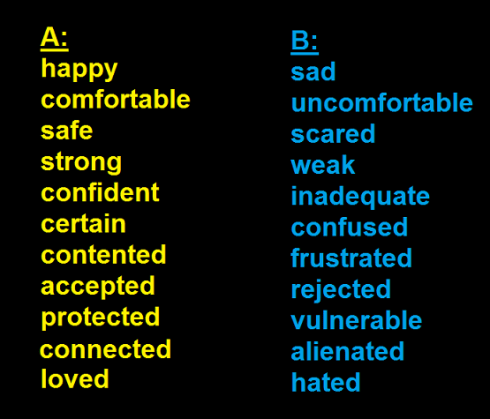
Like you, I want to feel certain feelings. I also want to avoid feeling others.
For example, I want to feel column A and avoid column B.
And so on.
Sense of control refers to those moments when we feel only the items in column A.
It’s in those moments that our internal universe seems to be under our command.
And we hunger for those moments. We hunger for happiness and safety, confidence and love. Those experiences are what we live for.
In fact, our whole lives are arranged in an attempt to repeat these experiences as often as possible.
Think about it. Doesn’t every choice you make boil down to an attempt to answer questions like What will make me happy, not sad? Comfortable, not uncomfortable? Connected, not alienated?
Our preference for Column A experiences is rooted in survival instinct, and so hardwired into us. That makes it the inevitable basis for all our conscious choices, and all our unconscious choices too.
And often we conclude that what will enable us to choose comfort over discomfort is to get actual control — control of the external world around us.
And that’s a valid conclusion sometimes. Of course I’ll feel better if
~ My car stays on the road (instead of hitting that tree),
~ The boss raises my salary (instead of firing me),
~ My kid aces English (instead of failing it),
~ This attractive woman agrees to have dinner with me (instead of slapping my face).
All these experiences, and a million others like them, leads us to conclude that the way to get a sense of control is to get actual control.
A natural conclusion, but a flawed one.
Because one (the internal feeling) is a goal. And the other (control over the external world) is just one means to that goal.
They’re. Not. The. Same.
And it can be dangerous, self-defeating, and crazy-making to conclude that they are.
Leave a comment | tags: addiction to control, compulsive controlling, control addiction, illusion of control, pathologies of control | posted in control, controlling behavior, dysfunctional controlling, external control, unconscious controlling

We control addicts are terribly confused about boundaries.
.
We confuse externals (people, places and things) with internals (our own thoughts, feelings and behavior).
.
We compulsively try to rearrange external reality — bits and pieces of the world around us — in order to feel certain ways (safe, accepted, loved, contented) and not feel other ways (scared, frustrated, rejected, lonely).
.
We do this so much we forget our real goal is an emotional one, not the rearranging itself.
.
But the real goal of all controlling is to control internal reality — feelings.
.
And that’s a goal you can reach by means other than editing externals.
.
Which is good to know.
.
Since external control is (as elections and terrorists like to remind us) so often impossible…
.
It’s nice to remember that it’s not always necessary.
1 Comment | posted in control
* * *
And don’t forget to watch:
Leave a comment | posted in control
* * *
And don’t forget:
3 Comments | posted in control