Category Archives: control

Beyond

..

A note from Bert:

Regular readers of this blog (or monkeys, as I like to think of them) may recall that my coauthor Steve has identified three alternatives to control addiction. 
He calls them surrender, responsibility and intimacy.
And he believes they represent what is bravest and most grown-up in the human personality.
“To get good at the alternatives,” Steve says, “is as healthy as a human being gets.”
I’m lousy at all three. 
Naturally this embarrasses him, since he’s this big expert on control and all. 
So in an attempt to improve me (who’s controlling now, Steve?) he decided I should pay some attention to people who are better at these alternatives than I am.
And to help me with this, he created a new Monkeytraps feature, which starts today.
It’s a collection of articles, videos, interviews and whatever illustrating how people practice the three alternatives.
I asked him what these people have in common.
“Willingness to go beyond,” he said.
“Beyond what?”
“The ordinary, the safe, the predictable.  They’re willing to step out of their comfort zone and try something unfamiliar or risky.  To have a new experience.” 
He calls this collection Beyond Control.
I’ve seen some of the things he’s scheduled.  They’re kind of cool.
We hope you think so too. 
If you do, please write and say so.
Love,
Bert.

* * *

.

.

And so when I moved to New York City after college and got completely sucker-punched in the face by depression, I did the only thing I could think of at the time. 

I wrote those same kind of letters that my mother had written me — for strangers — and tucked them all throughout the city, dozens and dozens of them.

I left them everywhere, in cafes and in libraries, at the U.N., everywhere. 

I blogged about those letters and the days when they were necessary, and I posed a kind of crazy promise to the Internet:

that if you asked me for a hand-written letter, I would write you one, no questions asked.

~ From Love letters to strangers 

by Hannah Brencher (4:53).

.
Here’s a newspaper article about Hannah’s letter-writing project:
For North Haven woman,
writing love letters a labor of love
And here’s her remarkable blog —
The world needs more love letters
— where she writes,
We’re going to tell you that we write and mail love letters, handwritten love letters, to strangers in need all over the world. We’re going to invite you to request a love letter for someone in your life who needs one. And we’re going to insist that you step out of your own shoes of Comfort & join us. You are going to think we are a bit crazy. A tad loopy. But you’ve been looking for a website that leaks love all this time… so we aren’t worried you’ll leave us.
It’s not about stamps. Not about stationery. It’s about your neighbor. The cracked parts of your own story & how you can use them to lift someone else. It’s about the stranger enveloped in sadness. The chance to pull off Twitter & step away from your networks to turn your best love letter into a lamp… a lantern… to light the path of someone who needs to read it tonight.


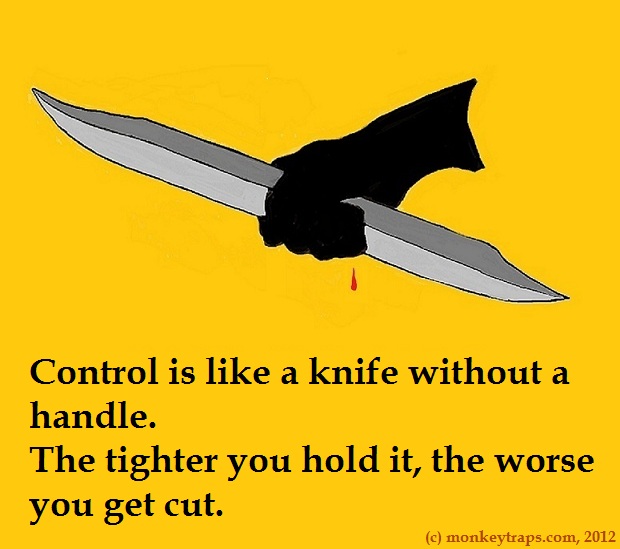
Knife

.

* * *

Since feeling out of control

is uncomfortable,

it makes me seek more control.

.

The more I seek control,

the more sensitive I become

to control issues.

.

The more sensitive I become

to control issues, the more often

I feel out of control.

.

Which makes me

uncomfortable.

.

Since feeling out of control

is uncomfortable, it makes me…

.

You know.


Leaf

11/13/12 (Tuesday).

I’m blowing leaves down the driveway when I notice Henry raking the leaves on his lawn. 

I think that’s his name, Henry.  We’ve exchanged maybe ten words since he moved in.  

Four years ago. 

So I’m surprised to find myself thinking of offering him my leaf blower.

Surprised, then annoyed.  Since the impulse makes me uncomfortable. 

I’m shy.  I don’t do shit like that.

“Why even consider it?” I ask myself. 

But I know why.  It’s what Chris said to me the other night on the way to a family gathering.  She knows  family gatherings make me nervous.  

“Get your Buddha on,” she told me.

I knew what she meant.  Stop being scared of people.  Stop avoiding them.  Stop taking them personally.  Detach.  Relax.  Breathe.  Practice what you preach. 

“Shut up,” I answered.

But now I sigh and switch off the blower and coil the endless orange cord around my forearm and walk it over to Henry, who is plainly startled to see me but covers it nicely.

We chat.  While I’m talking with him I’m talking to myself. 

“Practice,” I say. “This is practice.” 

And, “You don’t practice enough.” 

And, “You don’t practice what you preach.”

And, “But maybe you’ll start.  Maybe this is you turning over a new leaf.” 

Eventually Henry declines my offer, which is a relief (since now I don’t have to come back to collect the damned blower), and I walk home feeling both virtuous and silly. 

There was nothing to be scared of here, and I knew that going in, and  was scared anyway. 

I’m sixty-two now.  Scared for sixty-two years. 

“Will I die this way?” I wonder.

Then a last thought comes as I walk back up my clean driveway and into my house.

“How to handle feelings isn’t just a human problem,” I think. 

“It’s the human problem.  And all the others come from that.”

* * *


Fish

.

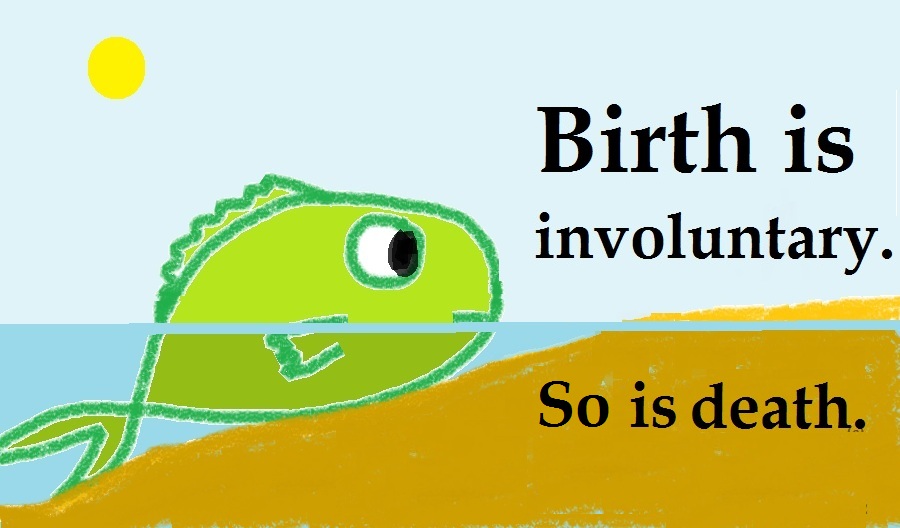
So is most of what

falls in between.

.

But we can’t

accept this.

.

Because we’re

the monkeys

that control.

.

So we spend our lives

trying to get control, 

like fish

whose fondest wish

is to walk on

the land.


Feedback

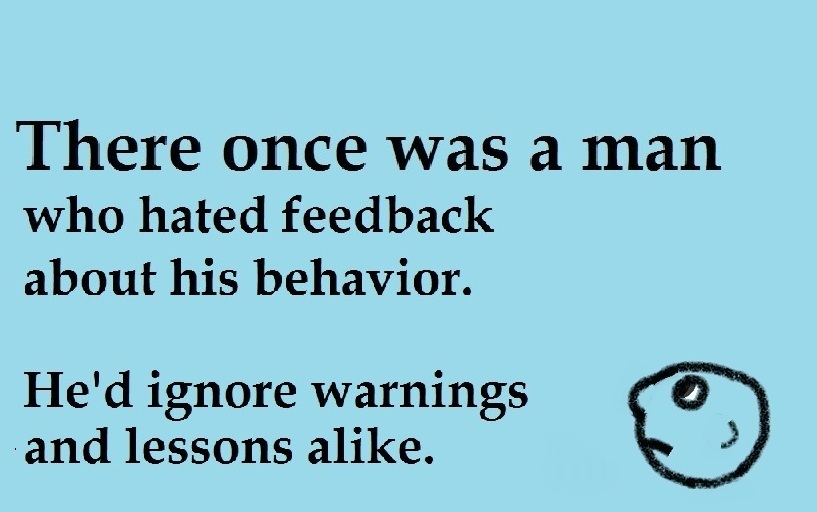
   When his wife warned him

   to wear a hat while shoveling

   snow he replied “All right,

   all right” and caught a cold.

.

   When his boss warned him

   to stop coming late to work

   he replied “All right, all right”

   and got fired.

.

   When his therapist warned him

   his stubbornness was killing

   his marriage he replied “All

   right, all right” and got divorced.

.

   When his bartender warned him

   he was in no shape to drive

   he replied “All right, all right”

   and got busted for DWI.

.

   When the judge warned him his

   drinking was self-destructive

   he replied “All right, all right”

   and died driving drunk.

.

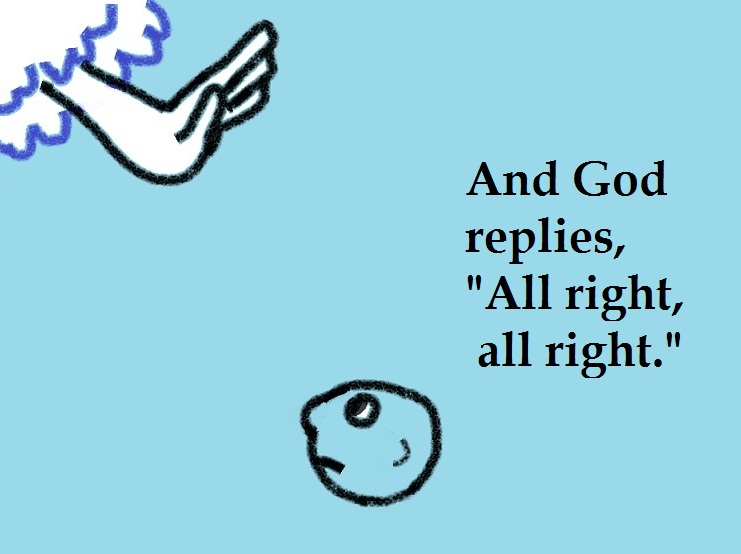
   So now he stands before God,

   awaiting judgment.

.

  “Look, God,” he says.  “I know I

   screwed up.  I was rigid and

   stubborn and stupid.  But I’ve

   learned my lesson.  Please give

   me another chance.”

.


Dream

.

The power and the appeal

.

.

.

.

.

.

of the American dream

.

.

.

..

.

grow from its promise of control.

.

.

.

.

..

.

.

Because it gives us hope that,

.

.

.

.

.

despite all contrary evidence,

.

..

.

we really can 

determine

our own destinies.

.

.

.

.

.

.

.

* * *

Oh, and by the way:

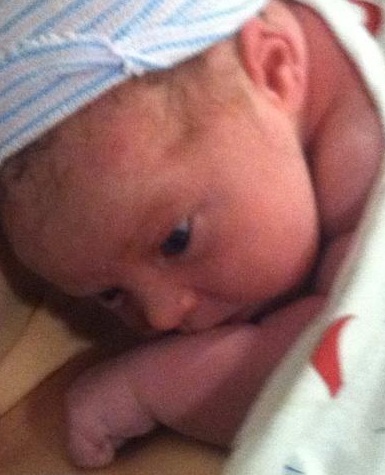
Please welcome my new grandson,

Wyatt Michael Trahan

(9 lb, 6 oz).

.

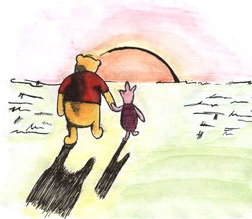
“When you wake up in the morning, Pooh,” said Piglet at last, “What’s the first thing you say to yourself?”

“What’s for breakfast?” said Pooh.  “What do you say, Piglet?”

“I say, I wonder what’s going to happen exciting today?” said Piglet.

Pooh nodded thoughtfully.

“It’s the same thing,” he said.

                                              ~ A.A. Milne


Outside, inside

* * *

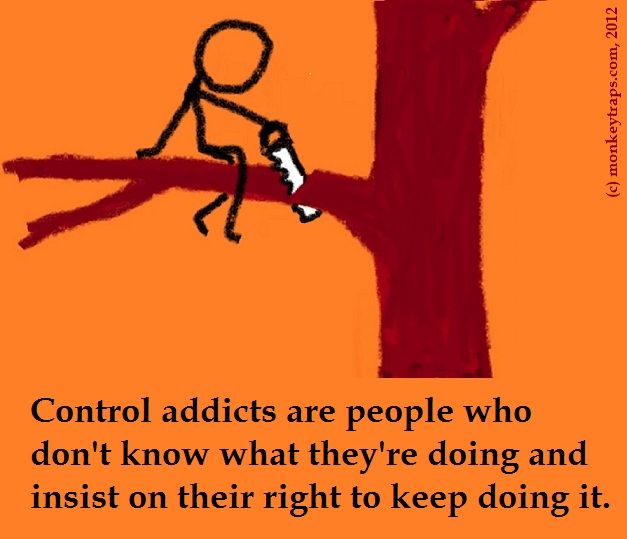
Control addicts tend to be confused about boundaries.

.

We confuse externals (what’s outside) with internals (what’s inside).

.

We tend to rearrange bits and pieces of the world around us so we can feel some feelings (safety, acceptance, contentment, connection) and avoid others (fear, rejection, frustration, loneliness).

.

We do it so much we forget our real goal is an emotional one, not rearranging for its own sake.

.

But the real goal of all controlling is to control feelings.

.

Which you can reach by means other than editing external realities.

.

Which is a helpful thing to know.

.

Because external control is so often impossible (as hurricances and elections like to remind us).

.

So it’s nice to remember that it’s not always necessary.


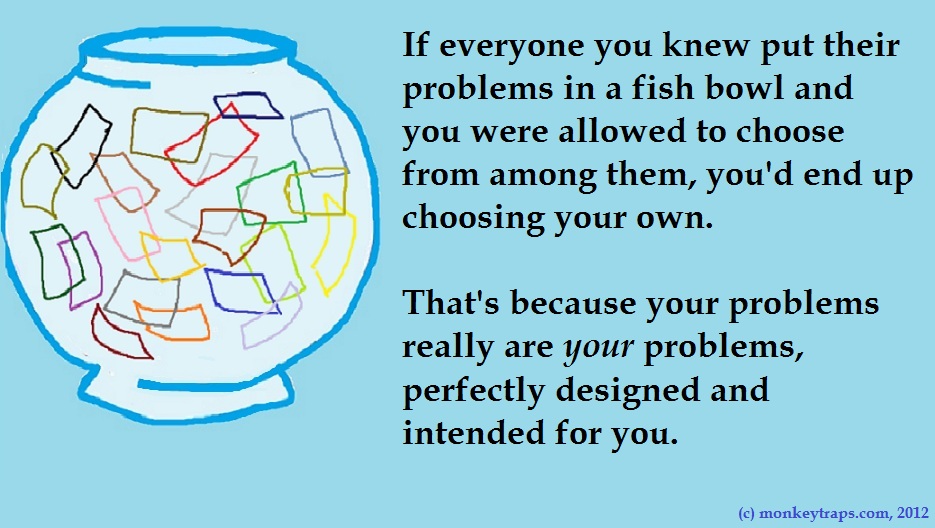
Your problems

.

.

* * *

Our problems persist

because of our attachment

to the familiar:

.

We keep doing the same things

in the same way.

.

Want to improve your

problem-solving?

.

Stretch yourself.

.

Develop tolerance

for new experiences.

.

You can start here,

with this short video,

“29 Ways to stay creative”

(1:50):

.

.

While you’re watching,

ask yourself,

“Which of these

would stretch me?”

.

Pick one.

(Something easy.)

  .

Now go practice.


Oak-people and birch-people

Hurricane Sandy’s descending on us as I write this, which reminds me of something I wrote last year just after Hurricane Irene.  So I thought I’d tweak and repost it before the lights go out.

Stay safe, everyone.

* * *

Hurricane Irene swept through here the other day, reminding me of a conversation I’ve had with many clients over many years.

“Let’s say you’re a tree and a hurricane is coming,” I say.  “Which would you rather be, an oak or a birch?”

I sit back and watch them do a mental comparison:

Oak…

versus Birch:

“Oak,” they usually say.

Then I remind them what can happen to a rigid oak in a high wind:

All this tree-talk is metaphorical, of course.  We’re really talking about people and how they cope.

Specifically, how they view the idea of control.

Oak-people see control as essential to their sense of security.  They have a picture in their minds of How Things Should Be, and deviations from that picture make them uncomfortable.

This leaves them uncomfortable much of the time.

It also leaves them rigid and unbending, resistant to change, and likely to confuse strength with inflexibility.

Birch-people see control as essential in some situations and dangerous in others.  They’ve learned to learn to recognize their own preferences as that — preferences — and to become less insistent on forcing life to meet their expectations.

This makes them more elastic, more able to accept change and weather adversity. When life blows them over they bounce back up.

They go with the blow.

Me, I’m an old oak, trying to become a birch.

Not easy work, psychologically speaking.  But I prefer it to being repeatedly uprooted by all the stuff I cannot control.

And you?

Which kind of tree are you?

And which kind of tree would you like to be?

* * *


Man bites monkey

(New to Monkeytraps?

Then this post won’t make much sense to you.

You’d need to know that (a) Monkeytraps’ author is a therapist named Steve who specializes in control issues, and that (b) its coauthor is Steve’s hopelessly control-addicted inner monkey, named Bert.

That’s Bert above, post-bite.

Bert speaking:)

I had to write this.  I need to vent.

I’m so pissed.

At what?  At that moron.

Which moron?

Steve.

Do you know what the moron plans to do on November 1st?

He’s going to start writing a novel.

A 50,000-word novel.

Fifty thousand words.

And he plans to finish it in thirty days.

He’s been considering this for years, ever since he heard about this NaNoWriMo nonsense.  But each year I’ve been able to talk him out of it.

NaNoWriMo is short for National Novel Writing Month.  It’s this weird project where people commit to, well, writing a novel in a month.

Even if they’ve never written a novel before.  Even if they’ve no clue what they’re doing.  Especially if they’re clueless.

It’s the brainchild of a writer named Chris Baty (thanks a load, Chris), who created it in 1999 and later wrote a book about it titled No Plot? No Problem.  

Baty’s got some strange ideas.  One is that

Literature is not merely a spectator sport…  Fiction writing can be a blast when you set aside debilitating notions of perfection and just dive headlong into the creative process.

Another is that

The biggest thing separating people from their artistic ambitions is not a lack of talent.  It’s the lack of a deadline.  Give someone an enormous task, a supportive community, and a friendly-yet-firm due date, and miracles will happen.

So he created this organization and set up this website where people go and sign up (god help me, Steve registered last night) and get tips about writing and support each other in forums and all that communal crap.

Damned stupid idea, if you ask me.

Hey, I’m already busy.  I can barely keep up with the shit Steve makes me do now.

The practice.  The blog.  The slideshow series he’s developing.  The book about control he’s been wanting to write.

And then there’s the house (falling apart) and the lawns (full of leaves and pine needles) and the cars (both on death’s doorstep).

What’s worse — now get this — Steve’s daughter is about to have a baby.

Due on Election Day.  I mean, I’m happy about that and all (though being called Grandpa is a bit unnerving.)

But it’s got to complicate my life further, right?  Having a grandchild will change my life in ways I can’t even imagine now.

But let’s face it.  The real problem here is,

I’m a control addict.

Doesn’t he know how much pressure this puts on me?

How many things this forces me to not control?

Like the time and energy this will cost me.

Or how the family feels about my being MIA.

Or what readers think of what I write.  (I don’t have to show it to anyone, Steve says.  Like that ever stopped me from worrying before.)

Or whether I can even write at all.  What if I get blocked?  

(Shudder.)

Or my mental state.  (I’m already obsessing about how to start the damned story.)

Or my physical condition.  (I get tired just thinking about it.)

Or my emotional health.  (What if I get depressed?)

This whole idea scares me shitless.

I feel like he’s just taken a enormous bite out of my peace of mind.

But.

The moron’s made up his mind.

What’s can I do?

Only…surrender.

Breathe.

Do my best.  Let go of the rest.

Go with the flow.

Like he always tells me (and everyone else) to do.

(Sigh.)

That moron.

.

* * *

The creative process must be explored not as the product of sickness, but as representing the highest degree of emotional health, as the expression of normal people in the act of actualizing themselves.

~ Rollo May

Putting a book together is interesting and exhilarating.  It is sufficiently difficult and complex that it engages all your intelligence.  It is life at its most free.

~ Annie Dillard

New organs of perception come into being as a result of necessity. 

Therefore, O man, increase your necessity, so that you may increase your perception.

~ Rumi

As an improvising musician, I am not in the music business, I am not in the creativity business; I am in the surrender business. 

To the extent that we feel sure of what will happen, we lock in the future and insulate ourselves against those essential surprises.  Surrender means cultivating a comfortable attitude toward not-knowing.

~ Stephen Nachmanovich


* * *

Valuing enthusiasm and perseverance over painstaking craft, NaNoWriMo is a novel-writing program for everyone who has thought fleetingly about writing a novel but has been scared away by the time and effort involved.

As you spend November writing, you can draw comfort from the fact that, all around the world, other National Novel Writing Month participants are going through the same joys and sorrows of producing the Great Frantic Novel.

In 2011, we had 256,618 participants and 36,843 of them crossed the 50K finish line by the midnight deadline, entering into the annals of NaNoWriMo superstardom forever. They started the month as auto mechanics, out-of-work actors, and middle school English teachers. They walked away novelists.

~ From About NaNoWriMo.


Self-care

.

* * *

Self-care is something I preach to all my clients.

Most of them have trouble with self-care.

Most of them don’t love themselves enough to stop working and rest and relax.

Most of them put the needs of their job or their family or their house or their spouse ahead of their own.

And I have this thing I say to the most stubborn clients.

“You remind me,” I tell them, “of a guy I know who wants to drive from New York to California. 

“Except he says, ‘Gas is too expensive, so I won’t buy gas here. 

“I’ll wait to buy gas when I get out to the coast.’”

~ From Gas in California

* * *

Compassion really involves three basic components:

noticing suffering,

being kind and caring in response to that suffering,

and remembering that imperfection is part of the human experience, something we all share.

.

And is this the same for self-compassion?

.

Exactly the same.

With self-compassion the most important step, actually, is to notice your own suffering.

And a lot of people say, “Isn’t that blindingly obvious?”

But in fact it’s not.

Especially when your suffering comes from your own self-judgment and self-criticism….

.

~ From

Self-compassion, part 1

by Kristin Neff


To stop fighting

.

My last cartoon carried this caption:

.

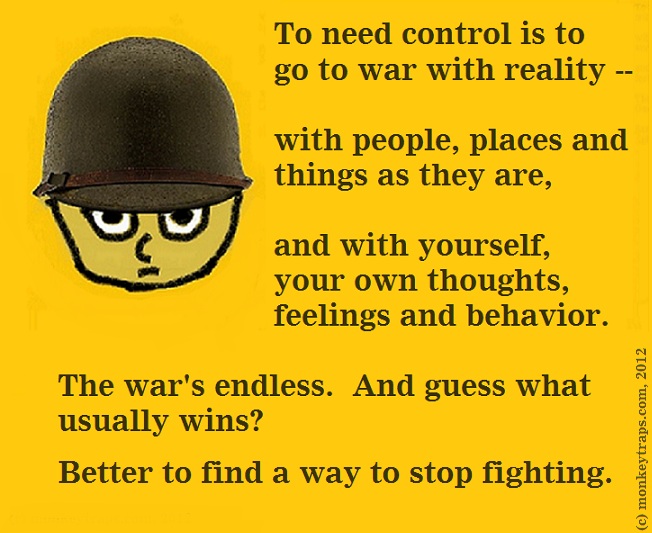
To need control is to go to war with reality

 — with people, places and things as they are, 

and with yourself, your own thoughts, 

feelings and behavior.


The war’s endless.  And guess what usually wins?

Better to find a way to stop fighting.

.

To which my reader Julie replied, “The big question is, ‘How to stop fighting?'”

That’s the question, all right.

How do you stop fighting reality?

How accept life on life’s terms? 

Is it even possible?

Yes, I think so.

I’ve found three ways.

They’re not new.  They’re not complicated.  They’re not mysterious, either.  We all know them.

We just don’t practice them much.

Surrender

Surrender means giving up control over what you can’t control anyway.

For me that usually means finding a way to accept some smelly lump of reality that life has dropped in my lap.

Some lumps are easier to accept than others.  Bad weather, I’m okay with that.   I can handle slow drivers too.  Also long bank lines.  Also crabgrass.  Even the occasional indoor gift left by Loki.

Other stuff’s harder.  Like the rising poll numbers of politicians whose guts I despise. And reality tv.  And Rush Limbaugh.  And Cialis commercials.

Not to mention whether you’ll like what I’m writing.

Then there’s stuff  I really want to control, stuff that feels essential to my peace of mind or happiness.  Like my income.  Or my weight.  Or my wife’s mood.  Or how other people see me.  That last one especially.

This stuff forces me to practice surrender almost constantly.

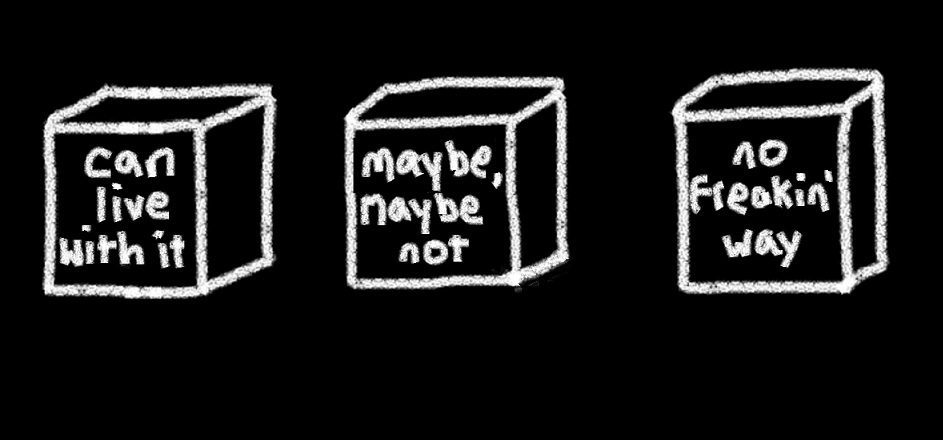
Practice how?

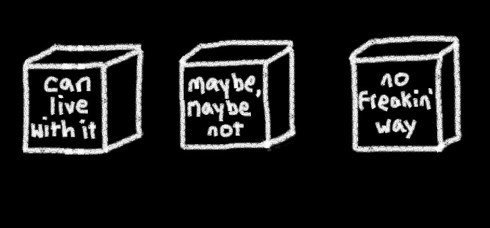
I  imagine three boxes.  (See above.)  I sort the realities I’m facing into them.  Then I work on moving items from right to left.

Item by item.  Slowly and patiently.  Over and over.

Responsibility

Responsibility means being able to respond — that is, answer reality — appropriately and effectively.

For me that usually means listening to my feelings and making choices based on what I hear.

I’ve been trained not to do this.  Like you, I learned early to ignore such internal cues and focus on external ones instead — rules, conventions, the expectations of others.  I also learned that ignoring external cues gets you punished.

Called socialization, this process begins with toilet training and continues right through grad school.

What am I saying?  It starts at birth, and continues forever.

So it takes courage to detach from externals, risk disapproval or rejection, and listen to myself anyway.

Responding is hard, too, because a lifetime of ignoring feelings leaves them hard to hear.   I buried mine so deep I lost touch with them for decades.   When anyone asked me “How are you feeling?” I’d answer with what I thought.  Years of this left me so confused and depressed that I had to go into therapy and excavate the parts of me I’d buried.

So living an emotionally responsible life, one based on listening to oneself…

Well, look around.  How many people do you see doing that?

Intimacy

Intimacy is both the scariest way of not-fighting and the most rewarding.

It means being yourself with another person, and letting them do the same with you.

It’s hard because it combines responsibility and surrender — showing who you are and letting go of how someone else will react to it.

It’s scary, because we need love and acceptance so desperately.

On the other hand, avoiding intimacy — or worse, being incapable of it — is the hardest and scariest fate of all.

Because being stuck in hiding is the ultimate disconnection, the worst loneliness.

And because, paradoxically, control addiction leads to feeling utterly out of control.

.

* * *


War

* * *

To some people, surrender may have negative connotations, implying defeat, giving up, failing to rise to the challenges of life, becoming lethargic, and so on.

.

True surrender, however, is something entirely different.

.

It does not mean to passively put up with whatever situation you find yourself in and to do nothing about it.

.

Nor does it mean to cease making plans, or initiating positive action.

.

Surrender is the simple but profound wisdom of yielding to, rather than opposing, the flow of life….

.

It is to relinquish inner resistance to what is.

.

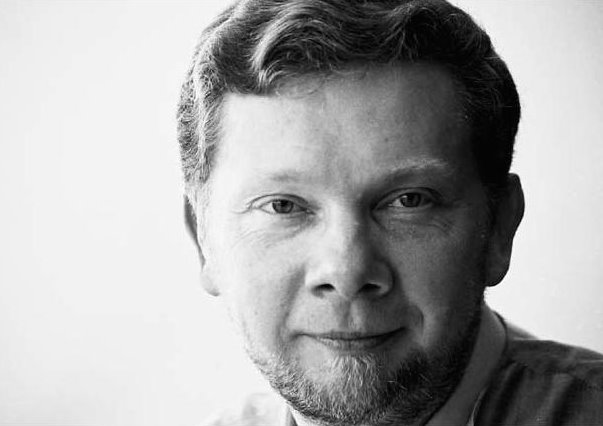
~ From

The wisdom of surrender

 by Eckhart Tolle (9:33).


So scared

*

* * *

.

To laugh is to risk

appearing the fool.

.

To weep is to risk

appearing sentimental.

.

To reach out to another

is to risk involvement.

.

To expose feelings

is to risk exposing your

true self.

.

To place your ideas

and dreams before a crowd

is to risk their loss.

.

To love is to risk

not being loved in return.

.

To hope is to risk

despair.

.

To try is to risk

failure.

.

But risks must be taken.

.

 Because the greatest

risk in life is

to risk nothing.

.

The person who risks nothing

does nothing, has nothing,

is nothing.

.

He may avoid

suffering and sorrow,

but he cannot learn,

feel, change, grow,

or live.

.

Chained by his certitude,

he is a slave who has forfeited

all freedom.

.

Only the person who risks

is free.

.

   ~ William Arthur Ward

.

* * *

Guess:

.

Dismissed from drama school with a note that said “Wasting her time.  She’s too shy to put her best foot forward.”

*

*

Cut from the high school basketball team, he went home, locked himself in his room, and cried.

*

*

A teacher told him he was too stupid to learn anything, and he should go into a field where he might succeed by virtue of his pleasant pesonality.

*

*

His fiancee died, he failed in business twice, he had a nervous breakdown, and he was defeated in eight elections.

..
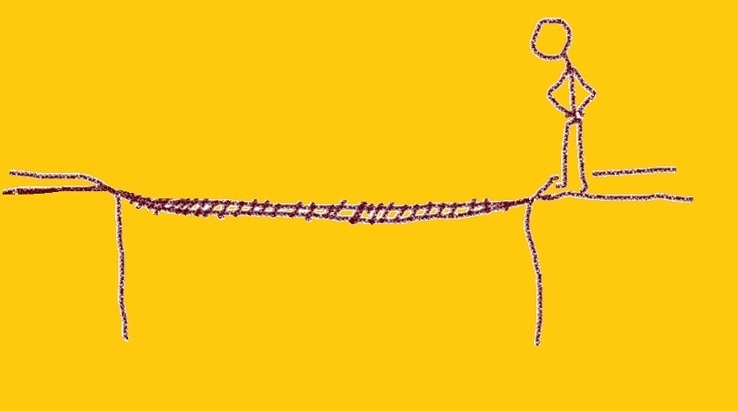
~ From Life = risk (1:19).

Control addicts

.

* * *

.

.

Here are the three things you need to know about shame:

We all have it.

We’re all terrified to talk about it.

The less we talk about it the more we have it.

~ From Part 1 of a PBS interview of Dr. Brene Brown (4:56).

*

Q: You say that shame leads to disconection.  So how do we reconnect?

A:  You know, it’s funny.

One of the ironies is that shame fills us with this fear of disconnection.

But it is our imperfection that connects us to each other.  It is the fact that our shared humanity is imperfect.

I think if we can find the courage to talk about our lives honestly, and our struggles, not only does that free us, it gives other people the freedom to be more authentic and real as well.

I don’t think connection is possible without authenticity.

~ From Part 2 of a PBS interview of Dr. Brene Brown (5:31).