
Category Archives: pathologies of control
Third Paradox: Tradeoff
The Third Paradox of control:
.
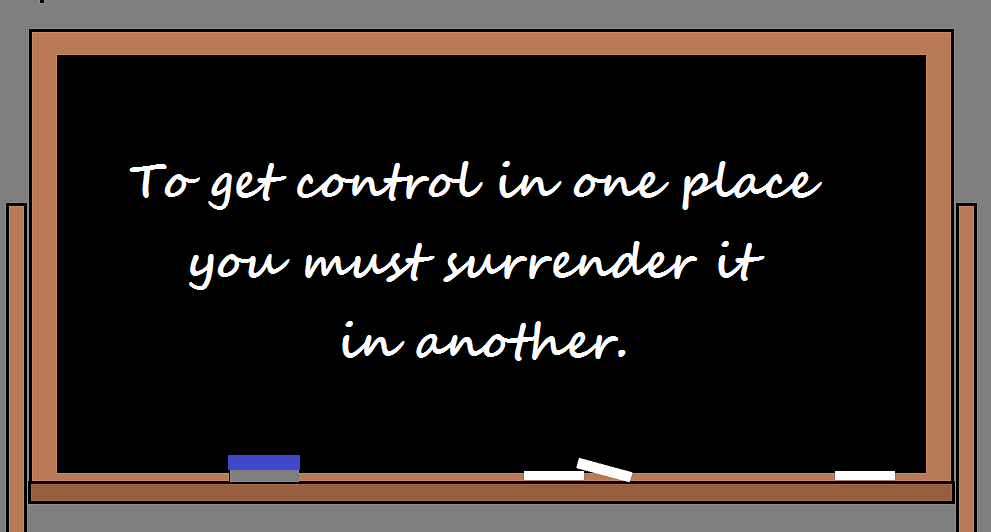
Controlling boils down to a tradeoff.
Gain control here, lose control there.
Think of the original monkey trap:
To hold on to the banana, the monkey surrenders his freedom. To regain his freedom, he must let the banana go.
It also explains all garden-variety codependent interactions:
To control you (make you like, love or accept me) I must surrender control of something else — like my ability to be honest, or spontaneous, or emotionally expressive.
Conversely,
Taking control of my emotional life — especially how I feel about myself — means surrendering control over how you react to me.
It also applies to New Year’s resolutions, not to mention all goal-setting:
To reach a particular goal (like writing my book) I must surrender control of others (like spending time with my family, or on chores that absorb my energy and attention).
To gain control of my weight I must surrender control (i.e., limit my choices) of what I put in my mouth.
To control my social anxiety I must detach from how other people see me and practice being myself.
And so on.
So control and surrender are two sides of the same coin.
And getting control of anything means losing control of something else.
To win A, you must sacrifice B.
Tradeoff.
Balance.
Yin-yang.
Fill your bowel to the brim
and it will spill.
Keep sharpening your knife
and it will blunt.
Chase after money and security
and your heart will never unclench.
Care about people’s approval
and you will be their prisoner.
*
How to spot monkeytraps
.
How are your holidays going?
Thought so.
Bert and I guessed you could use this refresher:
.
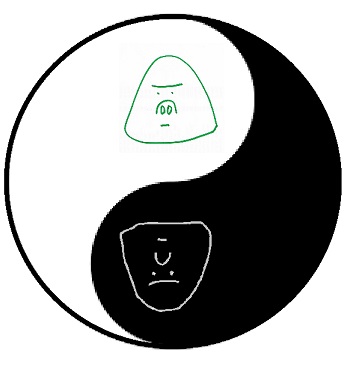
In Asia they trap monkeys by placing bait in a heavy jar with a narrow neck. The monkey smells the bait, reaches in to grab it, and traps himself by refusing to let go.
A psychological monkeytrap is any situation that triggers you into compulsive controlling — into holding on when you really should let go.
And how can you tell when you’re at risk of entrapment?
Three tips:
.
Tip 1:
Notice where you’re uncomfortable.
We’re controlling whenever we need or want to change some piece of reality instead of accepting it or adapting to it as is. And we’re most likely to want to change realities that make us uncomfortable. So it makes sense that our discomfort zones are where we’re most likely to get monkeytrapped.
![[] bert panel (print for edit)](https://monkeytraps.com/wp-content/uploads/2014/04/bert-panel-print-for-edit.jpg?w=490) Bert: Me, I hate rejection. So I’m most controlling with people I think might reject me. I hide feelings I think will upset them, pretend to agree when I really don’t, laugh at stupid jokes, avoid confronting behavior I dislike, try to read their minds, and so on and so on. Keeps me busy.
Bert: Me, I hate rejection. So I’m most controlling with people I think might reject me. I hide feelings I think will upset them, pretend to agree when I really don’t, laugh at stupid jokes, avoid confronting behavior I dislike, try to read their minds, and so on and so on. Keeps me busy.
![[] bert panel (print for edit)](https://monkeytraps.com/wp-content/uploads/2014/04/bert-panel-print-for-edit.jpg)
.
Tip 2:
Notice where you’re stuck.
Stuck as in not learning, healing or growing — struggling with the same damn problem over and over. You know you’re monkeytrapped whenever you find yourself doing what you already know doesn’t work.
Bert: All that controlling I just described traps me because it (a) stops me from being myself, which (b) prevents me from ever getting accepted as myself, which (c) keeps me chronically scared of rejection, which brings me right back to (a). Like riding an endless merry-go-round.
.
Tip 3:
Notice where you’re scared.
Like all addictions, compulsive controlling is anxiety-driven. We stay monkeytrapped because we’re scared to do anything else. Often even the thought of giving up control in such situations is enough to scare us silly.
Bert: Took me a long time to see that controlling doesn’t work. Or it does, but only for five minutes. Then another scary thing comes along and I have to control that. And life being what it is, there’s no end to scary things. So as an anxiety-reduction tactic controlling is a total flop.
The most frightened people are the most controlling people, and the most controlling people stay the most frightened.
Adult children
First time I heard it, the term adult child made no sense to me.
It seemed an obvious contradiction in terms, like square circle or military intelligence.
I understand better now.
I understand that an adult child is someone who’s adult on the outside, childish inside.
That the childish part is a collection of unmet needs, unresolved conflicts and unexpressed feelings.
That, under stress, this part gets triggered, and the adult experiences all the fears and insecurities of the child when that child’s growth was interrupted.
And that you needn’t have grown up in an alcoholic or abusive or especially dysfunctional family for this to be true of you.
That it happens to all of us.
In other words, that Andrew Malraux was right when he wrote,
There is no such thing as
a grown-up human being.
That we are all adult children.
Two questions
Everyone over the age of two knows relationships are difficult.
Not everyone understands why.
It’s because relationship forces us to combine things that don’t go together.
Specifically, to meet two sets of seemingly incompatible needs:
Connection and separateness.
Security and freedom.
Acceptance by another and self-acceptance.
A real partner and a real self.
Put another way, relationship forces us to answer two questions:
How can I have you without losing me?
How can I have me without losing you?
Tough questions.
How do I have you and me at the same time?
Most people I know are secretly convinced that you can’t.
Most came from families — alcoholic, or abusive, or otherwise dysfunctional — unable to teach them to balance connection with separateness.
What they learned instead was that having one meant losing the other. That winning love and approval from parents, for example, meant sacrificing parts of themselves, like the freedom to express feelings or take care of their own needs.
The family that raised us is where each of us learned our own personal answer to the two questions. And the answer we learned grew into a crucial (though mostly unconscious) part of our basic view of life and relationships, what I call our Plan A.
Some of us decide, “Since I can’t have both, I’ll have you, and to hell with me.” This is the infamous codependent answer.
Others decide, “Since I can’t have both, I’ll have me, and to hell with you.” Shrinks call this the narcissistic answer.
Neither answer works.
Eventually codependents tire of feeling like doormats, while narcissists tire of feeling all alone.
At which point, if they’re smart (or have a smart therapist), they go back to struggling with the two questions.
You can’t answer these questions, only struggle with them.
But it’s the struggling that matters.
Because without it, healthy relationship is impossible.
* * *
Re: my impending book,
click here.
You say potato
Most new clients and I start off with a language problem.
We’re both speaking English, of course, but the words we use have different meanings.
This happens because people come to therapy for help with emotional problems, and I see most (maybe all) such problems as caused by control addiction. And that view has changed my view of almost everything human.
For example, it often happens that what clients call polite, I see as artificial.
What they call niceness, I see as fear.
What they call respectful, I see as dishonest.
What they call strong, I see as rigid.
What they call responsible, I see as oversocialized.
What they call loyal, I see as coerced.
What they call productive, I see as compulsively busy.
What they call helpful, I see as intrusive.
What they call protecting, I see as enabling.
What they call love, I see as codependency.
At the start of our work clients often object to my redefinitions of behaviors in which they’ve been engaged until now.
Sometimes they get so angry at how I see things that they leave and never return.
But if they keep coming back, eventually they start asking themselves:
If I’ve really been doing what I thought I was doing, why do I need therapy?
Perfect parents
Women’s group. Six members.
All mothers.
One has been discussing problems her grown children face. Which leads into reviewing her failures as a parent. Which makes her cry.
The others listen and nod sadly.
After a minute I say, “Question for the group. Is there such a thing as an unguilty mother?”
They look at me, startled. Then at each other.
“I doubt it,” I say. “Every child deserves perfect parenting. No child ever gets it. And every mother knows this and feels bad about it. So feelings of inadequacy and failure and guilt are built into being a mother.”
“Always?” one asks.
“Maybe not,” I concede. “Occasionally I meet a parent unaware of his or her inadequacies. But they’re usually narcissists, and they usually scare the crap out of me.”
The crying mother sniffles.
“I can’t help feeling guilty,” she says. “When they hurt it feels like my fault.”
Right, Mom. You, me, and most every parent I know.
Look, guys.
Perfect parenting is not just impossible, it’s unnecessary.
The psychoanalyst Donald Winnicott once famously argued that kids don’t need perfect parenting — just parenting that’s “good enough.” Winnicott wrote,
The good-enough mother starts off with an almost complete adaptation to her infant’s needs, and as time proceeds she adapts less and less completely, gradually, according to the infant’s growing ability to deal with her failure. Her failure to adapt to every need of the child helps them adapt to external realities.
Catch that last line?
The mother’s imperfection is what helps her child adapt to reality.
So relax if you’re not perfect. You can’t be, and you don’t have to be. And it would probably be bad for your kids if you were.
Personally I take comfort in how one of my supervisors once defined good-enough parenting.
“The sign of successful parenting,” he said, “is that your kids can pay for their own therapy.”
Your other foot
A man loses his foot in an accident. Forced to hobble and use a crutch, he finds himself the object of unexpected attention and sympathy. Then his doctor fits him with a prosthetic foot. The hobbling ends. The crutch becomes unnecessary. The attention and sympathy dwindle away. So he takes an axe and cuts off his other foot.
Crazy?
I see it all the time.
In the husband who complains daily about his unhappy marriage but puts off getting a divorce.
Or the wife who rages about how her husband avoids or ignores her but won’t examine how her behavior pushes him to do so.
Or the teacher who bemoans the bullies who abuse her at work but refuses either to learn how to assert herself or to change jobs.
Or the son so scared his alcoholic parents will reject him if he stops drinking that he clings to his addiction in self-defense.
Welcome to the world of secondary gain.
Secondary gain refers to an emotional or psychological benefit that comes from having a problem or illness.
The gain may be attention, acceptance, sympathy, safety, familiarity, resistance to change, distraction from responsibility, avoidance of intimacy, or denial of other problems.
Seeking such gains is not faking or manipulation.
It’s often unconscious.
It can be seen as an attempt to meet legitimate needs in an unhealthy way
It’s also a monkeytrap: a situation that encourages you to hold on when it would be healthier to let go.
Suspect you might be monkeytrapped in this way?
Try asking yourself one question about your persistent symptom or problem:
If I were to fix this, what would I lose?
Gasoline
One classic symptom of control addiction is enabling.
Enabling is anything you do to solve a problem that ends up making the problem worse.
Like trying to put out a fire with gasoline.
Or scratching a rash left by poison ivy.
Or trying to get an alcoholic to stop drinking by hiding their booze or nagging them to enter treatment.
Or trying to improve communication with your kids by forcing them to talk to you.
Or trying to improve your marriage by reminding your spouse how disappointing and inadequate he/she is.
The forms it takes are infinite.
What they all have in common, though — and what makes them so difficult to stop — is that they gratify a short-term need.
The need to do something.
We hate feeling helpless. We hate facing the fact that some problems we simply cannot solve.
So we cling to the illusion of control.
Maybe this time it will work, we tell ourselves.
Or Maybe if I try it this way.
Or This is too important. I can’t do nothing.
Pass the gasoline.
Not God
A codependent in recovery tells me that once, in utter frustration over how his life was going, he fired his Higher Power.
“Wow,” I reply. “I guess that makes you the Higher Power.” I reach over to shake his hand. “Been wanting to meet you.”
He laughs.
But there’s a serious truth buried here.
“The fundamental and first message of Alcoholics Anonymous to its members,” writes Ernest Kurtz, “is that they are not infinite, not absolute, not God. Every alcoholic’s problem has first been claiming God-like powers, especially that of control.”*
All addicts seek control to an unhealthy degree. That’s why the First Step urges them to confront their lack of control (“Admitted we were powerless…”). Can’t heal addiction otherwise.
So recovery starts with a surrender. And that’s no less true of control addicts — a.k.a. codependents — most of whom have spent years trying to control the uncontrollable.
It’s why I suggest everyone get into the habit, when stressed, of asking themselves three questions:
What am I trying to control here?
Have I had any success controlling this before?
And if not,
What can I do instead?
Many benefits flow from this sort of self-questioning.
And one is that, the more often you employ it, the clearer it becomes that you’re not God.
_________________________
*Not-God: A History of Alcoholics Anonymous by Ernest Kurtz (Hazelden Press, 1979).
Pickpocket
I became a therapist for the wrong reason.
Not to help people, but to get helped.
Not to give, but to take.
I didn’t like myself much, and thought if I solved people’s problems they’d be grateful and like or love me in return.
I was sort of an emotional pickpocket.
Bad reason, as I said, to become a shrink.
But not an unusual one.
For years I’ve met people in the helping professions — doctors, nurses, teachers, therapists, even lawyers and cops — who were similarly motivated.
It’s not necessarily fatal. The lucky ones discover it in time and take steps to get their emotional needs met in healthier ways.
If they can do that they can become true professionals — adults able to defer their own needs to the service of others.
The unlucky ones never discover the real motive behind their career choice. Or they do, and then can’t decide what to do about it.
And so keep picking pockets.
Taking while pretending to be giving.
Which can become the opposite of helping.
In the weeds
She has an elephantine memory.
She remembers everything, especially painful stuff.
She can describe every frustration, disappointment and betrayal that wounded her in the last twenty years.
She can (and does) recite conversations — especially hurtful ones — from a decade ago.
Listening to her I sometimes feel like we’re crawling together through an endless field of weeds.
The technical term for this is perseveration: the tendency of certain memories to persist even when they’ve stopped being relevant.
Bad habit, perseverating.
Because where you put your attention is what grows.
Keep your attention on painful memories, and you fill your life with pain.
Keep your attention on stuff you cannot change (like the past), and you fill your mind with helplessness.
Sometime you need to find a way to stand up and see beyond the weed field.
Group anxiety
Most people are anxious when they first join a therapy group.
Some take a long time to get over their anxiety. A few never do.
Usually they don’t understand why.
It’s because on some level they expect to be treated in group as they were treated in their family of origin.
If they were abused or neglected as kids, they expect the group to abuse or neglect them. If they were controlled or criticized or rejected or shamed, they expect the same treatment again.
For this reason even the idea of group is terrifying to some.
But it’s also what makes group such a powerful therapeutic tool.
Because when an emotionally wounded person joins group and nothing bad happens — when instead they receive the attention, acceptance and caring their family couldn’t provide — they have what’s called a corrective emotional experience:
Some deep part of them starts to realize they’re not kids anymore, and that not everyone is like the people who disappointed or hurt them when they were.
It’s a realization I’ve seen change lives.
Impasse
I’m stuck.
Part of me says Yes, do it. Do it now.
Another part says No, I can’t. Or No, I’m scared.
Gestaltists call this stuckness impasse: the point at which you stop yourself from moving forward because you’re afraid you won’t survive the attempt.
Scared, for example, of ending the marriage. Quitting the job. Starting the business. Writing the book. Expressing the feeling. Telling the truth.
Such stuckness always involves old fears, triggered in some part of me that hasn’t grown up.
That part so clearly remembers being dependent, helpless and/or scared of punishment that it hasn’t discovered I’m grown up now, and in charge of my own life.
“We are continually projecting threatening fantasies onto the world,” Fritz Perls wrote, “and these fantasies prevent us from taking the reasonable risks which are part and parcel of growing and living.”
The surprising thing about an impasse?
It’s almost always imaginary. It doesn’t exist in reality.
Push back against the fear and it tends to vanish, like a nightmare does when you turn on the bedroom light.
Answer
To respond means to answer. Responsibility means the ability to do that, answer life and its problems appropriately, intelligently and effectively. Yet control addiction has essentially the same response (I must control this) to every problem, regardless of circumstances or how well it’s worked in the past. That’s neither appropriate, effective nor responsible. It’s crazy.
***
From Bert’s Therapy, session 5:
![[][] Bert's therapy [FRAMED, 50%]](https://bertstherapy.files.wordpress.com/2014/07/berts-therapy-framed-50.jpg?w=490)
You face a choice of symptoms.
Read the rest here.
Steve & Bert

COMING SOON: An expanded 2nd edition

CLICK HERE TO ORDER MONKEYTRAPS (THE BOOK)

Follow the conversation:
-
-

-
-
BERT’S IN THERAPY. To listen in, click on his nose.


