Category Archives: personal growth

Camping

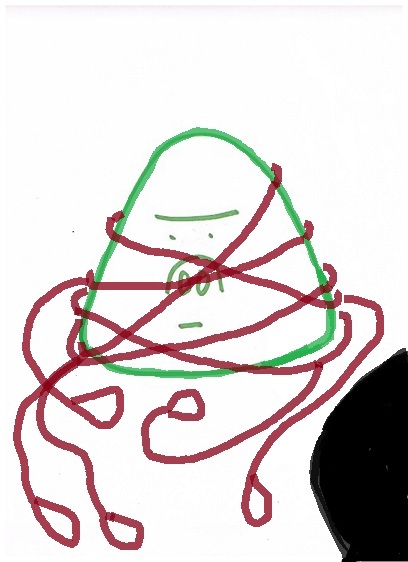
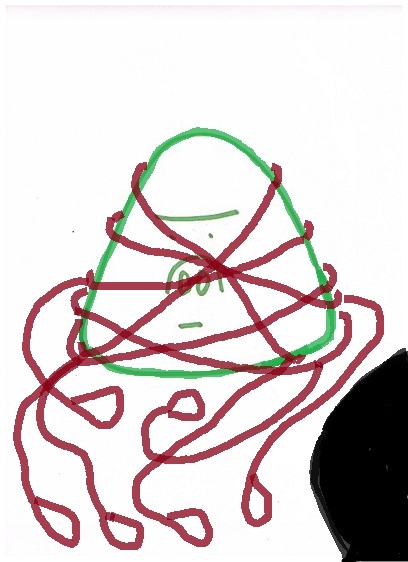
“I’m working on it,” he says.  “Almost there.”
He’s telling me, for the tenth time in ten weeks, that he’s almost ready to end his bad marriage.
“No,” I say.  “You’re camping.”
He knows just what I mean.  It was one of his sessions that inspired Resigned, which compared discouraged clients to mountain climbers who camp on the side of the mountain.
“I know,” he says sadly.  “But I have to keep climbing.  I’ll never be happy otherwise.”
“Have I ever told you about the Paradoxical Theory of Change?” I ask.  “It’s an idea from Gestalt therapy.  It says As long as you try to change yourself, you stay stuck.  But accept yourself as you are, and change happens automatically.”  
“I don’t get it,” he frowns.
“Sometimes trying to change feels less like growth than self-abuse.  Not I deserve more, but I’m not good enough as I am.
“I think that’s happening here.  The Adult part of you says I’ll never be happy here, so I better get on with ending this marriage.  But the Kid part says Hell, no.  Divorce scares the crap out of me.  I’m not going anywhere.  Sound about right?”
He nods.  “And the Kid wins the argument.”
“Always.  And you’re not going anywhere without that Kid.  Nowhere good, anyway.  So maybe you should listen to him.”
“I shouldn’t just drag him along?”
“No.  He’s had a lifetime of that.  Stop pushing him.  Accept him as is, for now.”
“Let him camp?”
“For now.  Let him build a campfire, roast a marshmallow, get a good night’s sleep.  You’d be surprised how strengthening real rest can be.
“And the mountaintop will still be there tomorrow.”


Practicing responsibility

Seventh is the series
Notes on Recovery
.
I probably use the word responsible differently than you.
To me it means able to respond.  “Respond” as is reply or answer.   
I see responsible people as those who can answer a situation, challenge or problem in a healthy way – one that meets their needs, respects their feelings, acknowledges their preferences, promotes their growth, and leaves them more powerful.
I’m guessing responsibility means something else to you.
That may be because I’ve known so many clients who confuse it with following rules, meeting expectations and discharging obligations.  These are people who regularly lose themselves.  They sacrifice their needs, feelings, preferences and growth to other people, or jobs, or imposed codes of behavior, or impossible standards, or endless To Do lists.  They do this less out of love or idealism than self-defense: they’re scared of what will happen if they don’t do it.
I call that irresponsible.
Truly responsible people, as I see it, as the ones who can (a) listen to themselves and (b) act in their own self-interest.
Listen to themselves mean focus inside, pay attention to feelings and the messages their bodies send telling them what their needs are.
Act in self-interest means respecting those emotional and bodily signals instead of ignoring or hiding them.
This sort of responsibility starts with simple stuff: eating when hungry, resting when tired, peeing when your bladder is full.  It extends to venting when angry, crying when sad, reaching out to others when lonely or scared.
As I said, simple stuff.  But if you suffer from control addiction I bet you don’t do any of it nearly enough.
So that’s what you need to practice in recovery.  Call it responsibility, self-love, self-care, or (as I do) healthy selfishness.
“Selfish,” of course, is the dirtiest of words.  Most people confuse it with behavior that harms or neglects others.
But who isn’t selfish?  Preoccupation with ourselves is built into our nature and neurology.  We can’t help that.  Our only choice is to admit or deny it.  To be honestly selfish, or hide our true motives behind a mask of selflessness.
Thus in the end practicing responsibility means being able, willing and brave enough to take care of yourself.
Because if you don’t, who’s going to?
 Next: Practicing intimacy


Refocusing

Fourth in the series
Notes on Recovery
 
Our need to refocus comes from realizing the real reason we try to control stuff:
We’re trying to control how we feel.
We’re especially trying to manage anxiety.
Think about it.  What scares you most?  Criticism?  Failure?  Rejection?  Abandonment?  Humiliation?  Physical pain or discomfort?
That’s what you feel most compelled to control.
Compulsive means anxiety-driven.   Whenever I act like a control addict – for example,
~ hide my real self from other people,
~ hide my true feelings from myself,
~ try to impress, coerce or manipulate others,
~ insist things be done my way,
~ caretake friends or family members,
~ worry endlessly about the future, or
~ try to make my environment just as I want it to be
– I’m being driven by some anxiety about what will happen if I don’t do these things.
Recovery means finding another way to manage this anxiety.
Which is where refocusing comes in.
When I refocus, I shift my attention from Out There to In Here.  I redefine the problem from some external trigger (X looks mad) to my own reaction (I’m scared of X).
I  step back from that reaction and realize that, to feel safe again, I really don’t need to control X.  I just need to change my reaction.  If I can do that, X’s anger stops being a problem.
Changing my reaction to stuff is what allows me to stop trying to control it.
Next: The three questions

* * *

Previous posts in this series:
(A sort of preface:) Tricky
1. Bottom 
2. Power
3. Plan B


The big lie

In Mein Kampf (1925) Adolf Hitler explains the propaganda technique known as The Big Lie.

Most people, he writes, never think to fabricate “colossal untruths,” and so never expect others will have the gall to do so.  This makes them gullible — so gullible that

Even though the facts [disproving the lie] may be brought clearly to their minds, they will still doubt and waver and will continue to think that there may be some other explanation.

Some families promulgate Big Lies, too.

I know this because there’s one lie with which therapists struggle every working day.

I wrote about it here not long ago (All my fault).

The lie is,

A family’s problems are

caused by the children.

This lie is usually told by parents, who may believe it themselves.  (Often because their parents taught them to.)

Some deliver it directly.  I wish you were never born.  Or Why do I drink?  You’re why I drink.

That’s rare, though. More often the lie is delivered indirectly.  If I wasn’t pregnant, do you think I’d have married your father?

And sometimes it’s delivered nonverbally, with not words but behavior.

A sigh.  A sniff.  A look.  Averted eyes.  Angry or rejecting body language.  Even comments meant to be overheard.  That kid will be the death of me.

How can children defend against this?

They can’t.

Kids are like sponges.  They absorb whatever poison they’re soaked in.

So if you’re a parent it’s worth taking time to examine how you explain, in the privacy of your mind, your own family’s pains and problems.

Because, accurate or cockeyed, your conclusions will probably become your kids’ conclusions.

And in some cases, the lie they end up living.


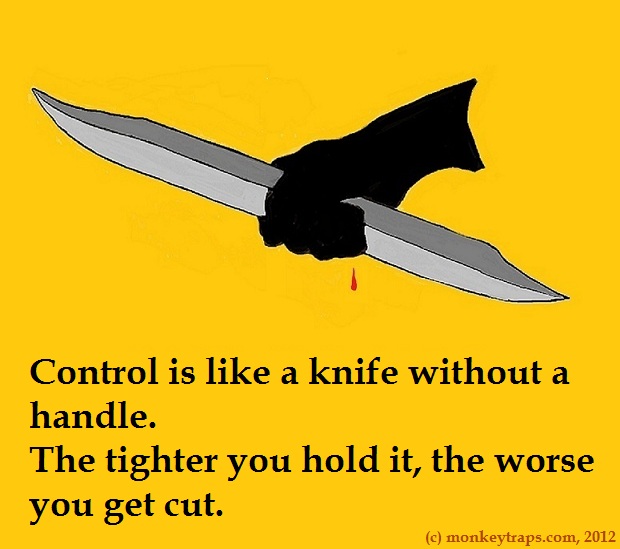
Knife

.

* * *

Since feeling out of control

is uncomfortable,

it makes me seek more control.

.

The more I seek control,

the more sensitive I become

to control issues.

.

The more sensitive I become

to control issues, the more often

I feel out of control.

.

Which makes me

uncomfortable.

.

Since feeling out of control

is uncomfortable, it makes me…

.

You know.


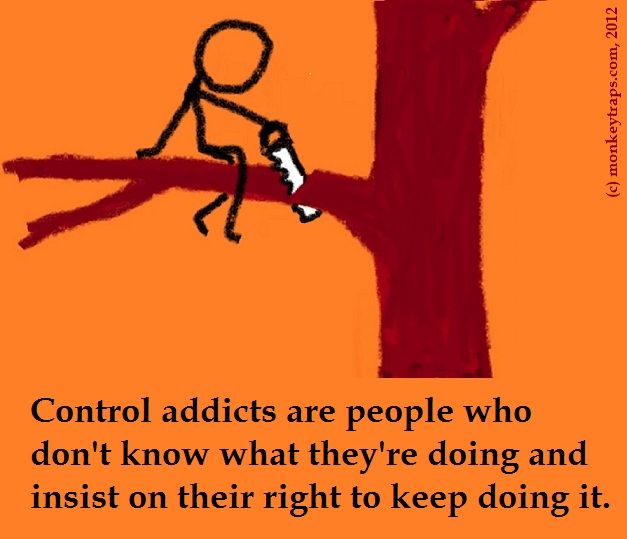
Control addicts

.

* * *

.

.

Here are the three things you need to know about shame:

We all have it.

We’re all terrified to talk about it.

The less we talk about it the more we have it.

~ From Part 1 of a PBS interview of Dr. Brene Brown (4:56).

*

Q: You say that shame leads to disconection.  So how do we reconnect?

A:  You know, it’s funny.

One of the ironies is that shame fills us with this fear of disconnection.

But it is our imperfection that connects us to each other.  It is the fact that our shared humanity is imperfect.

I think if we can find the courage to talk about our lives honestly, and our struggles, not only does that free us, it gives other people the freedom to be more authentic and real as well.

I don’t think connection is possible without authenticity.

~ From Part 2 of a PBS interview of Dr. Brene Brown (5:31).


The split-level relationship

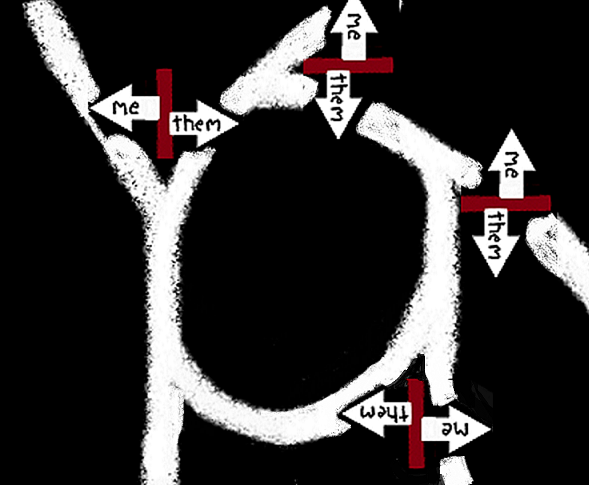
There are two questions with which you must struggle if you want a healthy relationship:

How can I have you without losing me?

How can I have me without losing you?

You can’t really answer these questions, just struggle with them.

But it’s the struggling that matters.

Why?

Because they represent two essential needs each of us brings to any relationship:

Connection and freedom.

Acceptance by another person, and self-acceptance.

A real partner, and at the same time, a real self.

Most people I know are convinced you can’t have both at the same time.

Most came from families — alcoholic, abusive or otherwise dysfunctional — unable to teach them to balance connection with freedom.

What they learned instead was that having one meant losing the other.  That winning love and approval from parents, for example, meant sacrificing important parts of themselves, like the freedom to express feelings or take care of their own needs.

The family that raised us is where each of us learned our own personal answer to the two questions. And the answer we learned grew into a crucial (though mostly unconscious) part of our basic view of life and relationships, what I call our Plan A.  

Some of us decide, “Since I can’t have both, I’ll have me, and to hell with you.”  Shrinks call this the narcissistic answer.

Others decide, “Since I can’t have both, I’ll have you, and to hell with me.” This is the infamous codependent answer.

So the narcissistic partner says “Me first,” and the codependent replies, “Yes, dear.”

And the two personality types end up together with stunning regularity.  (Remember Archie and Edith Bunker?)

Watching such couples interact, one is struck by their predictability.  In every situation the narcissist finds some way to say “Me first,” and the codependent to reply “Yes, dear.”  It’s as if long ago they sat down and signed a contract.

Which in a way they did.

Their complementary answers to the two questions probably account, in large part, for why they felt attracted to each other.

In any case, the vast majority of couples I see for couples counseling follow this pattern — so many that I felt the need to give them their own name.

I call them split-level relationships.

Split-level relationships work for a while, but almost always break down.  Eventually one or both partners realize they’re not getting what they need.

Codependents usually notice first.  When that partner is female this can lead to the syndrome called the Walk-Away Wife.

But narcissists tend to be unhappy too. They often complain of loneliness, lack of connection to their codependent partner, or an absence of respect or affection.  They may feel impatient, frustrated, irritated, resentful. Sometimes they drink, drug, overeat, rage or cheat, and then feel bad about that.

All this happens because split-level relationship is inherently unhealthy.

Familiar, sure.  Comfortable, even, in the way the predictable may come to feel.

But not healthy.  The unbalanced answers on which a split-level relationship is based simply cannot fill the emotional needs of two adults.  So both partners end up feeling deprived, often without understanding why.

What does recovery for such a couple look like?

Put simply, a sort of role reversal.

Codependent partners must develop courage and practice standing up, asserting themselves.  Narcissistic partners must develop empathy and practice stepping down, giving instead of grabbing.

Easy?  No.  Not easy for either of them.

Just necessary to life on the same level.


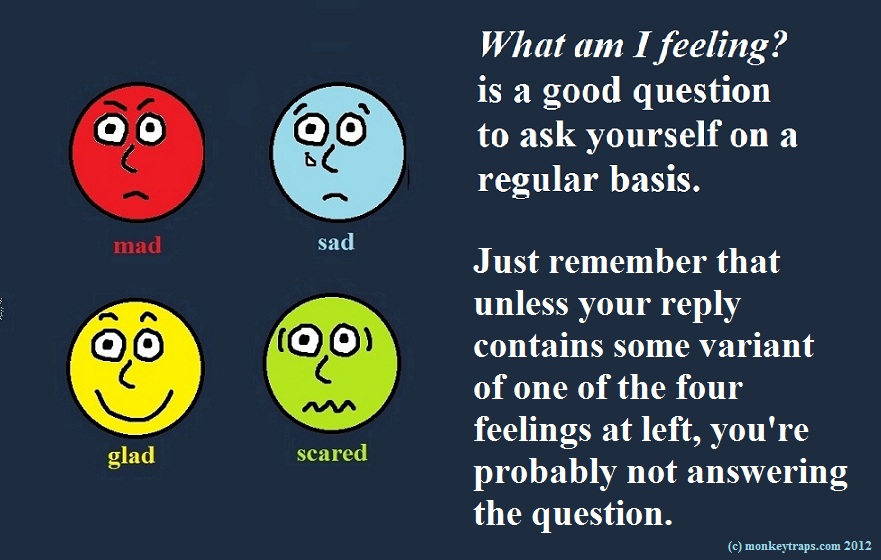
Feelings

.

.

* * *

.

20 years ago:

.

“What are you feeling?”


“I feel upset”


“Upset? What does upset mean?”


“Upset! It means that I feel upset!”


“Upset isn’t a feeling. Are you sad? Or scared? Or angry? Or feeling loss? Or something else?”


“I’m not sure.”


Yes, I was so afraid of my emotions that I couldn’t even begin to identify my “negative” emotions.


That would have meant getting close enough to them to start to really feel them, which felt utterly overwhelming.


And I’m not only talking about feelings related to the abuse, I’m talking about the feelings related to every day life.


Thus began my education about emotions.

~ From I have to feel what? by catsmeow at Living While Healing.


Addict

(Bert speaking.)

I’ve been addicted to control for as long as I can remember.

That is, for as long as I can remember I’ve been trying to force reality — people, places, things, even myself — to match the pictures in my head of how I want reality to be.

I do this constantly.

I do it unconsciously.  Which means I usually don’t know when I’m doing it.

And I do it compulsively.  Which means I get really really anxious when I can’t get control.

I expect to stay an addict until I die.

Yes, I’m in recovery.  But that just means I’m less controlled by my need for control than I used to be, just as recovering alcoholics are less controlled by their need to drink.  They’ll always be alcoholics, though, and I’ll always be a control addict.

I’ll always feel this urge to control stuff.  Even when I know it’s crazy to try.

It’s crazy, I’ve learned, because control is largely an illusion.

Sure,  it’s not always an illusion.  If I pour sugar in my coffee the coffee gets sweeter.  If I pull the steering wheel to the right my car will reliably turn right.

But the world is larger than sugar and steering wheels.  And the truth is that, beyond these concrete ways of changing my immediate circumstances, much of my controlling operates more on the level of wishful thinking.

Why?  Because most of my controlling is an attempt to control feelings and relationships.

And feelings have no steering wheel.  And in relationships sugar doesn’t always work.
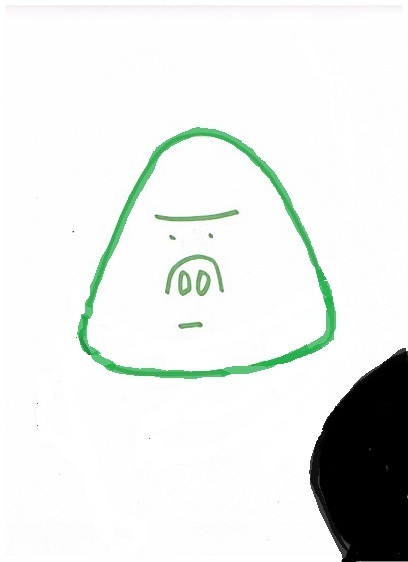
Let me explain.

Say I have a feeling I don’t want.  Say I feel inadequate.  But it’s uncomfortable to feel that, and I also worry that if you see that I feel inadequate you may agree with me, which would make me feel worse.  So I hide my feeling, from you and from myself.  I work hard at presenting myself as adequate, even superior. (For an example, see “Bert’s mask.”)  And let’s say it works: I convince you I’m superior.  I have successfully controlled your perception of me.

Do I feel better?

Not so much.

At least, not for long.  Why?  Because I know it’s an act, a pretense.  I’ve basically fooled you about me, and I can’t forget that.  So whatever approval I get from you is essentially meaningless.  And I end up feeling both inadequate and phony.

See how that works?

Another example:

Say I’m mad at you, but afraid to show it.  I’m scared you might get mad back at me, which would make me unhappy.

So I hide my anger from you.  I bury it.

But overcontrolling feelings tends to be bad for me.  Feelings are meant to be expressed, not contained.  Released, not stored up.  So burying my anger makes me uncomfortable.  Constipated.  Pressured.  Uneasy.  Anxious.  And when I do it long and habitually enough, I get depressed.  I.e., chronically unhappy.

How’s that for irony?

Why doesn’t control work better in the realms of feeling and relationships?

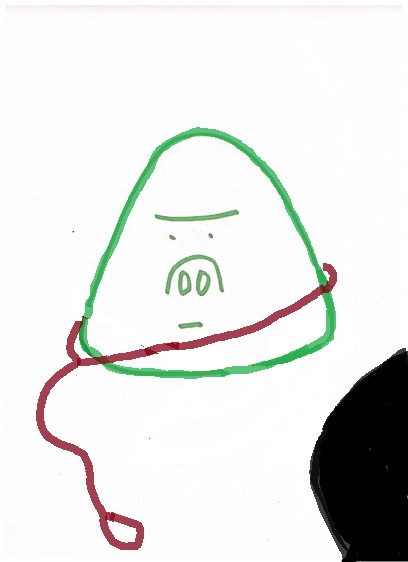
Because at the heart of this addiction lies an annoying but inescapable paradox:

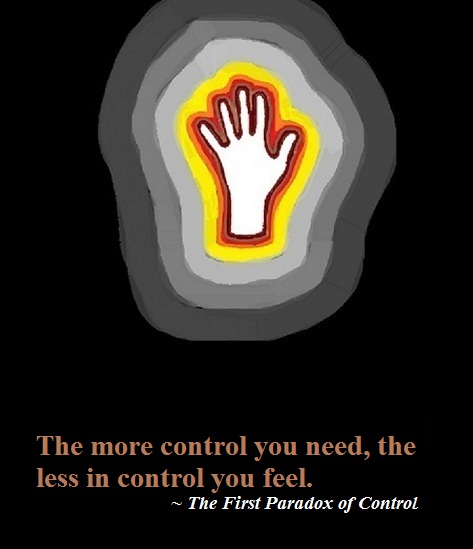
The more control I need, the less in control I feel.
* * *


Hang a left

It’s her first appointment, and she’s crying. 
“I feel so stuck,” she says.

I pass the tissues.   “How so?” I ask.

She tells me. 

Her husband bowls every Wednesday, golfs weekends, watches tv each night until bed.  Never talks to her, never compliments her, hasn’t taken her out to dinner in years.  Expects sex regardless. 

“Regardless of what?” I ask. 

“How I feel about it,” she says.

She has two teenagers, whom she serves as cook, laundress, chambermaid, tutor, therapist, referee and chauffeur.  On Mother’s Day they gave her a World’s Greatest Mom card from Wal-Mart, then spent the day with friends.

Her parents are in from Florida.  They visit frequently without asking, stay a week at a time, and criticize everything from her haircut to her parenting.  (I jot critical parents on a mental note card, file it away for a later session.) 

Her best friend is recently divorced, and calls her nightly either to exult or to mourn her new freedom, depending on how her last date went.  (“And do you ever call her?”  “What for?” she asks, without irony.)

Her mood’s been sliding downhill for years.   She sleeps badly.  Feels tired.  Feels alone.  Feels sad.  Cries.

“Ever take a day off?” I ask.

“No.”

“Ever take a nap?”

“No.”

“Have any hobbies?”

“No.”

“Have any friends or family who aren’t totally self-involved?”

She half-smiles.  “No.”

“Ever tried therapy?”

“I didn’t see how it could help,” she says.  “Can it?”

“Yes,” I say.

“How?” she asks.

“By teaching you to drive,” I say.

She looks puzzled. 

“Imagine someone who learned to drive a car without ever being  taught how to make a left turn.  So whenever they go out all they can do is turn right.  What would happen to them?”

She frowns.  “They’d go in a circle.”

“Exactly.  That’s what you’re doing now.”

“I don’t understand.”

“Think of all the choices you make in a day.  Now think of each choice as a fork in the road.  When you put others first, you turn right.  When you put yourself first, you turn left. 

“When was the last time you made a left turn?”

Her eyes widen.  She thinks.

“I don’t make those,” she says finally.

“Right,” I say.  “You’re driving in circles.  It’s why you feel stuck.”

“And therapy can teach me to turn left?”

I nod.  I’m expecting the next question. 

“But isn’t that selfish?”

“Yes,” I said.  “What’s your objection to selfishness?”

I’ve asked that question hundreds of times.  No one has a good answer. 

“It’s just…bad.”

“That’s what everyone says,” I say.  “I suppose some believe it.  But most people use it to convince others to put them first.  The most selfish people I know tend to be the first to condemn selfishness in others. 

“Me, I think of it as a survival skill.   Selfishness is essential, at least some of the time.  If you don’t take care of yourself, who will?”

“Well, this isn’t working.”  She blows her nose.   “I guess I should hang a left once in a while.  But my family won’t like it.”

“Probably not.  You’ll have to train them.”

“How?”

“We’ll talk details later.  But it amounts to putting yourself first and letting them adapt to it.” 

“And that works?”

“Sure,” I said.  “Look how well it’s worked for your husband, your kids and your parents.”

1

2

* * *


Self-love, my liege, is not so vile a sin as self-neglecting.

~ Shakespeare, Henry V


1212

* * * 

Some of us give because we can’t not give.  It’s our way of getting by in the world. 

At least if I give, the thinking goes, others will like me.  Better yet, they may even come to need me.  Then I won’t be so alone in the world.

Giving becomes a kind of barter to belong — a bid for love, rather than an expression of it.

~ From “Healthy selfishness” at daily.om.

1

* * *

I think it unhealthy to not know the things you like and the things you want.

I think if you do not allow yourself to know them and to exercise adequate levels of self-care by satisfying those wants and needs in ways that make you feel good you will find unhealthy and unsatisfying behaviors that you do in order to be safe.

The relationship will become toxic and cycle through predictable patterns of acting out, failure and disappointment.

Selfish behaviors that take advantage of or hurt someone else are not what I am describing.  Behaviors that are done in service of the health of the self are self-ish.

~ From “The concept of healthy selfishness in therapy” by Brett Newcomb.

* * *


The tribe: Expectations


Most people feel anxious in group without really understanding why.

1

2

member 1

3

4

1=

2=

Personally I think it’s because, on some deep level, the group reminds us of our family of origin.

1

2

member 2

3

4

5


2=

And we expect it to treat us just as our family did.

1

2

member 3

3

4

1=

2a

=

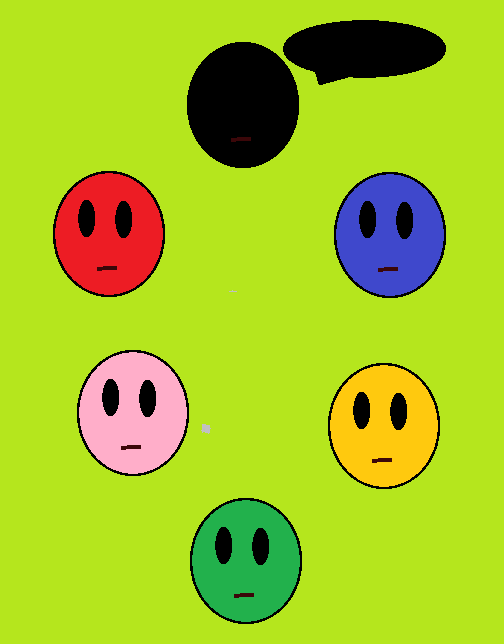
So tell me.  If this group were your family, what would you be expecting now?

1

2

member 4

3

4

1=

2=

therapist 5

1

2

To get hit.

3

4

5

6

1=

2=

1

2

3

4

5

1

To get humiliated.

3=

\


therapist 7

1

2

To be told to shut up.

3

4

5

1=

2=

1=

therapist 8

1

2

3

4

To be ignored.

3

4

1=

2=

Pink?  What would you expect?

1

2

member 9

3

4

5

1=

2=

therapist 10

1

2

3

All of the above.

3

4

5

1=

2=

Jeez.

1

2

member 11

3

4

5

6

1=

2=

So you all have good reason to feel anxious in this room.

1

2

member 12

3

4

5

1=


2=

But I have to ask Pink:

1

2

member 13

3

4

5

1=

2=a


How’d you work up the courage to even come here?

1

2

member 14

3

4

5

1=

2=

therapist 15

1

2

3

Two beers, half a pizza, and a Vicodin.

3

4

5

6

7

* * *


Group therapy. 

In Hebrew. 

“Hello, this is Fear Management. 

“My name is Moni, and I too have a phobia. 

“I have a fear of shouting. 

“You know, a, h, h, h, exclamantion mark, ‘ahhh’!

“At this point I suggest we all tell about ourselves…” 


Excerpt from the Israeli TV show “Ktzarim”:  Five troubled people (that description includes the group leader) meet for group therapy.  In Hebrew with English subtitles (2:22).


* * *


Overheard at the House:

Eventually, and every time, I used to drive my current partner insane with my hang ups and he broke off the relationship….

So I decided only I could change and needed to put my – sorry to be blunt – infantile behaviour aside and choose blind trust, no matter the outcome….

Result: I came to accept that my life is my life and not dependent on anyone else for survival or safety – and in a way I was going to be alone, with or without a partner: it’s part of the human condition….


Come. 

Join the conversation. 

Monkey House.

Because we’re all monkeys on this bus.


Session 45: Feeding Felicia

So.  I gave Felicia the cookie.

1

2

3

Ah.  Left it on her pillow?

1

2

3

And flew away, as you suggested.

1

2

And? 

1

2

3

And she came and asked why I did it.

1

2

What did you say?

1

1

2

3

“I wanted to.”

1

2

3

Good answer.

1

2

3

Apparently.  She hugged me.

1

2

3

Good job.

1

2

3

It was just a cookie.

1

No, it was a course correction.  You feel you two moving in a new direction now?

1

1

2

3

Yeah.  How do I keep it going?

1

2

3

Keep feeding her. 

1

2

3

Cookies?

1

2

3

No, no.  Emotional feeding.

1

2

3

With what?

1

Well, there are four foods we need from our important relationships.

1

1

2

3

bert10

1

2

Attention, acceptance, appreciation and affection.

1

1

2

3 

And if we don’t get that stuff regularly…

1

2

3

We starve.

1

1

2

3

Okay.  I fed her attention with the cookie.  How can I show acceptance?

1

Name something she does that she knows annoys you.

1

1

2

3

Watches reality tv.

1

2

3

Huh.  That’s a tough one.

1

2

3

Why?  What are you suggesting?

1

2

Sit and watch with her.

1

1

2

3

Holy mother of God.

1

2

3

Not for long.  Ten minutes.

1

2

3

You’re kidding, right?  “The Kardashians”?

1

2

(Shivers.) 

1

2

3

bert16

1

2

Neverthless.  Do it for the marriage.

1

2

3

I’m not sure any marriage is worth it.

1

2

Now, now.  Just once.  Treat it like an experiment.

1

2

3

Okay.  (Gulps.)  I’ll try.

1

2

Good man.  Be brave.  Be  curious.   

1

2

3

Can I be drunk?

1

2

3

4

5

6


* * *


Session 41: Gorilla warfare

Felicia’s pissed at me.

1

2

3

What about?

1

2

3

I’m not really sure.

1

2

3

therapist-2

1

2

3

Monday she said I don’t make enough money.

1

2

3

th

1

2

3

Tuesday she complained I’m not home enough.

1

2

3

therapist-4

1

2

3

Wednesday she called me an “uninvolved father.”

1

2

3

therapist-5

1

2

3

Thursday she called me a slob.

1

2

Sounds confusing.

1

2

3

Bet your ass.

1

2

3

How did you respond?

1

2

3

Well, let’s see. Tuesday I went in and asked my boss for a raise.

1

2

3

therapist-8

1

2

3

Wednesday I came home early with flowers.

1

2

3

therapist-9

1

2

3

Thursday I helped Junior with his science project.

1

2

3

therapist-10

1

2

3

And Friday I did two loads of laundry and cleaned the bathroom.

1

2

Did it work?

1

2

3

No.  Now she tells me I’m fat.  What’s going on here?

1

23

Gorilla warfare.

1

2

3

Don’t you mean “guerilla” warfare?

1

No, gorilla.  It’s a control thing.  Your two inner monkeys are battling it out. 

1

2

3

bert-14

1

2

Happens all the time in split-level relationships.*

1

2*What’s this?  Click here.

3

bert-14

1

One partner seeks satisfaction by complaining or making endless demands on the other.

1

2

3

bert-15

1

2

The other seeks relief by trying to appease the first.  But it never works.

1

2

3

Why not?

Because they’re ignoring the real problem, whatever that is.  Pretty common in couples who haven’t learned to talk to each other.

1

2

3

Well, I hate feeling beat up.  What can I do?

1

2

Less.

1

2

3

Meaning…

1

2

Give up control.  Stop appeasing her. 

1

2

3

She’ll get angry.

1

2

She’s already angry.  Same result, less work. 

1

2

3

Okay.  Anything else?

1

Give up control in another way.  Ask what she’s really angry about. 

1

2

3


1

She may not know at first. That’s fine. Be patient.  Be curious.  Be brave.  Keep asking.

2


3

That I can’t do.

1

2

3

Why not?

1

2

3

She might actually tell me.

1

2

3

Oh.  Well, in that case…

1

2

3

1

2

There’s always Weight Watchers.

1

2

* * *


Session 39: Leashed

There’s something I don’t understand about control addiction.

1

2

3

What’s that?

1

2

3

You say everyone is addicted to control?

1

2

3

4

Right.

1

2

3

4

Doesn’t that mean this “addiction” is really just human nature?

1

23

Well, I’m not sure what “human nature” means.  So I’d put it differently.

1

2

3

bert

1

2

It’s perfectly normal for human beings to be addicted to control.  It just isn’t healthy. 

1

2

3

“Normal” and “healthy” aren’t the same thing?

1

2

3

Oh no.  How many normal people do you know?

1

2

3

Lots.

1

2

3

4

And how many healthy people do you know?

1

2

3

4

Hm.  I take your point.

1

2

3

4

5

therapist-7

1

2

3

But I still don’t see what’s “normal” about being a control addict.

1

2

3

Do you ever worry about the future?

1

2

3

Of course.

1

2

3

4

You’re addicted.  Do you ever fret over the past? 

1

2

3

Sure.

1

2

3

You’re addicted.  Ever hide your feelings for fear of how others might react? 

1

2

3

All the time.

1

2

3

You’re addicted.  Ever worry about whether people will like or love or accept you?

1

2

3

4

Constantly.

1

2

3

You’re addicted.  Ever lie, or manipulate, or distort the truth to get what you want? 

1

2

3

4

Okay, I get it.

1

2

Ever avoid annoying people or uncomfortable situations? 

1

2

3

4

I said, I get it.

1

2

3

Ever plan?  Strategize?  Analyze?  Fantasize?  Agonize?  Dream?  Ruminate?  Obsess? 

1

2

3

4

You can stop now.

1

2

Just making my point.  Controlling is so utterly ordinary that most of the time we barely notice we’re doing it. 

1

2

3

bert-16

1

2

3

4

Until it traps us, that is. 

1

2

3

And how does it trap us?

1

2

3

4

Have you ever walked six dogs at the same time?

1

2

3

4

No.

1

2

You set out thinking that you’re walking them.  But before long you realize the dogs are walking you.

1

2

3

Meaning…

1

2

Whatever we try to control controls us.  And the more controlling you are, the more out of control you feel.

1

2

35

* * *


Session 17: Guilty

Bad day at work.

1

2

3

4

What happened?

1

2

3

4

Boss yelled at me.

1

2

3

4

And how do you feel?

1

2

3

4

Guilty.

1

2

3

4

Why’d the boss yell?

1

2

3

4

Having a bad day, I guess.  He’s like that.

1

2

3

4

So why do you feel guilty?

1

2

3

4

I don’t know.

1

2

3

4

That’s not guilt you’re feeling.   

1

2

3

4

It’s not?

1

2

No.  It’s anger.  Internalized anger often feels like guilt.

1

2

3

4

It does?

1

2

3

Sure.  Anger’s like poison.  If you don’t spit it out at the person who hurt you, it eats away at you and feels like guilt.

1

2

3

4

I don’t know about that.  I’ve always been a pretty guilty person.

1

2

3

4I see.  Tell me, what’s your boss like?

1

2

3

4

He’s an asshole.

1

2

3

How big an asshole?

1

2

3

4

Big.

1

2

3

4

Big?

1

2

3

4

Enormous.

1

2

3

4

And how’s it feel, working for an enormous asshole?

1

2

3

4

I hate it.  I hate him.  I hate my job.

1

2

3

4

th12

1

2

3

4

Hate hate hate hate hate hate hate hate.

1

2

3

4

therapist (13)

1

2

3

4

bert (14)

1

2

3

4

How you feeling now?

1

2

3

4

Better.  Much better.  Not guilty at all.

1

2

3

4

th

1

2

3

4

Does that always work?

1

2

3

4

When the guilt comes from internalized anger, pretty much.

1

2

3

4

bert (17)

1

2

3

4

By the way, how’s your marriage going?

1

2

3

4

bert (18)

1

2

3

4

* * *

1

2

3

4