Category Archives: recovery

Parable

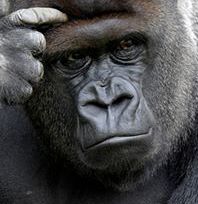
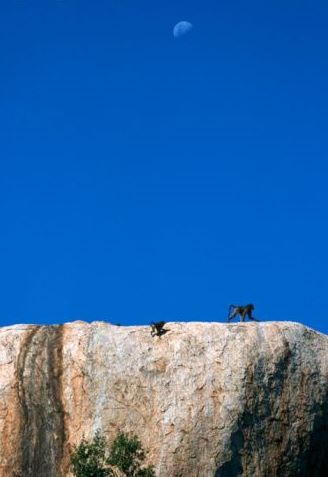
Two monkeys meet in the mountains at sundown.

Each is alone, having been separated from his tribe.  Both are tired from trudging for days through the rocks.

But monkeys are wary beasts.  So for a long time they stand motionless, eyeing each other suspiciously.

Finally the tireder of the pair gets tired of this too. 

“Oh, screw it,” he says, and sits down in the dirt.

The other watches him for a moment, then sits down as well.

They look around at the dirt, the rocks, the huge sky, the sinking sun.  Finally their eyes meet.

“What’s your name?” asks the first monkey.

The second monkey scowls.

“What’s yours?” he replies.

They fall silent.

The sun’s lower edge touches the horizon.  The air chills. 

The first monkey reaches into his knapsack and pulls out a cigarette lighter.  He scratches together a tiny pile of twigs and pushes the lighter into the center of it.  The twigs catch.  A small flame appears.

“Got anything to burn?” he asks.

The second money is leaning towards the flame, but the question stops him.

“Do you?” he answers.  He places a protective paw on his knapsack.

The first monkey sighs.

The sun sinks below the horizon.

Now it is dark.  Dark in the mountains is especially dark.

“Oh, screw it again,” says the first monkey.  He reaches into his knapsack and brings out a small lump of something wrapped in cloth. 

“This is a secret,” he tells the other.   “I never show it to anyone.  It’s embarrassing.  But I guess it’s better than freezing to death.”

He unwraps a stinky old fish head. 

A rotten smell fills the clearing.  First Monkey swallows hard, then lays the fish head carefully atop the pile of twigs like an offering.  

It catches fire.  Flames leap up. 

The smell disappears.

Second Monkey now looks embarrassed.

“That’s not so bad,” he says finally.  “I can beat that.”

He reaches into his knapsack and comes out with a medium-sized lump, also wrapped in cloth.

“Really?” First Monkey smiles.

Second Monkey nods, unwraps his fish head, swallows hard and lays it on the fire.

Again a bad smell fills the clearing.   The second head catches fire.  Again the smell goes away.

The monkeys inch closer to the flames.  They reach out their paws.  Overhead the moon starts its climb across the sky.

“You got more, I hope,” Second Monkey says.

“I do if you do,” replies First Monkey.

Both giggle.

And so the night passes, hour after hour, fish head after fish head, each larger and more fragrant than the last, until both knapsacks are empty and the fire burns on without feeding and the sun peeks up over the mountains in the east.

“I’m Sid,” mutters Second Monkey suddenly.

“I’m Barry,” replies First Monkey.  “Pleased to meet you.”  

Moral:

Nobody on this bus but us monkeys.

The illusion of control

The heat’s back today, and it’s too hot to walk. 

But there’s good news too. The aging AC in my building finally expired, transforming my office into a sauna with sofas.  So I had to stay home. 

Like a snow day, but with sweat.

Anyway, I’m sitting here at my desk with a fan at my elbow, reading chirpy blogs filled with excellent advice about how to transform my neuroses and finances, when I hear footsteps. 

Guess who? Bert growls.

***

Oh, please.  Take the day off, can’t you?

I want to chat. 

What about?

 About the other day.  After we talked I felt better.

Great.  You’re welcome.  Go take a nap.

Planning on it.  First I have a question.

Of course you do.

Patience, please.  Your monkey’s your monkey.

(Sigh.)  What’s your question?

Why did I feel better?

Come again?

Nothing changed.  All the stuff I was complaining about stayed exactly the same.  I felt better anyway.  Why?  What did you do?

I helped you detach from the illusion of control.

Oh.  (Pause.)  What the hell does that mean?

You were attached to an idea that was making you unhappy.  I just helped you move your attention elsewhere.

What idea was I attached to?

That you had to solve your problems.

But I did have to.  I still do.

Not in order to feel better.   For that you had to detach. 

“Detach,” meaning…

Let go of. 

How does that help?

How does it help to put down any load you’re carrying?

Oh.  Okay.  But the problems are still there.

Right.  So?

I still have to solve them.

Let’s say you do that.  What then?

I don’t follow.

You’ve solved all your problems.  What do you do now?

That’s silly.  Nobody can solve all their problems.

Exactly.  At best we exchange old ones for new ones.  And to believe anything else is an illusion.

The illusion of control. 

Right.   

And you believe that?  Control is an illusion?

Most of the time, yes.

But wait.  Some problems are solvable, right?

Sure.

So we can have some control. 

I’d say it differently.  I’d say there are times when we’re able to stop chasing control.  That’s not the same as actually having it. 

You lost me.

Yes, that happens.

(Pause.)  Let me ask it another way.  Why do you believe control is an illusion? 

Why do you think?

I don’t know.  Anyway, I’m not convinced it is.

Oh?  Have enough control, do you?

No.  Of course not.  But that doesn’t mean it’s not possible.

Right.  You just have to try a bit harder.

Right.

Do you know anybody who has enough control?

I’ve never asked.  But I doubt it.

Me too.  So why assume control is possible?

Well, it must be. 

Because?

(Silence.)

Look.  The idea of control is what might be called a necessary fiction.  It’s a myth, a story we tell ourselves in order to go on. 

Go on living.

Yes.  It gives us a sense of security and a sense of direction.  And it really is necessary, because facing our lack of control is terrifying for most people.  But it really is a fiction too. 

But why?  Why can’t I ever have control? 

Do you remember the four laws?

Yes and no.   I mean I do, but I keep forgetting them.

Yes, that’s normal.  The third law is

3. Behind all controlling is the wish to control feelings.

Yes, I remember now.

And that’s why control is mostly an illusion. 

Why?

Because feelings are mostly uncontrollable. 

Wait.   That’s not true.  If it were, we’d all run amuck.   I’d punch out everyone that makes me angry, or seduce every woman I find attractive, or…

You’re confusing feelings with behavior.  

Sure, behavior is controllable.  Sure, we can choose to express our feelings or hold them in.  We can split ourselves into controller and controlled. 

What I’m saying is, ultimately feelings are stronger.  Ultimately emotional life is beyond our control.  No one stays in control of their emotional life. 

But you know this.  You sit with me in that consulting room every day.  You know what happens to people who rely on control. 

They get sick.

Right.  Anxious, depressed, addicted. 

Divorced.

That too.

So what’s the alternative?  

To controlling your emotional life?

Yes.

You know that too.

Remind me.

Can you control the weather?

Of course not.

Is that a problem?

No.  

Why not?

Because I can handle the weather.  I know how to respond to it.  It rains, I wear a raincoat.  It snows, I wear galoshes.  It’s hot and the office AC crashes, I stay home with a fan in my face. 

Exactly.  Feelings are like weather.  Not a problem when you learn how to respond to them.

Respond to.  Not control.

Right.  

Which means…

Well, it starts with listening to them.  Listening for instructions, I call it.   Which I’m about to do.

How?

By ending this conversation.   We just passed 800 words. 

Oh.  Crap.   Lost some readers, I imagine.

That’s okay.  The ones who are interested will come back. 

Can I come back?

I expect you will, whether or not I give you permission.

(To be continued.)


Bert’s therapy

Finally the heat broke, so I went out for a walk. 

It was the sort of day that reminds you of summers in childhood, of how life felt without the permanently clenched fist in your midsection.  Lawns bright with sunlight.  A solid blue sky you want to swim in.  Breeze like a kiss.

So I’m walking along, enjoying all this, listening to the Corrs through my earphones, and I feel a tap on my shoulder. 

Bert sidles up next to me.

I need some therapy, he mutters.

I sigh.  For just one hour I’d have liked to have skip the whole neurotic thing.

But your monkey’s your monkey.

“Sure,” I tell him.  “Walk along with me,” and I pull out my earphones. 

* * *

What’s up?

I’m discouraged.  Depressed, maybe. 

How come?

You know.

Tell me anyway.  Part of the therapy.

Well, I’m really tired.  That heat wore away at me like sandpaper. 

I know.

And I’m sick to death of this insurance audit.  What’s it now, six months?      

Something like that. 

I’m sick of not having money.  Or a vacation.  It really hurt to skip Vermont again this year.

I know.  For a day or so I thought you might lose it.

Me too.

What else.

The house is a mess.

As usual.

Still bothers me.

I know.  What else.

The block’s back.

Yeah, I noticed.   What’s up with that? 

I got discouraged by the lack of comments.

Hm.

What’s that mean?

Nothing.  I’m listening.   Go on.   Is there more?

Well.

What?

I’m sixty.  (Sighs.) 

Yes, we are.

Sixty fucking years old.

I know.

Thought it’d be easier by now.

I hear you.  I feel you, as the kids say. 

So.  What would you tell a client like me?

Good question.  Let me think.

You get people like me?

All the time. 

So what do you tell them?

Well, first I guess I try to reframe things.  Help them see what they’re not seeing.

And what am I not seeing?

How lucky you are.

Excuse me?

Your marriage works.  Your kids love you.  You’re a pretty good therapist. 

Am I?

You help most of the people who come to you.  

I guess.

You like what you do for a living.  You own your own home.  You’re not sick, or crippled, or divorced, or in Afghanistan.

True. 

You worry about money, but your bills get paid. 

Eventually.

Right.  The house embarrasses you, but it’s your house.  Remember what renting was like? 

True.

And you have options.  Writing is still an option.  You’re a step closer to writing for money than you’ve ever been.    And you managed to start Monkeytraps in the face of all this other crap.

That’s true too.  So why don’t I feel better?

Oh, that’s easy.  You’re tired.

That’s it?

It’s important.   “Fatigue makes cowards of us all.”

You and your quotes.  Who said that?

Vince Lombardi. 

So what do I do?

Rest.

How?  I have work to do.

Find a way.

That’s what you’d tell a client?

Pretty much, yes. 

Sounds too simple.

Simple, yes.  Easy, no.  For one thing, it takes courage.   You’d have to give up controlling all the crap you just mentioned.

(Silence.)

You’d have to let go of the bills and the practice and the house and the blog.  In your head, I mean.  And have faith that the sky won’t cave in.   

(More silence.)

And you’d have to act like you deserve a rest.  Which you’re not at all sure that you do. 

No, I’m not. 

I know you’re not.  Do it anyway.

How can I?

No choice.  You have to save yourself.  If you don’t, who will? 

Hmpf.  

Too late to get parented.  It’s all your job now.

(He frowns.  I wait.  He scratches his head.  I wait some more.  Now his eyes open.  He looks at me.)

Hey.  I know why I hate this.

Why?

It’s an AFGO.

Yes, it is.

Another fucking growth opportunity.

Yep.

I hate them.

Yeah.  Me too.  Anything else?    

(He squints at me, like he suspects a trick question.  Shakes his head.  Leaves.)

(I put on my earphones, turn up the Corrs, and resume trying to swim up into the solid blue sky.)