.
Last night I replayed a conversation
for the eleventh time.
.
I was trying to get it right.
.
Not the conversation itself; that
was over and done with.
.
But how I felt about it.
.
I did not feel good.
.
So I reviewed
(a) what I said,
(b) what I should have said,
(c) what I shouldn’t have said,
(d) what the other person said,
(e) what they really meant,
(f) what they might be thinking now.
.
Each pass gave me a flicker of relief.
A sense that I was getting closer
to something.
.
But the longer I stayed with it,
the crappier I felt.
.
Which told me I was monkeytrapped.
.
By now you’re probably familiar with
this analogy:
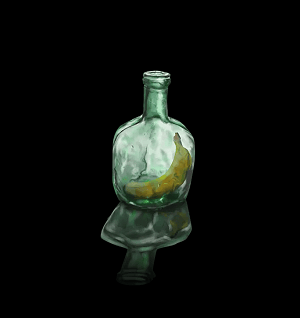
A banana is placed inside a jar with a
neck just wide enough for the monkey’s
paw to slip inside. The monkey grabs
the fruit, then finds its clenched fist is
too large to pull back out. It could free
itself easily; it just has to let go. But it
really really wants that banana. So it
hangs on. And it’s still hanging on when
the trappers come to collect it.
.
That’s a literal monkeytrap.
I write about the psychological version:
any situation which tempts us to hang
on when we really should let go.
Any discomfort which pulls us to try
and control what can’t or shouldn’t
be controlled.
.
Last night I was hooked by the promise
that if I just thought a bit longer,
analyzed more carefully, revisited
the conversation one more time, I’d
finally feel better — less tense, or
uncertain, or uneasy, or guilty, or
whatever the hell it was that I
was feeling.
.
Relief seemed just one more attempt away.
.
And then I noticed something new:
I’d been trapped by the smell of the
banana.
.
It was the irresistable smell of relief
that kept me obsessing over that
conversation, long after I should
have realized that its promise of
relief was a lie.
.
And lately this is something I’ve
come to see more and more clearly
in my work with clients:
.
Monkeytraps trap us because they work.
.
Just for a moment, they work. There’s
this tiny flicker of relief that comes
from replaying, analyzing, obsessing,
rechecking feelings, trying to think
our way into certainty.
.
Just enough relief to answer the inner
voice whispering You need to fix this.
.
So we set about trying to fix, and it
feels like we’re doing something,
clarifying something, moving toward
some kind of answer.
.
That moment is the hook. Because
the flicker of relief is real.
.
Then it fades. And we have to grab
for it again.
.
And again.
.
Psychologists call this negative
reinforcement. Negative refers to
removing something unpleasant,
reinforcement to encouraging the
behavior that removed it.
.
Translation: Controlling behavior
relieves just enough discomfort to
lead us into more controlling behavior.
.
It’s what makes controlling an addiction.
.
So it’s the smell of the bait that leads
us to review the conversation one more
time, or read another person’s mind,
or ask others what they think, or
doubt our perceptions, or beat
ourselves up for mistakes, or …
.
You know.
.
Over time, this becomes less of a choice
and more of a reflex. The moment
something feels off we move automatically
into managing it, or trying to.
.
Anyway. Last night all this flashed through
my mind pretty quickly, like a sudden
mental ZIP download.
.
Followed by one of my favorite aphorisms:
Where you put you attention is what grows.
.
So I took a deep breath, and suspended
the replay
.
I felt around in my body.
Found a small tightness in my chest.
.
It was the discomfort I had been
trying to fix.
.
Now I just looked at it.
Just looked.
.
I imagined it as a rubber band around
my heart.
.
I took another breath.
.
I kept looking.
.
There was no dramatic shift, no
immediate relief or resolution.
.
But the rubber band began to loosen.
Not all at once, and not completely.
.
But I felt better.
.
Not because I had figured anything
out.
.
Because I’d stopped trying to.
.
.
Bert and I recently began
publishing on Substack.
Come follow us.
https://substack.com/@stevehauptman
.
.
.
.
.