
Author Archives: Steve Hauptman
BOOK EXCERPT: Tradeoff (the Third Paradox)
z
From Monkeytraps: Why Everybody Tries to Control Everything and How We Can Stop by Steve Hauptman (Lioncrest, 2015).
Chapter 53: Tradeoff
To get control in one place you must surrender it in another.
~ The Third Paradox
I once met a speedcuber, one of those people who could solve Rubik’s Cube in sixty seconds. Nice friendly young guy. I sort of hated him.
I was jealous. Life always felt to me just like one big insoluble Rubik’s Cube. I could never get things under control on all sides at once. The harder I tried to make one side of my cube all one color, the more infuriatingly multicolored the other sides got.
It’s still like that. I still can’t get everything right at once. I can see clients, or do chores around the house. I can spend time with my family, or work on my book. I can go to dinner with friends, or watch my weight. I can keep up with my professional reading, or read mysteries to relax. The one thing I can’t do is everything. I’m trading off all day long.
I am not alone. Every day I talk with people whose determined attempt to get control over one area of their lives triggers a loss of control in another. Like
The drinker who uses alcohol to manage his feelings, then loses control of his health.
The careerist who achieves success and status at work, but becomes estranged from his wife and kids.
The compulsive mother who makes her children the focus of her existence, then loses her husband to an affair.
The depressive who successfully hides his feelings from everyone, then one morning finds himself too exhausted to get out of bed.
And so on.
Earlier I mentioned Fritz Perls’ idea that all attempts at self-change will trigger a resistance from deep within ourselves. That seems to be how change works in the larger world too. The more we try to force reality to meet our expectations, the more reality pushes back.
It is a point made by cautionary tales as old as Midas and Scrooge, and as modern as Jurassic Park.
And it is especially relevant to those of us who struggle with addiction to control. We should remember that, in the world of feelings and relationships no less than the physical world, Newton’s Third Law of Motion pertains. For every action, there is an equal and opposite reaction.
Or, if you prefer: Every yin seeks its yang, and vice versa.
But the scales always get balanced somehow.
The same point is spelled out in a letter to Carl Jung from one of his longtime patients:
By keeping quiet, repressing nothing, remaining attentive, and by accepting reality — taking things as they are, and not as I wanted them to be — by doing all this, unusual knowledge has come to me, and unusual powers as well, such as I could never have imagined before. I always thought that when we accepted things, they overpowered us in some way or other. This turns out not to be true at all, and it is only by accepting them that one can assume an attitude towards them. So now I intend to play the game of life, being receptive to whatever comes to me, good and bad, sun and shadow forever alternating, and in this way, also accepting my own nature with its positive and negative sides. Thus everything becomes more alive to me. What a fool I was! How I tried to force everything to go according to the way I thought it ought to.*

*Quoted in Stephen Cope, The wisdom of yoga: A seeker’s guide to extraordinary living (New York: Bantam Books, 2006), 136.
BOOK EXCERPT: Boomerang (the Second Paradox)
z
From Monkeytraps: Why Everybody Tries to Control Everything and How We Can Stop by Steve Hauptman (Lioncrest, 2015).
Chapter 52: Boomerang
The more we try to control other people,
the more we force them to control us back
~ The Second Paradox
.
Most people freely admit hating to be controlled, and to resisting it however they can.
But for some reason they tend to forget that others feel the same way. So they regularly try to control the people in their lives, and are surprised when those people react just as they would.
I see this all the time in family work.
Parents in particular seem unable to anticipate that their kids will resist being controlled by them. It’s as if they believe parents should have control, and that kids should simply acquiesce. Their narcissistic blindness in such matters sometimes takes startling forms.
A father insists his son be truthful in all things. He also judges and criticizes the boy whenever the truth he tells displeases Dad. Unable see how his reaction actually discourages truthtelling, he is genuinely surprised when Junior turns into a habitual liar. (Lying, of course, is the son’s way of controlling Dad back.)
One mother regularly searches her adolescent daughter’s room, cell phone and social media postings for evidence that the girl is having sex. Then she is astounded when (you guessed it) the girl turns up pregnant. Though I doubt the daughter got pregnant intentionally, it is hard to ignore what a powerful Fuck you, Mom message it conveys.
Dad brings his depressed son for counseling and stays to explain the problem. “He never expresses feelings,” Dad complains. “Looks like he’s expressing some now,” I reply, nodding at the son, sitting sullen and silent on my sofa. “You look like you’d rather be anywhere else but here,” I tell Junior. “That’s not an option,” Dad interrupts. “Okay,” he snaps at the boy, “come on. Open up.” Predictably, the therapy goes nowhere.
Note that in these examples each parent’s overt controlling is countered by covert controlling by the child. (See chapter 7.) Yes, some kids openly defy their parents, but covert and unconscious resistance (like the pregnant daughter’s) is much more common. While most kids feel emotionally outgunned by parental authority, that doesn’t mean they’re helpless.
And then there are times when kids don’t resist the controlling, they try to comply, and parents are still left feeling out of control.
An insecure mom intent on impressing the neighbors demands high achievement from her son and her daughter. Both kids try their best. The daughter gets straight A’s and becomes captain of the cheerleading squad. The son makes Honor Society and wins the lead in his school play. Then in her senior year the daughter breaks under the pressure, swallows a bottle of Excedrin and ends up in a psych ward. A year later the son gets drunk, drives Mom’s car through a neighbor’s yard and is arrested. Mom can’t see her role in these tragedies. “They’re my whole life,” she cries. “How could they do this to me?”
The Second Paradox shows up regularly in marital work too, where controlling by spouses boomerangs more often than not.
One form familiar to all couples therapists is the Pursuer/Distancer dynamic, where one partner chases and the other runs away. The pursuer is always demanding more of something – more time, attention, affection, money, sex – and the other is always refusing or evading the demand. It’s like a self-perpetuating dance in which each partner’s move triggers the other’s: pursing provokes distancing, and distancing provokes pursuit. Even when I point this out and the couple sees what they’re doing, it can be impossible to get either partner to change. Instead they play You Go First. I’d stop chasing him if he’d give me what I want. I’d give her what she wants if she’d leave me alone. And the dance goes on.
For years now I’ve begun every marital and family therapy by spending time alone with each of the individuals involved. I do this because we’re all control addicts, and this addiction causes most of our emotional problems, including those that emerge in relationships. So we need to address our individual addiction before those relationships can be healed.
We need to identify why we control, and how we control, and how our controlling hurts the people we love. Most of all, we need to see how our controlling hurts us.
Because in the end our relationships with others can’t be any healthier than our relationship with ourselves.
NEXT: The Third Paradox
BOOK EXCERPT: The more you need (The First Paradox)
z
From Monkeytraps: Why Everybody Tries to Control Everything and How We Can Stop by Steve Hauptman (Lioncrest, 2015).
Chapter 51: The more you need
The more control you need, the less in control you feel.
~ The First Paradox
x
People who say they want to feel in control usually mean they want to feel calm, safe, settled, secure.
But using control to achieve security is self-defeating. It’s the emotional equivalent of trying to put out a fire with gasoline, or treating toothache by chewing chocolate.
This paradox takes many forms, but two common examples should suffice.
One is anxiety management.
As noted earlier, we tend to be afraid of feelings. We often express this fear by holding them inside. But instead of making us feel safe, suppressing feelings actually raises our anxiety. Paul Foxman:
When feelings are denied or kept inside there is typically a buildup or physical tension. When that tension is not released, an internal pressure builds up. An accumulation of such pressure leads to anxiety, due to fears of losing control emotionally. That condition also triggers anxiety because of its physiological similarity to the fight/flight response, which is normally associated with danger. Thus our personality creates a paradox in which we deny feelings to prevent anxiety but experience anxiety when we deny our feelings.[1]
Alexander Lowen agrees:
It is not generally recognized that suppression of a feeling makes one afraid of that feeling. It becomes a skeleton in the closest one dares not look at. The longer it is hidden, the more frightening it becomes. [2]
This is the problem of emotional constipation I discussed earlier (see chapter 24). Feelings are meant to be expelled, not buried. Buried feelings don’t dissipate, they collect.
Thus clients who fear their own anger need to be encouraged to express it in session, and those afraid of grief need to be encouraged to cry, and the chronically frightened need to be helped to identify and express their anxieties whenever they come up. Only when this happens can one begin to feel calm inside.
A second area in which the first paradox operates is that of self-improvement.
Some clients enter therapy declaring their wish to be “better people.” What they mean varies. Some want to be better spouses or parents, or better at their jobs. Some want to be more disciplined, more honest or more brave. All valid goals. But every self-improvement project that springs from self-judgment and self-rejection is doomed to fail. Fritz Perls writes,
We are all concerned with the idea of change, and most people go about it by making programs. They want to change. “I should be like this” and so on and so on. What happens is that the idea of deliberate change never, never, never functions. As soon as you say, “I want to change” — make a program — a counter-force is created that prevents you from change. Changes are taking place by themselves. If you go deeper into what you are, if you accept what is there, then a change automatically occurs by itself.[3]
Perls is describing what Gestaltists call the Paradoxical Theory of Change:
The more you try to change yourself, the more you stay stuck. But the moment you accept yourself as you are, change happens by itself.
In therapy, then, my job is to help people be who they are now — their feelings and needs especially — instead of self-controlling their way into some new improved version. Until they can do this they remain internally split, into judge and defendant, controller and controlled, and all their energy gets wasted in an exhausting and futile fight against themselves.
*
*
NEXT: The Second Paradox
1. Paul Foxman, Dancing with fear: overcoming anxiety in a world of stress and uncertainty (Northvale NJ: Jason Aronson, 1996), 48.
2. Alexander Lowen, The spirituality of the body (New York: Macmillan, 1990), 45.
3. Frederick S. Perls, Gestalt therapy verbatim (Lafayette, CA: Real People Press, 1969), 178.
BOOK EXCERPT: The three paradoxes of control
z
From Monkeytraps: Why Everybody Tries to Control Everything and How We Can Stop by Steve Hauptman (Lioncrest, 2015).
Chapter 50: Three paradoxes
A paradox is “a statement that is seemingly contradictory or opposed to common sense and yet is perhaps true.”*
Three paradoxes govern the functioning of control.
The first paradox is intrapsychic, operating within the controller’s own mind. The second is interpersonal, governing interactions between people. And the third is existential, rooted in the nature of existence itself.
The first paradox is
The more control you need, the less in control you feel.
The second paradox is:
The more you try to control other people, the more you force them to control you back.
The third paradox is:
To get more control in one place, you must give it up in another.
*
*
TOMORROW: The First Paradox
*Webster’s New Collegiate Dictionary (Springfield, MA: G. & C. Merriam Company, 1977), 830.
BOOK EXCERPT: Monkeymind
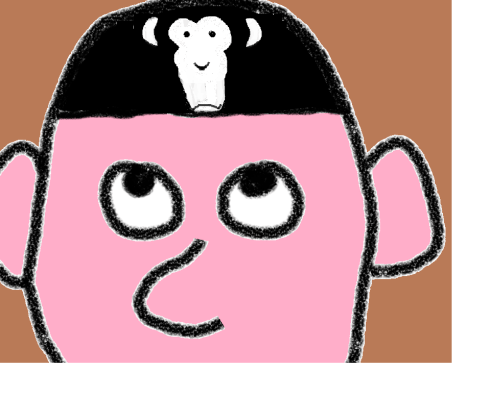 Monkeymind is a Buddhist metaphor that describes how normal human consciousness operates.
Our minds jump from thought to thought, feeling to feeling, just like a monkey jumps from tree to tree.
Unsettled, restless, never content with the present moment, they are constantly distracted by the endless stream of internal chatter passing through.
Two important things to remember about monkeymind:
(1) Monkeymind is, arguably, insane.
That’s if we define sanity as being in touch with reality. Monkeymind is anything but.
Preoccupied with memories of the past and projections of the future, it spins a narrative saturated with fantasy and only minimal awareness of what’s actually happening right here, right now.
Anyone who’s tried to meditate knows this narrative all too well.
Never have? Try now:
Sit still. Close your eyes. Take a deep breath.
Stop thinking. Put all your attention on your breathing instead.
Count your breaths.
(Authorial pause while reader counts.)
How far did you get before your counting was interrupted by a thought?
That chatter you heard? That’s monkeymind.
(2) Monkeymind is all about control.
Acquiring control — being able to edit the reality we have into the one we want — is monkeymind’s mission.
It pursues it mainly by recalling old wounds and trying to heal them, anticipating new problems and trying to solve them. (Did you notice, a moment ago, how the thoughts that spontaneously came to mind were wound- or problem-related?) It is pain-driven and anxiety-driven, which is why the narrative it spins often feels like a bad horror movie.
It does this with the best of intentions. It’s trying to heal us, protect us, make us happy, keep us safe.
Unfortunately the control it chases is an illusion.
So in the end what monkeymind mostly accomplishes is to keep us confused, scared, angry, unhappy, and more than a little nuts.
~ From Monkeytraps: Why Everybody Tries to Control Everything and How We Can Stop by Steve Hauptman (Lioncrest, 2015). Available at amazon.com.

Blame and sickness
*
Yesterday I published this poster on Facebook:
*

*
Many people Liked it and left approving comments. Two comments, though, surprised me.
“Mental illness is a disease,” wrote one person. “I did not and do not choose to have this disease nor do I choose to live this way. That post [is] ignorant, cruel, and judgmental.”
Wrote another, “oh I had control over this. silly me, good to know. aids patients too right?”
I know neither of these writers. But I can guess where they’re coming from.
Every day I meet people who’ve been blamed for their illness. That’s probably the main reason so many avoid seeking help from a therapist. They’re afraid that I, like others in their lives — including people who love them and mean well but don’t know what they’re talking about — will blame them for their anxiety, or depression, or addiction, or their struggles with relationships.
Of course this blaming goes back centuries. The stigmatizing of mental illness has roots in a dark past when emotional and psychological problems were attributed to possession by evil spirits, and victims were condemned, imprisoned, even tortured.
All that sounds absurd to us now. Yet every day I hear echoes of it in session.
The husband who advises his depressed wife to Just get a grip. The mom of a school-phobic child who answers all my attempts to explain anxiety by repeating But she has to go to school. The wife of a recovering alcoholic who wishes aloud that he’d resume drinking because He used to be more fun.
There is ignorance here, of course, but also fear. Mental illness scares us because (a) we don’t understand it and (b) we sense how vulnerable we ourselves are. So we explain it in ways that oversimplify it (depressed people are just weak) and put maximum distance between this sickness and ourselves (I’ve got a grip). Or we explain it in ways that imply we can somehow control it. (Hey, don’t be so serious. Relax, have a drink.)
Actually, most of the causes of mental illness are, at least initially, beyond our control — like losses or abuse or traumas we experience, or how we were parented or taught to handle feelings or relationships.
Personally I believe emotional problems are unavoidable. I don’t know anyone who hasn’t struggled with some degree of anxiety or depression, who isn’t addicted to something or other, and whose relationships are entirely problem-free.
This is true because, even if we’re not abused or traumatized as kids, even if we grow up adequately loved and cared for by reasonably healthy parents, we are still forced to adapt to and live in a culture that does not promote emotional wellness.
It’s a culture that values things over people, money over relationship, comfort over growth, intellect over feeling, image over authenticity, and encourages us constantly to try to control things which neither can be nor should be controlled.*
“It is no measure of health to be well adjusted to a profoundly sick society,” wrote Jiddu Krishnamurti. And when forced to adjust to society’s sickness, we ourselves sicken.
Which was the whole point of the post.
So no, we are not to blame.
And no, we are not helpless.
In the end there usually is a connection between how healthy we are and how we live, how well we understand and take care of ourselves.
And that, friend, is an entirely good thing.
Because it is that which makes recovery possible.
_________________________
*The subject of my book Monkeytraps: Why everybody tries to control everything and how we can stop (Lioncrest, 2015). Available at amazon.com.
Stamp collecting
 Jack’s sessions have become predictable. He comes in mad at his wife and starts listing her most recent sins.
She’s so disorganized I can’t find anything. This morning I had to go hunting for clean socks. She texts her friends when she should be supervising the kids. She buys stuff we don’t need, leaves dirty dishes in the sink, and there’s always mail piled up for me to go through. She’s home all day and can’t go through the damned mail?
This happen every Monday. Tuesdays I see his wife Jill, with identical results.
He doesn’t talk, he barks. Every word out of his mouth sounds angry. I try hard to make him happy, but there’s always something I haven’t done or that I’ve done wrong. And he overreacts all the time. This morning he couldn’t find his socks and he lost it. The kids are scared of him. I go from scared to angry to discouraged and back to scared again.
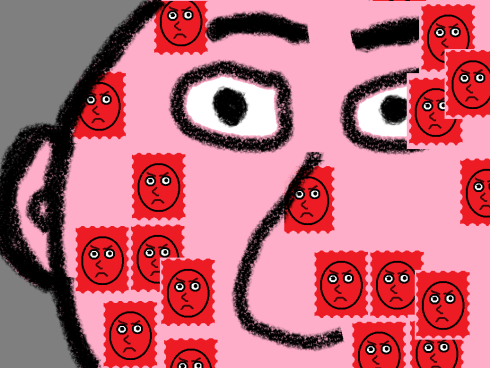
Welcome to stamp collecting.
It’s a metaphor drawn from decades ago, when supermarkets gave out trading stamps. You bought a bag of groceries and they gave you a sheet of little stamps that you took home and pasted into a stamp book. Fill enough books and then trade them in for a toaster or something.
The emotional version of this is a kind of evidence-gathering. People attached to a particular feeling or belief do it as a way of validating their prejudice. Jack and Jill, for example, both carry chronic anger at the other, plus the belief my partner causes my anger. And they spend their days collecting evidence that both the feeling and the explanation are justified.
Three things to remember about stamp collecting.
~ It’s the result of selective attention, and so results in a distorted picture. Jack’s stamp collecting, for example, ignores the things Jill does right and how hard she tries to please him, while Jill’s stamp collecting ignores how stressed Jack is by work and how much he loves his children. But the unconscious payoff for stamp collecting is self-validation, not accuracy or fairness.
~ It’s usually symptomatic of a dandelion fight. Dandelion fights are fights about the wrong thing, fights which ignore underlying issues. Couples scared of addressing questions like “Do we still love each other? Was this marriage a mistake? Have we grown too far apart to repair it?” often fight about finances or parenting or laundry. Stamp collecting perpetuates these battles.
~ The feelings behind it are often outdated. Every partner brings unfinished business into the marriage — unexpressed feelings, unresolved conflicts, unmet needs. (Jack, for example, had an alcoholic mother who left him needy for attention and nurturing, while Jill’s emotionally absent parents left her scared of abandonment and doubtful anyone can love her.) This unfinished business then gets triggered and reenacted again and again. Dandelion fights and stamp collecting keep this business unfinished.
By the way, chronic anger is not the only payoff for stamp collecting, which may be used to validate any feeling, conclusion or prejudice. Many people unconsciously collect stamps to perpetuate feelings of sadness, hopelessness, inadequacy, rejection, distrust or victimization.
But in the end stamp collecting is like collecting pretty stones on the beach.
Each individual stone looks attractive, worth grabbing and stuffing in your pocket.
But do it long enough and you end up overloaded, exhausted, and forever limping.
Expectation vs. hope
Human beings love to imagine the future; we do it constantly.
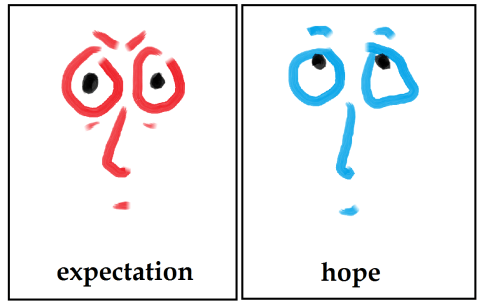
And our imaginings tend to take two forms — expectation and hope.
They seem similar, but shape our perceptions and our emotional lives in quite different ways.
So the differences between them are worth noting:
Expectation is essentially a demand. I must have X, it says, or I’ll be unhappy.
Hope is more accepting and receptive. I look forward, it says, to what comes.
Expectation is like a closed hand, clinched and tense.
Hope is like an open hand, relaxed and patient.
Expectation wants to control reality, to impose its own selfish terms.
Hope trusts reality, has faith that the facts will be friendly.
Expectation is wary and defensive. It keeps one eye on what it wants and the other on what it fears.
Hope is optimistic and inclusive. Unfocused on any particular outcome, it stays flexible enough to make room for whatever.
Expectation kills. By crushing flexibility, spontaneity, creativity and joy, it squeezes the life out of life.
Hope is life-giving, promoting patience, courage, power and growth.
Expectation is restrictive, tying you to a particular desire.
Hope is inclusive, freeing you to play with whatever comes next.
Expectation is an emotional anchor that drags you down.
Hope is a spiritual wind that lifts you up.
Tricky
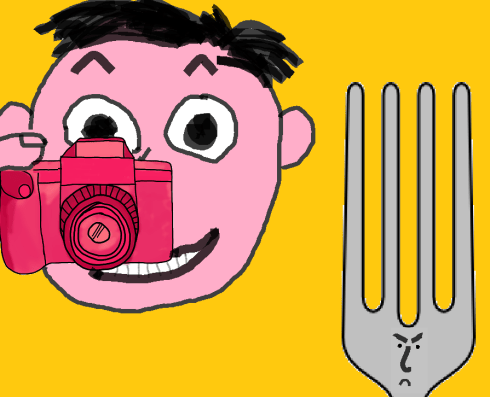
It’s our wedding day, and my new wife’s cousin keeps taking photos of us. Each time he presses the shutter he chirps “I think you’re gonna like this picture,” a line from an old TV show.
The first time he says it I chuckle. The second time I smile politely.
By the tenth time I want to stab him in the face with a fork.
I was reminded of Cousin Forkface recently by a client who jokes compulsively. The more anxious he feels, the more he jokes. He’s knows he’s doing it but can’t help himself. It’s sad, and it’s irritating.
It’s also, of course, a controlling behavior.
Like those others I’ve written about here in the past — compulsive apologizing (Apology), , comfort-seeking (Comfort), self-editing (Friends), self-blame (All my fault), persevorating (Gum), reenacting old battles (Dandelion fights), blaming others (Blaming), expectations (Killers) and giving up (Resigned).
Each of us has a jillion tricks like these — tactics we use to ease our way through life, increase pleasure, avoid discomfort, reduce anxiety, slip out of emotional tight spots.
They’re attempts to control our experience, what we feel.
Most are unconscious. We don’t realize we’re using them.
Most are harmless enough.
Some are merely annoying.
But some cause more problems than they solve.
And some actually make us (or people we care about) emotionally sick.
Our attempts to control stuff we either can’t or shouldn’t control lie at the root of our anxiety, depression, addictions, and nearly all our relationship problems.
They interfere with trust, safety, communication, intimacy, peace of mind, and love.
So it’s worth becoming more conscious of our unconscious trickiness, so we can distinguish the harmless tricks from the harmful.
And maybe avoid getting stabbed in the face.
Maybe
 In group. Liz, usually relaxed and friendly, looks like a truck just hit her.
She’s learned that her eldest son has developed a drinking problem.
To the daughter of an alcoholic father and survivor of an alcoholic marriage this comes as devastating news.
“It’s always been my worst fear,” she says numbly. “I feel like I can never be happy again.”
The other members try to reassure her, but you can tell they’ve no idea what to say.
There’s a Zen story I want to tell her. But I’m tired tonight, and though I remember the point of the story I can’t for the life of me remember the details. So instead I ask a question.
“Is this a good thing or a bad thing?”
She looks startled.
“My son’s addiction?”
“Yes.”
“It’s a terrible thing,” she says.
“Are you sure?” I ask.
She stares blankly.
“Would it surprise you to hear,” I go on, “that when I was training as an alcoholism counselor I attended AA meetings where people stood up and thanked God for their addiction?”
“Huh?”
“Yes, that’s how I felt. Took me a while to understand. I finally realized they were grateful because their addiction taught them stuff they needed to learn, important stuff they would never have learned otherwise. You know, how some people say their heart attack taught them how to live healthier lives?”
She nods.
“So as terrible as their addiction was, it was also a good thing in disguise. You might try thinking in this way about what’s happening with your son. Maybe, in a weird way, this will teach him something he needs to learn. Maybe it will be a good thing in disguise.”
She looks relieved.
“Maybe,” she says.
Which is ironic. Because that happens to be the title of the Zen story that I wanted to tell her.
Maybe
There was an old farmer who had worked his crops for many years. One day his horse ran away. Upon hearing the news, his neighbors came to visit. “Such bad luck,” they said sympathetically. “Maybe,” the farmer replied. The next morning the horse returned, bringing with it three other wild horses. “How wonderful,” the neighbors exclaimed. “Maybe,” replied the old man. The following day, his son tried to ride one of the untamed horses, was thrown, and broke his leg. Again the neighbors came to offer their sympathy on his misfortune. “Maybe,” answered the farmer. The day after, military officials came to the village to draft young men into the army. Seeing that the son’s leg was broken, they passed him by. The neighbors congratulated the farmer on how well things had turned out. “Maybe,” said the farmer.
The fourth box
 In session. He’s 54, pale, worried.
His doctor just told him he has an ulcer.
“It’s stress-related,” he tells me. “Doc says I need to learn stress management.”
“Okay,” I say.
“So.” He pauses. “What the hell is stress management?”
We both laugh.
“Well,” I say, “stress is how the body reacts to a demand. And there are better and worse ways to react. Stress management is about letting go of worse ways and learning better ones.”
“Worse ways?”
“Like worry. Worrying is a common reaction to stress, but not very effective. Solves nothing, eats up lots of time and energy, can even make you sick emotionally or physically. You worry much?”
“Sure,” he frowns.
“What about?”
“Everything.”
“Okay,” I say. “I did too. One reason was I couldn’t distinguish important stuff from unimportant.”
“That’s me,” he says. “Everything feels like an goddamned emergency.”
“Right. Then I learned to prioritize. I used the three-box trick.”
“What’s that?”
“I made a list of everything I worried about. Then I broke that list into three smaller lists, which I put into three imaginary boxes. I labeled the boxes Must Do Now, Should Do Soon and Can Do Later. It made things a lot more manageable.”
“Okay,” he says, “that makes sense. But some things can’t be put into boxes.”
“What are you thinking of?”
“Problems I can’t solve and can’t let go of.”
“For example?”
“Like how the economy is hurting my business. And my dad’s skin cancer. And how my wife and daughter can’t stop fighting.”
“Oh,” I say. “For that you need the fourth box.”
“What’s the fourth box?”
“It’s labeled Can’t Do Shit. It’s for all the stuff you can’t control, like the economy and acts of God and other people’s relationships. It’s my favorite box.”
“Why?”
“Because putting stuff in it helps reduce my stress more than anything else.”
“Really? Doesn’t it make you feel helpless?”
“The opposite of helpless, actually.”
“Why?”
“Because when there’s nothing I can do, there’s nothing I have to do. So when I put something in that box, I can let go of it. It stops being a problem, stops being a demand. And when I redefine it that way, I get back the time and energy it’s been costing me.” I smile. “And I feel a little bit stronger.”
Boat rocking
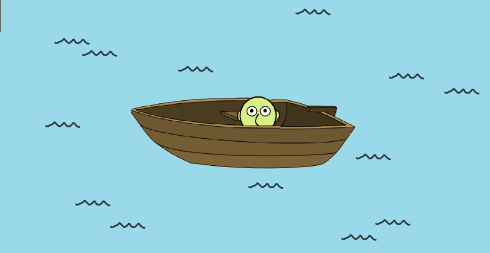
Angela has a stress-ridden adolescent son who throws up every morning before school. She worries about his anxiety and perfectionism, but is afraid to stop pressuring him about grades because “he’ll think it’s okay to not set goals or try hard.”
Betty has an alcoholic husband who stays out late and lies to her. She hates this, but resists my suggestion she visit Al-Anon or join a support group because “he might find out and get angry.”
Carl is married to a narcissistic woman who ignores his feelings and dismisses his preferences. Unhappy for years, he refuses to stand up to her because he hates conflict, and “a leopard doesn’t change its spots, so why bother?”
Everyone knows someone like this.
Someone who, faced with a particular problem, hangs on to the status quo as if it were a life preserver.
Welcome to the famous Don’t Rock the Boat syndrome.
DRTB is rooted in several pernicious and often unconscious assumptions, like
~ the familiar is safe,
~ the unfamiliar is scary,
~ change is usually for the worst,
~ with attention comes problems,
and
~ giving up control is dangerous.
It’s common among anxious people, beset by imaginary bears.
It’s also common among people who’ve learned to fear and avoid interpersonal conflict.
Then there are those for whom DRTB is a conscious tactical choice. They decided it provides enough safety, or the illusion of same, to outweigh the emotional stuckness it invariably costs them.
Hey, if DRTB works for you, fine. No problem. Stop reading.
But if it doesn’t — if you’re one of the unhappy stuck ones, sick of complaining about (or suffering silently with) some chronic problem that never seems to change — four suggestions:
(1) Review those unconscious assumptions listed above, and identify which ones you use to justify your choices.
(2) Ask yourself if DRTB has really helped you become a less worried or less anxious person.
(3) Consider replacing Don’t rock the boat with another mantra — something more assertive, like If nothing changes, nothing changes.
(4) Seek out people who will encourage your courage, and support your attempt to risk boat rocking.
Two bears
 Alice explains why she can’t stand up to her husband Joe.
“It’s a fear problem,” she says. “I’m terrified of his anger.”
“What’s Joe do when he gets angry?” I ask.
“He yells.”
“Ever hit you?”
“No.”
“Throw things? Break things?”
“No.”
“Hurt the kids? Leave you? Threaten you in some other way?”
“No,” she frowns. “Just yells.”
“Okay,” I say. “Yelling’s unpleasant. But why do you think you’re terrified of Joe’s yelling?”
“Oh, my dad yelled,” she says. “All the time. Dad hit us, too.”
“Then I’d say you don’t have a fear problem,” I say. “It’s an anxiety problem.”
“Aren’t they the same thing?”
No, they’re not.
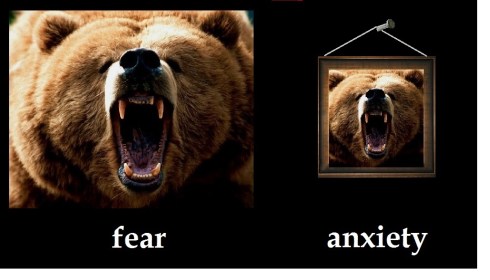
Yes, fear and anxiety feel like the same thing. But one is a reaction to a real danger, and the other is a reaction to danger you imagine.
Say you walk into the woods and a bear rushes out at you. What you feel is fear, because this is a real bear who can really make a meal of you. But say you walk into the woods and see crowds of dark trees and think There could be bears here. This is anxiety.
It’s an important distinction. Because these two reactions reflect different problems which are solved in different ways.
Fear signals a problem out there in the environment, to which the correct response is some version of fight or flight — shoot the bear, or run away from it.
But you can’t shoot imaginary bears, and they’re hard to run away from.
Instead you solve an anxiety problem by examining the reaction itself.
“So now that you think about it,” I say to Alice, “why does Joe’s anger terrify you?”
“It must remind me of dad.”
“Right. And there wasn’t much you could do back then, was there? Couldn’t yell back, hit back, run away?”
“No.”
“And now?”
“Now is different,” she says. “I’m not helpless now.”
“Right. Have you ever yelled back at Joe?”
“Once,” she nods.
“What happened?”
“He stopped yelling.”
“And what happened to your anxiety?”
“It went away,” she smiles.
“Because?”
She smiles.
“I scared off the imaginary bear.”
Grades are bullshit
 Yesterday I came across a poster on FaceBook.
Your child’s mental health is more
important than their grades,
it said.
I love that poster.
Sounds like common sense, no?
Yet the number of parents who don’t believe it is truly frightening.
I meet such parents all the time. Especially in spring, as the school year grinds towards its exhausting conclusion, and they come to me panicked because Janey or Johnny are at risk of failing something.
And I tell them,
Relax.
Grades are mostly bullshit.
They don’t measure real knowledge or intelligence or understanding or creativity or anything people really need to be successful.
They don’t measure honesty or courage or kindness or compassion or self-awareness or whether a kid knows the difference between right and wrong or what’s important and what’s not.
More often they measure memory (short-term at that), obedience, conformity, fear of failure, need for approval, or the results of parental coercion.
Thus academic success is not the predictor of success in adult life everyone pretends it is. Einstein, Edison, Newton, Churchill and Steven Speilberg were all lousy students.
So try not to stress over Janey’s D in Social Studies or Johnny’s F in Math.
Don’t get angry, and don’t get scared.
Give your kid a hug. Make them feel loved and accepted just as they are, and that you have faith that they will grow just as they need to.
That’s what they need from you.
Not lectures. Not warnings. Not dire predictions.
They’ll get plenty of those elsewhere.
From you they need a sense of how unique and valuable they are.
And that school is just school.
And that grades are mostly bullshit.
Steve & Bert

COMING SOON: An expanded 2nd edition

CLICK HERE TO ORDER MONKEYTRAPS (THE BOOK)

Follow the conversation:
-
-

-
-
BERT’S IN THERAPY. To listen in, click on his nose.


