Category Archives: control
 .
.
In 1983 Janet Woititz offered a list of thirteen traits typical of adult children.*
Her description came to be known in recovery circles as The Laundry List.
If you’re trying to decide whether you possess such traits, it’s still a good place to start.
Below is a revised version.
If you’re an adult child,
1. You guess at what normal is, then try to imitate it.
2. You have trouble following projects through from beginning to end.
3. You lie when it would be just as easy to tell the truth.
4. You judge yourself without mercy.
5. You have trouble relaxing or having fun.
6. You take yourself very seriously.
7. You struggle with intimate relationships.
8. You over-react to changes beyond your control.
9. You constantly seek approval and affirmation.
10. You feel different from other people.
11. You’re either super responsible or super irresponsible.
12. You’re extremely loyal, even in the face of evidence that your loyalty is undeserved.
13. You’re impulsive — i.e., tend to lock yourself into a course of action without thinking through alternatives or consequences. This creates confusion, self-loathing and loss of control over your environment. You also spend large amounts of time and energy cleaning up the mess.
Part 8 of a series on monkeytraps and adult children.
Read part 1 here.
________________________
3 Comments | posted in control
The first time I heard the term adult child it made no sense to me.
It seemed an obvious contradiction in terms, like jumbo shrimp or compassionate conservative.
Twenty-five years of practicing therapy taught me to see it differently.
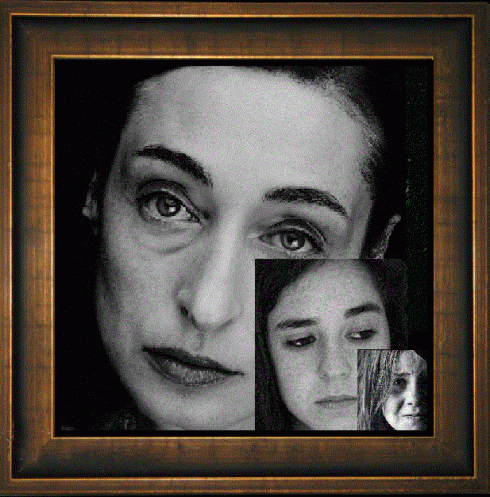
Now I understand that adult children are people who look like grownups on the outside but inside feel like kids.
That the Kids inside are collections of unmet needs, unexpressed feelings, unresolved conflicts and other unhealed emotional wounds.
That this part gets triggered by stress, and suddenly the adult feels exactly like the scared inadequate helpless kid he or she used to be.
Adult child was a term invented in the 1970s to describe the problems of people who grew up in alcoholic homes.
But since then it’s become obvious that a person needn’t have grown up with an alcoholic parent to carry the symptoms of an adult child.
Such symptoms can be caused by abuse, or neglect, or illness, or some other loss or trauma.
But they can also be caused by being forced to grow up too fast (Big boys don’t cry), or hide feelings (Don’t cry or I’ll give you something to cry about), or cave under peer pressure (Try it, don’t be a baby), or falsify who you are in some other way.
This is called socialization, and it happens to all of us.
“To be nobody but yourself in a world which is doing its best, night and day, to make you everybody else, means to fight the hardest battle which any human being can fight; and never stop fighting,” wrote the poet e.e. cummings.
I suspect cummings would have agreed with Malraux that there is no such thing as an entirely grown-up human being.
That each of us carries inside us a damaged inner Kid.
That we spend our lives trying to heal that Kid’s wounds.
And that, as a result, we are all adult children.
Part 7 of a series on monkeytraps and adult children.
Read part 1 here.
7 Comments | posted in control
 x
x
So if you grow up holey, you have what therapists call unfinished business.
Of which unmet emotional needs are just one sort.
Others include
Unexpressed feelings. We love to believe that the pain, fear, anger and grief we experience in childhood go away when we grow up. Yeah, no. They go into storage, lie waiting to be triggered, and resurface (usually in inconvenient ways) during moments of stress.
Unresolved conflicts. Didn’t get along with dad? You may feel unsafe around male authority figures. Butted heads with mom? Older women may make you uneasy or irritated. Bullied or betrayed by siblings or extended family or friends? You may find it difficult to really trust adult partners or coworkers. Again, we want to believe we’ve put all that behind us. Then we’re surprised to find someone who makes us feel exactly like we did around Aunt Sally.
Unanswered questions. Are feelings safe or dangerous? Is it safe to be honest? Can I really get my needs met in relationships? Did my parents really love me? Am I lovable? Am I adequate? Hell, who am I anyway? What do I really want?
Ungreived losses. Maybe someone died, or moved away, or you had to move yourself and leave friends behind. Maybe you were sick or injured or had a learning disability or were abused. Maybe you struggled in school and came out feeling stupid or inadequate. Maybe bad things happened to your family and you lost your sense of security or safety or normalcy early on. And maybe you believed, for whatever reason, that it wasn’t okay to talk about any of these things, or express your feelings without getting judged or shamed for them.
Unrelieved guilt. Two sources for this. One is the common run of mistakes, failures, stupidities and humiliations that all flesh is heir to. (I may never get over getting myself kicked off the soccer team by talking back to the coach.) The other source is internalized feelings. If you carry anger at a parent, for example, that anger is nearly impossible to discharge safely while you’re still a kid. (Don’t take that tone with me, young lady.) So you bury it, carry it around inside, and it comes to feel — surprise — like guilt. You feel like a bad son or daughter (Look at all they’ve done for me) when in fact you’re just angrily constipated.
Unhealed trauma. Traumas don’t always come in obvious packages. Besides experiences we all recognize as traumatic — loss of a loved ones, car accidents, serious illness, or abuse — there are common occurrences that shock our systems so badly we are affected in long-lasting ways. These range from natural disasters to dental procedures, physical injuries to public humiliation, academic failure to being the victim of bias, hospitalization to being painfully teased.
Think of all these sorts of unfinished business as unhealed emotional wounds.
Such wounds usually lie at the root of the symptoms that bring most people into therapy: anxiety, depression, addiction, communication problems and unhappy relationships.
I call them the Big Five.
Everybody I know has at least one of them.
Put another way:
Everyone has unfinished business.
Unfinished business is the inevitable price of having once been a child.
Part 6 of a series on monkeytraps and adult children.
Read part 1 here.
4 Comments | posted in control
x
Inner abuse creates perpetual pain because it leaves us holey.
Holey means riddled with emotional holes.
The holes are unmet needs.
How does this happen?
First, notice how it’s supposed to go:
We’re supposed grow up in a family healthy and nurturing enough to meet our basic emotional needs.
Those needs are the Four A’s: attention, acceptance, approval and affection.
The 4 A’s are the components of love.
If we get enough of these components, we fill up in childhood, just like kids fill up with good food.
And we enter adulthood feeling like reasonably solid people, reasonably valuable and lovable and (this is critical) able to love ourselves.
Which means able to feed ourselves the same emotional food — attention, acceptance, approval and affection — we got from our family.
On the other hand:
If we grow up in a dysfunctional family — one burdened by abuse, addiction, mental illness, overstressed parents, or parents who dislike each other or their children — several things happen:
~ We grow up hungry, with unmet emotional needs that appear as holes in our confidence and self-esteem.
~ We grow up ashamed, having concluded that we’re unworthy of emotional feeding. If my family didn’t love me, our Inner Kid reasons, I must not be worth loving. (That’s how inner Kids think. Like real kids, they think everything is about them.)
~ This shame makes us bury our true self — our Kid — out of fear that others will also find it unlovable.
~ We bury the Kid by keeping it in the closet, so others remain won’t see how needy we are. (Emotional neediness, the Kid believes, is a sin.)
~ And we bury the Kid by being mean to it, sending it abusive messages (Your feelings don’t matter, etc.) that perpetuate both its neediness and its shame.
~ Finally, we don’t give the Kid what it needs most: our own attention, acceptance, approval and love.
The result of all this is a lifetime of holeyness and emotional pain.
Part 5 of a series on monkeytraps and adult children.
Read part 1 here.
4 Comments | posted in control

Child photo: Anthony Kelly
Why is that?
Because it’s abusive.
Abusing the Kid inside has the same effect abuse has on a real kid.
Stop a moment. Think of a child you know personally. Imagine that child’s face, and voice, and how it moves, and the emotional energy it emits.
How would that real kid react to being locked in a real closet?
How would it affect him/her to being ignored day after day? Or being told over and over Shut up, or Go away, or You’re being silly, or I don’t care what you want, or Your feelings don’t matter?
How would you feel if you heard an adult saying those things to a real child?
Inner child abuse teaches part of you — arguably, an indispensible part — to feel unvalued, unheard, unloved and unloveable.
It is a source of perpetual pain.
And if part of you is in perpetual pain, how can the rest of you feel much better?
Part 4 of a series on monkeytraps and adult children.
Read part 1 here.
Leave a comment | posted in control
x
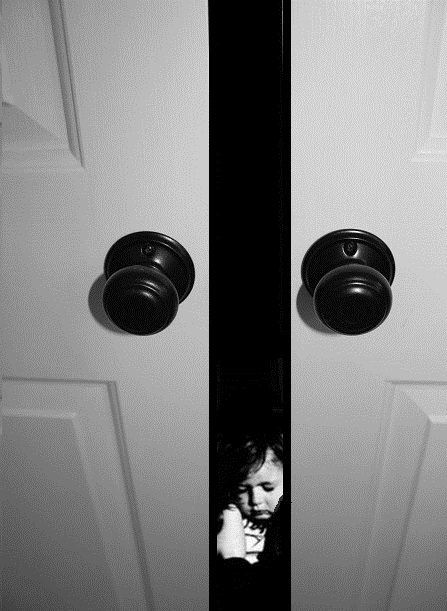
I once bought a battered old paperback copy of Andre Malraux’s Anti-Memoirs because of a single sentence I found on its first page.
There is no such thing as a grown-up person,
it read.
That struck me as a great truth.
Forty years later, it still does.
Every client I meet in my therapy practice confirms it.
Yet it’s one of those obvious truths — like the inevitability of aging or death — that everyone tries to ignore.
We all want to forget the Kid we carry inside us.
Partly this is because we need and want the world to see us as fully grown-up.
And partly it’s because of what I call the worst curse — the sense that we can can never escape the pains and anxieties of childhood.
So we hide our Kid, even from ourselves.
We keep our Kid in the closet.
We lock the door.
And we yell at our Kid should it try to escape.
Unfortunately this only perpetuates the curse.
Part 3 of a series on monkeytraps and adult children.
Read part 1 here.
6 Comments | posted in control
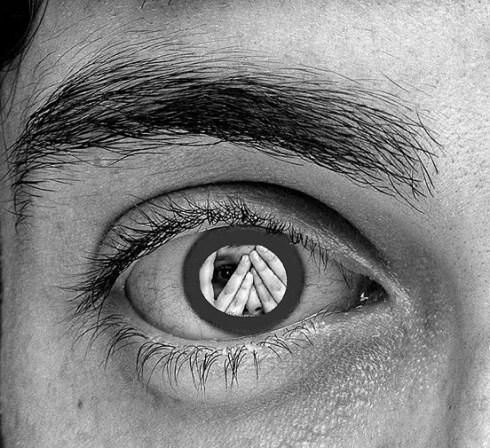 Of all the curses we carry from childhood into adulthood, one is especially destructive.
That is the curse of feeling like a kid inside.
I’m not referring here to childish joys, to spontaneity or play or freedom or imagination or exuberance or silliness.
I’m talking about feeling surrounded by giants.
Feeling vulnerable, like the nearest giant could easily squash you.
Fragile, like one dirty look from a giant can make your heart crumble.
Powerless, unable to protect yourself or choose what you want.
And on the edge of terrified, like your survival depends on the kindness and protection of big people.
We all remember those feelings.
Many of us still carry them now.
Maybe not always. But certainly more often than we’d like.
Like at moments of uncertainty or challenge or stress, when — no matter how old or big or accomplished we are — inside we feel just like little children.
We’re embarrassed by these feelings.
What’s the matter with you? we scold ourselves. Grow the hell up.
We do this instead of telling others how we secretly feel.
Which is a real shame.
Because if we did we might discover just how many of the grownups around us also suffer from the worst curse.
Part 2 of a series on monkeytraps and adult children.
Read part 1 here.
Read part 1 here.
4 Comments | posted in control

I don’t believe in magical curses.
I do believe in psychological ones.
As they appear in therapy, psychological curses are false beliefs absorbed in childhood by a kid too innocent to know better.
You’re stupid, his father tells him over and over. So he believes it. He may be bright as Einstein. No matter. He’ll start to feel, think and behave like a stupid person. Because that’s what dad told him he is.
The world is unsafe. People are not to be trusted. Relationships will disappoint you. I run into such curses every day.
You’re not enough. You won’t succeed. You’re unlovable. These are among the most poisonous curses of all.
How to lift such a curse?
Insight usually isn’t enough. That’s because insights (Ah, I see how I came to believe that) usually come to the Adult part of the personality.
And it’s the Child part that’s cursed.
What the Child requires is a corrective emotional experience.
The kid who feels unsafe needs safe relationships. The kid who feels unlovable needs to feel loved.
Without such experiences, curses can last lifetimes.
24 Comments | posted in control
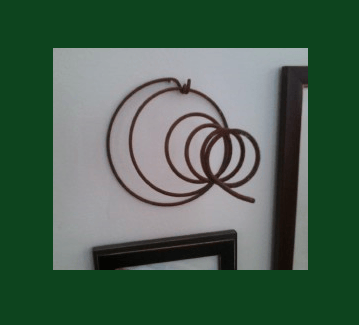
She’s a new client, looking around my office.
“I like your pictures,” she says. “But what’s that?”
She points to the rusty bedspring on my wall.
“A metaphor,” I say.
“For what?”
“Recovery. It’s the recovery spiral.”
“I don’t understand.”
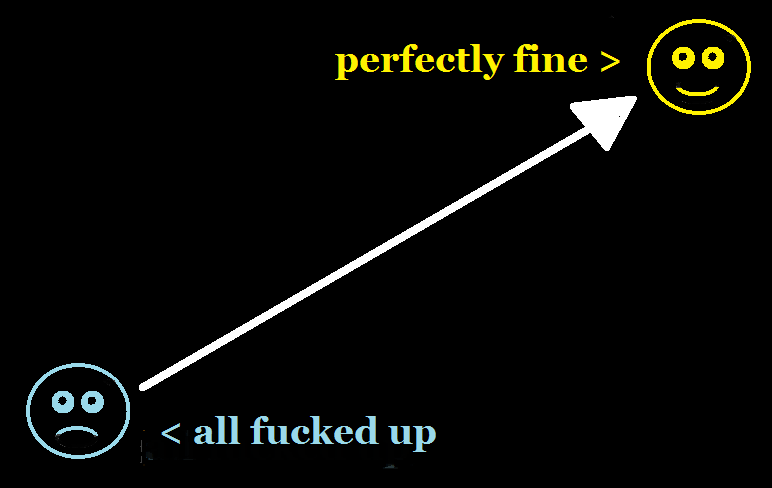
“Most people think of recovery as a linear process. They think you start off down here, at All fucked up, and 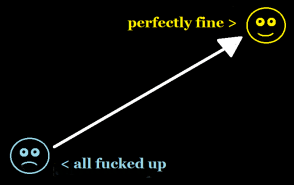 climb straight up to there, Perfectly fine.
“They think there’s a straight line between those two points, and that any deviation from that line – relapses, setbacks, mistakes — means some kind of failure.”
“Doesn’t it?”
I shake my head. “Not if you see recovery as a spiral.”
“Emotional growth means moving in a circle. The points of the circle are the issues or problems we’re working on — parents, money, work, sex, feelings, communication, control, whatever. And you go around and around the same circle, facing the same issues over and over.
“But each time you go around you’re a bit higher on the spiral. Meaning you know a bit more than the last time around. And you’re a little bit stronger. And you have more resources, both inside you and outside.
“And that’s recovery.
“If you’re lucky, there’s no end to it until you die. There’s no There there, no Perfectly fine end point. Just learning and growing as long as you live.
“So when someone comes to me all discouraged and says Oh god, I fucked up or I’m so embarrassed that I’m still struggling with this I show them the spiral and explain what it means.
“And then I ask, ‘What do you know now that you didn’t know last time you were here?’
“And they can usually find something. And then they can think of their relapse as a lesson, not a failure.”
She frowns, looking at my wall.
“Where can I get a rusty bedspring?”
2 Comments | posted in control, metaphor for
The John E. Trahan Memorial Fund
John E. Trahan (33) was a loving and devoted father, husband, son, brother, brother-in-law, nephew, cousin, friend and coworker, and all he has left behind in this world are both devastated and heartbroken.
Almost 20 years ago, at the age of 14, John was struck by a car while out riding his bike in Rocky Point, NY, where he lived most of his life. This accident left him without a spleen and with a weakened immune system. When John suddenly became ill with an infection this December, no one could imagine how quickly things would progress, and that his life would be taken away in just a few days. John passed peacefully, surrounded by his loved ones, on December 14, 2017.
John leaves behind a beautiful, young family. His wife Trish and he were busy building a wonderful life together with their four children Declan (4), Mason and Hadley (2), and Harper (5 months). The sole provider for them all, John worked steadfast as an ambitious, well-respected CPA.
The outpouring of love and support for John’s family during this time of grief and mourning has been overwhelming, and they are all so thankful and comforted in the knowing that John touched so many lives with his kindness and good heart.
This fundraising effort has been started in hopes that it can help John’s wife Trish and their four children in the difficult months and years that lay ahead without him; that it can help to alleviate some of the stress of financial burdens and let Trish focus on continuing to raising their children as planned.
To donate, click here.
Leave a comment | posted in control
1.
I feel inadequate.
2.
This is an uncomfortable feeling, so I try to change myself.
3.
When I try to change myself, another part of me rises up to resist the change.
4.
The parts that resists change is usually stronger than the part that wants it.
5.
Being unable to change feels like failure.
6.
I feel inadequate.
~ From Monkeytraps in Everyday Life:
A Guide for Control Addicts (in press).
1 Comment | posted in control
 x
x
Besides weekly therapy, she paints, plays piano, is active in the peace movement, attends a support group and wonders why she’s still depressed and anxious.
I tell her it’s because she goes home every night to a loveless marriage to a alcoholic husband.
Another woman comes to individual sessions every Monday and group every Wednesday and can’t understand why her self-esteem and her confidence aren’t improving.
I tell her it’s because she spends every Tuesday and Thursday with her narcissistic parents who abuse her emotionally and drain her psychologically.
A man who divorced his wife eighteen months ago sits on my sofa and rages endlessly at his ex for her selfishness and for not loving him adequately.
I tell him he may be divorced legally, but emotionally he’s as married as ever.
All three live in prisons of their own creation.
Because hanging onto an invalidating or abusive or toxic relationship while telling yourself you’re “handling it” is an exercise in denial.
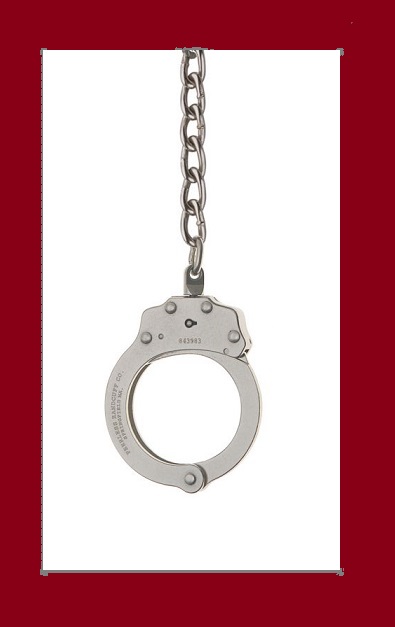
It’s like handcuffing yourself to the bumper of a truck, then telling yourself you’re actually free because only one hand is handcuffed.
One handcuff is enough to keep you trapped.
Forever.
More than enough.
Leave a comment | posted in control
1.
I’m scared of X.
2.
Because I’m scared of X, I avoid it.
*
3.
Because I avoid X, I never discover what X is really like.
*
4.
I’m scared of x.
~ From Monkeytraps in Everyday Life:
A Guide for Control Addicts (in press).
Leave a comment | posted in control
1.
I’m scared all the time.
2.
I’m ashamed of being scared all the time.
3.
Because I’m ashamed I hide my anxiety.
4.
When I hide my anxiety it grows.
5.
When I hide my anxiety nobody knows I need reassurance, so nobody reassures me.
6.
I’m scared all the time.
~ From Monkeytraps in Everyday Life:
A Guide for Control Addicts (in press).
2 Comments | posted in control