Category Archives: control
1. I have been hurt, which makes me feel angry.
2. My situation allows me no safe way to express angry feelings.
3. In self-defense, I internalize my anger — turn it against myself.
4. Anger turned against the self feels just like guilt.
5. I have been hurt, which makes me feel guilty.
![~~~MT IN EVERYDAY LIFE [#2, row] -- for posts](https://monkeytraps.com/wp-content/uploads/2016/02/mt-in-everyday-life-2-row-for-posts.png?w=300&h=414)
Leave a comment | posted in control
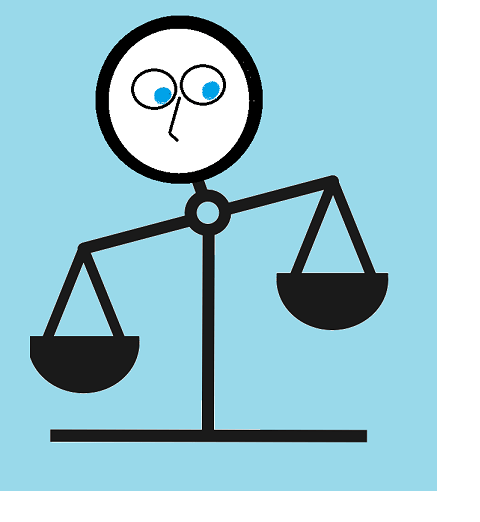 Again, there are three paradoxes of control.
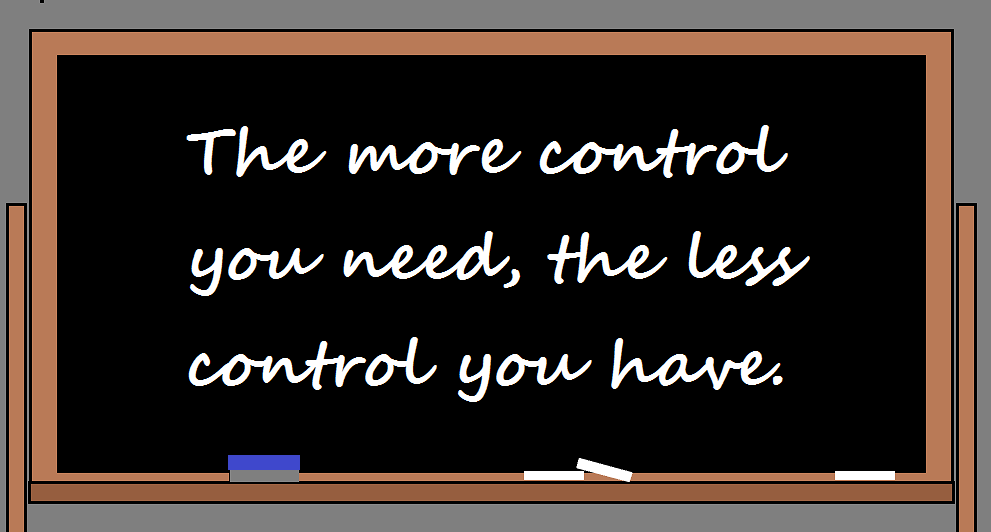
The First Paradox (“The more control you need, the less you have”) is intrapsychic or internal.
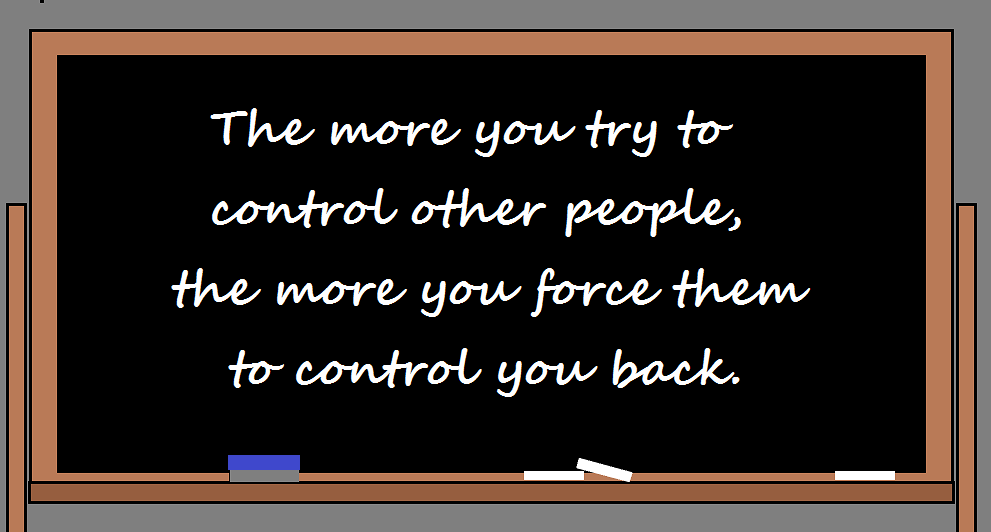
The Second Paradox (“The more I control you, the more I force you to control me back”) is interpersonal.
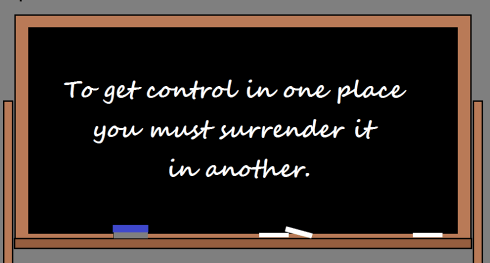
And I guess you’d call the Third Paradox existential, since it seems to apply to existence in general, to reality both inside and outside our heads:
.
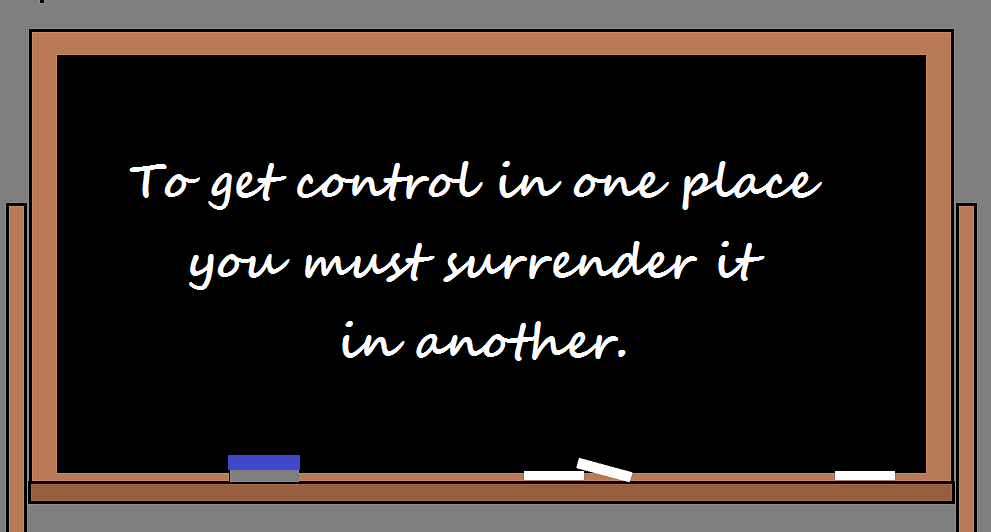
Controlling boils down to a tradeoff: gain control here, lose control there.
Think of the original monkey trap:
To hold on to the banana, the monkey surrenders his freedom. To regain his freedom, he must let the banana go.
It also explains all garden-variety codependent interactions:
To control you (make you like, love or accept me) I must surrender control of something else — like my ability to be honest, or spontaneous, or emotionally expressive.
Conversely,
Taking control of my emotional life — especially how I feel about myself — means surrendering control over how you react to me.
It also applies to New Year’s resolutions, not to mention all goal-setting:
To reach a particular goal (like writing my book) I must surrender control of others (like spending time with my family, or on chores that absorb my energy and attention).
To gain control of my weight I must surrender control (i.e., limit my choices) of what I put in my mouth.
To control my social anxiety I must detach from how other people see me and practice being myself.
And so on.
So control and surrender are two sides of the same coin.
And getting control of anything means losing control of something else.
To win A, you must sacrifice B.
Tradeoff.
Balance.
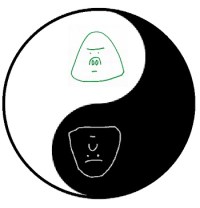
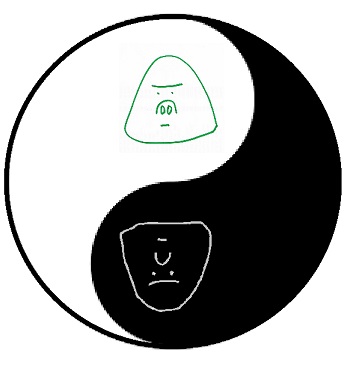
Yin-yang.
Fill your bowel to the brim
and it will spill.
Keep sharpening your knife
and it will blunt.
Chase after money and security
and your heart will never unclench.
Care about people’s approval
and you will be their prisoner.
1 Comment | posted in control
 As I was saying, control addiction behaves paradoxically.
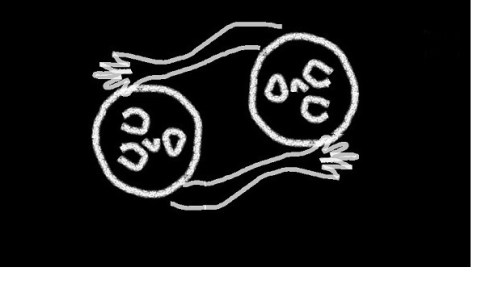
The Second Paradox is:
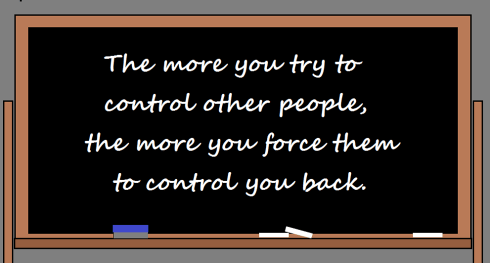
.
This is an interpersonal version of the First Paradox (“The more control you need, the less control you have”).
And what does it look like in action?
Consider:
Heather wants to marry Ian, who’s scared of commitment. So she pressures him to propose. This scares him, so he backs away. This scares her, so she steps up the pressure (“Why won’t you marry me?”). Which makes him back away further and faster. And so on.
*
“He never talks to me,” Janet complains about Kenny, who grew up in a family where no one talked about anything. The more she begs him to talk, the more anxious and inadequate Kenny feels. The more anxious and inadequate he feels, the more silent he becomes. Which angers Janet, which makes her beg harder. And so on.
*
Liz, a people pleaser, gets anxious when Mark is unhappy. So she knocks herself out putting his feelings, needs and preferences ahead of her own. Mark – who enjoys this – finds he can keep Liz motivated by remaining unhappy. The unhappier he becomes, the harder she tries. The harder she tries, the unhappier he becomes. And so on.
*
Nancy: “If you didn’t drink, I wouldn’t nag you.” Oscar: “If you didn’t nag me, I wouldn’t drink.” Rinse and repeat.
*
Patty and Ron both grew up in families that didn’t acknowledge or respect feelings. Hungry for emotional validation, they now seek it from each other. Unfortunately each takes the position, “I’ll validate you after you validate me.” Since neither validates first, no one gets validated. Ever. So their childhood deprivation continues. Indefinitely.
See the pattern?
This paradox grows out of two facts of human nature: Everyone wants control, and no one wants to be controlled by others.
That’s what is being played out above. Each of these ten partners tries desperately (if unconsciously) to transform the other into the partner they want. And each resists transformation as hard as they can.
Even people who seem to comply with their partner’s (or parent’s) demands are doing it out of a need to control the other’s behavior.
This creates not love, not intimacy, not healthy connection, but monkeyship — relationship bent out of shape by control issues.
Some of this goes on in all our relationships. At some point we all turn monkeyish. We all try to make our partner into the person we want them to be.
It has little to do with how much we love that partner.
It has everything to do with how much control we think we need to feel safe.
And it continues until we learn alternatives to monkeyish behavior.
2 Comments | posted in control
x
paradox: a seemingly true statement or group of statements that lead to a contradiction or a situation which seems to defy logic or intuition. ~ Wikipedia
.
 In my book Monkeytraps — which argues that to be a human being is to be addicted to control — I describe how this addiction is hard to escape because it behaves paradoxically.
I.e., not at all as you’d expect.
And I explain three paradoxes that confuse the hell out of people and keep them addicted.
Here’s the First Paradox of control:
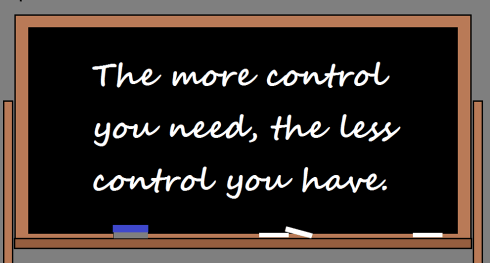
Needing control has a sort of boomerang effect. The harder you try to get more of it, the more you end up feeling controlled.
You feel controlled by, surprise, your need for control.
And this happens with weird regularity.
Still, it’s easy to overlook this phenomenon unless you’re looking for it. So I thought some stories might help to illustrate.
The actors in each of these (except the last) are heavily disguised, but all the events are based in fact.
Annie’s depressed because she’s overweight. So she eats cookies to make the depression go away. Which makes her more overweight. Which makes her more depressed. Which makes her eat more cookies. The more control you need, the less you have.
*
Barry’s wife drinks. This panics Barry, so he does everything he can think of to stop her. He reasons, begs, nags, yells, makes nasty comments, threatens divorce, hides her wine, pours it down the toilet. Stressed by Barry’s behavior, his wife drinks more. The more control you need, the less you have.
*
Carol’s daughter fails Math and lies about it. This enrages Carol, who can’t stand to be lied to. So she confiscates her daughter’s cell phone and warns her of worse punishments if she lies again. This scares her daughter, who starts keeping more secrets and lying about more stuff. Which leads to more punishments. Which lead to more fear and more lies. The more control you need, the less you have.
*
Dennis is an anxious man whose last wife cheated on him. Now he worries his new wife might do the same. So he carefully monitors her comings and goings, and makes sure he knows where she is and who she’s with. Then listens in on her phone calls. Then intercepts and examines her cell phone records. Then starts following her on errands. As a result of all this his anxiety soars to panic-attack levels, and his wife finds a boyfriend with whom she can relax. The more control you need, the less you have.
*
Eve’s boyfriend is abusive. He doesn’t hit her, but yells and criticizes and threatens her constantly. Friends beg Eve to dump him, but she’s scared that will make him angrier. So she does her best to pacify and appease him. Since the boyfriend likes this result, he continues to yell, criticize and threaten. Then one day he hits her. The more control you need, the less you have.
*
Fred and Ginger are married. It’s the second marriage for each, and each brings to it a history of disappointed relationships. Both want the marriage to work and are scared that it won’t, which makes them hypersensitive to any and all relationship problems. They monitor each other closely for signs of dissatisfaction or anger. They repeatedly seek reassurance that their partner still loves them. They discuss their problems constantly. All this leaves them chronically uneasy in each other’s presence. The distance between them grows, which increases their uneasiness. They begin to bicker, then to fight. When they finally come to me for couples counseling the marriage is, in Fred’s words, “Circling the drain.” The more control you need, the less you have.
*
Steve’s dog runs away from home. Steve chases him across front lawns and through backyards, up and down streets. Panting and bracing himself for his first heart attack, Steve suddenly remembers the First Paradox. He stops running. He sits down in the street. The dog glances back at him over his shoulder. Steve flops over sideways. Closes his eyes. Waits. Hears nails clicking on pavement. Feels a long tongue flick his nose. Reaches out and grabs the dog’s collar. The more control…
Oh, you know.

4 Comments | posted in control
 (This is an updated version of a post I originally published in 2011. It continues to get the most weekly hits of anything on Monkeytraps, and the problem it describes continues to emerge in sessions. Hence this reposting.)
Three times last week I gave my speech on Men Who Can’t Love Women.
Twice I gave it to wives of men avoiding therapy.
Once I was talking to a man who’s a husband himself.
The speech I created spontaneously about six months ago, to address a relationship problem that kept cropping up in sessions.
It goes something like this.
I see this more and more lately:
Men who can’t love women.
No, they’re not gay, impotent, or anything like that.
They’re not even men who don’t want to love women.
Or don’t try to.
Usually they’re men who believe that they can and do love the women they’re with.
The women they’re with, sadly, tend to see it differently.
Because those women know there’s a fundamental truth about healthy relationships that these men simply don’t grasp:
Giving is getting.
These guys don’t get that. They don’t see relationship as collaboration, where what’s good for you is good for me. Instead they seem to see it as some sort of competition.
They tend to act, often without realizing it, as if relationship were a zero-sum game, where there’s only so much good stuff to go around, and where a gain for one means a loss for the other.
It’s as if on some deep level they believe, “When you win, I lose.”
I hope (your husband, boyfriend, lover) isn’t one of these.
Because — due respect to the members of my gender – these guys can be damned hard to retrain.
The idea of giving-as-getting is something most women know in their bones. That’s probably because they’re socialized to value relationships in a way men aren’t.
We train men to compete, not to partner.
Worse, we also train them to work, not to feel. Which leads to another missing piece in their relationships, something else that many men don’t get.
It’s the idea that love isn’t just an emotion — it’s behavior.
Most of my male clients struggle with relationships with women. And at some point I usually ask them, “Do you love her?”
They almost always say, “Yes.”
And then I ask, “How do you show it?’
And they stare at me as if I’ve just lapsed into a foreign language.
Some don’t understand the question. “What do you mean,” one asked blankly, “by show it?”
Some shrug. The shrug usually translates as, Hey, I know how I feel. I assume she knows too. Don’t women just know this stuff?
Others argue that they already communicate their love adequately. I go to work, pay bills, mow the lawn, drive Jimmy to soccer practice, put up with her mother, even wash dishes occasionally. Isn’t that enough? Shouldn’t it be?
If I suggest otherwise, some get angry at me.
My work with these men usually heads in one of two directions.
Some men — usually those who’ve come close to losing the woman in their lives and come into therapy genuinely frightened — are able to face their limitations. We then have a series of conversations about the nuts and bolts of loving behavior (ways of communicating acceptance, attention and affection), which they work to internalize and practice. These are the lucky ones.
Others stand pat. Hey, this is me. She can take it or leave it. Interestingly, it’s not that they’re less frightened than the first group. They’re just more scared of changing than anything else. Some stand pat all the way to divorce court.
Some stand pat through multiple marriages and divorces.
My heart goes out to these men. They’re not bad guys. They’re not trying to hurt anyone. They’re just undereducated and overdefended. (Also emotionally wounded in four specific ways, described here).
But the hurt happens anyway, and it can be devastating to all concerned.
So, some questions to chew on:
Have you ever known a man who can’t love women?
Have you ever been in a relationship with one?
Are you such a man yourself?
Are you sure?
Leave a comment | posted in control
 If you love an addict, or live with one, or depend on one in some way, you are probably in, as the old saying goes, nine kinds of pain.
And I’m guessing that, whether or not you realize it, the very worst of these pains comes from being confused about the difference between power and control.
No, they’re not the same.
In some ways they are opposites.
One difference: power is possible, but control is usually an illusion.
Another: seeking power can set you free, while seeking control can make you crazy.
Let me explain.
Control, as I define it, means the ability to dictate reality. To make reality what we want it to be. To get life itself — people, places and things — to meet our expectations.
Power, on the other hand, means being able to get your needs met. To take care of yourself. To not just survive, but to heal, and grow, and be happy.
Here’s an example of the difference:
Imagine your rich uncle dies and leaves you control of his multinational corporation. So you wake up one morning the CEO of Big Bux, Inc. You go to your new job. You sit behind a huge desk. Four secretaries line up to do your bidding. You have tons of control. You can hire and fire people, buy things and sell things, build plants or close them, approve product lines and advertising campaigns, manage investments, bribe congressmen, you name it.
How do you feel?
If you’re anything like me, you feel crippled by anxiety. Bewildered and overwhelmed by your new responsibilities. Disoriented. Panicked.
Anything but in control.
Interesting, no?
There are two other interesting differences between control and power.
~ Control looks outward, mainly at other people, places and things. Power looks inward, to your own feelings and needs. So control-seeking pulls you away from yourself, away from self-awareness and self-care.
~ Control operates paradoxically. The paradox goes like this: The more control you need, the less in control you feel. Which means if you depend on getting control to feel safe and happy, you don’t feel safe or happy most of the time. Chasing control is a lot like chasing a train you can never catch. Power, though — rooted in healthy, intelligent self-care — is a real possibility.
Want to become more powerful? Here are seven ways to do it:
(1) Detach.
Let go of what you can’t control anyway. That may be a situation, or a person, or that person’s behavior. If it’s a person you love, you can detach with love, as they say in Al-Anon. Detaching doesn’t mean you stop caring. It just means you acknowledge your limitations. And when you do that, an enormous relief often follows.
(2) Refocus.
Start by shifting your focus from outside — people, places and things — to inside — your own needs, thoughts and feelings. Happiness is an inside job, and most of the answers you need are there.
(3) Take care of yourself.
Stop overcontrolling yourself, and learn to listen to your body instead. Hungry? Eat. Tired? Sit. Rest. Maybe take a nap. (Naps are great.) Lonely? Seek out safe people. (More on this below.) Angry? Scream (into a pillow, maybe, so you don’t scare the neighbors). Sad? Let yourself cry. It’s how the body naturally relieves tension, and it helps.
(4) Educate yourself.
You’re not crazy; your pain means something. Your job is to find out what it’s trying to tell you. Education can take many forms, from Googling alcoholic family or codependency to reading self-help books (start with Janet Woititz’s Adult Children of Alcoholics or Melody Beattie’s Codependent No More), or listening to tapes (try the library), or talking to a friend, or attending a self-help meeting, or finding yourself a good therapist. After his first Al-Anon meeting one of my clients told me, “It was like a light coming on in a dark room, and suddenly I could see all the furniture I’ve been tripping over.” Hey, why live in the dark if you don’t have to?
(5) Get support.
No one gets through life alone. (Even if you could, why would you want to?) Seriously consider checking out a self-help program, like Al-Anon or Nar-Anon or CODA. You’re probably scared of that first meeting. That’s okay; everyone is. Go anyway. It won’t kill you, and you can’t know beforehand what you’ll hear. A good meeting can save your life and your sanity.
(6) Listen to feelings.
This is a big one. Living with an addict usually requires hiding your feelings, sometimes even from yourself. But feelings are essential. You need to get them back again. Hang out with people who are trying to reclaim their feelings, and who can keep you company while you’re trying to reclaim yours.
(7) Have faith.
Develop your spiritual life. No, you don’t need a church. You don’t even need to believe in God. You do need to believe in something bigger than you, something you trust even when you don’t understand it. Call it Nature. Call it The Force. Al-Anon calls it Higher Power, but you can call it what you like. I used to reject the idea of God, but I always believed in psychology. Then I heard Scott Peck suggest that it’s not unreasonable to replace the word God with the word unconscious. That permanently reframed the idea of God for me. I realized there was some intelligence inside I could listen for, and which would guide me if I let it. (I might doubt the existence of God, but who can doubt the existence of that voice? That part that Knows Better?) So that gave me something to trust. Hey, we all need some invisible support.
Leave a comment | posted in control
1. I am a child to whom bad things have happened.
2. These bad things made me feel helpless.
3. Since helplessness is scary, I look for another explanation.
4. I decide I somehow caused the bad things that happened.
5. Now I am a child who deserved the bad things that happened.
6. I grow into a guilty adult who deserves bad things.
Leave a comment | posted in control
 There is an inescapable conflict between self-control and self-expression which self-control invariably wins. That’s because we are social animals. We see connection to each other as essential, and self-control as essential to remaining connected. We believe we must hold ourselves in or risk rejection. True enough, far as it goes. It’s also why neurotic — split into two parts, public and private — is as healthy as any of us ever gets. It’s why we value expressive people like writers and artists and actors and reward the best of them disproportionately. It’s why we spend hours on social media, hoping to be seen and heard by someone. It’s why we cry in private and scream in our cars. It’s why we overwork and overworry and overcontrol and self-medicate with all manner of substances and other distractions. It’s why so many of us finally limp into a therapist’s office hoping to find a safe place to step out of our cages, if just for an hour. It’s why most people lead lives of existential loneliness and silent desperation. And it’s why, as adults, our first responsibility must be to teach kids how to identify and express what they feel. If we don’t understand this, or lack the skills or courage to teach this crucial human lesson, we inflict a wound that usually takes a lifetime to heal. If it ever does.
Leave a comment | posted in control
1. Because I can’t accept you as you are, I try to change you.
2. When I try to change you, you try to get me to stop.
3. So I try to change you, and you try to change me.
4. And nothing changes except we stop liking each other.
~ From the forthcoming Monkeytraps in Everyday Life: A Guide for Control Addicts.
2 Comments | posted in control
1. I see myself as somehow stuck or inadequate.
2. This judgment leads me to try to change myself.
3. The moment I try to change myself, another part of me rises up to resist the change.
4. The resisting part tends to be stronger than the part that wants change.
5. My attempt at change fails.
6. I resume seeing myself as stuck or inadequate.
~ From the forthcoming Monkeytraps in Everyday Life: A Guide for Control Addicts.
Leave a comment | posted in control
1. Life keeps hurting me.
2. Because I do not cause or deserve this pain, I feel victimized.
3. Because victims are helpless, I see myself as helpless.
4. Helplessness is painful.
5. Life keeps hurting me.
~ From the forthcoming Monkeytraps in Everyday Life: A Guide for Control Addicts.
1 Comment | posted in control
1. I’m scared all the time.
2. I’m ashamed of being scared all the time.
3. Because I’m ashamed, I hide the fact that I’m scared all the time.
4. When I hide my anxiety, it gets bigger.
5. When I hide my anxiety, my shame gets bigger too.
6. When I hide my anxiety, nobody reassures me, because nobody knows I need reassurance.
7. I’m scared all the time.
~ From the forthcoming Monkeytraps in Everyday Life: A Guide for Control Addicts.
Leave a comment | posted in control
1. Feelings scare me.
2. My fear leads me to hide my feelings, both from others and from myself.
3. Sensing my fear, others hide their feelings from me too.
4. So I never talk about feelings, ever, with anyone.
5. Feelings scare me.
~ From the forthcoming Monkeytraps in Everyday Life: A Guide for Control Addicts
5 Comments | posted in control
1. I have a problem I cannot solve.
2. This problem makes me feel scared, helpless and inadequate.
3. To defend against these feelings, I pretend I don’t have this problem.
4. I have a problem I cannot solve.
~ From the forthcoming Monkeytraps in Everyday Life: A Guide for Control Addicts.
1 Comment | posted in control


![~~~MT IN EVERYDAY LIFE [#2, row] -- for posts](https://monkeytraps.com/wp-content/uploads/2016/02/mt-in-everyday-life-2-row-for-posts.png?w=490)





