
Category Archives: control addiction
Not God
A codependent in recovery tells me that once, in utter frustration over how his life was going, he fired his Higher Power.
“Wow,” I reply. “I guess that makes you the Higher Power.” I reach over to shake his hand. “Been wanting to meet you.”
He laughs.
But there’s a serious truth buried here.
“The fundamental and first message of Alcoholics Anonymous to its members,” writes Ernest Kurtz, “is that they are not infinite, not absolute, not God. Every alcoholic’s problem has first been claiming God-like powers, especially that of control.”*
All addicts seek control to an unhealthy degree. That’s why the First Step urges them to confront their lack of control (“Admitted we were powerless…”). Can’t heal addiction otherwise.
So recovery starts with a surrender. And that’s no less true of control addicts — a.k.a. codependents — most of whom have spent years trying to control the uncontrollable.
It’s why I suggest everyone get into the habit, when stressed, of asking themselves three questions:
What am I trying to control here?
Have I had any success controlling this before?
And if not,
What can I do instead?
Many benefits flow from this sort of self-questioning.
And one is that, the more often you employ it, the clearer it becomes that you’re not God.
_________________________
*Not-God: A History of Alcoholics Anonymous by Ernest Kurtz (Hazelden Press, 1979).
Pickpocket
I became a therapist for the wrong reason.
Not to help people, but to get helped.
Not to give, but to take.
I didn’t like myself much, and thought if I solved people’s problems they’d be grateful and like or love me in return.
I was sort of an emotional pickpocket.
Bad reason, as I said, to become a shrink.
But not an unusual one.
For years I’ve met people in the helping professions — doctors, nurses, teachers, therapists, even lawyers and cops — who were similarly motivated.
It’s not necessarily fatal. The lucky ones discover it in time and take steps to get their emotional needs met in healthier ways.
If they can do that they can become true professionals — adults able to defer their own needs to the service of others.
The unlucky ones never discover the real motive behind their career choice. Or they do, and then can’t decide what to do about it.
And so keep picking pockets.
Taking while pretending to be giving.
Which can become the opposite of helping.
In the weeds
She has an elephantine memory.
She remembers everything, especially painful stuff.
She can describe every frustration, disappointment and betrayal that wounded her in the last twenty years.
She can (and does) recite conversations — especially hurtful ones — from a decade ago.
Listening to her I sometimes feel like we’re crawling together through an endless field of weeds.
The technical term for this is perseveration: the tendency of certain memories to persist even when they’ve stopped being relevant.
Bad habit, perseverating.
Because where you put your attention is what grows.
Keep your attention on painful memories, and you fill your life with pain.
Keep your attention on stuff you cannot change (like the past), and you fill your mind with helplessness.
Sometime you need to find a way to stand up and see beyond the weed field.
Impasse
I’m stuck.
Part of me says Yes, do it. Do it now.
Another part says No, I can’t. Or No, I’m scared.
Gestaltists call this stuckness impasse: the point at which you stop yourself from moving forward because you’re afraid you won’t survive the attempt.
Scared, for example, of ending the marriage. Quitting the job. Starting the business. Writing the book. Expressing the feeling. Telling the truth.
Such stuckness always involves old fears, triggered in some part of me that hasn’t grown up.
That part so clearly remembers being dependent, helpless and/or scared of punishment that it hasn’t discovered I’m grown up now, and in charge of my own life.
“We are continually projecting threatening fantasies onto the world,” Fritz Perls wrote, “and these fantasies prevent us from taking the reasonable risks which are part and parcel of growing and living.”
The surprising thing about an impasse?
It’s almost always imaginary. It doesn’t exist in reality.
Push back against the fear and it tends to vanish, like a nightmare does when you turn on the bedroom light.
Flavors
Controlling comes in many flavors: healthy and unhealthy, necessary and unnecessary, public and private, conscious and unconscious, choiceful and compulsive, functional and dysfunctional. It’s your job to decide which flavors you prefer.
.
* * *
From Bert’s Therapy, Session 2:
![[][] Bert's therapy [FRAMED, 50%]](https://bertstherapy.files.wordpress.com/2014/07/berts-therapy-framed-50.jpg?w=604) She says I have communication issues.
She says I have communication issues.
Read the rest here.
Labels
In times of crisis she calls herself names.
“I’m so stupid,” she’ll say. Or “I’m crazy.”
But when I offer her a diagnosis – suggest she has an anxiety disorder, say – she rejects it:
“I don’t like labels.”
Puzzling. What are stupid and crazy if not labels?
It reminds me of something many addicts say when I suggest medication:
“I don’t want to need a pill to make me feel good.”
I hear this regularly from people already dependent on pot, street drugs or alcohol.
How explain this inconsistency?
To some people, accepting a diagnosis or medication feels like a loss of control.
I sympathize. Nobody likes to feel defined or directed by somebody else.
But resisting diagnosis and treatment usually leaves such people feeling neither freer nor stronger.
Just crappier.
Not more in control, but more helpless.
Another reminder of what I call the First Paradox.
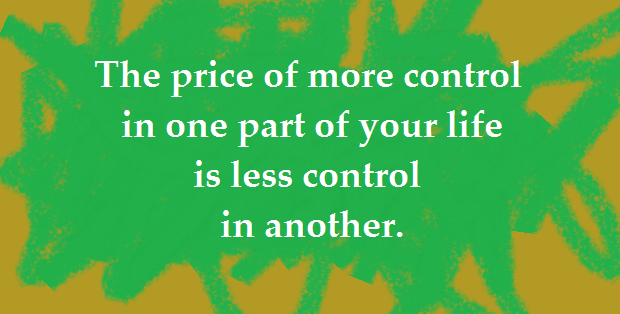
The greater your need to feel in control, the less in control you’re likely to feel.
Practicing intimacy: Intimate communication
Ninth in the series
Notes on recovery
Intimacy depends on the quality of communication.
And the first step to raising that quality is by not doing stuff we normally do.
Psychologist Thomas Gordon once famously identified twelve “roadblocks to communication” between parents and children. It’s a good list to memorize, since each item is essentially a controlling behavior able to destroy intimacy between anyone and anyone else:
1. Ordering or directing
2. Warning or threatening
3. Advising or suggesting
4. Arguing or persuading
5. Lecturing or moralizing
6. Criticizing, judging or blaming
7. Agreeing or praising*
8. Ridiculing or shaming
9. Analyzing or diagnosing
10. Reassuring or sympathizing*
11. Questioning or probing
12. Withdrawing, humoring or distracting
A client with whom I shared this list responded, “What’s left? Hand signals?”
I sympathize. We’re so used to these ways of unconsciously controlling each other that it’s hard to imagine doing without them.
But there are alternatives.
I-statements, for example. Ever notice how any sentence containing the word You tends to make the listener defensive? I-statements avoid this by focusing on me instead. I’m confused by what you’re saying, instead of You make no sense. I’m mad at you, instead of You suck. Like that. Which do you think leads to better communication?
Then there’s feedback, a skill I teach in therapy groups. Group requires a lot of emotional safety, so to forestall judgments or unsolicited advice members are asked to respond to what they hear by describing only what it made them think, feel or remember. (When you talk about your anger I remember all the times I lost my temper and how it felt.) These expanded I-statements not only make it safer for everyone to talk about sensitive issues, they help members get to know each other quickly, and to understand their own reactions and perceptions reactions on a deeper level.
Finally, monologuing is an exercise I teach couples who want to learn intimate communication. Each partner takes five minutes to list his/her resentments (I resent when you insult my mother) and appreciations (I appreciate when you make coffee so I don’t have to) while the other just listens. Then they switch roles. Monologuing’s not meant to settle disputes or solve problems; it’s used to keep the air clear, lines of communication open, and each partner in touch with where the other is emotionally. It also teaches them to make I-statements, identify feelings, listen without interrupting, and develop empathy. (I didn’t know you felt that way is a common reaction.) Couples who monologue regularly tell me it becomes a way they can talk safely about almost anything.
___________________
*Yes, items 7 and 10 tend to surprise people. See here for an explanation of why they inhibit parent/child communication.
Practicing responsibility
Seventh is the series
Notes on Recovery
.
I probably use the word responsible differently than you.
To me it means able to respond. “Respond” as is reply or answer.
I see responsible people as those who can answer a situation, challenge or problem in a healthy way – one that meets their needs, respects their feelings, acknowledges their preferences, promotes their growth, and leaves them more powerful.
I’m guessing responsibility means something else to you.
That may be because I’ve known so many clients who confuse it with following rules, meeting expectations and discharging obligations. These are people who regularly lose themselves. They sacrifice their needs, feelings, preferences and growth to other people, or jobs, or imposed codes of behavior, or impossible standards, or endless To Do lists. They do this less out of love or idealism than self-defense: they’re scared of what will happen if they don’t do it.
I call that irresponsible.
Truly responsible people, as I see it, as the ones who can (a) listen to themselves and (b) act in their own self-interest.
Listen to themselves mean focus inside, pay attention to feelings and the messages their bodies send telling them what their needs are.
Act in self-interest means respecting those emotional and bodily signals instead of ignoring or hiding them.
This sort of responsibility starts with simple stuff: eating when hungry, resting when tired, peeing when your bladder is full. It extends to venting when angry, crying when sad, reaching out to others when lonely or scared.
As I said, simple stuff. But if you suffer from control addiction I bet you don’t do any of it nearly enough.
So that’s what you need to practice in recovery. Call it responsibility, self-love, self-care, or (as I do) healthy selfishness.
“Selfish,” of course, is the dirtiest of words. Most people confuse it with behavior that harms or neglects others.
But who isn’t selfish? Preoccupation with ourselves is built into our nature and neurology. We can’t help that. Our only choice is to admit or deny it. To be honestly selfish, or hide our true motives behind a mask of selflessness.
Thus in the end practicing responsibility means being able, willing and brave enough to take care of yourself.
Because if you don’t, who’s going to?
Next: Practicing intimacy
Refocusing
Fourth in the series
Notes on Recovery
Our need to refocus comes from realizing the real reason we try to control stuff:
We’re trying to control how we feel.
We’re especially trying to manage anxiety.
Think about it. What scares you most? Criticism? Failure? Rejection? Abandonment? Humiliation? Physical pain or discomfort?
That’s what you feel most compelled to control.
Compulsive means anxiety-driven. Whenever I act like a control addict – for example,
~ hide my real self from other people,
~ hide my true feelings from myself,
~ try to impress, coerce or manipulate others,
~ insist things be done my way,
~ caretake friends or family members,
~ worry endlessly about the future, or
~ try to make my environment just as I want it to be
– I’m being driven by some anxiety about what will happen if I don’t do these things.
Recovery means finding another way to manage this anxiety.
Which is where refocusing comes in.
When I refocus, I shift my attention from Out There to In Here. I redefine the problem from some external trigger (X looks mad) to my own reaction (I’m scared of X).
I step back from that reaction and realize that, to feel safe again, I really don’t need to control X. I just need to change my reaction. If I can do that, X’s anger stops being a problem.
Changing my reaction to stuff is what allows me to stop trying to control it.
Next: The three questions
* * *
Previous posts in this series:
(A sort of preface:) Tricky
1. Bottom
2. Power
3. Plan B
Harbor
Six women, crying.
All moms or grandmothers, and all worried about a kid.
One kid is gay and her parents are rejecting her. One’s being fed junk food and left alone all day with tv. One (a big one) is a germophobe whose marriage is in jeopardy. One (another big one) drinks too much. And the last flies into rages when he can’t get his way.
Anxiety, frustration, guilt and helplessness slowly fill the group room like a swimming pool.
And behind each story is one question: What can I do about this? And the same frightened answer: I can’t do anything.
“Okay,” I say finally. “Ready for some good news?”
They look at me.
“Not the answer you’re looking for, probably. And not where you’re looking for it. Not out there, among the people you love and want to rescue and the problems you hate and want to solve.”
I get up from my chair and go to a mobile hanging in one corner. It’s my Seafood Mobile, all fish, crabs and starfish. I flick a tuna with my finger. The whole mobile bounces.
“This is a family,” I say. “See what happens when one member’s in trouble? The trouble migrates throughout the system. Affects everyone. Got that?”
They nod.
“Now watch.” I hold the tuna between my thumb and forefinger. The mobile calms down. “This is what happens when one member stabilizes or heals. That healing migrates throughout the system too.”
I sit down again.
“You’ve no control over these problems. But you also have more power than you know. You can be the calm fish. You can help stabilize the system.
“Remember when you were kids? Remember the adults that helped you the most? They weren’t the anxious, angry or desperate ones. Not the ones who scolded or punished or rescued.
“They were the ones who reassured you, encouraged you, praised you, helped you feel good about yourselves. Who modeled calmness, acceptance, or faith. Who helped convince you – because they really believed it – that Everything Will Be Okay.”
“That’s what you can bring to your families.
“Your kids and grandkids are each in their own little rowboat. You can’t row it for them. Can’t stop the storm or calm the waters. You don’t have that kind of control.
“But if you learn how to calm yourselves without controlling, you can offer them a safe harbor. Model faith that Everything Will Be Okay. And provide an emotional space where they can pull in, drop oars, catch their breath, regain hope.
“Not a small thing.”
The big lie
In Mein Kampf (1925) Adolf Hitler explains the propaganda technique known as The Big Lie.
Most people, he writes, never think to fabricate “colossal untruths,” and so never expect others will have the gall to do so. This makes them gullible — so gullible that
Even though the facts [disproving the lie] may be brought clearly to their minds, they will still doubt and waver and will continue to think that there may be some other explanation.
Some families promulgate Big Lies, too.
I know this because there’s one lie with which therapists struggle every working day.
I wrote about it here not long ago (All my fault).
The lie is,
A family’s problems are
caused by the children.
This lie is usually told by parents, who may believe it themselves. (Often because their parents taught them to.)
Some deliver it directly. I wish you were never born. Or Why do I drink? You’re why I drink.
That’s rare, though. More often the lie is delivered indirectly. If I wasn’t pregnant, do you think I’d have married your father?
And sometimes it’s delivered nonverbally, with not words but behavior.
A sigh. A sniff. A look. Averted eyes. Angry or rejecting body language. Even comments meant to be overheard. That kid will be the death of me.
How can children defend against this?
They can’t.
Kids are like sponges. They absorb whatever poison they’re soaked in.
So if you’re a parent it’s worth taking time to examine how you explain, in the privacy of your mind, your own family’s pains and problems.
Because, accurate or cockeyed, your conclusions will probably become your kids’ conclusions.
And in some cases, the lie they end up living.
Knife
.
* * *
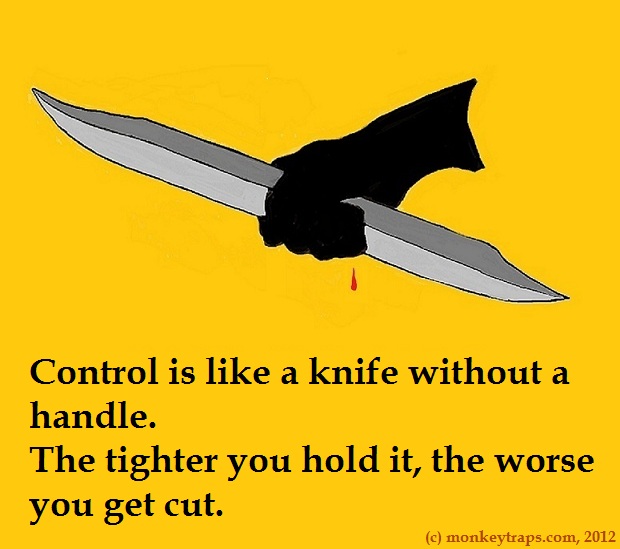
Since feeling out of control
is uncomfortable,
it makes me seek more control.
.
The more I seek control,
the more sensitive I become
to control issues.
.
The more sensitive I become
to control issues, the more often
I feel out of control.
.
Which makes me
uncomfortable.
.
Since feeling out of control
is uncomfortable, it makes me…
.
You know.
Leaf
11/13/12 (Tuesday).
I’m blowing leaves down the driveway when I notice Henry raking the leaves on his lawn.
I think that’s his name, Henry. We’ve exchanged maybe ten words since he moved in.
Four years ago.
So I’m surprised to find myself thinking of offering him my leaf blower.
Surprised, then annoyed. Since the impulse makes me uncomfortable.
I’m shy. I don’t do shit like that.
“Why even consider it?” I ask myself.
But I know why. It’s what Chris said to me the other night on the way to a family gathering. She knows family gatherings make me nervous.
“Get your Buddha on,” she told me.
I knew what she meant. Stop being scared of people. Stop avoiding them. Stop taking them personally. Detach. Relax. Breathe. Practice what you preach.
“Shut up,” I answered.
But now I sigh and switch off the blower and coil the endless orange cord around my forearm and walk it over to Henry, who is plainly startled to see me but covers it nicely.
We chat. While I’m talking with him I’m talking to myself.
“Practice,” I say. “This is practice.”
And, “You don’t practice enough.”
And, “You don’t practice what you preach.”
And, “But maybe you’ll start. Maybe this is you turning over a new leaf.”
Eventually Henry declines my offer, which is a relief (since now I don’t have to come back to collect the damned blower), and I walk home feeling both virtuous and silly.
There was nothing to be scared of here, and I knew that going in, and was scared anyway.
I’m sixty-two now. Scared for sixty-two years.
“Will I die this way?” I wonder.
Then a last thought comes as I walk back up my clean driveway and into my house.
“How to handle feelings isn’t just a human problem,” I think.
“It’s the human problem. And all the others come from that.”
* * *
Steve & Bert

COMING SOON: An expanded 2nd edition

CLICK HERE TO ORDER MONKEYTRAPS (THE BOOK)

Follow the conversation:
-
-

-
-
BERT’S IN THERAPY. To listen in, click on his nose.


