Category Archives: control addiction

To stop fighting

.

My last cartoon carried this caption:

.

To need control is to go to war with reality

 — with people, places and things as they are, 

and with yourself, your own thoughts, 

feelings and behavior.


The war’s endless.  And guess what usually wins?

Better to find a way to stop fighting.

.

To which my reader Julie replied, “The big question is, ‘How to stop fighting?'”

That’s the question, all right.

How do you stop fighting reality?

How accept life on life’s terms? 

Is it even possible?

Yes, I think so.

I’ve found three ways.

They’re not new.  They’re not complicated.  They’re not mysterious, either.  We all know them.

We just don’t practice them much.

Surrender

Surrender means giving up control over what you can’t control anyway.

For me that usually means finding a way to accept some smelly lump of reality that life has dropped in my lap.

Some lumps are easier to accept than others.  Bad weather, I’m okay with that.   I can handle slow drivers too.  Also long bank lines.  Also crabgrass.  Even the occasional indoor gift left by Loki.

Other stuff’s harder.  Like the rising poll numbers of politicians whose guts I despise. And reality tv.  And Rush Limbaugh.  And Cialis commercials.

Not to mention whether you’ll like what I’m writing.

Then there’s stuff  I really want to control, stuff that feels essential to my peace of mind or happiness.  Like my income.  Or my weight.  Or my wife’s mood.  Or how other people see me.  That last one especially.

This stuff forces me to practice surrender almost constantly.

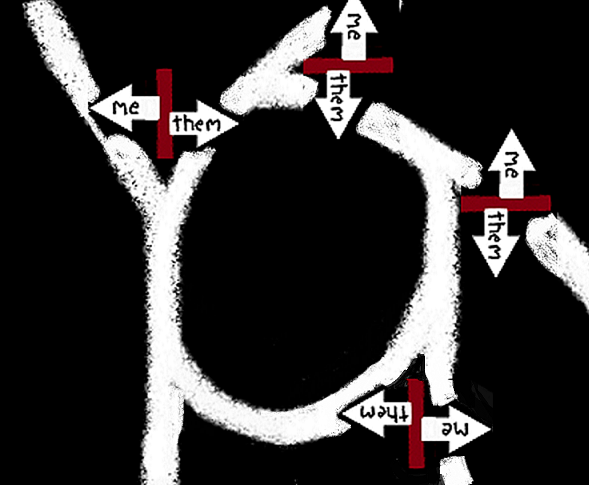
Practice how?

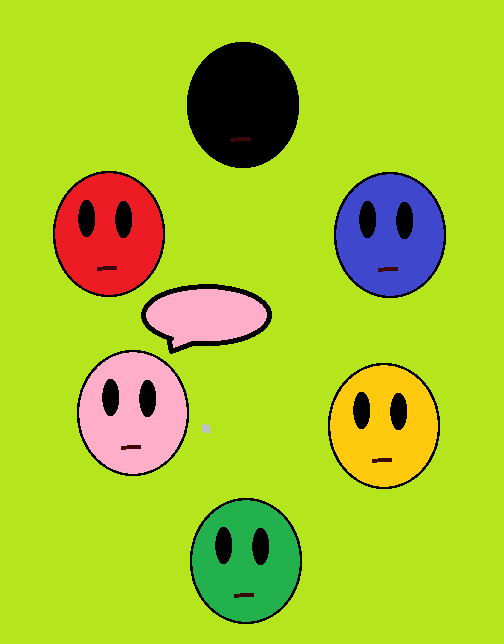
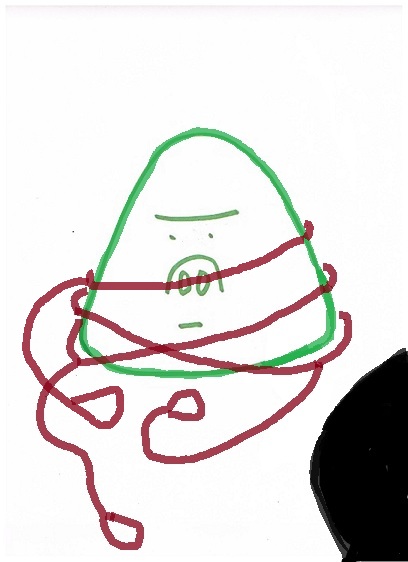
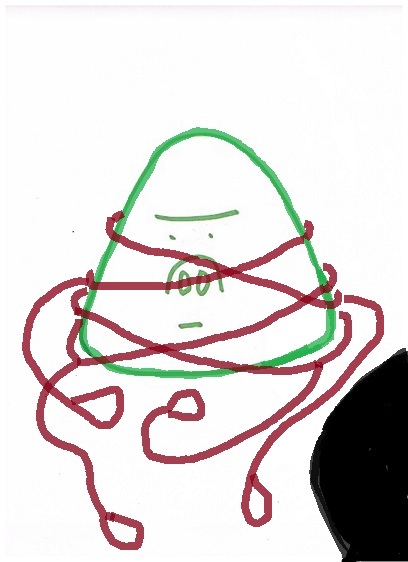
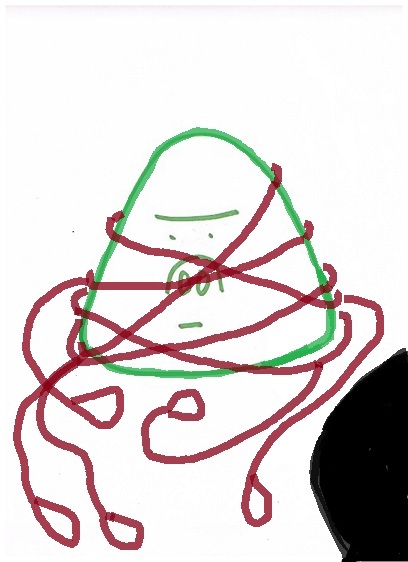
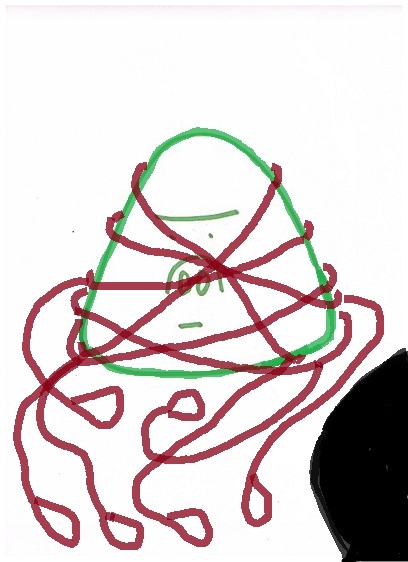
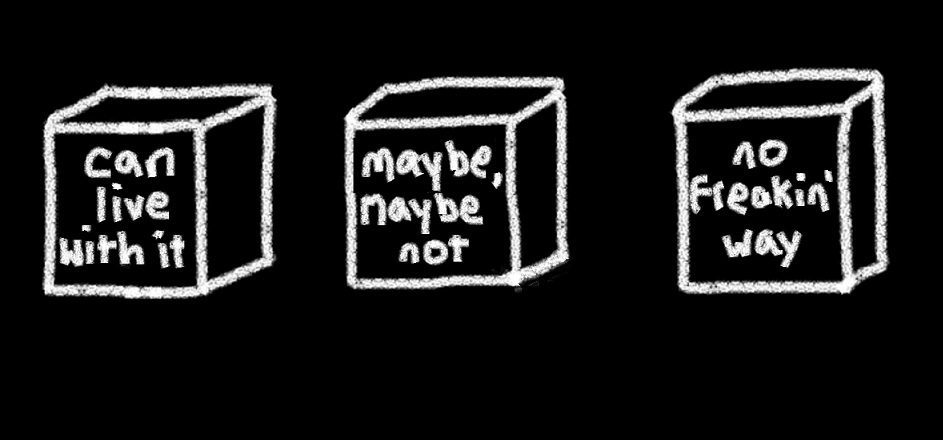
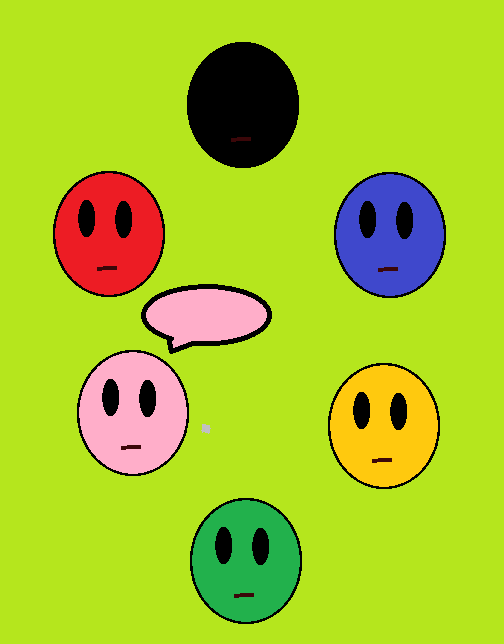
I  imagine three boxes.  (See above.)  I sort the realities I’m facing into them.  Then I work on moving items from right to left.

Item by item.  Slowly and patiently.  Over and over.

Responsibility

Responsibility means being able to respond — that is, answer reality — appropriately and effectively.

For me that usually means listening to my feelings and making choices based on what I hear.

I’ve been trained not to do this.  Like you, I learned early to ignore such internal cues and focus on external ones instead — rules, conventions, the expectations of others.  I also learned that ignoring external cues gets you punished.

Called socialization, this process begins with toilet training and continues right through grad school.

What am I saying?  It starts at birth, and continues forever.

So it takes courage to detach from externals, risk disapproval or rejection, and listen to myself anyway.

Responding is hard, too, because a lifetime of ignoring feelings leaves them hard to hear.   I buried mine so deep I lost touch with them for decades.   When anyone asked me “How are you feeling?” I’d answer with what I thought.  Years of this left me so confused and depressed that I had to go into therapy and excavate the parts of me I’d buried.

So living an emotionally responsible life, one based on listening to oneself…

Well, look around.  How many people do you see doing that?

Intimacy

Intimacy is both the scariest way of not-fighting and the most rewarding.

It means being yourself with another person, and letting them do the same with you.

It’s hard because it combines responsibility and surrender — showing who you are and letting go of how someone else will react to it.

It’s scary, because we need love and acceptance so desperately.

On the other hand, avoiding intimacy — or worse, being incapable of it — is the hardest and scariest fate of all.

Because being stuck in hiding is the ultimate disconnection, the worst loneliness.

And because, paradoxically, control addiction leads to feeling utterly out of control.

.

* * *
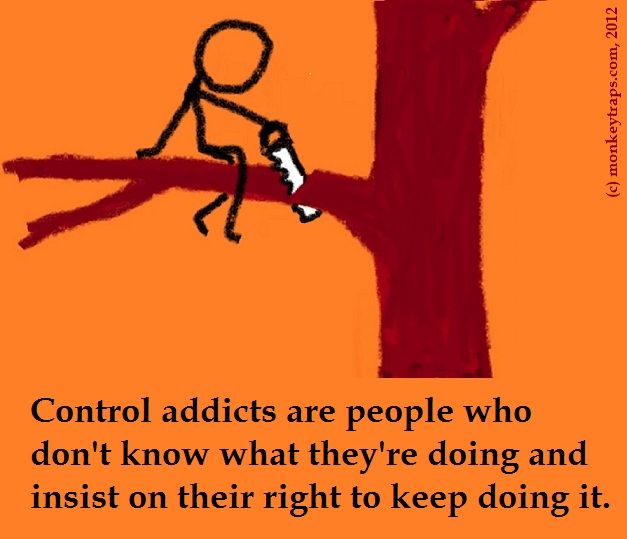

Control addicts

.

* * *

.

.

Here are the three things you need to know about shame:

We all have it.

We’re all terrified to talk about it.

The less we talk about it the more we have it.

~ From Part 1 of a PBS interview of Dr. Brene Brown (4:56).

*

Q: You say that shame leads to disconection.  So how do we reconnect?

A:  You know, it’s funny.

One of the ironies is that shame fills us with this fear of disconnection.

But it is our imperfection that connects us to each other.  It is the fact that our shared humanity is imperfect.

I think if we can find the courage to talk about our lives honestly, and our struggles, not only does that free us, it gives other people the freedom to be more authentic and real as well.

I don’t think connection is possible without authenticity.

~ From Part 2 of a PBS interview of Dr. Brene Brown (5:31).


The split-level relationship

There are two questions with which you must struggle if you want a healthy relationship:

How can I have you without losing me?

How can I have me without losing you?

You can’t really answer these questions, just struggle with them.

But it’s the struggling that matters.

Why?

Because they represent two essential needs each of us brings to any relationship:

Connection and freedom.

Acceptance by another person, and self-acceptance.

A real partner, and at the same time, a real self.

Most people I know are convinced you can’t have both at the same time.

Most came from families — alcoholic, abusive or otherwise dysfunctional — unable to teach them to balance connection with freedom.

What they learned instead was that having one meant losing the other.  That winning love and approval from parents, for example, meant sacrificing important parts of themselves, like the freedom to express feelings or take care of their own needs.

The family that raised us is where each of us learned our own personal answer to the two questions. And the answer we learned grew into a crucial (though mostly unconscious) part of our basic view of life and relationships, what I call our Plan A.  

Some of us decide, “Since I can’t have both, I’ll have me, and to hell with you.”  Shrinks call this the narcissistic answer.

Others decide, “Since I can’t have both, I’ll have you, and to hell with me.” This is the infamous codependent answer.

So the narcissistic partner says “Me first,” and the codependent replies, “Yes, dear.”

And the two personality types end up together with stunning regularity.  (Remember Archie and Edith Bunker?)

Watching such couples interact, one is struck by their predictability.  In every situation the narcissist finds some way to say “Me first,” and the codependent to reply “Yes, dear.”  It’s as if long ago they sat down and signed a contract.

Which in a way they did.

Their complementary answers to the two questions probably account, in large part, for why they felt attracted to each other.

In any case, the vast majority of couples I see for couples counseling follow this pattern — so many that I felt the need to give them their own name.

I call them split-level relationships.

Split-level relationships work for a while, but almost always break down.  Eventually one or both partners realize they’re not getting what they need.

Codependents usually notice first.  When that partner is female this can lead to the syndrome called the Walk-Away Wife.

But narcissists tend to be unhappy too. They often complain of loneliness, lack of connection to their codependent partner, or an absence of respect or affection.  They may feel impatient, frustrated, irritated, resentful. Sometimes they drink, drug, overeat, rage or cheat, and then feel bad about that.

All this happens because split-level relationship is inherently unhealthy.

Familiar, sure.  Comfortable, even, in the way the predictable may come to feel.

But not healthy.  The unbalanced answers on which a split-level relationship is based simply cannot fill the emotional needs of two adults.  So both partners end up feeling deprived, often without understanding why.

What does recovery for such a couple look like?

Put simply, a sort of role reversal.

Codependent partners must develop courage and practice standing up, asserting themselves.  Narcissistic partners must develop empathy and practice stepping down, giving instead of grabbing.

Easy?  No.  Not easy for either of them.

Just necessary to life on the same level.


Feelings

.

.

* * *
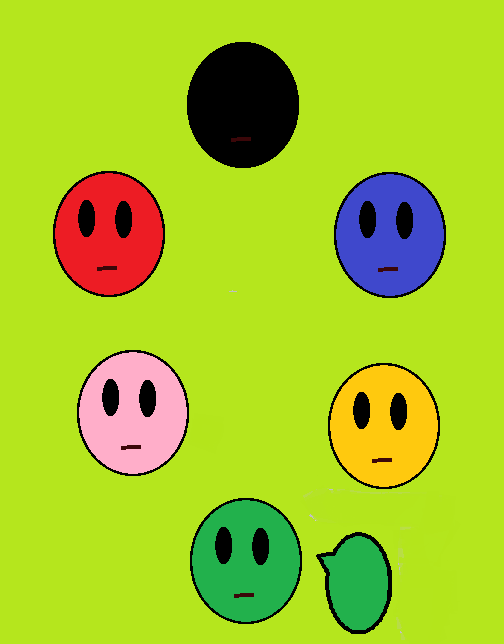
.

20 years ago:

.

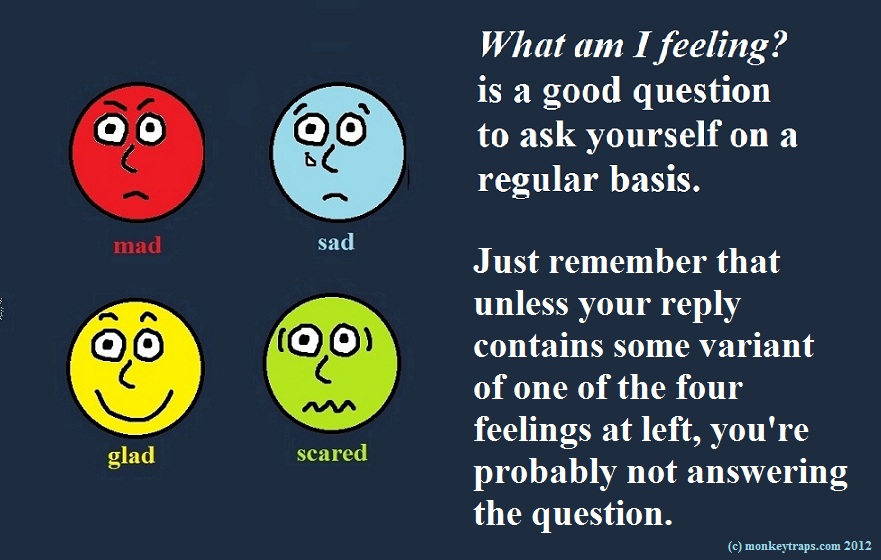
“What are you feeling?”


“I feel upset”


“Upset? What does upset mean?”


“Upset! It means that I feel upset!”


“Upset isn’t a feeling. Are you sad? Or scared? Or angry? Or feeling loss? Or something else?”


“I’m not sure.”


Yes, I was so afraid of my emotions that I couldn’t even begin to identify my “negative” emotions.


That would have meant getting close enough to them to start to really feel them, which felt utterly overwhelming.


And I’m not only talking about feelings related to the abuse, I’m talking about the feelings related to every day life.


Thus began my education about emotions.

~ From I have to feel what? by catsmeow at Living While Healing.


Plan B

(Bert speaking:)

Last time I mentioned that Steve created me to get control of his emotional life.

I tried to do that by controlling everything and everyone around me. 

I call this my Plan A.

It included hiding his feelings, wearing masks to impress other people, and reading their  minds – i.e., guessing what they liked or wanted and trying to give it to them. 

It also included sending him to social work school.

Social work didn’t interest me.  I wanted Steve to be a therapist, and that seemed the fastest way.

Why did I want him to be a therapist?

Selfish reasons.

Therapists know stuff civilians don’t.  I saw them as special, something like priests,  possessed of secret knowledge and understanding.  I liked that idea.  I wanted in on that.  

I also thought a therapist’s position allowed him to get really close to other people without exposing too much of himself.  Since people scared me, I liked that idea too.  I liked it a lot.

Finally, I figured if anyone’s in control of their emotional lives and their relationships, it must be therapists. 

What did I know?  I’m a monkey.

So I sent Steve off to social work school.

And he graduated.

And got hired as a therapist.

And began to work.

And discovered (surprise) that he couldn’t follow Plan A and do his job.

At least, not competently.

Steve, explain why.

Because good therapy is all about healthy relationship.  And you can’t create that and seek control at the same time.

You can’t, for example, seek control and have real communication.  Real communication means surrendering control, being honest and real and, yes, vulnerable.  Therapists have to do all that within professional boundaries, of course.  But editing out all realness and  vulnerability leaves a relationship cold, unreal, and sterile.  Which solves nothing and helps nobody.

Nor, I found, can a therapist overcontrol his own feelings and do good work.  It’s feelings that connect us,  allow us to understand other people. When I overcontrolled mine I lost touch with my clients.  When I lost touch, I did bad therapy.

It quickly became apparent that what therapy demanded from Steve was essentially the reverse of our Plan A.  Instead of guarding against feelings, he had to trust them.  Instead of handling people, he had to connect with them instead.

This was disturbing.  I began to think I’d made a terrible mistake. 

Then around this time Steve, suddenly and unexpectedly, burped up a poem.

Steve, describe that.

It came out of nowhere.  I was lying in bed one night and heard the thing writing itself. 

It began, “The truth is like a bear in the house.”  

And it went on to describe how, if you’re trapped in a house with a bear, you have only two choices: run away and wait for the bear to find you, or turn around and hunt the bear.  

At first I had no clue what this was about.

It took weeks to realize that my personal bear is the idea of control.

And so you set out to hunt it.

Right.  I figured the poem was like a telegram from my unconscious.  Part of me sending a message to another part. 

And when I brought bear-hunting to my work, I got another surprise.

I discovered that control isn’t just my bear. 

It’s everyone’s.

I saw that controlling is addictive, its patterns predictable and universal, and that they cause nearly all of the problems people bring to a therapist.

I saw that anxiety, depression, addictions, bad relationships and lousy parenting all stem from someone trying to control something they can’t or shouldn’t control.

And eventually I learned that a day comes — if we’re lucky — when we realize that controlling simply doesn’t work as a life strategy.

That’s the day we shift to Plan B.

Describe that shift. 

We start to notice our own controlling, catch ourselves in the act, learn and practice healthy alternatives.  We stop trying to control life and find ways to accept and cooperate with it.

And a great relief follows. 

That feeling is hard to describe.  It’s like you suddenly find yourself  sanding with the grain, instead of against. 

Or like giving yourself permission to stop swimming against the tide of feelings and events, and letting it carry you along instead.

Friends, consider this an invitation:

Come join the hunt.

.

* * *
“Love is how we ask for peace” 


Dear Friends,
 
Our young friends in Afghanistan, members of the Afghan Peace Volunteers, need our help.
 
Their requests for visas that would enable them to join the U.S.-Mexico Caravan for Peace that is touring the U.S. this summer were denied last Sunday after a less-than-10-minute interview at the U.S. Embassy in Kabul.
 
We are mounting a new campaign to try to convince Consular officials to take another look at their applications. We want them to understand that Abdulhai and Ali have many U.S. supporters, and that they are devoted to their work for peace and nonviolence in Kabul (and so would be eager to return to Afghanistan at the end of the Caravan tour).
 
Please help us by going to the following Roots Action page and adding your signature. If ever there was a time for us to encourage friendship between the youth of Afghanistan and the youth in this country, it is now.
 
And after you do that, would you please consider encouraging others in your network to do the same by forwarding this information?
 
Here is the link to the action page.
 
And here is a link to “Why Afghanistan can’t wait,” the Truthout article that Kathy Kelly and Hakim (mentor to the Afghan Peace Volunteers) recently wrote. 
 
Our new friend in the office saw them first.  “Here come your friends,” she said.  “Rejected,” she added, as we looked at their faces.  She and another Afghan guard listened sympathetically as Ali and Abdulhai described their absurdly brief interviews – they too had spent all but ten minutes of the three hours merely waiting. During those ten minutes, the interviewer had never touched the documents they submitted in their packets.
 
Please take a few moments to read this piece, which captures the true spirit of the work that Abdulhai and Ali and the other Afghan Peace Volunteers are involved in.  
 
As our friends in Kabul say, “Love is how we’ll ask for peace.”
 
We can do this.
 
Thank you,
Susan Perretti
 
PS:  If you want more information about our movement or how you can help, you can email me directly at oceanofjoy129@aol.com.
 

* * *
Steve here:

Afghanistan seems so far away.  Here’s a video (1:34) that brings it closer:

Be one of two million friends

.

***


Monkeytraps, and how to spot them

(Steve and Bert wrote this one together:)

Steve:  One reader writes,

I like your blog, but it’s a little scary, since before this I had no idea how controlling I am and how many problems it causes me.

What I want now is to learn to be more aware of my controlling, to keep the idea of control at the surface of my mind and to understand how wanting to control things drives how I react and what I do and say.

Got any tips on that?

Bert:  Good question.

Steve:  She wants to learn how to spot monkeytraps.

Bert:  Yeah.  You should remind everyone what a monkeytrap is.

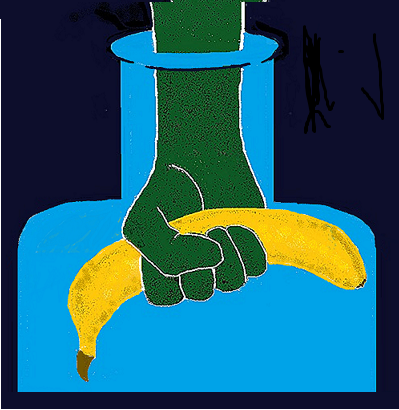
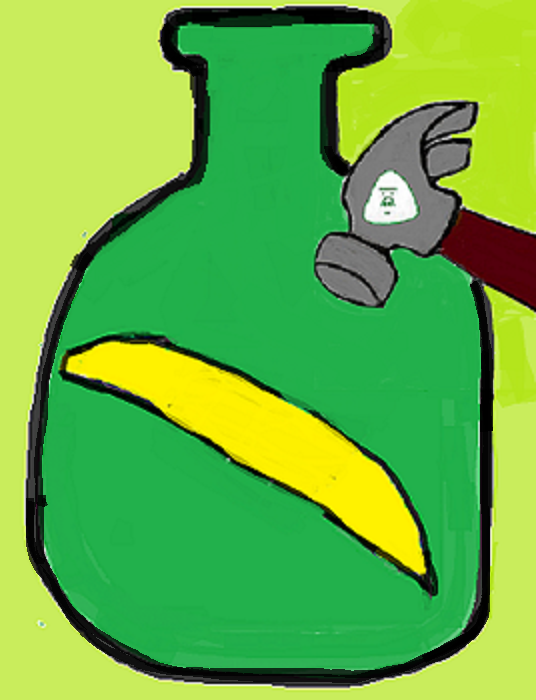
Steve:  In the East they trap monkeys by placing fruit in a weighted jar or bottle with a narrow neck.  The monkey smells the fruit, reaches in to grab it, and traps himself by refusing to let go.

A psychological monkeytrap is any situation that triggers you into compulsive controlling — i.e., into holding on when you really should be letting go.

Bert: And yes, we have tips on how to spot them.

Steve: Here’s the first:

Notice where

you’re uncomfortable.

We’re controlling whenever we need or want to change some piece of reality (instead of accepting it as it is).  And we’re most likely to want to change realities that make us uncomfortable.  So it makes sense that our discomfort zones are where we’re most likely to get monkeytrapped.

Bert:  I, for example, can’t stand rejection.  So it’s with people I think might reject me that I tend to be most controlling.

I do it in all sorts of ways: hide feelings I think might upset them, pretend to agree when I really don’t, laugh at their stupid jokes, avoid confronting behavior I dislike, try to read their minds, and so on.

Steve:  Tip #2:

Notice where

you’re stuck.

Stuck as in not learning, or healing, or growing — struggling with the same damn problem over and over again.

Bert:  Same example.  Working hard at controlling people’s reactions to me is a monkeytrap because it

(a) stops me from being myself, which

(b) prevents me from ever getting accepted as myself, which

(c) keeps me chronically scared of rejection.

In short, a dysfunctional merry-go-round.

Steve:  Right.  You know you’re monkeytrapped whenever you find yourself doing, over and over and over again, what doesn’t work.

And why do you?

That brings us to Tip #3:

Notice where

you’re scared.

Unhealthy controlling is driven by anxiety.  We stay monkeytrapped because we’re scared to do anything else.  Often even the thought of giving up control in such situations is enough to scare us silly.

Bert:  Like me telling my mother-in-law her breath stinks.

Steve:  Uh, yeah.  Great example.

So if you want to spot where you’re compulsively controlling, look for the three clues: discomfort, stuckness, and fear.

* * *


Addict

(Bert speaking.)

I’ve been addicted to control for as long as I can remember.

That is, for as long as I can remember I’ve been trying to force reality — people, places, things, even myself — to match the pictures in my head of how I want reality to be.

I do this constantly.

I do it unconsciously.  Which means I usually don’t know when I’m doing it.

And I do it compulsively.  Which means I get really really anxious when I can’t get control.

I expect to stay an addict until I die.

Yes, I’m in recovery.  But that just means I’m less controlled by my need for control than I used to be, just as recovering alcoholics are less controlled by their need to drink.  They’ll always be alcoholics, though, and I’ll always be a control addict.

I’ll always feel this urge to control stuff.  Even when I know it’s crazy to try.

It’s crazy, I’ve learned, because control is largely an illusion.

Sure,  it’s not always an illusion.  If I pour sugar in my coffee the coffee gets sweeter.  If I pull the steering wheel to the right my car will reliably turn right.

But the world is larger than sugar and steering wheels.  And the truth is that, beyond these concrete ways of changing my immediate circumstances, much of my controlling operates more on the level of wishful thinking.

Why?  Because most of my controlling is an attempt to control feelings and relationships.

And feelings have no steering wheel.  And in relationships sugar doesn’t always work.

Let me explain.

Say I have a feeling I don’t want.  Say I feel inadequate.  But it’s uncomfortable to feel that, and I also worry that if you see that I feel inadequate you may agree with me, which would make me feel worse.  So I hide my feeling, from you and from myself.  I work hard at presenting myself as adequate, even superior. (For an example, see “Bert’s mask.”)  And let’s say it works: I convince you I’m superior.  I have successfully controlled your perception of me.

Do I feel better?

Not so much.

At least, not for long.  Why?  Because I know it’s an act, a pretense.  I’ve basically fooled you about me, and I can’t forget that.  So whatever approval I get from you is essentially meaningless.  And I end up feeling both inadequate and phony.

See how that works?

Another example:

Say I’m mad at you, but afraid to show it.  I’m scared you might get mad back at me, which would make me unhappy.

So I hide my anger from you.  I bury it.

But overcontrolling feelings tends to be bad for me.  Feelings are meant to be expressed, not contained.  Released, not stored up.  So burying my anger makes me uncomfortable.  Constipated.  Pressured.  Uneasy.  Anxious.  And when I do it long and habitually enough, I get depressed.  I.e., chronically unhappy.

How’s that for irony?

Why doesn’t control work better in the realms of feeling and relationships?

Because at the heart of this addiction lies an annoying but inescapable paradox:

The more control I need, the less in control I feel.

* * *


Good dog

Alone in the kitchen, running late.  I’m nuking coffee for my travel mug when it occurs to me that my car’s out of gas and I haven’t left myself enough time to buy more. 

I get angry.

“Shit, ” I say to myself.  “Stupid.  Stupid.”

“No, no,”  another voice answers.

“You thought about this,” it says.  “Last night 0n the drive home.  You weighed the pros and cons and decided you were too tired to stop.  Remember?” 

I remember.  My anger at myself fades.

End of story.

Why tell you this? 

Because I found it remarkable.

Last year I published a post here which began,

I’d like to introduce you to my dog.

Please look down.

You’ll find him attached to my ankle.

Titled “Bert’s dog” (and accompanied by the disturbing  illustration below), it went on to describe that part of me a Gestaltist would call my Top Dog, and other shrinky types might label my Inner Critic or Punitive Superego.  

You know the part I mean.  You’ve got one yourself. 

It’s that inner voice that knows each of your faults and weaknesses and never lets you forget them. 

The part which pretends it’s protecting you or moving your forward when actually it’s just making you hate yourself.

The part that behaves as if relentless self-criticism somehow gives you more control of your life instead of making you feel more and more helpless.

That part.

Anyway, I wrote about how I call mine Dog for short, how he’s scared and tortured me my whole life, and how I learned to live with him over the past six decades.

The post ended,

So.  What to do with a dog like this?

Well, it helps me a lot to remember what I’ve learned about him.  That Dog isn’t me, just the scared worried part.  That he’s unappeasable, and that he lies, and that he’ll say or do anything to survive.

All this gives me some distance from his voice.  It means when he starts growling I can say “Oh, you again.  Shut up,” instead of taking him too seriously.

Which is just what I did in the kitchen this morning.

I found it remarkable because for so long — despite everything I tell clients and everything I tell myself — I was never entirely sure it would happen: that I’d actually outgrow the abusive voice that’s dogged me since childhood and replace it with a kinder, gentler inner parent. 

Realizing that I had, standing there by the microwave, felt like a cool breeze on a hot day. 

And the microwave’s bing sounded like music.

You, too, can train your Dog.


   * * *


 

Self–talk refers to the dialogue that goes on inside your head when faced with conflict or life challenges or even simple day-to-day concerns. 

This aspect of yourself has a running commentary about everything you do.  It never lets anything go by with out some comment, remark or evaluation.


Becoming aware of this process is the first step in taking charge of this part of yourself that can create a lot of unnecessary stress.

The automatic reactions you have to this constant barrage of negative thoughts, judgments and evaluations can keep you feeling stressed and less able to meet life’s challenges.

~ From Self-talk and stress at lifematters.com


   * * * 


I never dreamed that there’s a possibility of stopping until my teacher told me that I could stop.

I thought something would have to descend on me.  Or there would have to be a level of purification.  Or there would have to be some alignment of the planets….

But he said, “Forget all that — that’s part of the conversation.

“Just stop right now.  Just be still.”

~ From Silencing the mind by Gangaji (1:54).


* * *

You have brains in your head.

You have feet in your shoes.

You can steer yourself any direction you choose.

You’re on your own.

And you know what you know.

And YOU are the one who’ll decide where to go…

― Dr. Seuss, Oh, the Places You’ll Go!


* * *

postscript:

1


Hang a left

It’s her first appointment, and she’s crying. 

“I feel so stuck,” she says.

I pass the tissues.   “How so?” I ask.

She tells me. 

Her husband bowls every Wednesday, golfs weekends, watches tv each night until bed.  Never talks to her, never compliments her, hasn’t taken her out to dinner in years.  Expects sex regardless. 

“Regardless of what?” I ask. 

“How I feel about it,” she says.

She has two teenagers, whom she serves as cook, laundress, chambermaid, tutor, therapist, referee and chauffeur.  On Mother’s Day they gave her a World’s Greatest Mom card from Wal-Mart, then spent the day with friends.

Her parents are in from Florida.  They visit frequently without asking, stay a week at a time, and criticize everything from her haircut to her parenting.  (I jot critical parents on a mental note card, file it away for a later session.) 

Her best friend is recently divorced, and calls her nightly either to exult or to mourn her new freedom, depending on how her last date went.  (“And do you ever call her?”  “What for?” she asks, without irony.)

Her mood’s been sliding downhill for years.   She sleeps badly.  Feels tired.  Feels alone.  Feels sad.  Cries.

“Ever take a day off?” I ask.

“No.”

“Ever take a nap?”

“No.”

“Have any hobbies?”

“No.”

“Have any friends or family who aren’t totally self-involved?”

She half-smiles.  “No.”

“Ever tried therapy?”

“I didn’t see how it could help,” she says.  “Can it?”

“Yes,” I say.

“How?” she asks.

“By teaching you to drive,” I say.

She looks puzzled. 

“Imagine someone who learned to drive a car without ever being  taught how to make a left turn.  So whenever they go out all they can do is turn right.  What would happen to them?”

She frowns.  “They’d go in a circle.”

“Exactly.  That’s what you’re doing now.”

“I don’t understand.”

“Think of all the choices you make in a day.  Now think of each choice as a fork in the road.  When you put others first, you turn right.  When you put yourself first, you turn left. 

“When was the last time you made a left turn?”

Her eyes widen.  She thinks.

“I don’t make those,” she says finally.

“Right,” I say.  “You’re driving in circles.  It’s why you feel stuck.”

“And therapy can teach me to turn left?”

I nod.  I’m expecting the next question. 

“But isn’t that selfish?”

“Yes,” I said.  “What’s your objection to selfishness?”

I’ve asked that question hundreds of times.  No one has a good answer. 

“It’s just…bad.”

“That’s what everyone says,” I say.  “I suppose some believe it.  But most people use it to convince others to put them first.  The most selfish people I know tend to be the first to condemn selfishness in others. 

“Me, I think of it as a survival skill.   Selfishness is essential, at least some of the time.  If you don’t take care of yourself, who will?”

“Well, this isn’t working.”  She blows her nose.   “I guess I should hang a left once in a while.  But my family won’t like it.”

“Probably not.  You’ll have to train them.”

“How?”

“We’ll talk details later.  But it amounts to putting yourself first and letting them adapt to it.” 

“And that works?”

“Sure,” I said.  “Look how well it’s worked for your husband, your kids and your parents.”

1

2

* * *


Self-love, my liege, is not so vile a sin as self-neglecting.

~ Shakespeare, Henry V


1212

* * * 

Some of us give because we can’t not give.  It’s our way of getting by in the world. 

At least if I give, the thinking goes, others will like me.  Better yet, they may even come to need me.  Then I won’t be so alone in the world.

Giving becomes a kind of barter to belong — a bid for love, rather than an expression of it.

~ From “Healthy selfishness” at daily.om.

1

* * *

I think it unhealthy to not know the things you like and the things you want.

I think if you do not allow yourself to know them and to exercise adequate levels of self-care by satisfying those wants and needs in ways that make you feel good you will find unhealthy and unsatisfying behaviors that you do in order to be safe.

The relationship will become toxic and cycle through predictable patterns of acting out, failure and disappointment.

Selfish behaviors that take advantage of or hurt someone else are not what I am describing.  Behaviors that are done in service of the health of the self are self-ish.

~ From “The concept of healthy selfishness in therapy” by Brett Newcomb.

* * *


The tribe: Expectations


Most people feel anxious in group without really understanding why.

1

2

member 1

3

4

1=

2=

Personally I think it’s because, on some deep level, the group reminds us of our family of origin.

1

2

member 2

3

4

5


2=

And we expect it to treat us just as our family did.

1

2

member 3

3

4

1=

2a

=

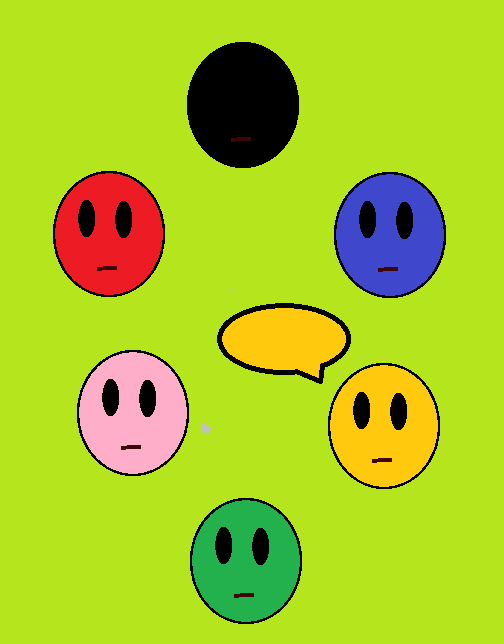
So tell me.  If this group were your family, what would you be expecting now?

1

2

member 4

3

4

1=

2=

therapist 5

1

2

To get hit.

3

4

5

6

1=

2=

1

2

3

4

5

1

To get humiliated.

3=

\


therapist 7

1

2

To be told to shut up.

3

4

5

1=

2=

1=

therapist 8

1

2

3

4

To be ignored.

3

4

1=

2=

Pink?  What would you expect?

1

2

member 9

3

4

5

1=

2=

therapist 10

1

2

3

All of the above.

3

4

5

1=

2=

Jeez.

1

2

member 11

3

4

5

6

1=

2=

So you all have good reason to feel anxious in this room.

1

2

member 12

3

4

5

1=


2=

But I have to ask Pink:

1

2

member 13

3

4

5

1=

2=a


How’d you work up the courage to even come here?

1

2

member 14

3

4

5

1=

2=

therapist 15

1

2

3

Two beers, half a pizza, and a Vicodin.

3

4

5

6

7

* * *


Group therapy. 

In Hebrew. 

“Hello, this is Fear Management. 

“My name is Moni, and I too have a phobia. 

“I have a fear of shouting. 

“You know, a, h, h, h, exclamantion mark, ‘ahhh’!

“At this point I suggest we all tell about ourselves…” 


Excerpt from the Israeli TV show “Ktzarim”:  Five troubled people (that description includes the group leader) meet for group therapy.  In Hebrew with English subtitles (2:22).


* * *


Overheard at the House:

Eventually, and every time, I used to drive my current partner insane with my hang ups and he broke off the relationship….

So I decided only I could change and needed to put my – sorry to be blunt – infantile behaviour aside and choose blind trust, no matter the outcome….

Result: I came to accept that my life is my life and not dependent on anyone else for survival or safety – and in a way I was going to be alone, with or without a partner: it’s part of the human condition….


Come. 

Join the conversation. 

Monkey House.

Because we’re all monkeys on this bus.


Session 41: Gorilla warfare

Felicia’s pissed at me.

1

2

3

What about?

1

2

3

I’m not really sure.

1

2

3

therapist-2

1

2

3

Monday she said I don’t make enough money.

1

2

3

th

1

2

3

Tuesday she complained I’m not home enough.

1

2

3

therapist-4

1

2

3

Wednesday she called me an “uninvolved father.”

1

2

3

therapist-5

1

2

3

Thursday she called me a slob.

1

2

Sounds confusing.

1

2

3

Bet your ass.

1

2

3

How did you respond?

1

2

3

Well, let’s see. Tuesday I went in and asked my boss for a raise.

1

2

3

therapist-8

1

2

3

Wednesday I came home early with flowers.

1

2

3

therapist-9

1

2

3

Thursday I helped Junior with his science project.

1

2

3

therapist-10

1

2

3

And Friday I did two loads of laundry and cleaned the bathroom.

1

2

Did it work?

1

2

3

No.  Now she tells me I’m fat.  What’s going on here?

1

23

Gorilla warfare.

1

2

3

Don’t you mean “guerilla” warfare?

1

No, gorilla.  It’s a control thing.  Your two inner monkeys are battling it out. 

1

2

3

bert-14

1

2

Happens all the time in split-level relationships.*

1

2*What’s this?  Click here.

3

bert-14

1

One partner seeks satisfaction by complaining or making endless demands on the other.

1

2

3

bert-15

1

2

The other seeks relief by trying to appease the first.  But it never works.

1

2

3

Why not?

Because they’re ignoring the real problem, whatever that is.  Pretty common in couples who haven’t learned to talk to each other.

1

2

3

Well, I hate feeling beat up.  What can I do?

1

2

Less.

1

2

3

Meaning…

1

2

Give up control.  Stop appeasing her. 

1

2

3

She’ll get angry.

1

2

She’s already angry.  Same result, less work. 

1

2

3

Okay.  Anything else?

1

Give up control in another way.  Ask what she’s really angry about. 

1

2

3


1

She may not know at first. That’s fine. Be patient.  Be curious.  Be brave.  Keep asking.

2


3

That I can’t do.

1

2

3

Why not?

1

2

3

She might actually tell me.

1

2

3

Oh.  Well, in that case…

1

2

3

1

2

There’s always Weight Watchers.

1

2

* * *


Session 39: Leashed

There’s something I don’t understand about control addiction.

1

2

3

What’s that?

1

2

3

You say everyone is addicted to control?

1

2

3

4

Right.

1

2

3

4

Doesn’t that mean this “addiction” is really just human nature?

1

23

Well, I’m not sure what “human nature” means.  So I’d put it differently.

1

2

3

bert

1

2

It’s perfectly normal for human beings to be addicted to control.  It just isn’t healthy. 

1

2

3

“Normal” and “healthy” aren’t the same thing?

1

2

3

Oh no.  How many normal people do you know?

1

2

3

Lots.

1

2

3

4

And how many healthy people do you know?

1

2

3

4

Hm.  I take your point.

1

2

3

4

5

therapist-7

1

2

3

But I still don’t see what’s “normal” about being a control addict.

1

2

3

Do you ever worry about the future?

1

2

3

Of course.

1

2

3

4

You’re addicted.  Do you ever fret over the past? 

1

2

3

Sure.

1

2

3

You’re addicted.  Ever hide your feelings for fear of how others might react? 

1

2

3

All the time.

1

2

3

You’re addicted.  Ever worry about whether people will like or love or accept you?

1

2

3

4

Constantly.

1

2

3

You’re addicted.  Ever lie, or manipulate, or distort the truth to get what you want? 

1

2

3

4

Okay, I get it.

1

2

Ever avoid annoying people or uncomfortable situations? 

1

2

3

4

I said, I get it.

1

2

3

Ever plan?  Strategize?  Analyze?  Fantasize?  Agonize?  Dream?  Ruminate?  Obsess? 

1

2

3

4

You can stop now.

1

2

Just making my point.  Controlling is so utterly ordinary that most of the time we barely notice we’re doing it. 

1

2

3

bert-16

1

2

3

4

Until it traps us, that is. 

1

2

3

And how does it trap us?

1

2

3

4

Have you ever walked six dogs at the same time?

1

2

3

4

No.

1

2

You set out thinking that you’re walking them.  But before long you realize the dogs are walking you.

1

2

3

Meaning…

1

2

Whatever we try to control controls us.  And the more controlling you are, the more out of control you feel.

1

2

35

* * *


Session 35: Stuck

I’m stuck.

1

2

3

How so?

1

2

3

I don’t like myself.  I really want to change.

1

2

3

therapist 2

1

2

3

But as hard as I try, I can’t seem to.

1

2

3

Change yourself?

1

2

3

Right.  Any advice on that?

1

2

3

Yes.  But you won’t like it.

1

2

3

How do you know?

1

2

3

Nobody likes it.  Nobody listens.

1

2

3

Why not?

1

2

It’s counterintuitive.  Contradicts what they want to believe. 

1

2

3

Well, I’m desperate.   Try me.

1

2

3

If you insist.

1

2

3

Bert 8

1

2

3

The way to change yourself is:

1

2

3

Bert 9

1

2

3

Stop trying.

1

2

3

Stop trying what?

1

2

Stop trying to change.  That’s how you change.

1

2

3

You’re confusing me.

1

It’s called the Paradoxical Theory of Change.  “The more you try to change yourself,” it says, “the more stuck you become.”

1

2

3

Bert 12

1

“But the moment you accept yourself as you are, change happens by itself.”

1

2

3

That makes no sense.

1

2

Didn’t you just say that pushing yourself to change has gotten you nowhere?  

1

2

3

Yeah.

1

2

3

There’s a reason for that. 

1

2

3

bert

Force yourself to change, and another part of you rises up in resistance.  An internal war starts.  Neither part wins.  You end up still stuck, just more tired.

1

2

3

That does sound familiar.

1

On the other hand, accepting yourself frees up all sorts of energy.  You feel stronger. Braver.  Hopeful.  Creative.  Growth follows.

1

2

3

That makes sense, I guess.

1

2

3

therapist

1

2

3

But I like believing in will power.

1

2

3

therapist.

1

2

3

I like thinking I can chart my own course.

1

2

3

therapist

1

2

3

That I’m the master of my fate.

1

2

3

therapist

1

2

3

That I’m the captain of my…

1

1

2

See? Nobody listens.

1

2

………………. * * *

 2


Bert on surrender

(If you’re new to Monkeytraps, Steve is a therapist who specializes in control issues, and Bert is his control-addicted inner monkey.

For this post,  Steve interviewed Bert.)

Steve:  So I’ve been writing about peace of mind and how control addiction makes it impossible, and how practicing alternatives to control make it easier to find.  And I wanted to ask you about surrender.

Bert:  What about surrender?

Steve:  How you practice it, mainly.

Bert:  Oh.  Sure this is a good idea?

Steve:  Why not?

Bert:   People will know how lousy I am at it.

Steve:  That’s okay.  They know it isn’t easy.

Bert:  I never use that word, by the way.

Steve:  No?

Bert:  No, that’s one of your writer’s words.

Steve:  You don’t like it.

Bert:  Not really.  Sounds too much like helplessness.

Steve:  That’s not what it means.  It….

Bert:  I know, I know.  Surrender means winning, not losing.  Letting go of what you can’t control represents the victory of awareness over denial, growth over habit, and faith over fear.  Right?

Steve:  Something like that.  What word do you prefer?

Bert:   Depends.  Sometimes I think of surrender as detaching.  

Steve:  Meaning?

Bert:  Taking a step back emotionally.  Like when that client cursed at us in session yesterday.

Steve:  And I told you to not take it personally. 

Bert:  Right.  That it was just transference.  And then other times I think of surrender as accepting. 

Steve:  “It is what it is.”

Bert:  Yes.  Though I hate that expression.

Steve:  Why?

Bert:  It’s like Have a nice day.  Everyone says it, then go right back to being raging control freaks. 

Steve:  Any other words for surrender?

Bert:  Let’s see.  Sometimes I do it by consciously reframing a situation instead of trying to control it.  Remember how mad I used to get at little old lady drivers?

Steve:  Anyone driving at the speed limit, you mean.   

Bert:  Right.  Well, now when I find myself behind one I just tell myself This is God reminding you to slow the fuck down.  And I slow down, and I’m okay with it.

Steve:  Very spiritual of you.

Bert:  I think so.  I use slogans too.

Steve:  Which slogans?

Bert:  Well, there’s the one you wrote on a Post-it and taped to your PC monitor:

99% of what we worry about never happens. 

That got us through some rough times.

Steve:  It did.

Bert:  And the one you kept in the little plastic frame in your office.  The one that made clients think you’re a little nuts: 

Everything’s perfect.

Steve:  I can’t count the times I tried to explain that.

Bert:  Anyone ever buy it?

Steve:  No.  Easier to sell Everything happens for a reason.

But back to you.  It sounds like you do a lot of surrendering, in one way or another.  Why do you say you’re lousy at it?

Bert:  Because of all the times I can’t.

Steve:  Explain.

Bert:  You know how we live.  Rushing from chore to chore, worry to worry.  Working down the To Do list with no end in sight.  Feeling like everything is urgent.  Lying in bed at night and trying to decide if you got enough stuff done to feel okay about yourself.

Then there’s the problem of people.  All the times I just can’t be myself. 

Steve:  Can’t tell the truth, you mean?

Bert:  Yes, but more than that.  All the times I can’t just relax and stop worrying about how someone’s going to react to me.   

But it’s more than that, too. 

It’s all the times I can’t just relax.  Can’t take, even, a really deep breath.  

You know?

Steve:  I know.  Can’t relax if you can’t surrender.  It’s a stubborn addiction. 

Bert:  Sometimes I’m sorry you told me I’m addicted.

Steve:  Do you mean that?

Bert:  No.  No, I guess not.

Steve:  What’s good about knowing?

Bert:  Well, it does clarify things.  When I feel angry or frustrated or crazy it’s usually because I’m trying to control something I shouldn’t.  Calms me down, just seeing that. 

Steve:  Another surrender?

Bert:  I suppose it is.  And then, remembering I’m addicted gives me more choices than I used to have. 

Steve:  More choices?

Bert:  Sure.  Before I knew, I never even thought of surrender as an option.  Now I know, even when I can’t do it.  It’s something to work towards.  Something to practice and get better at.  And that gives me hope.    

Steve:  Hope’s good.

Bert:  It is.  It even lets you breathe a little bit deeper.

* * *


What we mean when we talk about control, part 4: The illusion of control


If you’re new to Monkeytraps, Steve is a therapist who specializes in control issues, and Bert is his control-addicted inner monkey.

Steve and Bert wrote this one together:)


Steve:  Our last post (How to spot monkeytraps) explained where we got this blog’s title:

In the East they trap monkeys by placing fruit in a weighted jar or bottle with a narrow neck. The monkey smells the fruit, reaches in to grab it, and traps himself by refusing to let go.

A psychological monkeytrap is any situation that triggers you into compulsive controlling — i.e., into holding on when you really should be letting go.

One reader replied,

Why didn’t the monkeys just break the jar or bottle? I get that it was weighted down, but monkeys use tools. Were there no rocks laying around?  

Bert:  Shit.  Why didn’t I think of that?

Steve:  Just the comment I’d expect from a control addict.


4. The illusion of control

Bert:  Why?  What’s wrong with what I said?

Steve:  You misread the problem.

Bert:  How?

Steve:  You think the jar is what traps the monkey.   

Bert:  Of course. 

Steve:  But he could escape that just by opening his paw.   

Bert:  Oh.  Yeah.

Steve:  But he won’t.  He wants the banana.  More than anything. 

Bert:  And that’s what traps him. 

Steve:  Exactly.  Just as control addicts get trapped by their need for control.

Bert:  Why’d I miss that?

Steve:  Because you’re addicted.  Control addicts usually respond to loss of control by thinking, But I want control.  I need control.  There must be some way to get it.  Their craving distorts their thinking.

Bert:  So instead of letting go we try breaking the jar.

Steve:  Right.  Breaking the jar is a metaphor for imagining life as something we can control if we try hard enough.  And that’s a dangerous illusion.

Bert:  Tell me again.  It’s an illusion because…

Steve:  Because there are some bananas we’re not meant to have.

Bert:  Such as?

Steve:  Well, immortality, for example.  Much as we want to live forever, we can’t.

Control of emotions is another.  As determined as we are to feel only happy, safe and contented, life forces us to feel sad, scared and needy.

And then, of course, relationships.  Relationships never go as planned. 

Bert:  I noticed.  Why is that?

Steve:  Because relationships involve people.  And people tend to be uncontrollable. 

Bert:  So there’s no breaking the jar.   

Steve:  Right.  Life is what it is.  Messy, and unpredictable, and painful, and inconvenient, and unless we want to suffer endlessly we have to find some way of making peace with all that.

Bert:  To accept life on life’s terms.

Steve:  And let go of the banana.

Bert:  Okay.  Fine.  I get it.   Actual control’s an illusion. 

Now what?

Steve:  What do you mean?

Bert:  At the start of this series you told that story about seniors and house plants, and said having a sense of control is essential to both mental and physical health.  Right?

Steve:  Right.

Bert:  Well, if actual control is an illusion, how do I get a sense of control?

Steve:  Feel okay inside, you mean.

Bert:  Exactly.

Steve:  There are three ways.  I’ll explain them next time.

Bert:  Explain them now.

Steve:  I can’t.  It would take too long. 

Bert:  But I want it now.  I need it now.  There must be some way to get it now.

Steve:  Very funny. 


Art by Brian Bartley, of bartsartny.com, the only artist Bert ever posed for.


 .